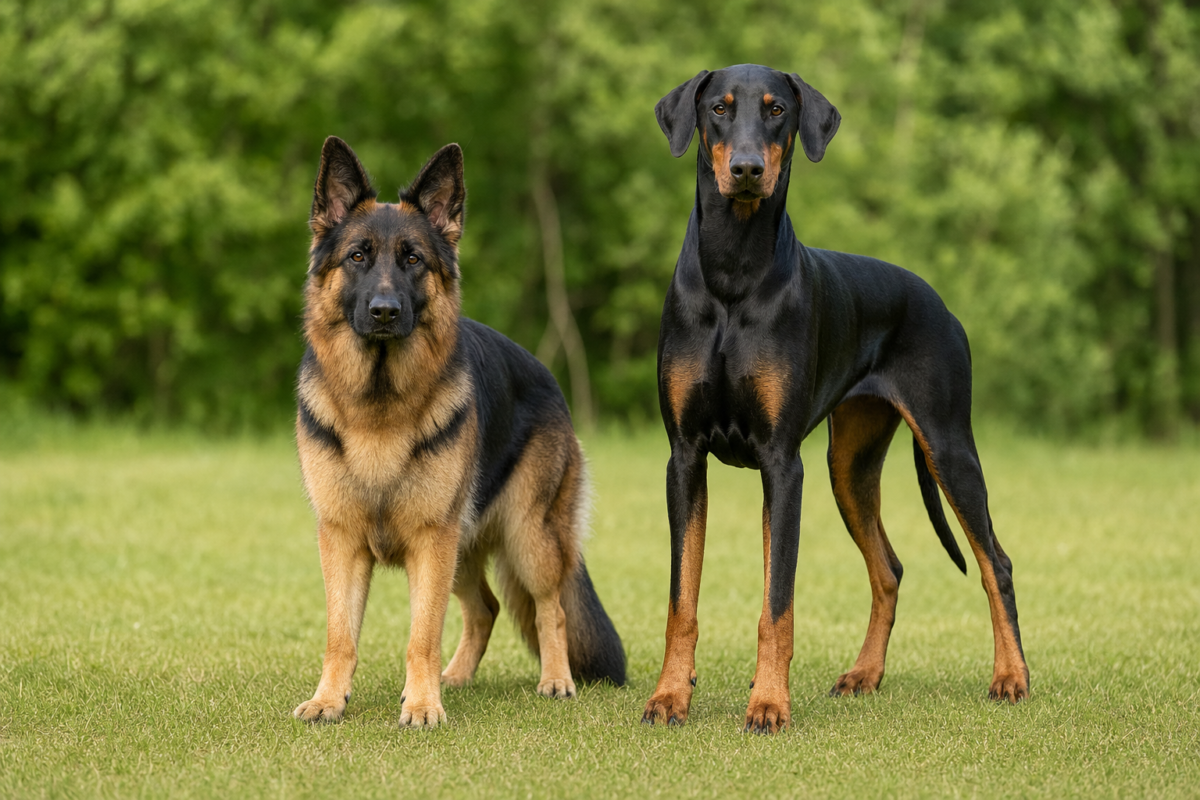
A Doberman is taller and leaner, standing 26 to 28 inches and weighing 75 to 100 pounds for a male, with a short single coat and a sensitive, deeply attached temperament. A German Shepherd is slightly shorter and heavier boned, standing 24 to 26 inches and weighing 65 to 90 pounds for a male, with a thick double coat and a more independent, workmanlike nature. Both are intelligent working breeds that need training, exercise and company.
Choosing between a German Shepherd and a Doberman is one of the better dilemmas a Dog Parent can have, because both are superb dogs. They look similar in silhouette to a passing stranger, and they share a working background, real intelligence and a strong bond with their people. Live with them and the differences are obvious within a week. This guide compares them on size, growth, coat, energy, temperament and daily practicality, so you can work out which one actually fits your household rather than which one photographs better.
What is the difference between a German Shepherd and a Doberman?
The core difference is build and coat. A Doberman is a tall, lean, short coated athlete built for speed and agility. A German Shepherd is a slightly shorter, more substantial dog with a thick double coat, built for endurance and steady work. Dobermans usually stand taller and can weigh more, while Shepherds carry more coat and more bone for their height.
Temperament separates them further. Dobermans tend to be intensely people focused, sensitive to tone, and happiest when physically close to their family. German Shepherds are typically more self contained, naturally watchful, and content to work at a slight distance. Both are highly trainable. They simply want different things from you.
Size and build compared
A male German Shepherd stands 24 to 26 inches at the shoulder and weighs 65 to 90 pounds, while a female stands 22 to 24 inches and weighs 50 to 70 pounds. A male Doberman stands 26 to 28 inches and weighs 75 to 100 pounds, with a female at 24 to 26 inches and 60 to 90 pounds.
On paper the Doberman is the bigger dog, yet the Shepherd often looks broader thanks to the coat. Run your hands over both and you find a Doberman is all length and hard muscle over a fine, tight skin, while a Shepherd carries a heavier frame under a dense layer of fur. That difference shows up in everything from how they feel to lift into a car to how they cope with a cold morning.
Growth chart compared, month by month
Use these figures as a friendly guide rather than a target. A puppy tracking a little above or below while looking lean and moving well is usually doing fine.
| Age | Shepherd male | Shepherd female | Doberman male | Doberman female |
|---|---|---|---|---|
| 2 months | 16 to 20 lb | 11 to 17 lb | 20 to 25 lb | 17 to 22 lb |
| 3 months | 22 to 30 lb | 17 to 26 lb | 30 to 35 lb | 26 to 30 lb |
| 4 months | 35 to 40 lb | 31 to 35 lb | 40 to 45 lb | 35 to 40 lb |
| 6 months | 49 to 57 lb | 41 to 49 lb | 55 to 65 lb | 50 to 58 lb |
| 9 months | 62 to 71 lb | 48 to 53 lb | 68 to 78 lb | 58 to 68 lb |
| 12 months | 66 to 79 lb | 51 to 60 lb | 72 to 88 lb | 60 to 75 lb |
| 18 months | 71 to 86 lb | 55 to 66 lb | 75 to 95 lb | 60 to 85 lb |
| 2 years plus | 65 to 90 lb | 50 to 70 lb | 75 to 100 lb | 60 to 90 lb |
The American Kennel Club’s Chief Veterinary Officer, Dr. Jerry Klein, DVM, has written extensively on the slower growth and development timeline of large and giant breeds. Read more from the AKC’s guidance on caring for large-breed dogs.
When do they stop growing?
Both breeds reach most of their adult height by around 18 months, then spend the second and sometimes third year filling out through the chest and shoulders. A German Shepherd finishes adding substance somewhere between two and a half and three years. A Doberman is usually done growing in height by 18 months, with muscle arriving through the second year and often a little beyond.
Dobermans commonly look startlingly narrow at a year old, all leg and ribcage with no chest at all. That is completely normal for the breed and it resolves. Shepherds go through their own gangly stage in the middle of the first year, with ears and paws that the body has not yet caught up to.
Why the growth window matters for both
Across roughly 8 to 24 months, both breeds are building the bone, cartilage and connective tissue that has to carry an athletic dog for a decade. The growth plates at the ends of the long bones stay open through much of that period. While they are open, lean feeding, moderate exercise and steady daily joint support all count for more than they will at any later stage.
Growing Too Fast
Rapid growth asks more of developing joints in both breeds. Aim for a steady curve, not a fast one.
Too Much Impact
Long runs and repeated jumping on open growth plates are best kept moderate through the first year and a half.
Under Stimulation
Both are working breeds. Without a job, that intelligence turns into chewing, barking and stress.
Left Alone Too Long
A Doberman in particular does badly with long days on its own. Plan company before you bring one home.
Feeding both breeds through growth
The feeding approach is broadly the same for both, which makes this the easy part of the decision.
- Choose a complete food formulated for large breed puppies, which balances calories, calcium and phosphorus for slower, steadier growth.
- Split the daily amount into three meals while young, then two as an adult.
- Feed to a lean, athletic body condition. Both breeds should look like athletes rather than like tanks.
- Confirm portions with your veterinarian at every checkup during the first year, since the right amount changes quickly.
How to check body condition in ten seconds
The scale tells you weight. Body condition tells you whether that weight suits your dog today.
- Ribs. Run your hands along the sides. You should feel each rib easily under a thin layer.
- Waist. Look down from above. You want a clear waist tucking in behind the ribs.
- Tuck. From the side, the belly should rise toward the back legs rather than running level.
Energy and exercise compared
Both breeds need roughly one to two hours of activity a day as adults, but the shape of that hour differs. A Doberman is a sprinter who wants sharp bursts of running and play, then genuinely enjoys switching off on the sofa afterwards. A German Shepherd is a marathoner who would happily potter alongside you all day and does not switch off quite so readily.
Mental work matters as much as physical work for both. Short training sessions, scent games and puzzle feeders tire either breed as thoroughly as a long walk, which is useful while a puppy is still growing and hard exercise is off the table.
Supporting an athletic frame
Both breeds live through their joints. Every turn, sprint and landing travels through cartilage and connective tissue, and both are built to do a great deal of all three across a long life. Supporting healthy joint development while the frame is still forming is a simple habit with a long payoff.
Alongside lean feeding and sensible exercise, many big dog parents add a daily joint support chew made for large breeds. MoveGuard Growth is built for the growth stage. It combines nine actives, including New Zealand Green Lipped Mussel, glucosamine, chondroitin, MSM and hyaluronic acid, to support the developing joints of young large breed dogs across the roughly 8 to 30 month growth window. You dose by expected adult weight, so most Shepherds and Dobermans sit at two chews a day with larger males at three. It ships as 90 chews, is made in the USA in an NSF facility, and is backed by a 60 day guarantee. Once your dog is fully grown, MoveGuard Adult carries the same idea forward for adult dogs.
Support A Working Frame
Give your growing Shepherd or Doberman daily joint support built for large and giant breeds. Explore MoveGuard Growth.
Temperament and family life compared
This is where most people actually make the decision. A Doberman is a shadow. They follow you between rooms, lean on your leg, and would sleep on your head given the option. They are sensitive to tone, respond poorly to harsh handling, and thrive with a family who are home a lot. A bored, lonely Doberman is an unhappy dog.
A German Shepherd is more measured. They are devoted, but the devotion looks like watching you from the doorway rather than sitting on your feet. They are naturally alert to their surroundings, tend to be more reserved with strangers, and cope a little better with quiet time alone. Both breeds want a job, and both are outstanding with children when raised thoughtfully and supervised sensibly.
Training both is a pleasure and a responsibility. These are strong, clever dogs who learn quickly whether or not you are teaching on purpose. Early socialisation and consistent, kind training are not optional extras for either breed.
Coat, grooming and climate
The practical difference nobody mentions until you own one. A German Shepherd has a thick double coat that sheds steadily all year and blows out heavily twice a year. Expect brushing several times a week, a vacuum you actually like, and fur on everything you own. In exchange your dog is comfortable in cold weather.
A Doberman has a short, tight single coat that needs little more than a weekly wipe over. Shedding is minimal and grooming is almost trivial. The trade is thin skin and no undercoat, so a Doberman genuinely feels the cold and often needs a coat for winter walks. If you live somewhere with hard winters, that is worth planning for.
Which one suits your home?
Consider a Doberman if you are home most of the day, want a dog physically attached to you, prefer minimal grooming, and live somewhere with mild winters. Consider a German Shepherd if you want a slightly more independent companion, do not mind the fur, live in a colder climate, or want a dog who is comfortable working at a distance from you.
Both need training, both need company, and neither is a good match for a household that is out twelve hours a day. Whichever you choose, ask your breeder about health screening for the parents, since responsible breeders of both breeds screen routinely and will show you the paperwork without being asked twice.
A simple growth game plan, stage by stage
The plan is nearly identical for both breeds. Only the coat care and the amount of company differ.
8 weeks to 4 months. Foundation stage. Complete large breed puppy food in three calm meals, heavy investment in socialisation, and short bursts of free play on soft ground. Start gentle training now with both breeds, because both learn fast either way.
4 to 8 months. Growth is quick and your puppy looks leggy and adolescent, especially a Doberman. Keep feeding lean, keep exercise moderate, and build calm habits around stairs and car entry. This is the natural point to begin a daily joint routine.
8 to 18 months. Height nears its peak while muscle begins to arrive. Match portions to a lean body condition, since an athletic appetite can outpace need. Add structured training and gradually build activity on soft surfaces.
18 months to 3 years. The adolescent becomes a powerful adult. Growth slows while chest and muscle continue to fill. Build exercise up as your veterinarian advises, and many Dog Parents keep a joint routine going into adulthood.
Common mistakes with both breeds
- Underestimating the mental need. Physical exercise alone does not satisfy either breed. Training and scent work are the missing half.
- Overfeeding for size. A heavy young dog is not a healthier one. Feed lean and let size arrive on its own schedule.
- Too much hard exercise, too young. Long runs and repeated jumping ask a lot of open growth plates in both breeds.
- Skipping socialisation. Both are watchful breeds, and a confident adult is built by careful early exposure.
- Waiting for a problem before supporting joints. The growth window is the ideal time to support developing joints.
Frequently asked questions
Is a Doberman bigger than a German Shepherd?
Usually yes in height and often in weight. A male Doberman stands 26 to 28 inches and weighs 75 to 100 pounds, while a male German Shepherd stands 24 to 26 inches and weighs 65 to 90 pounds. The Shepherd can look bulkier because of the double coat.
Which is easier to train, a German Shepherd or a Doberman?
Both are highly trainable and among the quickest learners of any breed. Dobermans are more sensitive to tone and want to work close to you, while Shepherds are a little more independent. Neither suits harsh handling.
Which breed sheds more?
The German Shepherd by a wide margin. A thick double coat sheds all year and blows out heavily twice a year. A Doberman has a short single coat that sheds very little and needs almost no grooming.
Which is better with children?
Both can be excellent family dogs when raised with early socialisation, consistent training and sensible supervision. Dobermans tend to be more physically attached to the family, while Shepherds are often more watchful of the household as a whole.
Do German Shepherds and Dobermans live the same length of time?
They are broadly similar, with both breeds commonly living around 10 to 13 years. Lean body condition, steady exercise and regular veterinary care support a comfortable life in either breed.
The bottom line
The Doberman is the taller, leaner, low grooming athlete who wants to be touching you at all times and will need a coat in January. The German Shepherd is the sturdier, furrier, more self contained worker who is happy in the cold and will redecorate your home in hair twice a year. Both are brilliant, both need a real job, and both reward early training and lean, steady growth. Pick the one whose daily reality suits your household and you will be delighted with either.
Want the Simple Roadmap in One Place?
Grab our free Big Dog Growth Blueprint for the growth window checklist, feeding framework and joint safe exercise limits, all written for large and giant breeds.
This article is for general educational purposes only and is not veterinary advice. It is not intended to diagnose, treat, cure or prevent any disease. Always consult your veterinarian about your dog’s individual health, nutrition and supplement needs. These statements have not been evaluated by the Food and Drug Administration.
Support Big Breed Joints from Day One
Large and giant breeds carry more load through every growth stage. MoveGuard Growth supports developing joints in young big dogs (8 to 30 months); MoveGuard Adult keeps grown big dogs moving comfortably.
Leave a Reply