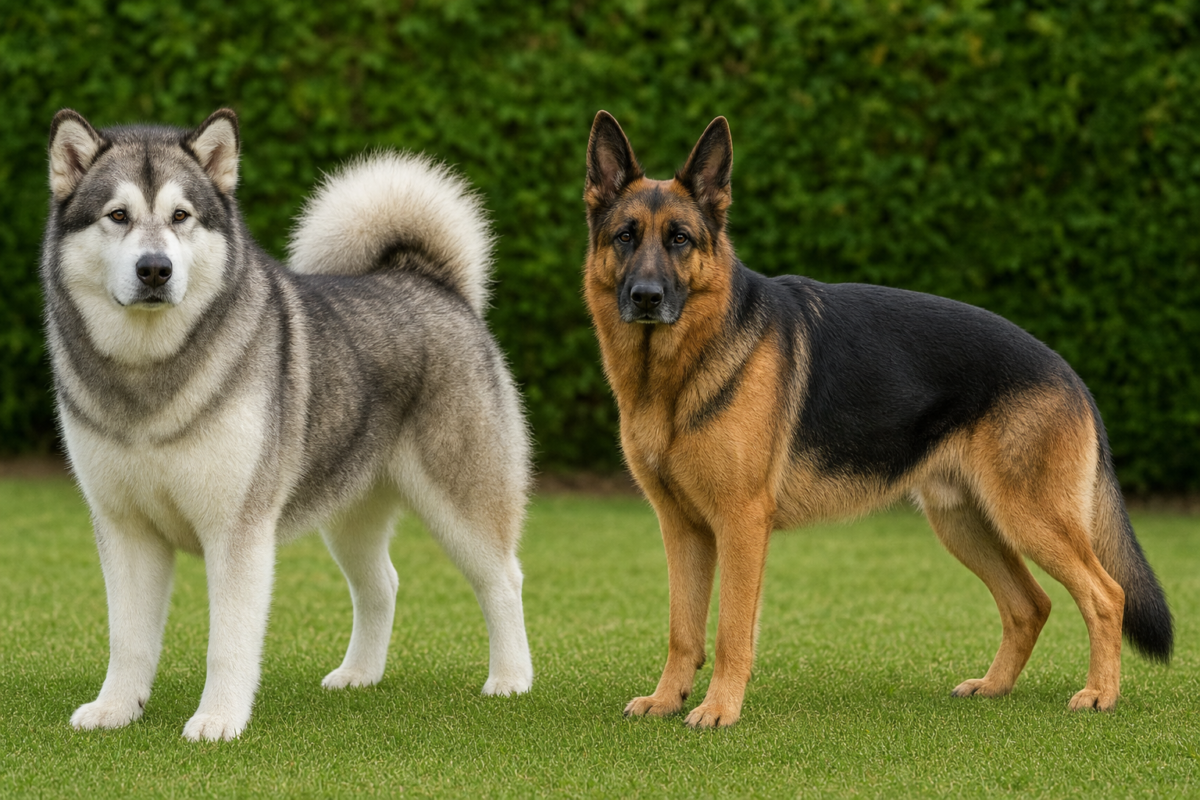
The Alaskan Malamute is a heavier, stockier freighting dog bred to haul weight over distance, standing 23 to 25 inches and weighing 75 to 100 pounds, with a thick double coat and an independent, stubborn nature. The German Shepherd is a lighter, more athletic working and herding breed, standing 22 to 26 inches and weighing 50 to 90 pounds, and it is far more biddable and easier to train. Choose the Malamute for calm strength and outdoor stamina, and the Shepherd for trainability, focus and a dog that wants a job with you.
These two are often shortlisted together, and that makes sense on paper. Both are big, powerful, thick coated northern looking dogs with serious presence. In daily life they could hardly be more different, and the difference is mostly about what each was bred to do. This guide lines them up side by side on size, temperament, trainability, exercise, coat and cost of living, so you can tell which one actually fits your household.
What is the difference between an Alaskan Malamute and a German Shepherd?
The core difference is purpose. The Malamute was bred by the Mahlemut people of Alaska to haul heavy freight over long distances at a steady pace, so it is built thick, powerful and self reliant, and it works alongside people rather than taking direction from them. The German Shepherd was developed in Germany in the late 1800s as a herding and then an all purpose working dog, so it is built lighter and quicker, and it was selected specifically for the willingness to take instruction.
That difference shows up everywhere. The Malamute is stronger, heavier coated, more independent and much harder to recall off lead. The Shepherd is faster, more trainable, more attached to its person and more likely to be restless without a job.
Size and build
A male Alaskan Malamute typically stands 25 inches at the shoulder and weighs around 85 pounds, with females around 23 inches and 75 pounds. Plenty of individuals run to 100 pounds or beyond. The build is substantial and compact rather than tall: a deep chest, heavy bone, a broad head, upright triangular ears and a plumed tail carried over the back.
A male German Shepherd stands 24 to 26 inches and weighs 65 to 90 pounds, with females at 22 to 24 inches and 50 to 70 pounds. The frame is longer, lighter and more angular, built for agility and endurance rather than pulling power. Side by side, a Malamute usually looks the bigger dog even when the Shepherd is taller.
| Attribute | Alaskan Malamute | German Shepherd |
|---|---|---|
| Male height | 25 inches | 24 to 26 inches |
| Male weight | 85 to 100 lb | 65 to 90 lb |
| Female weight | 75 to 85 lb | 50 to 70 lb |
| Coat | Thick double coat, heavy shed | Medium double coat, heavy shed |
| Trainability | Independent, stubborn | Highly biddable |
| Energy style | Stamina, steady effort | Drive, bursts and focus |
| Off lead reliability | Usually poor | Usually good |
| Adult height reached | About 12 to 18 months | About 18 months |
| Fully mature | About 2 years | About 2 and a half to 3 years |
The American Kennel Club’s Chief Veterinary Officer, Dr. Jerry Klein, DVM, has written extensively on the slower growth and development timeline of large and giant breeds. Read more from the AKC’s guidance on caring for large-breed dogs.
Temperament
The Malamute is famously friendly. This is not a guarding breed and it rarely makes a useful watchdog, because it tends to greet strangers as new acquaintances. What it is, is opinionated. A Malamute decides whether your request is worth its time, and if it is not, it simply will not. That independence is not defiance, it is what a freighting dog needed in order to keep working when its handler could not see the trail ahead.
The German Shepherd is a different animal emotionally. It attaches strongly to its people, wants to be included, and is naturally watchful without needing to be taught. That combination makes it an outstanding companion for someone who enjoys training, and a difficult one for someone who does not, because an under occupied Shepherd invents work of its own.
Both are affectionate with their families. The Malamute expresses it as physical closeness and noisy chatter. The Shepherd expresses it as attention, following you room to room and watching for what happens next.
Where each breed came from
The Alaskan Malamute is one of the oldest arctic sled breeds, developed by the Mahlemut people of northwestern Alaska to move heavy loads over long distances in brutal cold. It was never a racing dog. Speed was irrelevant; endurance, strength and the sense to keep going were everything. That history explains the heavy bone, the insulating coat, the appetite efficiency and the independent mind.
The German Shepherd is barely more than a century old. Max von Stephanitz set out in the 1890s to standardise a working herding dog, and selected hard for intelligence, nerve and willingness to work with a handler. Within decades the breed had moved from flocks into police and military work. That history explains the athletic build, the drive, the watchfulness and the extraordinary trainability.
Knowing the origins tells you most of what you need. One breed was bred to think for itself in the absence of instruction, the other was bred to wait for it.
Trainability
This is the sharpest split of all. The German Shepherd is one of the most trainable dogs in the world, which is why it fills police, service and search roles. It learns quickly, retains reliably and generally wants to get it right.
The Malamute learns just as fast and complies far less. Recall in particular is difficult, and a prey drive combined with a strong urge to roam means most Malamutes stay on lead or behind a secure fence for life. Training a Malamute works best with short sessions, high value food and a sense of humour. Expect cooperation rather than obedience.
Exercise needs
Both breeds need real daily exercise, but they need different kinds.
- Malamute. Long steady walks, hiking and pulling work in cool weather. Stamina is the strength. Heat is the limit, and a Malamute in a warm climate needs early morning and late evening activity only.
- Shepherd. A mix of physical and mental work. Training sessions, scent games and structured activity tire a Shepherd more thoroughly than distance alone.
- Both. Keep the frame lean and favour soft ground, and see our guide to low impact exercise for big dogs for sessions that build fitness without hard landings.
- While young. Keep long runs and repeated jumping moderate in both breeds while the growth plates are still open.
Malamute Heat Tolerance
A dense arctic coat is a real limit in warm climates. Plan activity around cool hours and shade.
Shepherd Understimulation
A bored Shepherd will find a job. Build training and scent work into the week, not just walks.
Malamute Containment
Strong roaming and digging instincts mean secure, tall fencing and lead walking are usually non negotiable.
Coat Volume
Both shed heavily and blow coat seasonally. Budget time for grooming rather than being surprised by it.
Grooming and shedding
Neither of these is a low maintenance coat. The Malamute carries a dense arctic double coat that sheds year round and blows out entirely twice a year, which is a genuinely dramatic event in a small home. Expect thorough brushing several times a week, daily during a coat blow, and never shave the coat, since it insulates against heat as well as cold.
The German Shepherd sheds almost as much with a shorter, less dense coat. Two or three brushings a week keeps it manageable. Long coated Shepherds need more. Both breeds do best with a slicker brush and an undercoat rake, and both will change how often you vacuum.
Feeding and growth
Both are large breeds that grow over a long window, so how they get to adult size matters more than the number they land on.
- Feed a complete food formulated for large breed puppies until about 18 months, which controls calories and mineral balance for steadier growth.
- Feed to a lean body condition throughout. You should feel the ribs easily under a thin layer.
- Split meals into three a day while young and two as an adult.
- Malamutes are famously efficient feeders and gain weight easily, so measure portions rather than free feeding.
- Shepherds are often the opposite and can look lean through adolescence. Confirm portions with your veterinarian rather than adding food to fill out the frame.
Our Alaskan Malamute growth chart and German Shepherd growth chart give month by month weight ranges for each.
Supporting the joints of a big working breed
Both breeds put real demand on their joints. The Malamute carries more weight over a heavier frame, and the Shepherd moves faster and turns harder, so the load arrives differently but it arrives in both. Steady growth, a lean body condition, sensible surfaces and daily joint support are worth building in early for either dog.
Many big dog parents run a daily joint chew alongside that. MoveGuard Growth is made for large and giant breed puppies across the roughly 8 to 30 month growth window, combining nine actives including New Zealand Green Lipped Mussel, glucosamine, chondroitin, MSM and hyaluronic acid to support healthy joint development, dosed by expected adult weight. MoveGuard Adult takes over for adult dogs from 25 to 75 pounds and adds eggshell membrane collagen, with the daily amount printed on the label and set by weight. Both are made in the USA in an NSF registered facility, come in chicken liver flavour and carry a 60 day guarantee.
Support A Working Frame
Daily joint support built for large and giant breeds, from puppyhood onward. Explore MoveGuard.
Lifespan and long term care
Alaskan Malamutes typically live 10 to 14 years and German Shepherds 9 to 13, which is respectable for dogs of this size. Both are considered large breeds by every veterinary measure, which means both benefit from the same long term habits: twice yearly veterinary checks once they are mature, a lean body condition held consistently, and attention to how they move rather than only to how they look.
Both breeds are worth insuring or budgeting for early, and both do best with a veterinarian who knows large breeds well. Ask about screening appropriate to each breed when you choose a puppy, and prefer breeders who test their stock and can show you results rather than describe them.
Which one suits your home?
Choose the Alaskan Malamute if you live somewhere cool, you want a calm and friendly giant rather than a watchful one, you enjoy long walks and hiking, you have a properly secure garden, and you are genuinely relaxed about a dog that will negotiate with you. Malamutes suit people who want company on an adventure rather than a partner in a task.
Choose the German Shepherd if you want a dog to train, work with and take places, you can commit to daily mental exercise as well as physical, and you would like a natural watchfulness around the home. Shepherds suit active households that enjoy structure. They are a poor fit for anyone who wants a low involvement dog.
Neither is a good first big dog for someone short of time. Both are strong enough to need real handling skills, both shed heavily, and both are unhappy if left alone for long stretches.
Living costs and practicalities
- Food. Both eat like the large dogs they are. A Malamute usually costs a little more to feed by weight.
- Grooming. Budget for regular equipment and time, or for a professional groomer twice a year at minimum for coat blows.
- Space. Both can live in a smaller home if genuinely exercised, but the Malamute needs a secure outdoor area more than the Shepherd does.
- Climate. Warm regions favour the Shepherd. Cold regions suit both, and the Malamute thrives.
- Time. The Shepherd needs more of your active involvement. The Malamute needs more of your patience.
Frequently asked questions
Which is bigger, an Alaskan Malamute or a German Shepherd?
The Alaskan Malamute is usually the heavier dog, at 75 to 100 pounds against 50 to 90 pounds for a German Shepherd, though a tall male Shepherd can match or exceed a Malamute in height. The Malamute carries far more bone and bulk for its height.
Which breed is easier to train?
The German Shepherd, by a wide margin. It was selected for biddability and is one of the most trainable breeds in the world. A Malamute learns quickly but complies on its own terms, and recall is rarely reliable.
Are Alaskan Malamutes good guard dogs?
Generally no. Malamutes are friendly with strangers and make poor watchdogs. If protective instinct matters to you, the German Shepherd is the natural choice of the two.
Do both breeds shed a lot?
Yes, heavily. The Malamute sheds year round and blows its dense arctic coat twice a year, while the Shepherd sheds almost as much from a shorter coat. Regular brushing is essential for both.
Which breed is better with children?
Both can be excellent family dogs when well socialised, and both are large and powerful enough to need supervision around small children. The Malamute tends to be more tolerant of strangers, while the Shepherd is more watchful and more attached to its own household.
The bottom line
The Alaskan Malamute and the German Shepherd look like relatives and live like opposites. The Malamute is the heavier, friendlier, more independent dog, built for steady effort in cold weather and happiest with an adventure and a secure garden. The Shepherd is lighter, quicker, deeply trainable and naturally watchful, and it thrives on being given a job. Match the breed to how much structure you actually want in your days, feed and exercise for a lean and steady frame, and support the joints early in either case.
Want the Simple Roadmap in One Place?
Grab our free Big Dog Growth Blueprint for the growth window checklist, feeding framework and joint safe exercise limits, all written for large and giant breeds.
This article is for general educational purposes only and is not veterinary advice. It is not intended to diagnose, treat, cure or prevent any disease. Always consult your veterinarian about your dog individual health, nutrition and supplement needs. These statements have not been evaluated by the Food and Drug Administration.
Support Big Breed Joints from Day One
Large and giant breeds carry more load through every growth stage. MoveGuard Growth supports developing joints in young big dogs (8 to 30 months); MoveGuard Adult keeps grown big dogs moving comfortably.
Leave a Reply