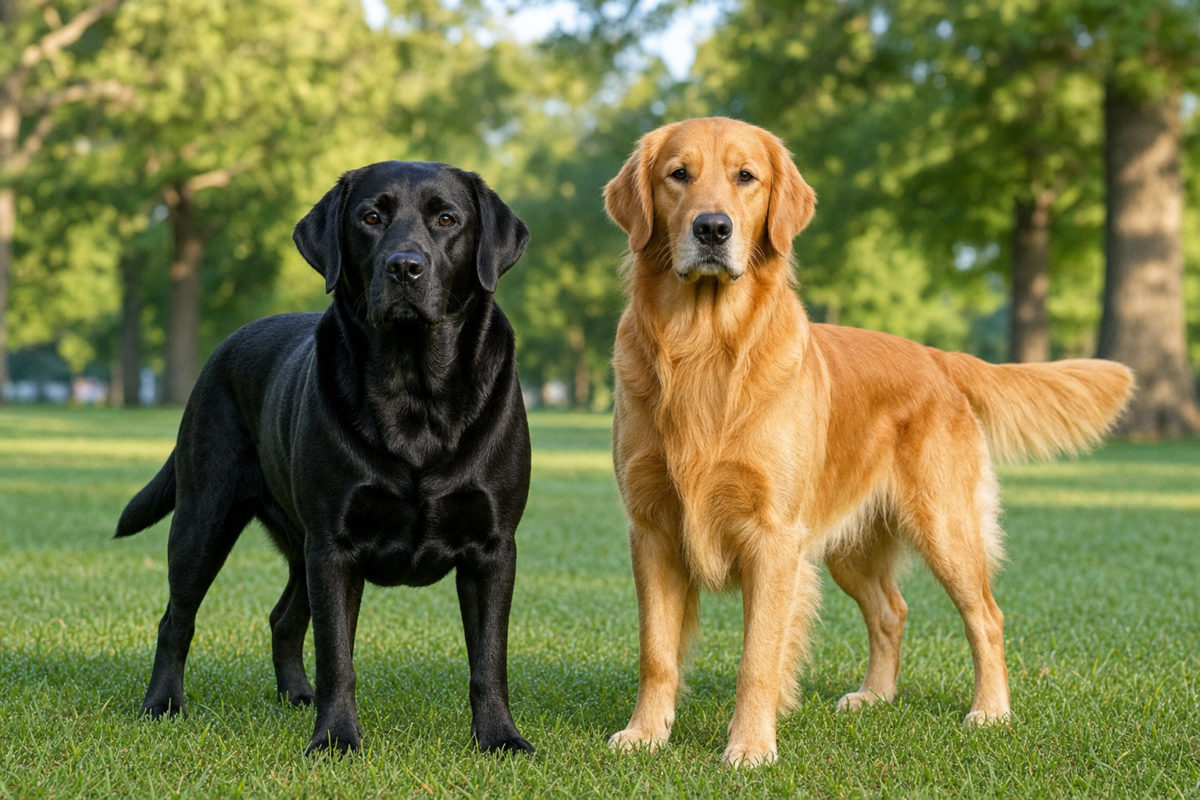
The main differences between a Labrador and a Golden Retriever are coat and temperament rather than size. The Labrador has a short, dense double coat that needs very little grooming, and a bold, boisterous, food motivated character that bounces back from anything. The Golden has a longer, feathered coat that needs regular brushing, and a softer, more sensitive character that reads a household closely. On adult size the two are close enough that most people cannot separate them by weight, and the Golden often looks larger because of the coat. Both were developed as retrievers, both are patient with children, both shed a great deal, and both typically live around 10 to 12 years.
Labradors and Golden Retrievers are close in size but differ most in coat and temperament. A male Labrador stands 22.5 to 24.5 inches and weighs 65 to 80 pounds, while a male Golden stands 23 to 24 inches and weighs 65 to 75 pounds. The Labrador has a short, dense, weatherproof coat and a boisterous, food driven, robust personality. The Golden has a longer feathered coat that needs far more grooming, and a softer, more sensitive nature. Both finish growing at around 18 to 24 months and both are affectionate family dogs.
These two breeds sit side by side at the top of almost every popular dog list, and for good reason. Both were bred to retrieve, both are gentle with families, and both grow into friendly dogs of roughly the same size. If you are choosing between them, you are not choosing between a good dog and a better one. You are choosing between two different daily experiences. This guide compares them on size, growth, energy, coat and temperament.
What is the difference between a Labrador and a Golden Retriever?
The main differences are coat and temperament rather than size. The Labrador has a short, dense double coat that needs very little grooming, and a bold, boisterous, food motivated character that bounces back from anything. The Golden has a longer, feathered coat that needs regular brushing, and a softer, more sensitive character that reads a household closely.
On size they are close enough that most people cannot separate them by weight, and the Golden often looks larger because of the coat. Both were developed as retrievers, both are patient with children, both shed a great deal, and both live around 10 to 12 years.
Size and build compared
A male Labrador stands 22.5 to 24.5 inches at the shoulder and weighs 65 to 80 pounds, while a female stands 21.5 to 23.5 inches and weighs 55 to 70 pounds. A male Golden Retriever stands 23 to 24 inches and weighs 65 to 75 pounds, and a female stands 21.5 to 22.5 inches and weighs 55 to 65 pounds.
The build differs more than the numbers suggest. A Labrador is thickset and compact, with a broad head, a deep chest and the famous thick otter tail. A Golden is a little taller and leaner in outline, with a more refined head and a feathered tail carried level with the back. Put them together and the Labrador looks solid while the Golden looks elegant.
Growth chart compared, month by month
Use this as a guide rather than a report card. A puppy tracking a little above or below while looking lean and moving well is usually doing fine.
| Age | Labrador male | Labrador female | Golden male | Golden female |
|---|---|---|---|---|
| 2 months | 10 to 15 lb | 8 to 13 lb | 10 to 16 lb | 8 to 14 lb |
| 3 months | 22 to 26 lb | 20 to 24 lb | 22 to 26 lb | 19 to 23 lb |
| 4 months | 30 to 35 lb | 25 to 32 lb | 30 to 35 lb | 25 to 31 lb |
| 6 months | 45 to 55 lb | 40 to 50 lb | 44 to 57 lb | 39 to 50 lb |
| 9 months | 55 to 68 lb | 48 to 58 lb | 55 to 68 lb | 47 to 58 lb |
| 12 months | 62 to 75 lb | 52 to 65 lb | 62 to 72 lb | 52 to 62 lb |
| 18 months | 64 to 79 lb | 54 to 68 lb | 64 to 75 lb | 54 to 64 lb |
| 2 years plus | 65 to 80 lb | 55 to 70 lb | 65 to 75 lb | 55 to 65 lb |
The American Kennel Club’s Chief Veterinary Officer, Dr. Jerry Klein, DVM, has written extensively on the slower growth and development timeline of large and giant breeds. Read more from the AKC’s guidance on caring for large-breed dogs.
When do they stop growing?
Both reach close to their adult height by around 12 to 14 months, then keep filling out through the chest and shoulders until roughly 18 to 24 months. The Golden usually takes longer to look finished, partly because the adult coat is still coming in through the second year.
As a rough guide, an expected adult weight of 65 to 80 pounds means growth carries on for roughly 18 to 22 months. That puts both breeds in the same band, so a leggy, adolescent looking twelve month old of either breed is exactly on schedule.
Why the growth window matters for both
Through this window both puppies are laying down the cartilage, bone and connective tissue that will carry them through an active life. Growth plates stay open for much of the first year, and while they are open, hard impact and excess body weight ask more of a frame that has not finished forming. Both breeds will happily overdo it, which makes lean feeding, sensible activity and daily joint support worth attention in either case.
Weight Gain
Both breeds gain weight easily and the Labrador especially so. Extra pounds load developing joints.
Endless Retrieving
Both will fetch until they drop. Repetitive sprint and turn is high impact, so you set the limit.
Growing Too Fast
Aim for a steady curve rather than a fast one. Rapid growth asks more of young joints.
Boredom
Both are working retrievers. Without a job that energy turns into chewing and mischief.
Feeding both breeds through growth
Both breeds are famously enthusiastic about food, and the Labrador is in a class of its own. Steady, moderate growth is the priority for either puppy.
- Choose a complete food formulated for large breed puppies, which balances calories, calcium and phosphorus for steadier growth.
- Measure every meal rather than topping up a bowl, and split into three meals while young and two as an adult.
- Count treats and training rewards as part of the daily total, since both will work all day for food.
- Confirm portions with your veterinarian at each checkup, since the right amount changes quickly in the first year.
How to check body condition in ten seconds
The scale tells you weight. Body condition tells you whether that weight suits the dog in front of you.
- Ribs. Run your hands along the sides. You should feel the ribs easily under a thin layer. If you have to press, ease back on food.
- Waist. Look down from above. You want a clear waist that tucks in behind the ribs.
- Tuck. From the side, the belly should rise toward the back legs rather than hanging level.
A thick coat hides a lot, so on a Golden trust your hands rather than your eyes.
Energy and exercise compared
Both are active sporting breeds that need real daily exercise. The difference is in the flavour of that energy.
The Labrador tends to be more physically boisterous, especially through adolescence. It leans into things, hits the end of the lead, and treats water as an invitation. The Golden is a shade softer and settles more readily indoors, though a young Golden is every bit as busy and the gap is smaller than the reputation suggests.
Both need roughly the same daily budget as adults, around an hour or more of varied activity, and both benefit from having something to think about. Scent games, retrieve based training and swimming suit both. Keep repetitive high impact retrieving moderate while either puppy is still growing.
Supporting an active frame
Both breeds live to move, and that travels through the joints on every stride, turn and landing. Supporting healthy joint development while the frame is being built, and keeping that habit into adulthood, is a simple thing to get right for either dog.
Alongside lean feeding and sensible exercise, many Dog Parents add a daily joint chew made for large breeds. MoveGuard Growth is built for the puppy stage, combining nine actives including New Zealand Green Lipped Mussel, glucosamine, chondroitin, MSM and hyaluronic acid to support the developing joints of young large breed dogs across the roughly 8 to 30 month growth window. You dose by expected adult weight, so most Labradors and Goldens sit at two chews a day. For grown dogs, MoveGuard Adult covers medium and large breeds from 25 to 75 pounds with every active amount printed on the label. Both are made in the USA in an NSF facility and backed by a 60 day guarantee.
Support An Active Retriever
Daily joint support built for large breeds, in a growth formula and an adult formula. Explore MoveGuard Growth.
Temperament and family life compared
This is where the two genuinely part company, and it is the difference that matters most day to day.
The Labrador is outgoing, resilient and cheerfully unbothered. It recovers quickly from a telling off, greets strangers as friends, and brings noise and mess into a house. That robustness makes it forgiving of a busy family, and it is part of why the breed suits first time Dog Parents so well.
The Golden is more sensitive and attuned to mood. It reads a room, watches its people closely, and stays physically near them. A harsh word lands harder on a Golden than on a Labrador. Handled gently it becomes an unusually soft, biddable companion, which is why the breed appears so often in therapy and assistance work.
Both are excellent with children when properly socialised, and both are poor guard dogs, far more likely to greet an intruder than challenge one. Neither does well left alone for long stretches.
Coat, grooming and shedding
This is the most practical difference in daily life. The Labrador has a short, dense, oily double coat that repels water and needs little more than a weekly brush. It sheds heavily, but short hair is easier to manage and does not mat.
The Golden has a longer double coat with feathering on the legs, chest, underside and tail. It needs brushing several times a week, more during a seasonal moult, and the feathering picks up mud, burrs and water. Expect regular attention to the ears too.
Both shed all year and heavily twice a year, so neither suits a household that wants a hair free home. If grooming time is scarce, the Labrador is the easier of the two.
Which one suits your home?
Choose a Labrador if your household is busy and boisterous, you want the shortest possible grooming routine, you would rather have a dog that shrugs things off, and you are ready to be firm about food.
Choose a Golden Retriever if you want a softer companion who stays close, you enjoy grooming or are happy to pay for it, your home is calmer, and you like a dog that reads you closely.
If you are still torn, meet adults of both breeds rather than puppies. Puppies of either are irresistible and almost identical in appeal. Grown dogs show you what you are actually choosing.
A simple growth game plan, stage by stage
8 weeks to 4 months. Foundation stage for both. Large breed puppy food, three calm meals a day, thorough socialisation and short bursts of free play on soft ground. Begin gentle training now, and teach a Labrador early that food comes from the bowl rather than every surface in the kitchen.
4 to 8 months. Growth is quick and both look leggy and adolescent. Keep feeding lean, keep exercise moderate, and build calm habits around stairs and the car. This is the natural point to begin a daily joint support routine. Start regular brushing with a Golden now so the adult coat is never a fight.
8 to 18 months. Height nears its peak while muscle arrives. Adolescence is at its most testing here, and a Labrador in particular may seem to forget everything it knew. Hold the routine, keep portions matched to a lean condition, and add structured activity gradually.
18 months to 3 years. The adolescent becomes a steady adult. Build activity up as your veterinarian advises, watch the weight closely, and many Dog Parents carry the joint routine into adulthood.
Common mistakes with both breeds
- Underestimating the energy. Neither is a calm house dog until it has been properly exercised and given something to think about.
- Letting the weight creep. Both gain easily and the Labrador is among the most food motivated breeds there is. Extra pounds load the joints.
- Endless ball throwing. Repetitive sprint, skid and turn is high impact, and a retriever will never call time on it.
- Leaving Golden grooming too late. A matted coat becomes a job for a professional and an unpleasant experience for the dog.
- Handling a Golden too firmly. Corrections that a Labrador shrugs off can shut a Golden down. Match the method to the dog.
- Assuming they are the same dog in different coats. They are close relatives, not interchangeable.
Frequently asked questions
Which is bigger, a Labrador or a Golden Retriever?
They are very close. A male Labrador weighs 65 to 80 pounds and a male Golden 65 to 75 pounds, with the Golden usually standing slightly taller. The Golden often looks bigger because of the longer coat, but a Labrador is typically the heavier and more thickset of the two.
Which breed is calmer?
Golden Retrievers are generally regarded as the softer and slightly calmer of the two, particularly indoors and as adults. Both are active sporting breeds, though, and a young Golden is every bit as busy as a young Labrador.
Which sheds more?
Both shed heavily all year with two bigger seasonal moults. The Golden loses longer hair and needs brushing several times a week, while the Labrador loses short hair that is easier to clean up. Neither suits a household that wants a hair free home.
Which is better for a first time Dog Parent?
Both are excellent first dogs. The Labrador is more forgiving of handling mistakes and needs far less grooming, while the Golden is more sensitive and asks for a gentler approach and a bigger grooming commitment.
Do they have the same joint concerns?
Both are large, active sporting breeds that ask a lot of their joints across a lifetime, so steady growth, a lean body condition, sensible exercise and daily joint support are sensible for either. Speak with your veterinarian about your individual dog.
The bottom line
A Labrador and a Golden Retriever end up roughly the same size, finish growing at roughly the same age, and give you roughly the same affectionate family dog. The choice is about coat and character. Take the Labrador for a robust, cheerful, low maintenance companion in a busy home, and the Golden for a softer one if you can commit to the brush. Feed either for lean, steady growth, keep exercise sensible while those joints develop, and give that retriever brain a job.
Want the Simple Roadmap in One Place?
Grab our free Big Dog Growth Blueprint for the growth window checklist, feeding framework and joint safe exercise limits, all written for large and giant breeds.
This article is for general educational purposes only and is not veterinary advice. It is not intended to diagnose, treat, cure or prevent any disease. Always consult your veterinarian about your dog’s individual health, nutrition and supplement needs. These statements have not been evaluated by the Food and Drug Administration.
Support Big Breed Joints from Day One
Large and giant breeds carry more load through every growth stage. MoveGuard Growth supports developing joints in young big dogs (8 to 30 months); MoveGuard Adult keeps grown big dogs moving comfortably.
Leave a Reply