
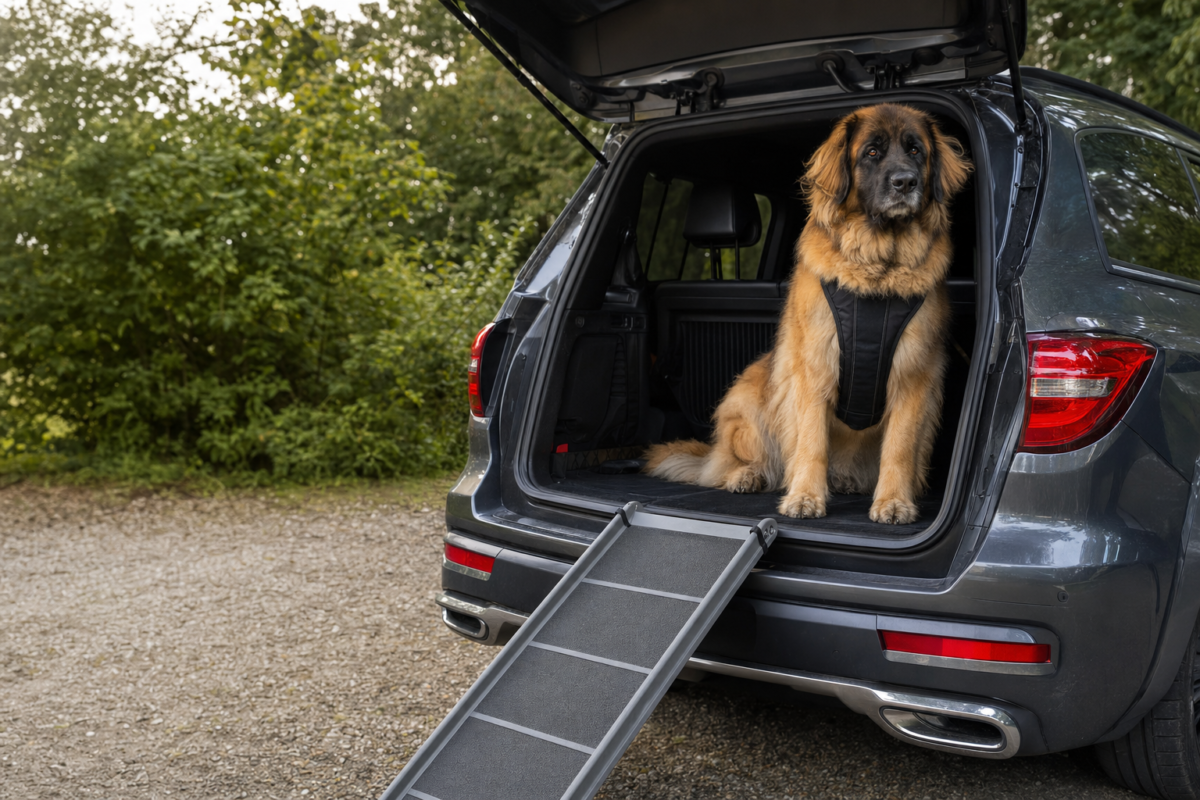
To keep a large breed dog safe in the car, restrain it every trip with a crash tested harness clipped to the seat belt system or a strong, well secured crate in the cargo area, and keep it out of the front seat where an airbag can strike it. Load and unload with a ramp or a low step rather than a big jump, keep the windows only slightly open, plan a break every two to three hours, and never leave your dog alone in a parked car, even for a few minutes.
Few things feel better than a road trip with a big, happy dog leaning on the window and watching the world go by. With a little planning, every drive can feel that good and stay that safe. A large breed dog needs a slightly different plan from a small one, because a bigger body carries more force in a sudden stop, takes up more space, and asks more of its joints on every jump in and out. This guide walks you through restraint options, the safest place for a big dog to ride, how to protect those joints at the doorway, and the simple habits that turn the car into a calm, comfortable place your dog is glad to be.
How do I keep a large breed dog safe in the car?
Keep a large breed dog safe in the car by restraining it on every trip, seating it in the back seat or a secured cargo area, helping it in and out with a ramp or step, managing heat and fresh air, and planning regular breaks. A crash tested harness attached to the seat belt system or a sturdy crate that is strapped or anchored in place are the two most reliable restraint choices. A big dog should never ride loose, never ride in the front passenger seat, and never be left alone in a parked car.
Each step solves a different problem. Restraint holds your dog in a sudden stop, the back seat keeps it clear of airbags, a ramp spares the joints a hard landing, and heat and break planning keep a heavy, often thick coated dog comfortable on longer drives.
Why big dogs need a different car plan
Size changes everything inside a vehicle. A loose ten pound terrier in a sudden stop is a worry. A loose ninety pound Labrador is a serious hazard to itself and to every person in the car. AAA has estimated that an unrestrained 80 pound dog in a crash at only 30 miles per hour can exert roughly 2,400 pounds of force. Even a hard brake at low speed can throw a big dog into the seat backs or the footwell.
Big dogs also fit cars differently. Many simply do not fit a standard back seat lying down, which tempts parents to let them stand or roam. A giant breed may need the full cargo area of an SUV to lie flat and turn around. And getting a big body into a high cargo floor usually means a jump of two feet or more, repeated twice on every trip, hundreds of times a year. That is a lot of landing force on young growth plates and on older joints, so the doorway deserves as much thought as the drive itself.
Restraint options for large breed dogs, compared
There is no single right answer for every dog and every vehicle, but some options are far safer than others. Use this table to match your dog and your car to the best fit.
| Option | Best for | What to look for |
|---|---|---|
| Crash tested harness | Most big dogs in the back seat | Independent crash test certification, wide padded chest plate, short tether to the seat belt or anchor point |
| Secured crate | SUVs, wagons and dogs who settle best enclosed | Strong construction, a crate size that lets your dog sit, stand, turn and lie flat, and straps anchored to the vehicle tie downs |
| Cargo area barrier | Giant breeds in a large SUV | A firmly fixed steel barrier. Helpful against distraction, but pair it with a harness or crate for crash protection |
| Hammock seat cover | Comfort and cleanliness | Non slip backing. It keeps a dog off the footwell but is not a restraint on its own |
| Collar tether | Not recommended | A sudden stop puts the whole force on the neck. Always attach to a harness instead |
| Riding loose | Never | Any big dog moving freely in a moving car is a hazard to itself and the driver |
A good test of any harness is how it fits. You should be able to slide two fingers under each strap, the chest plate should sit across the breastbone rather than the throat, and the tether should be short enough that your dog can sit and lie down but cannot reach the front seats or fall into the footwell. If you choose a crate, our guide to the right size crate will help you measure, since a crate that is too large lets a dog slide around inside it.
Where should a big dog ride in the car?
The back seat or the secured cargo area is the right place for any large breed dog. The front passenger seat is the one spot to rule out completely. Front airbags deploy with enough speed and force to seriously injure a dog, and a big dog up front is also a constant distraction to the driver.
Back seat or cargo area?
For a dog that fits lying down across the back seat, a crash tested harness on the seat belt system is usually the simplest setup. For bigger and giant breeds, or for dogs that settle better in a den, a secured crate in the cargo area of an SUV or wagon often works best. Make sure the crate is strapped to the tie down points so it cannot slide or tip, and leave a little space behind it if your vehicle has a short rear crumple zone. Whichever you choose, keep loose items such as water bottles and bags stowed, because anything unsecured becomes a projectile in a hard stop too.
Riding Loose
An unrestrained big dog carries enormous force in a sudden stop. Restrain every trip, even short ones to the park.
Front Seat Airbags
Airbags deploy faster than a dog can react. Keep large breeds in the back seat or a secured cargo area.
Heat In A Parked Car
A closed car can climb about 20 degrees in ten minutes on a mild day. Never leave your dog waiting inside.
Hard Jumps
Leaping from a high cargo floor loads young growth plates and older joints. A ramp or step makes every trip gentler.
Getting a big dog in and out without strain
The jump into the car is the moment most parents overlook. A high cargo floor or a tall SUV seat can mean a jump of two to three feet, and the landing on the way out is the harder half, because a heavy front end takes the impact through the shoulders and elbows. A few simple habits make every trip kinder on the frame.
- Use a sturdy dog ramp or a folding step with a non slip surface for any vehicle where your dog has to jump more than knee height.
- For puppies still in their growth years, avoid letting them jump down from the cargo area at all. Lift a small puppy with one arm under the chest and one under the rear, and switch to a ramp as soon as it gets too heavy to carry safely.
- Ask for a calm wait before your dog exits, so it walks down the ramp rather than launching out of the door into traffic.
- Park so the exit side faces the curb or a grassy verge when you can, giving your dog a safe, soft place to step out.
How to teach a ramp in ten minutes a day
Most big dogs need a short, positive introduction before they trust a ramp. You can build that trust in a few sessions.
- Flat first. Lay the ramp flat on the ground and reward your dog for walking across it with all four paws.
- Low angle. Prop one end on a low step and repeat, keeping a treat at nose level to guide the walk.
- Car height. Attach the ramp to the car, walk alongside with a hand near the harness, and reward at the top.
Keep sessions short and upbeat, and stop while your dog is still keen. Within a week most dogs walk up and down without a second thought.
Preparing for the trip: food, water, heat and breaks
A comfortable dog is a calmer, safer passenger. A little preparation before you leave makes long and short trips easier for everyone.
- Feed a light meal three to four hours before a long drive rather than right before you leave. This supports a settled stomach, and it matters for deep chested breeds, which are best kept quiet around mealtimes.
- Offer water before you set off and at every stop. A spill proof travel bowl makes this easy.
- Plan a break every two to three hours for a short walk, a drink and a bathroom stop, always clipping the leash on before the door opens.
- Run the air conditioning before your dog gets in on warm days, use sun shades on the rear windows, and keep an eye on panting. Our guide to hot weather safety covers the warning signs in detail.
- Open windows only a few inches. A big head out of the window invites eye injuries from debris and makes a jump far too tempting.
- Pack a travel kit with a spare leash, waste bags, a towel, water, any medication, and your veterinarian’s phone number.
Above all, never leave your dog alone in a parked car. Cracking the windows does very little, and even on a mild spring day a car interior can become dangerous within minutes.
Protecting your dog’s joints on every trip
Car travel is a small part of the day, yet the jumps in and out add up over a lifetime. A puppy building its frame through the growth window and an older dog whose joints have already done years of work both benefit when every landing is a gentle one. A ramp, a lean body condition and steady daily movement are the foundations of joint support that keep a big dog keen to hop in for the next adventure.
Alongside those habits, many big dog parents add a daily joint support chew made for large and giant breeds. MoveGuard Growth is built for young dogs across the roughly 8 to 30 month growth window, and MoveGuard Adult supports grown dogs who live an active life. MoveGuard Growth combines nine actives, including New Zealand Green Lipped Mussel, glucosamine, chondroitin, MSM and hyaluronic acid, to support healthy joint development and comfortable movement. You dose by expected adult weight, so most big dogs sit at two chews a day and larger dogs at three. It is made in the USA in an NSF facility, ships as 90 chews, and is backed by a 60 day guarantee.
Keep Every Adventure Comfortable
Give your big dog daily joint support built for large and giant breeds, from the puppy years onward. Explore MoveGuard Growth.
Signs your big dog is comfortable in the car
A dog that feels safe in the car shows it. Look for a dog that walks up the ramp willingly, settles into a sit or a lie down within a few minutes of setting off, breathes calmly with a soft mouth, and steps out at the end of the trip relaxed and ready to sniff around. A big dog that rides this way is far less likely to pace, lean on doors or fight its harness.
Signs that something needs adjusting include heavy panting on a cool day, drooling, whining, repeated yawning or lip licking, trembling, or reluctance to approach the car at all. These can point to motion sickness, anxiety or discomfort getting in and out. If they persist, or if your dog seems stiff or sore after a trip, a quick chat with your veterinarian brings peace of mind and helps you adjust early.
A simple car safety game plan, stage by stage
A big dog’s needs in the car change as it grows and ages. Here is the right emphasis at each stage.
8 weeks to 4 months. Foundation stage. Start with short, happy trips to fun places, not just the veterinarian. Use a secured crate or a puppy sized harness from day one, lift your puppy in and out, and keep early drives calm and brief so the car becomes a familiar, safe space.
4 to 8 months. Your puppy is heavier and more confident. Begin ramp training now, before it is too big to lift. Size up the harness or crate as it grows, and keep jumps out of the cargo area off the menu while the growth plates are still open.
8 to 18 months. Adolescence brings size and bounce. Hold firm on the calm wait at the door and the ramp routine, because this is the age when big dogs most want to leap. Check harness fit every few weeks, since the chest is still filling out.
Adult and senior years. Your dog knows the routine, so keep it consistent. As your dog ages, a lower step, a gentler ramp angle and a thicker, supportive bed in the cargo area all make travel easier. Our guide to helping a senior big dog with stairs shares the same gentle principles for the home.
Common car safety mistakes to avoid
Most car problems with big dogs come from a handful of easy habits. Avoid these and you are already ahead.
- Skipping the restraint on short trips. Most crashes happen close to home. Clip in every time, even for a five minute drive.
- Clipping the tether to a collar. In a sudden stop all the force lands on the neck. Always use a harness.
- Letting a big dog ride up front. Airbags and distraction make the front seat the riskiest place in the car.
- A crate that is too big or unsecured. A loose crate can slide or tip, and a dog in an oversized crate can be thrown about inside it.
- Jumping out of the cargo area. Repeated hard landings ask a lot of joints at every age. A ramp is a small habit with a big payoff.
- Leaving your dog in a parked car. Heat builds fast and big, thick coated dogs struggle to shed it. Take your dog with you or leave it at home.
- Feeding a big meal right before a long drive. A full stomach and a moving car are a poor mix. Feed lightly and earlier.
Helping a nervous big dog love the car
Many large breeds are gentle, sensitive souls under all that size, and a dog that once felt sick or frightened in the car can carry that worry for years. The good news is that big dogs learn quickly when the experience is consistently pleasant, and a calm passenger is a safer one.
Start by sitting in the parked car together with the engine off, sharing treats and a favourite chew, then step out before your dog has any chance to feel uneasy. Next, run the engine without moving. Then take a short drive around the block that ends somewhere wonderful, such as a quiet field or a friend’s garden. Build the distance slowly over days, not hours. A familiar blanket that smells of home, a steady temperature, soft music and a smooth driving style all help. If your dog regularly drools, vomits or trembles despite this gradual approach, ask your veterinarian about options for motion sickness or travel anxiety. With patience, most big dogs come to see the car as the doorway to their favourite places rather than something to dread.
Frequently asked questions
What is the safest way for a large dog to ride in a car?
The safest setup is a crash tested harness attached to the seat belt system in the back seat, or a strong crate that is properly sized and strapped down in the cargo area. Both keep your dog in place in a sudden stop and away from the front airbags.
Can a big dog ride in the front seat?
No. Front airbags deploy with enough force to seriously injure a dog, and a large dog in the front seat is a major distraction for the driver. Keep big dogs in the back seat or a secured cargo area every time.
Should my big dog jump in and out of the car?
It is best to avoid repeated jumps from a high cargo floor or tall seat. The landing puts real load on the shoulders, elbows and hips, especially in growing puppies and older dogs. A sturdy ramp or folding step makes every trip gentler on the joints.
How often should I stop on a long drive with my dog?
Plan a break every two to three hours for a short walk, a drink of water and a bathroom stop. Always attach the leash before you open the door so your dog cannot slip out into traffic.
Is it safe to leave a dog in a parked car with the windows open?
No. Even with the windows cracked, the inside of a car can heat up by around 20 degrees in ten minutes on a mild day, and large, thick coated dogs struggle to cool themselves. Never leave your dog alone in a parked car.
The bottom line
Keeping a large breed dog safe in the car comes down to a few steady habits: restrain your dog every trip with a crash tested harness or a secured crate, keep it in the back, help it in and out with a ramp, manage heat and breaks, and never leave it waiting in a parked car. Build those habits early, protect those joints at the doorway, and every drive becomes a calm, happy start to the next big adventure together.
Want the simple roadmap in one place? Grab our free Big Dog Growth Guide for the growth window checklist, feeding framework and joint safe exercise limits, all written for large and giant breeds.
This article is for general educational purposes only and is not veterinary advice. It is not intended to diagnose, treat, cure or prevent any disease. Always consult your veterinarian about your dog’s individual health, nutrition and supplement needs. These statements have not been evaluated by the Food and Drug Administration.
Support Big Breed Joints from Day One
Large and giant breeds carry more load through every growth stage. MoveGuard Growth supports developing joints in young big dogs (8 to 30 months); MoveGuard Adult keeps grown big dogs moving comfortably.
Leave a Reply