
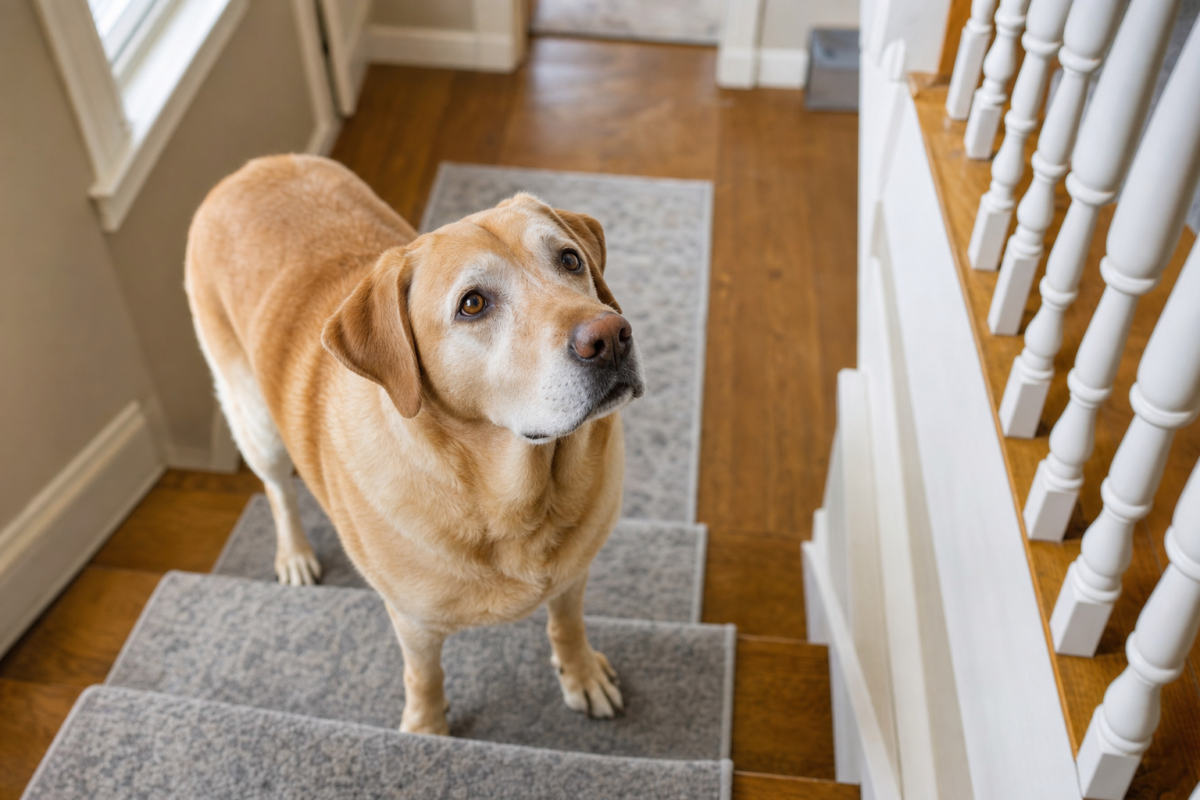
You help a senior big dog with stairs by fixing the footing first, then the route, then the body. Lay runners or stair treads so every step gives grip, add light at the top and bottom, and clear the landing of clutter. Teach a slow, one step at a time pace instead of a rush, and use a support harness with a handle when the hind end needs help. Keep your dog lean, keep daily movement gentle and regular, and move the bed, water and door access to one floor so the staircase becomes an occasional trip rather than a daily demand.
Watching an older big dog pause at the bottom of the stairs is one of those quiet moments that stays with you. Nothing dramatic has happened. Your dog simply looks up, thinks about it, and waits. The good news is that stairs are one of the most fixable parts of a senior big dog’s day, because most of the difficulty comes from footing, pace and layout rather than from age itself. This guide covers what changes with age, how to read what your dog is telling you at the foot of the stairs, and the setup that makes the trip safer for both of you.
How can I help my senior big dog with stairs?
Start with traction, because slipping is the single biggest reason older big dogs lose confidence on stairs. Cover bare treads with carpet runners, rubber stair treads or a stair runner secured at every step, and keep your dog’s paw hair and nails trimmed so the pads can actually grip. Then slow the trip down. Ask for one step at a time on the way down, stay beside the shoulder rather than in front, and let your dog set the rhythm. Finally, support the body: keep weight lean, keep movement regular, and fit a rear support harness with a padded handle if the hind legs tire on the last few steps.
Why stairs get harder for a big dog with age
Stairs ask a lot from a body. Going up is a push from the hind end, where an older dog often has the least strength left. Coming down is a controlled brake, absorbed through the shoulders and elbows, and it demands balance and confidence as much as muscle. A big dog carries far more weight through each of those movements than a small one, so the same staircase is simply a bigger task.
Three things tend to change at once in the senior years. Muscle mass in the rear quarters gets lighter, so the push gets weaker. Vision and depth perception soften, which makes the top step harder to judge in low light. And the joints that take the load feel less willing after rest, which is why the first trip of the morning is often the worst one of the day. None of that means your dog has to give up the stairs. It means the staircase needs to meet your dog halfway.
What your dog’s stair behaviour is telling you
Older dogs rarely announce a problem. They adapt around it, quietly, until the adaptation becomes the new normal. Reading those small changes early gives you time to make the easy fixes before they matter. This table covers the patterns Dog Parents most often notice first.
| What you see | What it often means | What helps first |
|---|---|---|
| Pausing at the bottom before starting up | Deciding whether the effort is worth it | Better footing and a slower invitation, never a call from the top |
| Bunny hopping with both back legs together | Sharing the push across both hind legs | Shallower trips, a support harness, a veterinary check |
| Rushing down in a controlled fall | Avoiding the braking work by using momentum | Teaching a one step at a time pace with a lead on |
| Slipping on the last two or three steps | Tired hind end plus smooth treads | Traction on every step, not only the first few |
| Refusing at night but fine by day | Lower light and softer depth perception | A lamp or night light at both ends of the flight |
| Waiting at the top to be invited down | Lost confidence rather than lost strength | Rebuild with short, rewarded practice on two or three steps |
| Stiff on the first trip, easier later | A body that needs to warm up before it works | A short flat walk before the first descent of the day |
The American Veterinary Medical Association notes that larger breeds are generally considered senior earlier than small breeds, given their shorter typical lifespans. Read more from the AVMA’s guidance on caring for senior pets.
Any sudden change deserves a call to your veterinarian rather than a home fix. A dog that managed the stairs last week and cannot manage them today is telling you something a runner cannot answer.
Smooth Treads
Polished wood, tile and laminate give a big paw almost nothing to hold. Traction is the first fix, not the last.
Extra Weight
Every additional pound travels up and down with your dog. A lean senior climbs with far less effort.
Rushing Down
A fast descent is a fall your dog is steering. Slow it down before it turns into a real one.
Clutter And Dark
Shoes on the landing and an unlit top step turn a manageable flight into a hazard.
Setting up a staircase an older big dog can manage
Work through the staircase itself before you change anything about your dog’s routine. Most homes need an afternoon of small adjustments, and the difference is usually visible the same day.
- Cover every step. Rubber stair treads or a secured carpet runner on the full flight. Partial coverage teaches your dog that grip is unpredictable, which is worse than none.
- Fix the landings. A grippy mat at the top and bottom gives your dog somewhere safe to gather before and after the flight.
- Light both ends. A low lamp or plug in night light at the top and bottom, so the edge of each step reads clearly to older eyes.
- Clear the run. No shoes, no baskets, no toys on the treads. A big dog needs the whole width of the step.
- Trim the paws. Long nails change how the toes meet the tread, and hair growing between the pads slides like a sock. Both are quick wins.
- Add a gate if you need one. A gate at the top stops an unplanned solo trip at three in the morning, when nobody is there to spot a wobble.
How to test the footing in ten seconds
Press your palm flat on a tread and try to push it sideways. If your hand slides, your dog’s paw slides. Do the same on the covering you have added once it is down, and again at the top and bottom mats. Anything that shifts under a firm push will shift under a sixty pound dog changing direction, so secure it properly rather than trusting a rug to stay put.
Teaching a safer way up and down
Once the staircase is set up, the habit matters. Most older big dogs have spent years going down fast because it was easy, and that habit outlives the body that made it safe. Reteaching the pace takes a week or two of short sessions.
- Clip a lead on and stand beside the shoulder, level with your dog, never ahead and pulling.
- Ask for one step, pause, reward, then the next. The pause is the whole lesson.
- Work on the bottom two or three steps only at first, then build up the flight.
- Never call an older dog down towards you. A dog hurrying to reach a person stops watching the steps.
- Keep sessions short and end while your dog is still comfortable, because a tired senior practises the wrong pattern.
- Do the first descent of the day after a short flat walk, so the body is warm before it has to brake.
If your dog is already anxious about the flight, treat it as a confidence problem rather than a strength problem. Feed a few meals at the bottom of the stairs, reward calm approaches, and let your dog choose to try. Pressure on a worried senior tends to set the whole project back.
Support harnesses, ramps and knowing when to limit the stairs
Equipment is not an admission of defeat. Used early, it keeps a dog on their feet and doing more, not less.
- A rear support harness with a padded handle lets you take some of the push out of the climb without lifting the whole dog. It is the most useful single item for a big dog with a tired hind end.
- A full body harness with front and rear handles suits a dog who needs help at both ends, and gives you a safe hold if a leg gives way mid flight.
- A ramp works beautifully for a few shallow outdoor steps and for the car, where landing from a tailgate loads shoulders and elbows hard. Indoor staircases are usually too steep for a safe ramp angle.
- A one floor layout is the honest answer for many giant breeds. Bed, water, food and the door on the ground floor removes the daily repetition and keeps the stairs for occasions.
Lifting a large or giant breed dog up a full flight is rarely the right plan. It is unsteady for both of you and one awkward moment carrying eighty pounds hurts you both. Change the layout instead.
Weight and daily movement do the quiet work
The two levers that change stairs most have nothing to do with the staircase. A lean dog climbs with less load through every joint, and a dog who moves gently most days holds the muscle that makes the climb possible.
- Feed to a lean body condition and check it by hand every couple of weeks rather than by the number on the scale.
- Aim for two or three short walks a day rather than one long one, and let sniffing set the pace.
- Add gentle strength work such as slow walking up a shallow grass slope, if your veterinarian agrees it suits your dog.
- Prefer grass, dirt and forest floor to concrete, and keep sessions well within what your dog handles comfortably.
- Watch the following morning. Comfortable movement the day after is the best evidence you pitched the outing right.
How to check body condition in ten seconds
The scale tells you weight, but body condition tells you the useful part. Run your hands along the sides and you should feel the ribs easily under a thin layer, without pressing. Look down from above for a clear waist behind the ribs. From the side, the belly should rise towards the back legs rather than hanging level. If the ribs are hard to find, a small portion adjustment agreed with your veterinarian does more for your dog’s stairs than any piece of equipment.
Everyday habits that support joint comfort
Alongside footing, weight and gentle low impact exercise, many Dog Parents keep a daily joint support routine running right through the senior stage rather than starting and stopping it. Consistency is the point, because the ingredients that support joint comfort work with time rather than overnight.
MoveGuard Adult is built for medium and large breed adult dogs from 25 to 75 pounds. It brings together glucosamine, chondroitin, MSM, New Zealand Green Lipped Mussel, eggshell membrane collagen, hyaluronic acid and vitamins C and E to support cartilage, connective tissue and comfortable movement. Dosing follows weight, so a dog from 25 to 50 pounds takes one chew a day and a dog from 50 to 75 pounds or more takes two, with the label advising senior dogs aged seven and over to use the higher amount for their weight and to allow six to eight weeks. It ships as 60 chicken liver flavoured chews, is made in the USA in an NSF registered facility, and carries a 60 day guarantee.
Support The Years Ahead
Give your older big dog daily joint support made for medium and large breeds. Explore MoveGuard Adult.
Signs the new setup is working
You will know within a fortnight. The clearest sign is a dog who stops hesitating at the bottom and simply starts up. Look also for a steadier descent with visible foot placement rather than a rush, a willingness to do the trip more than once a day, and an easier first movement in the morning. If instead you see new stiffness after rest, reluctance that was not there before, a head bob while walking, or a leg that will not take weight, book the veterinary visit rather than adjusting the setup again.
A stair plan, stage by stage
Senior is a long chapter for a big dog, and the right help changes across it. Use whichever stage sounds like the dog in front of you rather than the number on the paperwork.
Early senior, still confident. This is the cheapest stage to act in. Put traction down before it is needed, light both ends of the flight, keep weight lean, and start the one step at a time habit while your dog still finds it easy. Habits built now hold up later.
Slowing a little. Your dog still uses the stairs but thinks about them first. Add the support harness and get your dog comfortable wearing it around the house before you ever use the handle. Begin reducing how many round trips a day the routine actually requires.
Needing real help. The hind end tires part way up and the descent is careful. Move water and the bed downstairs, use the handle every trip, and gate the stairs when nobody is home to spot a solo attempt. Ask your veterinarian about gentle strength work and whether a mobility assessment is worth doing.
Best kept off the stairs. If a flight has become a genuine risk, a one floor life is not a loss. Give your dog a warm, well padded bed away from draughts, easy access to the garden, water within reach overnight, and short gentle outings. Most dogs settle into it quickly once the daily worry is gone.
Common mistakes to avoid
Almost every stair problem in an older big dog gets worse through one of these. They are easy to fix once you can see them.
- Calling your dog down to you. A dog hurrying towards a person stops watching the steps. Go up and walk beside the shoulder instead.
- Covering only the first few steps. The slip almost always happens on the last two, where a tired hind end meets bare tread.
- Waiting for a fall before changing anything. One bad slip can cost months of confidence in a dog who was managing fine.
- Carrying a big dog up a full flight. It is unsteady for both of you. Change the layout rather than the lifting.
- Letting weight creep up in a quieter year. Less activity with the same bowl is how a comfortable senior slowly becomes an uncomfortable one.
- Treating sudden change as ageing. Age is gradual. A change over days is a veterinary question.
The confidence side of stairs
There is a part of this that has nothing to do with muscle. A big dog who has slipped once on a staircase remembers it, and the hesitation you see afterwards is often caution rather than weakness. Dogs are also reliably willing to hurt themselves to follow their people, which is exactly why a senior will attempt a flight they should not when they hear you go up.
You can use that. Keep your own body language calm at the foot of the stairs, because a worried voice from the top makes a hesitant dog rush, and reward the slow, careful trips rather than the quick ones. Where you can, remove the reason to follow at all: if your dog settles better on the ground floor, spending the evening down there does more for the stairs than any training session. Confidence responds to joint support, good footing and patience together rather than to any one of them alone.
Frequently asked questions
Are stairs bad for senior large breed dogs?
Stairs are not automatically bad, and for many older big dogs a few careful trips a day help maintain muscle and confidence. The risk comes from smooth treads, a rushed descent and repetition. Fix the footing, slow the pace and cut the number of daily trips, and most senior dogs manage a staircase comfortably for a long time.
What is the best flooring for stairs for a big dog?
Rubber stair treads or a carpet runner secured at every step give the most reliable grip. Cover the whole flight rather than part of it, add a grippy mat at the top and bottom, and press each surface firmly with your hand to check that nothing slides before your dog uses it.
Should I carry my senior big dog up the stairs?
Carrying a large or giant breed dog up a full flight is rarely a good plan, because it is unsteady for both of you and hard on your back. A rear support harness with a padded handle is safer, and moving the bed, water and door access to one floor removes most of the need entirely.
Why does my old dog struggle with stairs at night but not in the day?
Older eyes need more light and lose some depth perception, so the edge of each step is harder to read after dark. A lamp or plug in night light at the top and bottom of the flight often resolves it on its own. If the difficulty appears during daylight too, speak with your veterinarian.
At what age do big dogs start having trouble with stairs?
Large breeds are generally considered senior from about six or seven years, and giant breeds earlier still, but stair confidence varies widely between individual dogs. Rather than watching the calendar, watch for the pause at the bottom, a rushed descent or slipping near the top, which are the earliest practical signs.
The bottom line
Helping a senior big dog with stairs is mostly a home project, not a medical one. Give every step real grip, light both ends of the flight, teach a slow and deliberate pace, and add a support harness before your dog truly needs it. Keep the body lean and moving gently most days, and rearrange the house so the staircase is a choice rather than a daily obligation. Do those things early and you buy your dog years of steady, confident trips, and you replace that quiet pause at the bottom with a dog who simply gets on with it.
Want the simple roadmap in one place? Grab our free Big Dog Mobility Guide for the home setup checklist, the weight framework and gentle movement routines, all written for large and giant breeds.
This article is for general educational purposes only and is not veterinary advice. It is not intended to diagnose, treat, cure or prevent any disease. Always consult your veterinarian about your dog’s individual health, nutrition and supplement needs. These statements have not been evaluated by the Food and Drug Administration.
Support Big Breed Joints from Day One
Large and giant breeds carry more load through every growth stage. MoveGuard Growth supports developing joints in young big dogs (8 to 30 months); MoveGuard Adult keeps grown big dogs moving comfortably.
Leave a Reply