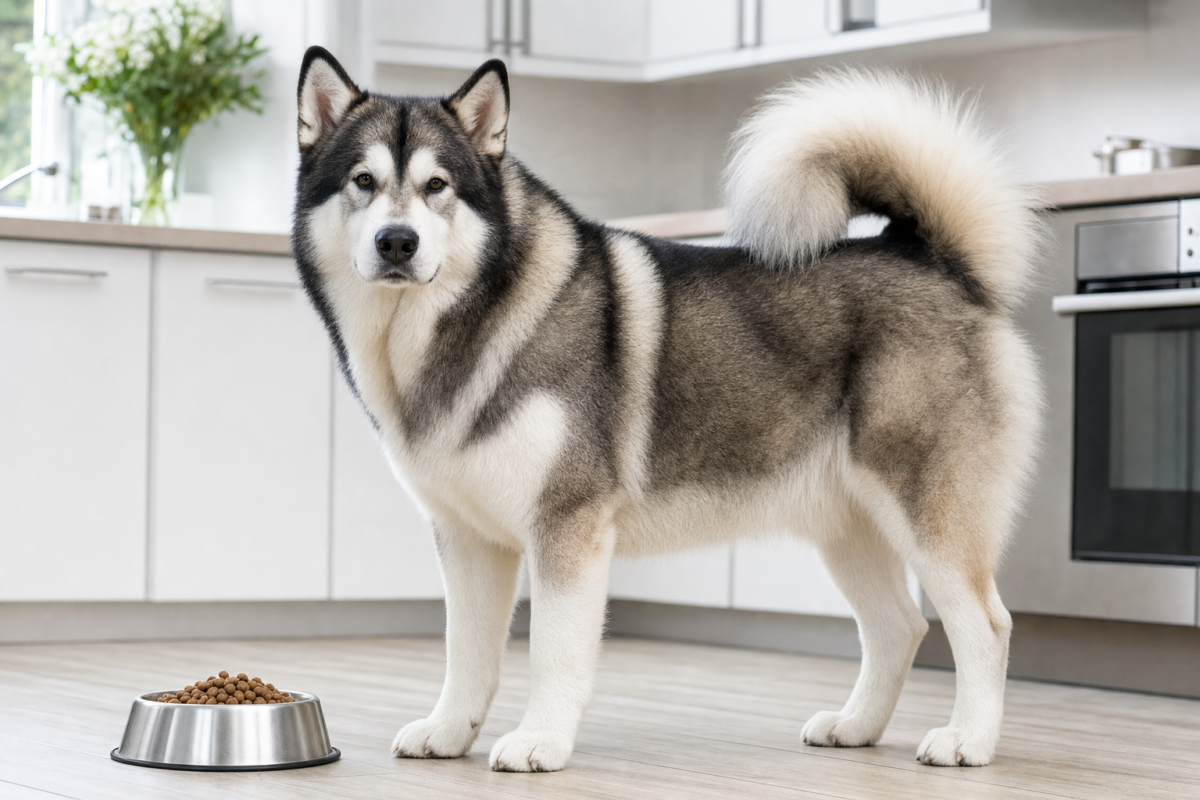
Most adult large breed dogs eat between 3 and 6 cups of dry food a day, split across two meals. A 60 pound dog usually needs roughly 3 cups, an 80 pound dog roughly 4 cups, and a 120 pound dog roughly 5 to 6 cups. Those figures are a starting point only. Activity level, age, neutering and the calorie density of your food can shift the right amount by a third in either direction, so set the portion by body condition rather than by the bag.
Feeding a big dog is one of those jobs that looks simple until you stand in front of the bag and realise the guidance covers everything from a spaniel to a mastiff. A large dog eats a lot, so getting the amount right saves money, protects the joints carrying all that weight, and keeps your dog comfortable for longer. This guide gives you a starting chart by weight, the calorie maths behind it, how to adjust for a real dog rather than an average one, and the checks that tell you when the portion is right.
How much should I feed an adult large breed dog?
An adult large breed dog typically eats 3 to 6 cups of dry food a day, divided into two meals. As a rough starting point, feed about 3 cups a day at 60 pounds, 4 cups at 80 pounds, 5 cups at 100 pounds and closer to 6 cups at 130 pounds, then adjust from there based on what you see and feel on your dog.
The reason no chart can be exact is that cups are a measure of volume, not energy. Two foods can look identical in the bowl and differ by 150 calories per cup. Always start with the feeding guide printed on your own bag, because it is written for the calorie density of that specific food, and treat any general chart as a sanity check.
What actually decides how much a big dog needs
Body weight is only the first input. Four other factors move the number more than most Dog Parents expect.
Activity level. A working or hiking dog can need a third more food than the same dog living a calm suburban life. Weekend activity does not count for much either. It is the daily pattern that sets the requirement.
Neutering. Spayed and neutered dogs generally need fewer calories than intact dogs of the same size. Many big dogs quietly gain weight in the months after surgery because portions never changed.
Age. Energy needs usually drift down from around seven years of age as activity softens and muscle mass changes. A senior large breed dog often needs noticeably less than it did at four.
Metabolism. Two dogs of the same breed and weight can differ by hundreds of calories a day. This is normal, and it is exactly why your hands matter more than any chart.
Adult large dog feeding chart by weight
Use this as a starting point for a moderately active adult dog on a standard dry food of about 350 to 400 calories per cup. Confirm against your own bag and your veterinarian.
| Adult weight | Typical daily food | Rough daily calories |
|---|---|---|
| 50 to 60 lb | 2.5 to 3 cups | 1,100 to 1,300 |
| 60 to 70 lb | 3 to 3.5 cups | 1,300 to 1,500 |
| 70 to 80 lb | 3.5 to 4 cups | 1,500 to 1,650 |
| 80 to 100 lb | 4 to 4.75 cups | 1,650 to 1,950 |
| 100 to 120 lb | 4.75 to 5.5 cups | 1,950 to 2,250 |
| 120 to 150 lb | 5.5 to 6.5 cups | 2,250 to 2,650 |
The World Small Animal Veterinary Association’s Global Nutrition Committee publishes evidence-based guidance for evaluating dog food and feeding practices. Read more from the WSAVA Global Nutrition Guidelines.
Split the daily total into two meals, morning and evening. Two meals suit a deep chested breed far better than one large bowl, and they keep energy steadier across the day.
The calorie maths, if you want the precise version
Veterinarians start from resting energy needs, which rise with body weight but not in a straight line. In practice, a neutered adult dog living a typical family life needs roughly 25 to 30 calories per pound of body weight per day at the lighter end of the large breed range, and proportionally fewer per pound as size climbs. A 60 pound dog lands near 1,300 calories, while a 130 pound dog needs closer to 2,400 rather than the 2,800 a simple multiplication would suggest.
That is why giant breeds do not eat double what a Labrador eats despite weighing double. If you want a number for your own dog, ask your veterinarian to calculate it at the next visit, then divide by the calories per cup printed on your bag.
How to check body condition in ten seconds
The chart tells you where to start. Body condition tells you whether you were right, and it is the only measure that adapts to your individual dog.
- Ribs. Run your hands along the sides. You should feel the ribs easily under a thin layer. If you have to press, ease back on food.
- Waist. Look down from above. You want a clear waist that tucks in behind the ribs.
- Tuck. From the side, the belly should rise toward the back legs rather than hanging level.
Check monthly, and change portions in small steps of about ten percent rather than large ones. A lean big dog moves more comfortably and carries less load through every joint.
Feeding By Eye
A scoop or a mug hides drift. Use a proper measuring cup or a kitchen scale for every meal.
Uncounted Extras
Chews, table scraps and training treats can add hundreds of calories. Count them inside the daily total.
Same Portion Forever
Needs change with age, season and activity. Revisit the amount every few months.
Excess Weight
Extra pounds travel through the hips, knees and elbows with every step. Lean is the kindest setting for a big frame.
How to measure and split the day
The mechanics matter as much as the number. A few habits keep portions honest:
- Weigh the food on a kitchen scale if you can. It is far more consistent than a cup, especially with large kibble.
- Feed two measured meals roughly twelve hours apart rather than one large bowl.
- Leave about an hour between a meal and hard activity in both directions.
- Keep treats to no more than about ten percent of daily calories, and subtract them from meals.
- Write the daily amount somewhere visible so everyone in the house feeds the same portion.
If your dog eats fast, a slow feeder bowl or a snuffle mat turns a two minute meal into a satisfying ten minute one without adding a single calorie.
Adjusting for a real dog rather than an average one
Start with the chart, then let four weeks of evidence correct it. Weigh your dog monthly if you have access to a scale, or use a tape measure and your hands if you do not. If the ribs are getting harder to feel, cut the daily amount by about ten percent and hold for a month. If your dog is looking sharp over the hips and losing muscle, add ten percent instead.
Season matters too. A dog who hikes all summer and mostly naps through winter genuinely needs two different portions, and adjusting for that is normal rather than fussy. The same applies after injury, after surgery and through any period of enforced rest.
Supporting the joints that carry the weight
Every pound your dog carries travels through the hips, knees, shoulders and elbows thousands of times a day. That is the real reason portion control matters more for a big dog than for a small one, and it is why feeding and mobility are the same conversation.
Alongside a lean body condition and steady daily movement, many big dog parents add a daily joint support chew made for medium and large breeds. MoveGuard Adult is built for grown dogs rather than growing ones. It combines glucosamine, chondroitin, MSM, New Zealand Green Lipped Mussel, eggshell membrane collagen and hyaluronic acid to help maintain healthy joints and comfortable movement in adult dogs. The dose is printed by weight, with 25 to 50 pound dogs on one chew a day and 50 to 75 pound dogs on two, and dogs of seven years and older taking the higher amount for their weight. It ships as 60 chews, is made in the USA in an NSF facility, and is backed by a 60 day guarantee.
Support Comfortable Movement
Give your adult big dog daily joint support built for medium and large breeds. Explore MoveGuard Adult.
Signs you have the portion right
A well fed adult big dog arrives at meals hungry but not desperate, finishes the bowl within a few minutes, holds a visible waist from above, and has ribs you can feel with light pressure. Coat is glossy, energy is even, and stools are firm and consistent. Weight stays stable month to month.
If your dog is gaining steadily, begging constantly, leaving food, or losing condition over the topline, that is a conversation for your veterinarian. Sudden appetite changes in a big dog are always worth a call rather than a guess.
A simple feeding plan, stage by stage
Adulthood is not one long flat stretch. The portion should move with the dog.
The transition, 12 to 24 months. Large breeds move from puppy food to adult food somewhere in this window, with giant breeds later. Talk to your veterinarian about the timing, and expect the daily amount to fall once growth finishes, because a growing puppy eats more than the adult it becomes.
Prime adult years, 2 to 6. Two measured meals a day, a monthly body condition check, and portion tweaks tied to activity. This is the easiest phase to let weight creep on quietly, so keep checking.
Early senior, 7 to 9. Activity usually softens and needs often drop. Many big dogs need around ten percent less here. Protein stays important for maintaining muscle, so reduce portions rather than switching to a thin diet.
Later senior, 9 and beyond. Watch muscle as closely as fat. Some older dogs need smaller, more frequent meals, and some need slightly more food to hold condition. Let your veterinarian steer this stage.
Common feeding mistakes to avoid
Most weight problems in big dogs come from a few avoidable habits.
- Trusting the bag without adjusting. Bag guides are generous and assume an active dog. Many pets need less than the printed amount.
- Free feeding. Leaving a full bowl down all day makes portion control impossible and hides appetite changes.
- Forgetting the extras. A large dental chew can carry as many calories as a small meal.
- Feeding to a number instead of a dog. Two dogs of identical weight can need very different portions. Trust your hands.
- Big meals around hard exercise. Leave a calm hour on either side, which suits deep chested breeds.
Getting the whole household on the same plan
A feeding plan only works if everyone in the house is running the same one. The most common cause of a heavy big dog is not one large meal. It is two people each giving dinner, or a family member adding a generous handful because a big dog always looks hungry.
Write it on the fridge. Note the daily amount, the two meal times, and the treat allowance for the day. If your dog has learned to work a room for extra food, and most large breeds learn this within a week of moving in, a shared note settles the argument without anyone feeling like the villain.
It helps to agree on what counts as a treat, too. Set aside a small portion of the daily kibble in a jar for training and rewards, and when the jar is empty the day is done. It costs nothing, keeps the total honest, and your dog never notices the difference.
Frequently asked questions
How many cups a day should a 70 pound dog eat?
Roughly 3 to 3.5 cups a day of a standard dry food, split into two meals, for a moderately active adult. Check the calories per cup on your own bag, since foods vary widely, and adjust to keep a lean body condition.
Should a large dog eat once or twice a day?
Twice a day is the better choice for large and giant breeds. Two smaller meals keep energy steadier and suit deep chested dogs far better than one large bowl.
How do I know if I am feeding my dog too much?
Run your hands over the ribs. If you cannot feel them easily under a thin layer, or the waist has disappeared when you look down from above, reduce the daily amount by about ten percent and reassess in a month.
Do large dogs need less food as they get older?
Usually yes. Energy needs often drop from around seven years of age as activity softens. Many senior big dogs need roughly ten percent less than they did in their prime, while still needing good quality protein to maintain muscle.
Do treats count toward the daily amount?
They do. Keep treats to about ten percent of daily calories and subtract them from meals. Chews and table scraps add up faster than most Dog Parents expect in a dog this size.
The bottom line
Most adult large breed dogs land between 3 and 6 cups a day across two meals, but the chart is only where you begin. Start from the guide on your own bag, measure every portion, check body condition once a month, and adjust in small steps as activity and age change. A lean big dog is a more comfortable big dog, and that comfort shows up in every walk, every set of stairs and every year you share.
Want the simple roadmap in one place? Grab our free Big Dog Mobility Guide for the daily habits, weight checks and movement routines that support comfortable joints in large and giant breeds.
This article is for general educational purposes only and is not veterinary advice. It is not intended to diagnose, treat, cure or prevent any disease. Always consult your veterinarian about your dog’s individual health, nutrition and supplement needs. These statements have not been evaluated by the Food and Drug Administration.
Support Big Breed Joints from Day One
Large and giant breeds carry more load through every growth stage. MoveGuard Growth supports developing joints in young big dogs (8 to 30 months); MoveGuard Adult keeps grown big dogs moving comfortably.
Leave a Reply