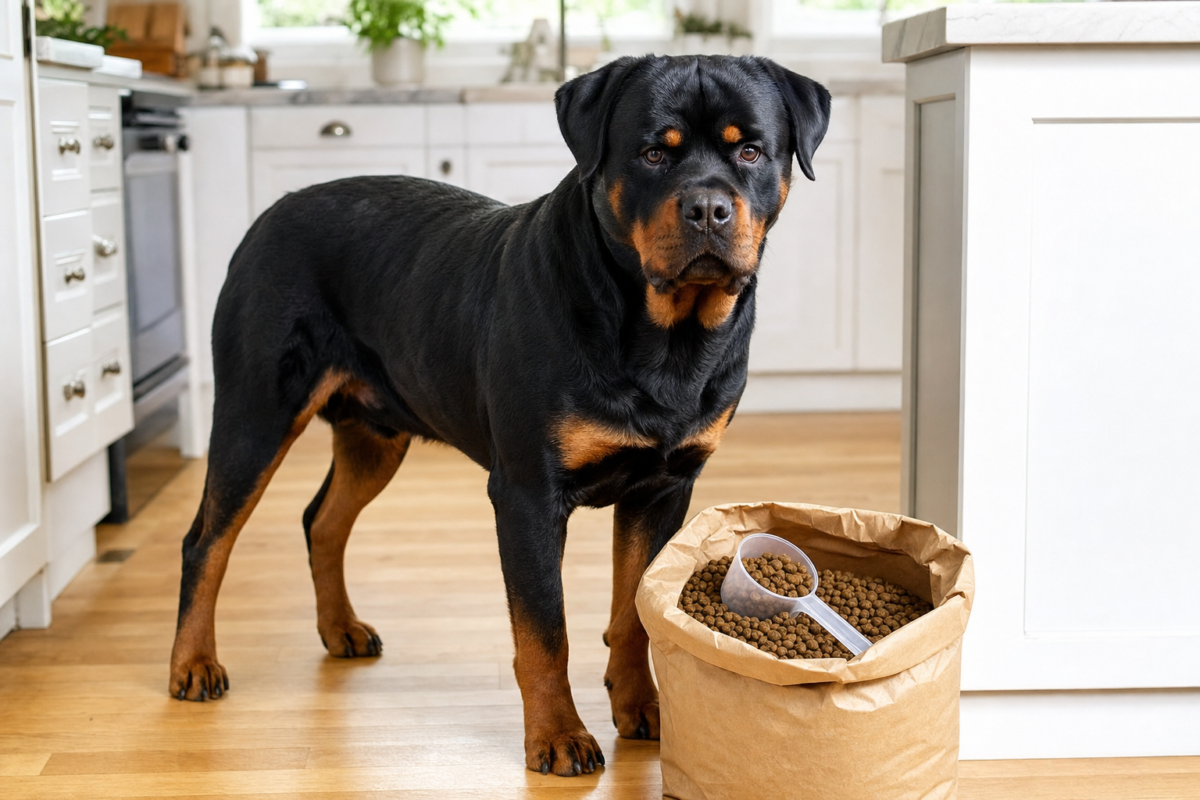
A typical neutered adult large breed dog needs roughly 1,150 to 2,000 calories a day at 50 to 100 pounds, and roughly 2,200 to 2,800 calories a day at 120 to 160 pounds. Calorie need does not rise in a straight line with weight, so a 140 pound dog eats far less than twice what a 70 pound dog eats. Growing puppies need about double those adult figures per pound of current body weight, and activity, age and neuter status can shift any of these numbers by 30 percent or more in either direction.
Feeding a big dog is one of those jobs where the bag on the shelf and the dog in your kitchen rarely agree. Feeding charts are written for averages, and your dog is a specific animal with a specific metabolism, a specific job and a specific number of treats slipped to them each evening. This guide gives you the real arithmetic behind a large breed dog’s daily calories, a table you can look your own dog up in, and the practical checks that tell you within a fortnight whether the number you landed on is the right one.
How many calories does a big dog need a day?
A typical neutered adult large breed dog needs roughly 1,150 calories a day at 50 pounds, about 1,650 at 80 pounds, about 1,950 at 100 pounds, and about 2,800 at 160 pounds. The reason those numbers climb so gently is that calorie need tracks body surface area rather than body mass, so it rises with weight raised to the power of three quarters rather than with weight itself. Double the dog and you add roughly 70 percent to the food, not 100 percent.
That single fact is the most useful thing a big dog parent can know about feeding, because it is the exact place most overfeeding starts. A parent moves from a 45 pound spaniel to a 110 pound mastiff, reasons that the new dog is nearly two and a half times the size, and doubles the bowl. The real gap is closer to 85 percent. The extra goes straight onto a frame that would rather not carry it.
The arithmetic, in plain language
Veterinary nutrition uses two numbers. The first is resting energy requirement, the calories a dog burns simply existing: standing in a warm room, breathing, keeping the heart going. The formula is 70 multiplied by body weight in kilograms raised to the power of 0.75. The second is maintenance energy requirement, which takes that resting figure and multiplies it by a factor for what the dog actually does all day.
Those factors are well established. A neutered adult sits around 1.6. An intact adult sits around 1.8. A dog carrying too much weight and on a reduction plan sits around 1.0 of the ideal weight rather than the current one. A genuinely working dog can run to 2.0 or beyond, and a hard working sled dog in cold weather can reach numbers that look absurd on paper. A puppy under 4 months old runs at about 3.0, dropping to about 2.0 from 4 months until it reaches adult size.
You do not need to do the maths yourself. You need to understand the shape of it, because that shape explains why two 90 pound dogs in the same neighbourhood can honestly need 500 calories a day apart from each other without either parent doing anything wrong.
Daily calories by adult weight
Use this table as a starting point, not a prescription. Find your dog’s ideal adult weight rather than their current weight, and start in the typical adult column.
| Ideal weight | Resting need | Typical neutered adult | Active or working adult |
|---|---|---|---|
| 50 lb | about 730 cal | 1,150 to 1,250 cal | 1,450 to 1,600 cal |
| 60 lb | about 835 cal | 1,300 to 1,450 cal | 1,650 to 1,850 cal |
| 70 lb | about 935 cal | 1,450 to 1,600 cal | 1,850 to 2,050 cal |
| 80 lb | about 1,035 cal | 1,600 to 1,750 cal | 2,050 to 2,250 cal |
| 100 lb | about 1,225 cal | 1,900 to 2,050 cal | 2,400 to 2,650 cal |
| 120 lb | about 1,400 cal | 2,150 to 2,350 cal | 2,750 to 3,000 cal |
| 140 lb | about 1,575 cal | 2,450 to 2,650 cal | 3,050 to 3,350 cal |
| 160 lb | about 1,740 cal | 2,700 to 2,900 cal | 3,400 to 3,700 cal |
Notice what the first and last rows are telling you. The 160 pound dog weighs more than three times the 50 pound dog but eats only about two and a third times as much. Big dogs are more efficient per pound than small ones, which is why a giant breed is not nearly as expensive to feed as people expect, and why they put weight on so easily when fed as though they were.
Growing puppies are a different calculation entirely
A large breed puppy is building bone, cartilage and muscle around the clock, and the calorie need per pound of current body weight is roughly double an adult’s. A 40 pound five month old puppy needs close to what a 75 pound adult needs. That is not a mistake in the table, it is what growth costs.
The catch is that with large and giant breeds, more is emphatically not better. Feeding a big puppy to the top of its appetite produces fast growth, and fast growth asks more of joints and growth plates that are still forming. The goal through the growth window is a steady, moderate curve. A complete food formulated for large breed puppies handles part of this for you by controlling calorie density along with calcium and phosphorus, but portion control is still your job.
Puppy factors in practice: about 3.0 times resting need from weaning to 4 months, then about 2.0 times resting need from 4 months until the dog reaches adult size. Because a puppy’s weight changes weekly, recalculate monthly and confirm the amount with your veterinarian at each checkup.
Scaling By Weight
Calories rise with the three quarter power of weight, not with weight itself. Doubling the dog does not double the bowl.
Uncounted Treats
Treats, chews and table food commonly add 20 to 30 percent on top of a carefully measured meal.
The Neuter Drop
Calorie need often falls noticeably after neutering while the same bowl keeps arriving. Reassess at that point.
Cups Not Grams
A scoop of kibble can vary by 20 percent between pours. A kitchen scale removes the guesswork entirely.
What changes your dog’s number
Two dogs of identical weight can need very different amounts. These are the factors that move the figure most:
- Neuter status. Calorie need usually drops after neutering. If the bowl does not drop with it, weight arrives quietly over the following months.
- Age. A senior dog moving less and carrying less muscle typically needs less than the same dog did at four years old, even though the scale has not moved.
- Real activity. Not walks on the calendar, walks that actually happen. Two brisk miles a day and a garden to patrol is a genuinely different dog from one that sleeps until the evening.
- Coat and climate. A thick coated dog living outdoors in cold weather burns more than a short coated dog in a heated house.
- Individual metabolism. Some dogs simply run hot or cold. This is why the table is a starting point and the body condition check is the answer.
- Food density. Kibbles range from roughly 320 to over 500 calories per cup. The same cup from two different bags is not the same meal.
How to check body condition in ten seconds
The scale tells you weight, but body condition tells you whether the calorie number is right. Do this check every couple of weeks.
- Ribs. Run your hands along the sides. You should feel each rib easily under a thin layer of covering. If you have to press to find them, the number is too high.
- Waist. Look down from above. You want a clear narrowing behind the ribs rather than a straight line from chest to hip.
- Tuck. From the side, the belly should rise toward the back legs rather than hanging level.
If all three look right, your number is right, whatever the bag says. If they do not, adjust the daily total by about 10 percent and check again in two weeks. Slow adjustments beat dramatic ones, and a change of one pound a week is plenty for a big dog.
Turning calories into an actual bowl
Calories are the unit that matters, but you feed food, not numbers. Here is how to close that gap without turning dinner into a spreadsheet:
- Find the calories per cup, or better per 100 grams, on your bag. It is usually printed in small type near the feeding guide as the metabolisable energy.
- Divide your dog’s daily calorie target by that figure to get the daily amount, then split it across meals.
- Weigh the food on a kitchen scale rather than scooping it. Scooping introduces real error, and on a big dog a 20 percent error is 300 calories a day.
- Budget treats inside the total, not on top of it. A reasonable ceiling is 10 percent of daily calories for everything that is not the main food.
- Recheck the figure whenever you change food brand or formula, because calorie density varies enormously between bags of the same size.
- Keep fresh water available at all times, and remember that a dog eating dry food drinks considerably more than one eating wet.
Feeding for a comfortable frame, not just a number
Calories decide what a big dog weighs, and what a big dog weighs decides how much work the joints do with every single step for the rest of their life. That is the real reason this arithmetic matters. A lean large breed dog is doing measurably less work per stride than the same dog carrying an extra ten pounds, and it does not take many extra biscuits a day to find those ten pounds over a year.
Alongside honest portions, many big dog parents add a daily joint support chew made for large and giant breeds. MoveGuard Growth is built for the roughly 8 to 30 month growth window, combining nine actives including 250mg New Zealand Green Lipped Mussel, 400mg glucosamine, 300mg chondroitin, 250mg MSM and 15mg hyaluronic acid to support developing joints, dosed by expected adult weight. MoveGuard Adult carries the same thinking through the years that follow. Both ship as 90 chews, are made in the USA in an NSF facility, and are backed by a 60 day guarantee.
Lean Frame, Daily Support
Pair honest portions with daily joint support built for large and giant breeds. Explore MoveGuard Growth.
Signs your calorie number is right
You do not need a daily weigh in to know the plan is working. Look for ribs you can feel under light pressure, a visible waist from above, steady energy through the day rather than a slump between meals, a consistent appetite that clears the bowl without desperation, and a weight that holds within a couple of pounds month to month.
If your dog is gaining steadily, begging constantly, leaving food, or losing condition despite eating well, those are all signals to revisit the number with your veterinarian. Sudden changes in appetite or weight with no change in the routine always warrant a conversation rather than a quiet adjustment at home.
A calorie plan, stage by stage
The right number moves through a big dog’s life. Here is roughly how it travels.
8 weeks to 4 months. The highest demand per pound your dog will ever have, at about 3.0 times resting need. Three meals a day, a complete large breed puppy food, and a fresh calculation every month as the weight climbs. Keep the curve steady rather than fast.
4 months to adult size. Drop to roughly 2.0 times resting need. This is the stage where overfeeding does the most quiet damage, because appetite is enormous and the frame is still forming. Feed to body condition, not to the empty bowl.
Adult, 2 to 7 years. Settle at 1.6 to 1.8 times resting need depending on neuter status and real activity. Reassess after neutering and after any change in exercise routine. This is the long stable stretch where a small ongoing error becomes a large problem.
Senior years. Activity usually falls and muscle mass with it, so the number often needs to come down even though the dog looks the same. At the same time some seniors lose condition and need more, not less. Check body condition monthly and let that guide the adjustment rather than the birthday.
Common calorie mistakes to avoid
Almost every overweight big dog got there through one of these, not through anything dramatic.
- Following the bag without adjusting. Bag guides are broad averages and tend to run generous. They are a starting point, never a final answer.
- Forgetting the treats. A handful of training rewards and a dental chew can easily be 300 calories, which on a 70 pound dog is a fifth of the entire day.
- Scaling straight from weight. Assuming a dog twice the size eats twice as much is the single most common arithmetic error in big dog feeding.
- Feeding the current weight of an overweight dog. Calculate from the ideal weight instead, or you will simply maintain the problem.
- Changing food without rechecking. Two bags can differ by 150 calories per cup, so the same scoop becomes a different meal overnight.
- Adjusting too hard. Halving the food to fix a few pounds is stressful and unnecessary. A 10 percent change, reassessed in two weeks, gets there comfortably.
Why big dogs deserve the extra care here
There is a reason this topic gets its own guide rather than a line in a feeding chart. Large and giant breeds carry more mass over joints that finished forming relatively recently, they live shorter lives than small dogs, and they show the consequences of extra weight sooner and more visibly. A small dog carrying two extra pounds is carrying a nuisance. A giant breed carrying fifteen extra pounds is carrying that load up every staircase, into every car, and through every turn in the garden.
The encouraging part is that this is one of the few variables in a dog’s health that sits entirely in your hands. You cannot choose their genetics or their expected adult weight, but you decide the daily number, and getting it right is quiet, unglamorous, and among the most valuable things you will ever do for a big dog.
Frequently asked questions
How many calories does a 100 pound dog need?
A typical neutered 100 pound adult dog needs roughly 1,900 to 2,050 calories a day, rising to around 2,400 to 2,650 if they are genuinely active or working. Confirm the figure against body condition after two weeks and adjust by about 10 percent if needed.
Do big dogs need more calories per pound than small dogs?
No, they need fewer. Calorie need scales with roughly the three quarter power of body weight, so a 140 pound dog needs far less than twice what a 70 pound dog needs. Large breeds are more efficient per pound, which is exactly why they gain weight easily when fed by simple proportion.
How many calories does a large breed puppy need?
Roughly double an adult figure for the same body weight. Puppies run at about 3.0 times resting energy need until 4 months, then about 2.0 times until they reach adult size. Recalculate monthly as the weight climbs and confirm portions with your veterinarian.
Should I feed my overweight dog based on current or ideal weight?
Calculate from the ideal weight, not the current one. Feeding for the current weight simply maintains it. Your veterinarian can set a realistic target and a safe rate of loss, which for a large breed is usually around one percent of body weight per week.
Do treats really make that much difference?
Yes. Treats, chews and table food routinely add 20 to 30 percent on top of a measured meal, which is more than enough to undo careful portioning. Keep everything outside the main food to about 10 percent of the daily calorie total and subtract it from the bowl.
The bottom line
Most adult large breed dogs land somewhere between 1,150 and 2,900 calories a day depending on size, and the honest number for your dog sits inside that range rather than on a bag. Work out the starting figure from ideal weight, weigh the food rather than scooping it, count the treats inside the total, and then let your hands on the ribs tell you within a fortnight whether you got it right. Adjust gently, recheck often, and your big dog carries a lean, comfortable frame through every year you have together.
Want the simple roadmap in one place? Grab our free Big Dog Growth Guide for the growth window checklist, feeding framework and joint safe exercise limits, all written for large and giant breeds.
This article is for general educational purposes only and is not veterinary advice. It is not intended to diagnose, treat, cure or prevent any disease. Always consult your veterinarian about your dog’s individual health, nutrition and supplement needs. These statements have not been evaluated by the Food and Drug Administration.
Support Big Breed Joints from Day One
Large and giant breeds carry more load through every growth stage. MoveGuard Growth supports developing joints in young big dogs (8 to 30 months); MoveGuard Adult keeps grown big dogs moving comfortably.
Leave a Reply