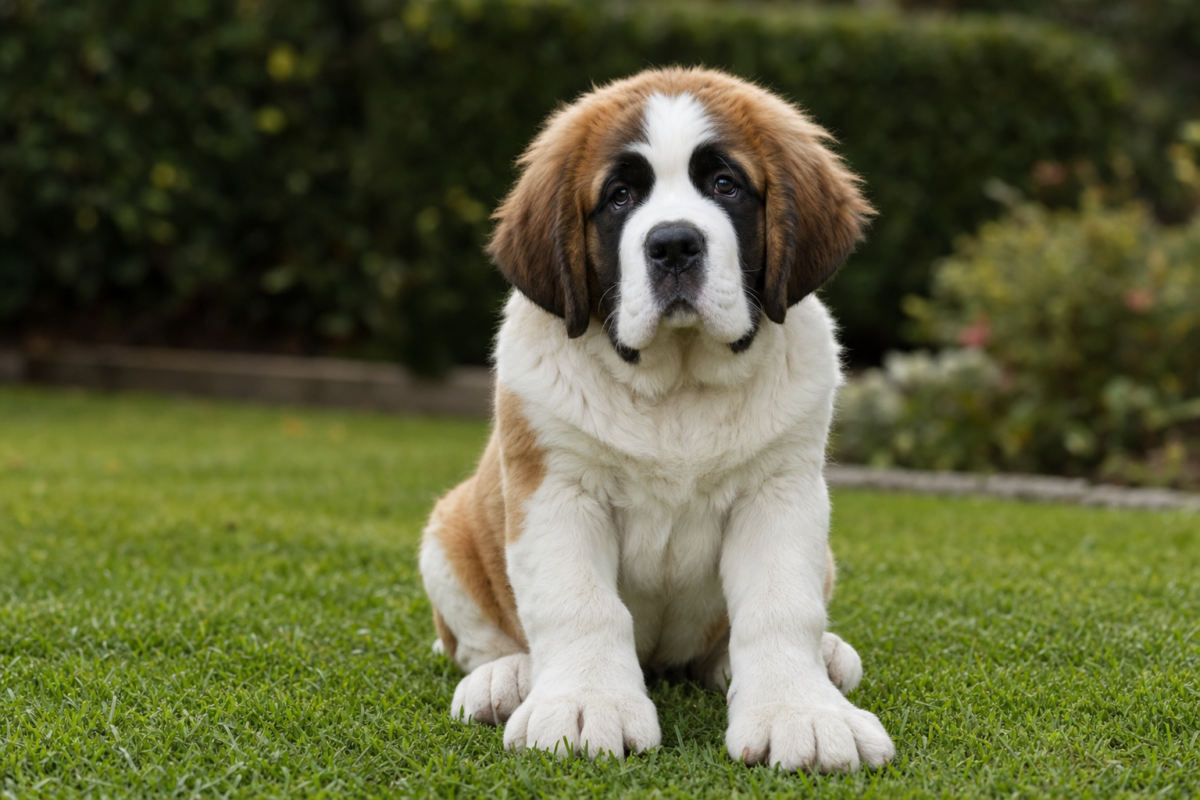
To estimate a large breed puppy’s adult weight, divide the current weight by the share of adult weight typical for that age and sex, then allow a margin either side. A large breed male is usually about 48 percent of his adult weight at 6 months and 78 percent at 12 months. A female of the same breed sits about 5 points further along at each stage and finishes lighter. Giant breeds are slower again. The calculator below does the maths for you.
Every parent of a big puppy asks the same question, usually while looking at a pair of paws that seem to belong to a much larger dog. How big is this one going to get? A growth calculator answers that in seconds, and it also tells you whether your puppy is tracking a steady curve or climbing too fast. Here is the tool, the formula behind it, and what to do with the number.
How can I calculate my large breed puppy growth?
You calculate a large breed puppy’s adult weight by dividing its current weight by the fraction of adult weight typical for its age and sex. At 6 months a large breed male has usually reached about 48 percent of his final weight, so a 40 pound six month old male points toward roughly 83 pounds. A female at the same weight and age is further along at about 53 percent, which points to roughly 75 pounds instead. Giant breeds are slower again and sit nearer 43 and 48 percent.
The calculation is an estimate rather than a promise. Genetics, line and body condition all shift the final number, and most puppies land within about 10 percent of a well made estimate. Use it to spot the shape of the curve, not to lock in a figure.
Large Breed Puppy Growth Calculator
Enter your puppy’s age, current weight, expected size class and sex, and see the estimated adult weight. Sex matters, so the estimate changes with it.
Estimates are guidance for healthy puppies on a steady growth curve, not a diagnosis. Always confirm feeding amounts and any concerns with your veterinarian.
How the calculator works
The tool uses the share of adult weight that large and giant breed puppies typically carry at each age, split by sex. Divide the current weight by that share and you have the estimate. The table below is the same reference the calculator uses, so you can run the numbers by hand. Every figure is a percentage of adult weight.
| Age | Large male | Large female | Giant male | Giant female |
|---|---|---|---|---|
| 2 months | 14 | 16 | 12 | 14 |
| 3 months | 24 | 27 | 21 | 24 |
| 4 months | 31 | 35 | 28 | 31 |
| 6 months | 48 | 53 | 43 | 48 |
| 8 months | 60 | 65 | 53 | 58 |
| 10 months | 71 | 76 | 63 | 68 |
| 12 months | 78 | 83 | 70 | 75 |
| 14 months | 84 | 89 | 77 | 82 |
| 18 months | 94 | 97 | 86 | 91 |
The American Kennel Club’s Chief Veterinary Officer, Dr. Jerry Klein, DVM, has written extensively on the slower growth and development timeline of large and giant breeds. Read more from the AKC’s guidance on caring for large-breed dogs.
So a 55 pound giant breed male at 6 months divides 55 by 0.43 and lands near 128 pounds, while his sister at the same weight and age divides by 0.48 and lands near 115. The heavier the expected adult, the longer the growth runs and the smaller the share carried early.
Why sex changes the growth curve
Males and females do not grow at the same speed and do not finish at the same size, so a calculator that ignores sex is guessing at the largest variable it could ask about. In most large and giant breeds males finish 15 to 25 percent heavier, with more height and bone.
Females also get there sooner. A female reaches any given share of her adult weight earlier than a male of the same breed, and her growth plates typically close a little earlier, so she finishes filling out months ahead of her brother. That is why the table shows females a few points ahead at every age.
The practical consequence catches many Dog Parents out. Two littermates who both weigh 45 pounds at 6 months are on different paths. The female is already past half of her adult weight and will finish near 85 pounds. The male is only 48 percent of the way there and will finish closer to 94. Same weight today, nearly ten pounds apart at maturity.
One timing note for your next appointment. The age at which a puppy is neutered or spayed can influence when growth plates close, which affects final height and proportions in big breeds. That is a conversation for your veterinarian, not a decision to make from a chart.
How accurate is a puppy growth calculator?
Accuracy improves with age. An estimate at 8 weeks is a rough sketch, because early weight depends heavily on litter size and feeding before you brought your puppy home. From about 4 months the curve settles, and between 5 and 8 months you are usually within 10 percent of the eventual adult weight.
Telling the calculator the sex removes the largest single source of error, which is why the range tightens once you select male or female. Leave it on not sure and the tool widens the range to span both paths, because that uncertainty is real.
Body condition is the other variable. A puppy carrying extra weight reads as a larger adult than the frame actually supports, which is one more reason to feed lean and check condition by hand rather than by scale.
Size class matters too. If your puppy comes from a breed that finishes around 100 pounds, run the numbers both ways and treat the results as the ends of a sensible range. Mixed breeds are the hardest case, since you may not know what is in the mix. Weigh more often and let the curve tell you which class your puppy is following.
Chasing The Number
A puppy tracking slightly above or below the estimate while moving well is doing fine.
Feeding To The Estimate
Extra food will not build a bigger frame. It only adds weight the joints must carry.
Growing Too Fast
A curve that climbs sharply between weigh ins asks more of developing joints than a steady one.
Weighing Too Often
Daily numbers create noise. Every two weeks through the growth years is plenty.
How to weigh a big puppy at home
A calculator is only as good as the weight you feed it, and weighing a wriggling adolescent is not always simple.
- Weigh at the same time of day, ideally before a meal, so readings are comparable.
- While you can still lift your puppy, stand on a bathroom scale holding them, then weigh yourself alone and take the difference. After that, most veterinary practices are happy for you to use the walk on scale in reception.
- Record every reading with the date. A short list on your phone becomes a growth curve, which is far more informative than any single number.
Weigh every two weeks through the fastest months, then monthly after the first year.
How much should a large breed puppy eat while growing?
Large and giant breed puppies do best on steady, moderate growth. A few habits make a real difference:
- Choose a complete food formulated for large or giant breed puppies, which balances calories, calcium and phosphorus for steadier growth.
- Split the daily amount into three meals while young, then two as an adult.
- Feed to a lean body condition. You should feel the ribs easily under a light layer.
- Resist feeding for size. Adult size is written in the genes, and extra food simply adds load.
- Ask your veterinarian to confirm the daily amount at each checkup.
How to check body condition in ten seconds
The scale tells you weight, but body condition tells you health.
- Ribs. Run your hands along the sides. You should feel the ribs under a thin layer. If you have to press, ease back on food.
- Waist. From above, you want a clear waist that tucks in behind the ribs.
- Tuck. From the side, the belly should rise toward the back legs rather than hang level.
Growth safe exercise while the numbers climb
Big puppies need movement, but during the fast growth months the goal is regular, moderate activity rather than repeated hard impact.
- Favour free play, sniffing walks and gentle exploring on soft ground such as grass.
- Keep long runs, forced jogging and repeated jumping moderate while the growth plates are open.
- Lift or ramp your puppy in and out of the car rather than letting them leap down.
- Add early training and scent games, which satisfy a young dog without pounding on joints.
- Let your puppy rest fully between bursts.
Supporting the joints the numbers are loading
Every pound the calculator predicts is a pound that will travel through your puppy’s joints for the rest of their life. Supporting healthy joint development while the frame is still forming is one of the simplest habits you can build.
Alongside lean feeding and sensible exercise, many big dog parents add a daily joint support chew made for large and giant breeds. MoveGuard Growth is built for exactly this stage. It combines nine actives, including New Zealand Green Lipped Mussel, glucosamine, chondroitin, MSM and hyaluronic acid, to support the developing joints of young large and giant breed dogs across the roughly 8 to 30 month growth window. You dose by expected adult weight, which is precisely what the calculator gives you, so 50 to 80 pounds is two chews a day and 80 to 100 pounds and above is three. It is made in the USA, arrives as a 90 chew jar at about $39.99 on subscription, and is backed by a 60 day guarantee.
Dose By Adult Weight
Now that you have the estimate, give your growing puppy daily joint support built for large and giant breeds. Explore MoveGuard Growth.
Signs your puppy is growing on track
You do not need a weekly weigh in. Look for a bright, alert puppy with a waist you can see from above, ribs you can feel with light pressure, smooth even movement, and a curve that rises gradually rather than in steps. A single reading above the estimate is rarely a concern if your puppy is lean to the touch and moving well.
If you notice limping, stiffness after rest, splaying legs on smooth floors, or a jump in weight that outpaces the table by a wide margin, a quick conversation with your veterinarian lets you adjust food or activity early.
A simple growth game plan, stage by stage
Raising a sound big dog takes the right emphasis at the right time, not a complicated program.
8 weeks to 4 months. Foundation stage. A complete large or giant breed puppy food, three calm meals a day, early socialisation, and short bursts of free play on soft ground. Weigh every two weeks and start your chart.
4 to 8 months. The steepest part of the curve, and where the calculator becomes genuinely useful. Keep feeding lean, keep exercise moderate, and begin a daily joint support routine that carries through the growth window.
8 to 18 months. Height nears its peak while muscle arrives, and females start levelling off before males. Match portions to a lean body condition, because a teenage appetite outpaces need.
18 to 30 months. Growth slows while chest and muscle fill in, especially in giant breed males. Build activity up as your veterinarian advises.
Common growth mistakes to avoid
Most growth troubles in big dogs come from a few avoidable habits.
- Overfeeding for size. Extra weight loads developing joints at the wrong moment. Feed lean and let size arrive on its own schedule.
- Skipping large or giant breed puppy food. These formulas control calcium and calories for steady growth. Confirm the food with your veterinarian.
- Too much hard exercise, too young. Long runs and repeated jumping ask a great deal of open growth plates.
- Panicking over one reading. Puppies grow in bursts. Look at the trend across a month.
- Waiting for a problem before supporting joints. The growth window is the ideal time to support developing joints, not the months after.
What the estimate does not tell you
The calculator cannot see your puppy’s parents, and parent weights remain the best single predictor of adult size. If your breeder can tell you the sire and dam weights, compare your puppy to the parent of the same sex and treat that as a second opinion alongside the estimate.
It also cannot see structure. Two dogs finishing at 90 pounds can carry that weight very differently, one on a light athletic frame and one on heavy bone. Use the estimate to plan portions, dosing and equipment, then let your hands and your eyes tell you how your puppy is doing.
Frequently asked questions
How can I calculate my large breed puppy growth?
Divide your puppy’s current weight by the share of adult weight typical for that age. A large breed puppy is usually about half its adult weight at 6 months, so a 40 pound six month old points toward roughly 80 pounds. Giant breeds sit nearer 45 percent at the same age.
How accurate is a puppy growth calculator?
Most healthy puppies land within about 10 percent of a well made estimate, and accuracy improves with age. Readings before 4 months are rough, while estimates between 5 and 8 months are usually the most reliable.
At what age is a large breed puppy half its adult weight?
Around 6 months for large breeds. Giant breeds reach the halfway point a little later, closer to 7 months, because they grow over a longer window and carry a smaller share of their final weight early on.
When do large breed puppies stop growing?
Most large breeds reach adult height between 16 and 24 months depending on expected weight, then keep filling out in muscle and chest. Giant breeds often continue developing until 30 months or a little beyond.
Do male and female large breed puppies grow at the same rate?
No. Females reach any given share of their adult weight earlier and finish growing sooner, while males grow for longer and finish 15 to 25 percent heavier in most large and giant breeds. Two littermates at the same weight today can be nearly ten pounds apart as adults, which is why the calculator asks for sex.
The bottom line
A growth calculator turns guesswork into one useful number, and that number does real work. It sets your feeding plan, your joint support dose and the size of the crate you buy. Tell it the sex, run it monthly, watch the shape of the curve rather than any single reading, and keep feeding lean while the frame comes together.
Want the Simple Roadmap in One Place?
Grab our free Big Dog Growth Blueprint for the growth window checklist, feeding framework and joint safe exercise limits, all written for large and giant breeds.
This article is for general educational purposes only and is not veterinary advice. It is not intended to diagnose, treat, cure or prevent any disease. Always consult your veterinarian about your dog’s individual health, nutrition and supplement needs. These statements have not been evaluated by the Food and Drug Administration.
Support Big Breed Joints from Day One
Large and giant breeds carry more load through every growth stage. MoveGuard Growth supports developing joints in young big dogs (8 to 30 months); MoveGuard Adult keeps grown big dogs moving comfortably.
Leave a Reply