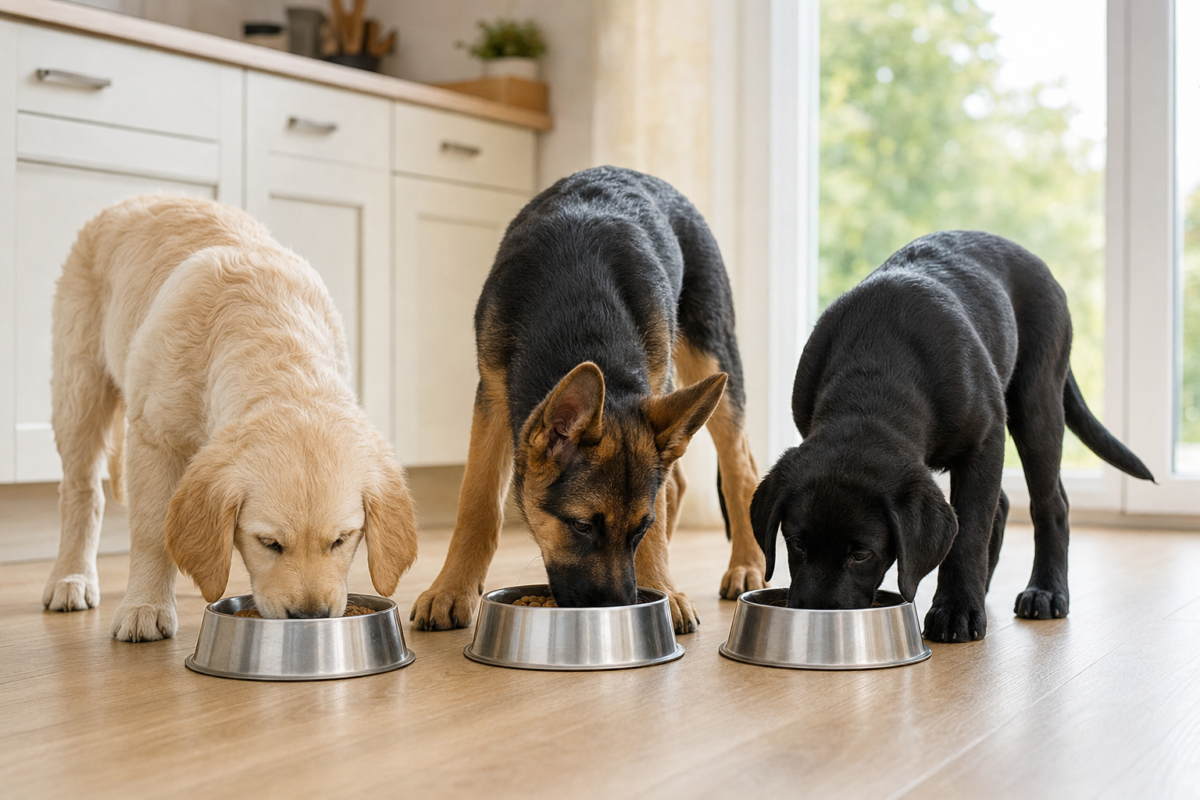
Most large breed puppies eat between 2 and 8 cups of a complete large breed puppy food per day, split across three or four meals, with the amount set by expected adult weight rather than current weight. A puppy headed for 50 to 75 pounds usually lands near 3 to 4 cups at the peak of growth, while one headed past 100 pounds may need 6 to 8. Feed to a lean body condition and confirm the amount with your veterinarian.
Standing over a food bowl with a scoop in your hand and a very hopeful puppy at your feet is one of the most common moments of doubt in big dog parenting. Feed too little and you worry you are holding your puppy back. Feed too much and you have heard that fast growth is hard on developing joints. The middle path is easier to find than most feeding charts make it look. This guide gives you daily amounts by expected adult weight and the simple checks that tell you whether you have it right.
How much should I feed a large breed puppy?
A large breed puppy should eat a complete large breed puppy food in an amount set by expected adult weight, usually 2 to 8 cups a day across three or four meals. Puppies finishing near 50 to 75 pounds typically peak around 3 to 4 cups daily, those headed for 75 to 100 pounds around 4 to 5.5 cups, and those growing past 100 pounds around 6 to 8 cups. Portions rise quickly until roughly six months, then flatten and often fall slightly as growth slows.
Two things matter more than the exact number. The first is calorie density, because foods range from roughly 320 to 450 calories per cup. The second is body condition. Use the chart as a starting point, then let your hands on your puppy’s ribs make the final call.
What makes a large breed puppy different at the food bowl
A small breed puppy reaches adult size in under a year on a gentle arc. A large breed puppy may multiply its birth weight seventy times or more over one to two years, across a skeleton that is still soft where bone is lengthening. The frame is being built and loaded at once, which is why nutrition at this stage is about pacing rather than pushing.
That is the reasoning behind foods labelled for large breed puppies. They carry lower calorie density, controlled fat and carefully limited calcium, because a young large breed skeleton has very little ability to filter out excess calcium from food. Choosing the right bag does a good share of the work before you pick up the scoop.
Large breed puppy feeding chart, month by month
Amounts below assume a large breed puppy food at roughly 360 to 400 calories per cup, grouped by expected adult weight. Always cross check against the chart printed on your own bag.
| Age | Adult 50 to 75 lb | Adult 75 to 100 lb | Adult 100 lb plus |
|---|---|---|---|
| 2 months | 2 to 2.5 cups | 2.5 to 3.5 cups | 3.5 to 4.5 cups |
| 3 months | 2.5 to 3 cups | 3.5 to 4.5 cups | 4.5 to 6 cups |
| 4 months | 3 to 3.75 cups | 4 to 5 cups | 5.5 to 7 cups |
| 6 months | 3 to 4 cups | 4.5 to 5.5 cups | 6 to 8 cups |
| 9 months | 3 to 4 cups | 4.5 to 5.5 cups | 6.5 to 8 cups |
| 12 months | 2.75 to 3.75 cups | 4 to 5.25 cups | 6 to 8 cups |
| 18 months | 2.5 to 3.5 cups | 3.5 to 5 cups | 5 to 7 cups |
The World Small Animal Veterinary Association’s Global Nutrition Committee publishes evidence-based guidance for evaluating dog food and feeding practices. Read more from the WSAVA Global Nutrition Guidelines.
Notice that the numbers stop climbing around six to nine months and then ease back. That surprises a lot of Dog Parents, because appetite keeps climbing long after the need for calories has levelled off. A puppy who empties the bowl is not telling you the bowl was too small.
Meals matter as much as amounts. Four small meals a day until about four months, three from four to six months, then two from about six months onward is the pattern most large breed puppies settle into. Deep chested breeds do better on several smaller meals than one large one.
When do large breed puppies stop growing?
Large breed puppies reach most of their adult height between roughly sixteen and twenty four months, and giant breeds can keep building into their third year. Height arrives first and substance follows, so a tall, leggy yearling is usually right where it should be. Feeding amounts follow the same curve.
By expected adult weight, dogs finishing at 50 to 65 pounds grow for about 16 to 18 months, 65 to 80 pounds for about 18 to 22 months, 80 to 100 pounds for about 20 to 24 months, and 100 pounds and up for 22 to 30 months or more.
Why the growth window matters at every meal
Through this window your puppy is laying down the cartilage, bone and connective tissue that will carry a heavy frame for a decade or more. Growth plates, the softer zones near the ends of long bones, stay open through much of the first year and beyond in giant breeds. While they are open, every extra pound is asked of a structure that is still forming. Lean feeding is not restriction. It gives the frame a fair chance to keep up with the body it carries.
Growing Too Fast
Extra calories speed the growth curve without changing the final size. Steady beats fast every time for a big frame.
Too Much Calcium
Young large breed puppies cannot filter out excess calcium well, so skip mineral top ups.
Free Feeding
A bowl left down all day makes portions invisible. Measured meals let you adjust what your puppy eats.
Treat Creep
Treats and scraps add up fast. Keep extras to about a tenth of daily calories and subtract them from meals.
How to feed a large breed puppy well, day to day
Once the food and the portion are right, a handful of habits do most of the remaining work.
- Choose a complete food formulated for large breed puppies, which balances calories, calcium and phosphorus for steadier growth.
- Measure every meal with a proper cup or a kitchen scale. Eyeballing portions is the most common source of quiet overfeeding.
- Recalculate the daily amount every two weeks during the fastest growth, because the right portion changes quickly.
- Count treats, chews and training rewards inside the daily total rather than on top of it.
- Keep fresh water available, and allow calm rest before and after meals.
- Feed to a lean body condition rather than to the chart. The chart is an estimate. Your puppy is the evidence.
How to check body condition in ten seconds
The scale tells you weight, but body condition tells you whether the portion is right. It is the single most useful feeding skill a big dog parent can build.
- Ribs. Run your hands along the sides. You should feel the ribs easily under a thin layer. If you have to press to find them, ease back on portions.
- Waist. Look down from above. You want a clear waist that tucks in behind the ribs.
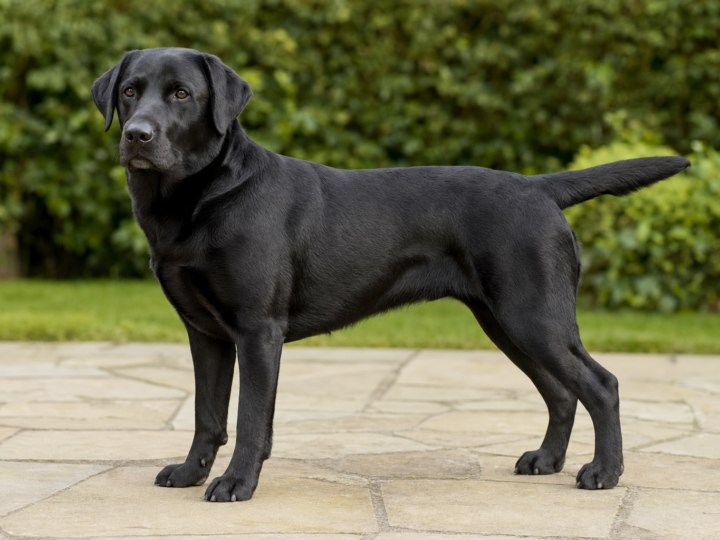
- Tuck. From the side, the belly should rise toward the back legs rather than hanging level.
Check every couple of weeks. If the ribs are disappearing, trim the daily amount by about ten percent. If the ribs are sharp and the hips prominent, add ten percent. Gradual adjustments beat dramatic ones.
Growth safe exercise while you are getting feeding right
Food and movement work together, and neither one fixes the other. A puppy carrying extra weight is not helped by more running, and a lean puppy still needs limits while the growth plates are open.
- Favor free play, exploring and short walks on soft ground over long structured distances.
- Keep long runs, hard sprints and repeated jumping moderate while your puppy is growing.
- Use training, puzzle feeders and scent games to burn energy without loading joints.
- Turn part of the daily ration into training rewards so mental work and meals share one budget.
Supporting the joints your feeding plan is protecting
Everything you do at the food bowl during these months has one goal underneath it, which is a frame that carries a big body comfortably for a long time. Lean feeding, measured portions and sensible activity all point the same direction, and daily joint support fits alongside them.
Many big dog parents add a joint support chew made for large and giant breeds during the growth years. MoveGuard Growth is built for exactly this stage. It brings together nine actives, including 250mg of New Zealand Green Lipped Mussel, 400mg of glucosamine, 300mg of chondroitin, 250mg of MSM, krill oil, hyaluronic acid, vitamins C and E and manganese, to support healthy joint development across the roughly 8 to 30 month growth window. Dosing follows expected adult weight, just like feeding, so a puppy headed for 50 to 80 pounds takes two chews a day and one headed for 80 to 100 pounds or more takes three. It is made in the USA, ninety chews to the jar, with a 60 day guarantee.
Feed Lean, Support The Frame
Give your growing puppy daily joint support built for large and giant breeds. Explore MoveGuard Growth.
Signs your large breed puppy is growing on track
You do not need a daily weigh in to know things are going well. Look for a bright, alert puppy with a visible waist from above, ribs you can feel with light pressure, smooth easy movement, firm regular stools and a shiny coat. Even, unhurried growth is what you want, even when it feels slower than the puppy next door.
A few things are worth a call to your veterinarian. Limping or stiffness after rest, reluctance to use stairs, a sudden jump in growth rate, or persistent loose stools all deserve a professional look. Catching a feeding issue early usually means a small adjustment rather than a big one.
A simple feeding game plan, stage by stage
You need the right emphasis at the right time, not a complicated program.
8 weeks to 4 months. Foundation stage. Settle on a complete large breed puppy food and stay with it. Four small measured meals a day, and no mineral supplements unless your veterinarian asks for them. Weigh your puppy at every visit and adjust the portion each time.
4 to 8 months. The fastest growth of your puppy’s life, and where portions climb quickest. Move to three meals a day and check body condition every two weeks, because appetite often outruns need here. This is also the natural moment to begin a daily joint support routine.
8 to 18 months. Growth slows and portions should slow with it. Many puppies stay flat or come down slightly even as they look bigger. Move to two meals a day and stay on large breed puppy food until your veterinarian recommends the switch.
18 months to 3 years. Transition to a large breed adult food across about a week, mixing increasing amounts of the new food into the old. Adult portions are usually lower than peak puppy portions. Keep checking body condition monthly.
Common feeding mistakes to avoid
Most feeding trouble in big puppies comes from a short list of habits.
- Feeding for size. A heavier puppy is not a bigger adult, only a faster growing one. Genetics set the final size. Feeding sets how comfortably you get there.
- Using a regular puppy formula. Standard and small breed puppy foods run richer in calories and calcium than a big growing frame handles well.
- Adding calcium or mineral supplements. A complete puppy food is already balanced. Extra calcium is one of the clearest known risks during large breed growth.
- Forgetting to recalculate. The portion that was right last month is rarely right this month, and free feeding hides the problem. Reset it every two weeks while growth is quick.
- Waiting for a problem before supporting joints. The growth window is the ideal time to support developing joints, not after signs appear.
Appetite, temperament and the growing months
Large breed puppies have big appetites and even bigger persuasive powers, and much of the feeding challenge is emotional rather than nutritional. A young Great Dane who finishes a measured meal in forty seconds and then sits by the bowl looking heartbroken is genuinely hard to walk past. It helps to remember that a full stomach and a correct ration are different things.
Practical tricks take the pressure off. A slow feeder bowl or a snuffle mat stretches the same food across several minutes and gives the meal a satisfying shape. Setting aside part of the daily ration for training turns food into engagement, which most large breeds crave as much as calories. Keeping the household on one script, so nobody quietly adds a second dinner, protects the plan more than any chart will. The habits you build around food now shape more than the frame.
Frequently asked questions
How much should I feed a large breed puppy each day?
Most large breed puppies eat 2 to 8 cups of a large breed puppy food per day, set by expected adult weight. A puppy headed for 50 to 75 pounds usually peaks near 3 to 4 cups, one headed for 75 to 100 pounds near 4 to 5.5 cups, and one growing past 100 pounds near 6 to 8 cups.
How many times a day should a large breed puppy eat?
Four small meals a day until about four months, three meals from four to six months, then two meals from roughly six months onward. Several smaller meals suit a growing large breed better than one large one.
When should a large breed puppy switch to adult food?
Large breeds usually move to adult food between twelve and eighteen months, and giant breeds often stay on puppy food to eighteen or twenty four months. Make the change gradually across about a week.
Can I feed a large breed puppy regular puppy food?
It is not the best choice. Standard puppy formulas tend to be richer in calories and higher in calcium than a growing large breed skeleton handles comfortably. A food labelled for large breed puppies is formulated for steadier growth.
Should a large breed puppy be lean?
Yes. A lean body condition, where you can feel the ribs easily under a thin layer and see a waist from above, is the goal throughout the growth years.
The bottom line
Feeding a large breed puppy well comes down to three decisions repeated calmly over a couple of years. Pick a complete large breed puppy food, measure a portion based on expected adult weight, and let your hands on the ribs correct the number every two weeks. Portions climb until about six months, level off, then ease back as the frame finishes somewhere between sixteen and thirty months. Feed lean, count the treats, keep exercise sensible, and support those developing joints through the whole growth window.
Want the roadmap in one place? Grab our free Big Dog Growth Blueprint for the growth window checklist, feeding framework and joint safe exercise limits, all written for large and giant breeds.
This article is for general educational purposes only and is not veterinary advice. It is not intended to diagnose, treat, cure or prevent any disease. Always consult your veterinarian about your dog’s individual health, nutrition and supplement needs. These statements have not been evaluated by the Food and Drug Administration.
Support Big Breed Joints from Day One
Large and giant breeds carry more load through every growth stage. MoveGuard Growth supports developing joints in young big dogs (8 to 30 months); MoveGuard Adult keeps grown big dogs moving comfortably.
Leave a Reply