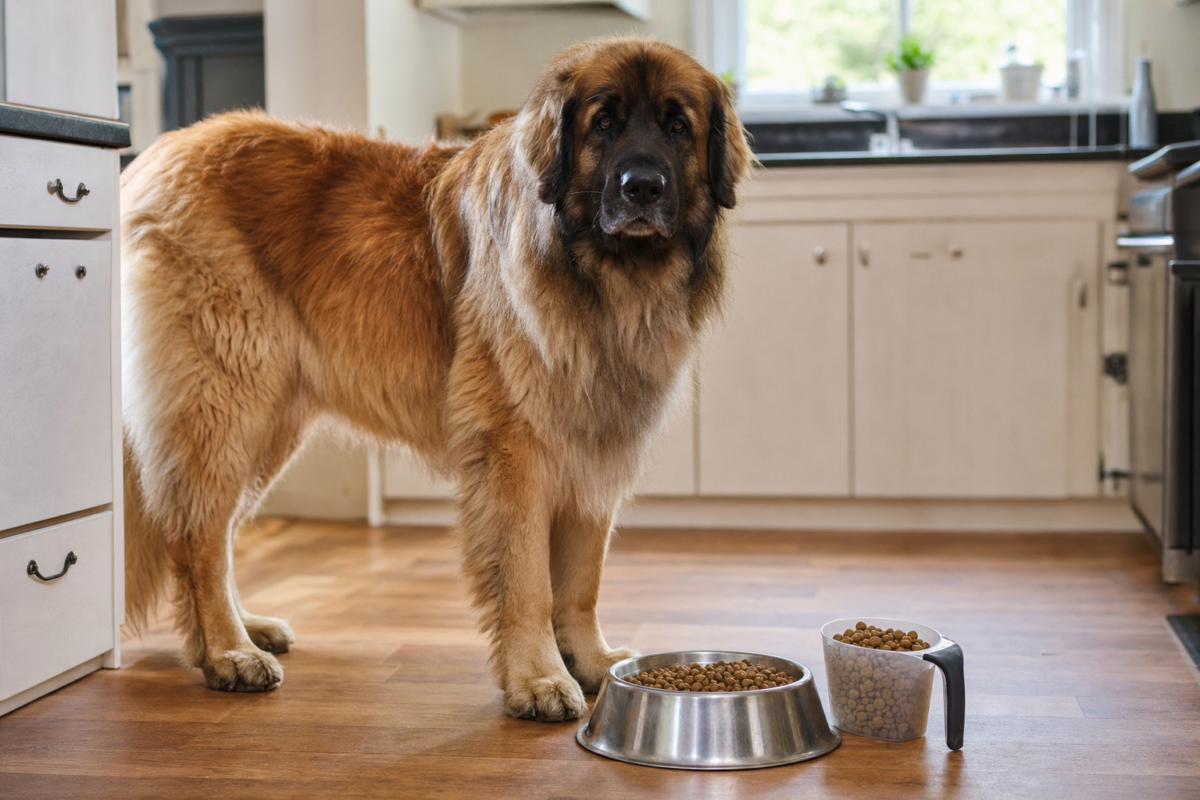
Most adult large breed dogs need somewhere between 1,300 and 2,700 calories a day, which works out at roughly 3 to 7 cups of a typical large breed kibble. A growing large breed puppy over four months old needs about a quarter more than that at the same body weight. The fastest way to find your dog’s number is to take resting energy needs, multiply by a life stage factor, then divide by the calories per cup printed on your bag. Body condition is what confirms the answer.
Feeding a big dog is one of those jobs where the bag label rarely feels like enough. The chart on the back gives one range for a 70 pound dog and another for a 130 pound dog, and somehow the dog in your kitchen sits between the two and is either always hungry or quietly getting heavier. This guide gives you a portion calculator you can actually use, built on the same energy maths your veterinarian works from, plus the ten second body check that tells you whether the number is right for your dog.
How much food should I give my large breed dog?
An adult large breed dog usually needs about 1,300 to 2,700 calories a day depending on body weight, which is roughly 3 to 7 cups of a standard large breed kibble at around 380 calories per cup. A growing large breed puppy past four months needs close to twice its resting energy requirement, which lands about 25 percent higher than an adult of the same weight. Split that total into two meals for an adult and three meals for a puppy.
Those figures are a starting point, not a prescription. Two dogs of identical weight can differ by 30 percent in daily need depending on age, neutering, coat, climate, activity and simple individual metabolism. That is exactly why the calculation below ends with a body check rather than a number.
What decides the right portion for a big dog
Portion size is not really about breed. It is about energy in versus energy out, and six things move that balance for large and giant breeds.
- Body weight. Energy need rises with weight, but not in a straight line. A 150 pound dog does not need twice what a 75 pound dog needs, because larger bodies are more efficient per pound. This is why simple doubling always overfeeds giant breeds.
- Life stage. A puppy building bone and muscle burns far more per pound than the same dog will at four years old. A senior often needs less again.
- Neuter status. Neutered and spayed dogs typically need around 20 to 30 percent fewer calories than intact dogs of the same size, which is the single most common reason a portion that worked last year now does not.
- Activity. A farm dog working outdoors all day and a house dog with two gentle walks can differ by well over a thousand calories.
- Food density. Kibble ranges from roughly 300 to 500 calories per cup. The same cup can therefore mean very different things, which is why cups alone are a poor unit.
- Extras. Training treats, chews and table food all count. On many big dogs the extras quietly supply 20 percent of daily calories.
Large breed portion calculator, by weight and life stage
Find your dog’s current weight in the left column. The calorie figures are the target; the cup figures assume a kibble at about 380 calories per cup, which is typical for large breed formulas. Check your own bag and adjust, because a 450 calorie food changes every number in the right hand columns.
| Current weight | Growing puppy, calories per day | Adult, calories per day | Adult cups per day |
|---|---|---|---|
| 20 lb | 730 | 590 | 1.5 cups |
| 30 lb | 990 | 790 | 2 cups |
| 40 lb | 1,230 | 985 | 2.5 cups |
| 50 lb | 1,455 | 1,165 | 3 cups |
| 60 lb | 1,665 | 1,335 | 3.5 cups |
| 80 lb | 2,070 | 1,655 | 4.5 cups |
| 100 lb | 2,450 | 1,960 | 5 cups |
| 120 lb | 2,800 | 2,240 | 6 cups |
| 150 lb | 3,315 | 2,650 | 7 cups |
Calculate Daily Portions
The World Small Animal Veterinary Association’s Global Nutrition Committee publishes evidence-based guidance for evaluating dog food and feeding practices. Read more from the WSAVA Global Nutrition Guidelines.
Puppies under four months old sit higher still, closer to three times resting need, and they change weight so quickly that a monthly recheck matters more than any single figure. If your dog is neutered, inactive or an older adult, start at the low end of the adult column and adjust from there.
How to run the calculation yourself
The table covers most dogs, but if you want your dog’s own number rather than the nearest row, the arithmetic takes about a minute and is the same method used in veterinary practice.
The three step method
Step one, find resting energy. Convert weight to kilograms by dividing pounds by 2.2. Raise that number to the power of 0.75 on any calculator, then multiply by 70. A 100 pound dog is 45.4 kg, which gives a resting energy requirement of about 1,225 calories a day.
Step two, apply the life stage factor. Multiply resting energy by 1.6 for a typical adult, by 1.4 for a neutered or less active adult, by 1.8 to 2 for a genuinely active adult, by 2 for a puppy over four months, and by 3 for a puppy under four months. Our 100 pound adult lands near 1,960 calories.
Step three, convert to cups. Divide the daily calories by the calories per cup on your bag, usually listed as kcal per cup on the back panel. At 380 calories per cup, 1,960 calories is about 5 cups a day, split into two meals.
Write the answer on a note on the food bin, then treat it as a hypothesis rather than a fact. The next two weeks of body condition tell you whether to nudge it up or down.
Free Feeding
Leaving the bowl down all day removes every portion control you just calculated and hides how much your dog actually eats.
Guessing The Scoop
A coffee mug is not a cup. Use a proper measuring cup or, better still, a kitchen scale in grams.
Feeding For Size
A bigger puppy is not a healthier one. Rapid growth asks more of open growth plates in a frame still forming.
Forgetting Extras
Chews, training treats and leftovers should stay under 10 percent of daily calories, and they need subtracting from the bowl.
How to feed the number you calculated
Getting the total right is half the job. How that total arrives across the day matters too, particularly for deep chested breeds.
- Choose a complete food formulated for large breed puppies while your dog is growing, because these formulas control calcium, phosphorus and calorie density for slower, steadier growth.
- Split the daily amount into three meals for a puppy and two meals for an adult. One enormous meal is harder work for a big dog than two moderate ones.
- Measure with a scale where you can. Cups vary by how firmly the kibble settles, and grams do not.
- Keep water freely available, and leave a quiet gap around meals rather than feeding straight after hard exercise.
- Recheck the number every month during growth and every few months as an adult, or whenever activity, season or neuter status changes.
How to check body condition in ten seconds
The calculator gives you a starting portion. Body condition tells you whether it is the right one, and you can read it at home in seconds.
- Ribs. Run your hands flat along the sides. You should feel the ribs easily under a thin layer of covering. If you have to press to find them, ease the portion back by about 10 percent.
- Waist. Look down from above. You want a clear waist that tucks in behind the ribs rather than a straight line from chest to hip.
- Tuck. From the side, the belly should rise toward the back legs instead of hanging level with the chest.
Check every couple of weeks through the growth years and monthly as an adult. Adjust in small steps of about 10 percent and give each change two to three weeks before judging it, with your veterinarian’s guidance on the target for your individual dog.
How activity changes the number
Two dogs on the same table row can genuinely need different bowls, and activity is usually the reason. A dog hiking for two hours a day is running a different budget from one who walks around the block twice, and a big dog living outdoors in winter burns more again simply staying warm.
- Light activity, meaning short daily walks and a mostly indoor life, sits at the low end. Use a factor of 1.4.
- Moderate activity, meaning an hour or so of walking plus play, sits at the standard 1.6.
- High activity, meaning long hikes, sport or genuine working days, sits at 1.8 to 2.
- Growing puppies should not have their portion raised to match hard exercise, because the answer during the growth window is less impact rather than more food.
Season matters too. Many big dogs eat noticeably less through summer and more through winter, so a portion set in January often needs revisiting in July.
Feeding well and moving well go together
The reason portion control matters so much for a big dog is that every extra pound travels through the joints with each stride, turn and set of stairs. Feeding to a lean body condition is the single most useful daily habit for supporting comfortable movement across a long life, and it costs nothing.
Alongside lean feeding and sensible exercise, many big dog parents add a daily joint support chew built for large and giant breeds. MoveGuard Growth is made for the roughly 8 to 30 month growth window and combines nine actives, including New Zealand Green Lipped Mussel, glucosamine, chondroitin, MSM and hyaluronic acid, to support healthy joint development while the frame is still forming. You dose by expected adult weight, so a dog heading for 50 to 80 pounds takes two chews a day and one heading for 80 to 100 pounds or more takes three. For dogs already grown, MoveGuard Adult carries the routine forward. Both ship as 90 chews, are made in the USA in an NSF facility, and are backed by a 60 day guarantee.
Support Every Pound You Feed
Pair lean portions with daily joint support built for large and giant breeds. Explore MoveGuard Growth.
Signs the portion is right
You do not need a daily weigh in to know the number is working. A dog on the right portion holds a visible waist, has ribs you can feel with light pressure, keeps steady energy through the day, and finishes meals with interest rather than desperation. Stools are firm and consistent, and body weight drifts slowly rather than jumping.
Signs the number needs adjusting are just as readable. A dog whose waist is disappearing, who tires on familiar walks, or who has gained noticeably over a month is probably eating above need. A dog whose ribs and hips are becoming prominent, whose coat is dulling, or who is losing condition is probably eating below it. Either way a quick conversation with your veterinarian is worth having before making a large change, especially if appetite or weight has shifted suddenly.
A simple feeding game plan, stage by stage
The right portion is a moving target through the first few years. Here is what to emphasise at each stage.
8 weeks to 4 months. The highest energy stage relative to body size. Feed a complete large breed puppy food across three calm meals a day, calculate from current weight rather than expected adult weight, and recalculate every two to four weeks because the dog is changing that fast.
4 to 8 months. Growth is quick and appetite often outruns need. Drop to roughly two times resting energy, keep the body check weekly, and resist the pull to feed for size. This is the stage where most large breed dogs pick up the extra weight they carry for years.
8 to 18 months. Height nears its peak while muscle fills in. Recalculate monthly, stay lean, and start planning the transition to adult food with your veterinarian, usually somewhere between 12 and 18 months for large breeds and later for giant ones.
18 months onward. Move to the adult factor and expect the number to fall, particularly after neutering. From here, recheck every few months and whenever activity or season changes. A portion set once and never revisited is the most common cause of slow weight gain in adult big dogs.
Common portion mistakes to avoid
Most feeding problems in large breeds trace back to a handful of habits rather than anything complicated.
- Feeding to expected adult weight. A puppy heading for 130 pounds eats for the dog it is today, not the dog it will be. Calculating from adult weight badly overfeeds young dogs.
- Ignoring calories per cup. Switching foods without checking the panel can change intake by 30 percent overnight while the scoop looks identical.
- Letting treats float free. Extras belong inside the daily total, not on top of it.
- Adjusting too hard. Cutting a portion by a third to fix weight gain is stressful and rarely sticks. Move in steps of about 10 percent.
- Never recalculating. Neutering, ageing, winter and a quieter routine all shift the number, and the bowl needs to follow.
- Adding calcium supplements. A complete large breed puppy food is already balanced, and extra minerals are not helpful during growth. Ask your veterinarian before adding anything.
Why big dogs are so easy to overfeed
There is a reason portion drift happens more with large breeds than with small ones. A big dog asking for food is persuasive in a way a terrier simply is not. The head resting on your knee, the patient stare at the food bin, the genuinely convincing suggestion that breakfast never happened all land differently when they come from a dog the size of a coffee table.
The bigger factor is that a mistake scales. Half a cup of extra kibble a day is around 190 calories, which on a 120 pound dog is nearly a tenth of daily need, and over a year that is a meaningful amount of extra body weight arriving so gradually that nobody in the house notices. Large breeds also carry coat and frame that hide condition well, so a dog can be visibly heavy at the vet while looking normal at home.
None of this calls for strictness, only for measurement. Weigh the food, count the treats, run the body check every couple of weeks, and let affection travel through walks, training and attention rather than the bowl. A lean big dog is a comfortable big dog, and comfort is what all of this is really for.
Frequently asked questions
How many cups of food should a 100 pound dog eat?
An average adult dog of 100 pounds needs roughly 1,960 calories a day, which is about 5 cups of a kibble providing 380 calories per cup, split into two meals. Neutered or less active dogs of that weight often need closer to 4.5 cups, and body condition should confirm the amount.
How much should I feed a large breed puppy?
Calculate from your puppy’s current weight, not expected adult weight. A puppy over four months needs about twice its resting energy requirement, and a puppy under four months closer to three times. Recheck every two to four weeks, because the right portion changes quickly during growth.
Should I feed my big dog once or twice a day?
Twice a day suits most adult large breeds, and three times suits puppies. Splitting the total keeps energy even and means a deep chested dog is never handling one very large meal. Leave a calm gap around meals rather than feeding straight after hard exercise.
Do treats count toward the daily calorie total?
Yes. Treats, chews and table food should stay under 10 percent of daily calories and need subtracting from the bowl. On many big dogs the extras quietly account for a fifth of daily intake, which is enough to undo an otherwise correct portion.
How do I know if I am feeding my large breed dog too much?
Run the ten second body check. If you have to press to feel the ribs, if the waist has disappeared when viewed from above, or if weight has climbed noticeably over a month, the portion is likely above need. Reduce by about 10 percent and reassess in two to three weeks with your veterinarian’s guidance.
The bottom line
The right portion for your large breed dog comes from three things: resting energy based on current weight, a life stage factor, and the calories per cup on your own bag. That gives most adult big dogs 3 to 7 cups a day and most growing puppies about a quarter more at the same weight. Then hand the final decision to the body check, adjust in small steps, and recalculate whenever your dog, the season or the routine changes. Feed lean, measure honestly, and the number will look after itself.
Want the Simple Roadmap in One Place?
Grab our free Big Dog Growth Blueprint for the growth window checklist, feeding framework and joint safe exercise limits, all written for large and giant breeds.
This article is for general educational purposes only and is not veterinary advice. It is not intended to diagnose, treat, cure or prevent any disease. Always consult your veterinarian about your dog’s individual health, nutrition and supplement needs. These statements have not been evaluated by the Food and Drug Administration.
Support Big Breed Joints from Day One
Large and giant breeds carry more load through every growth stage. MoveGuard Growth supports developing joints in young big dogs (8 to 30 months); MoveGuard Adult keeps grown big dogs moving comfortably.
Leave a Reply