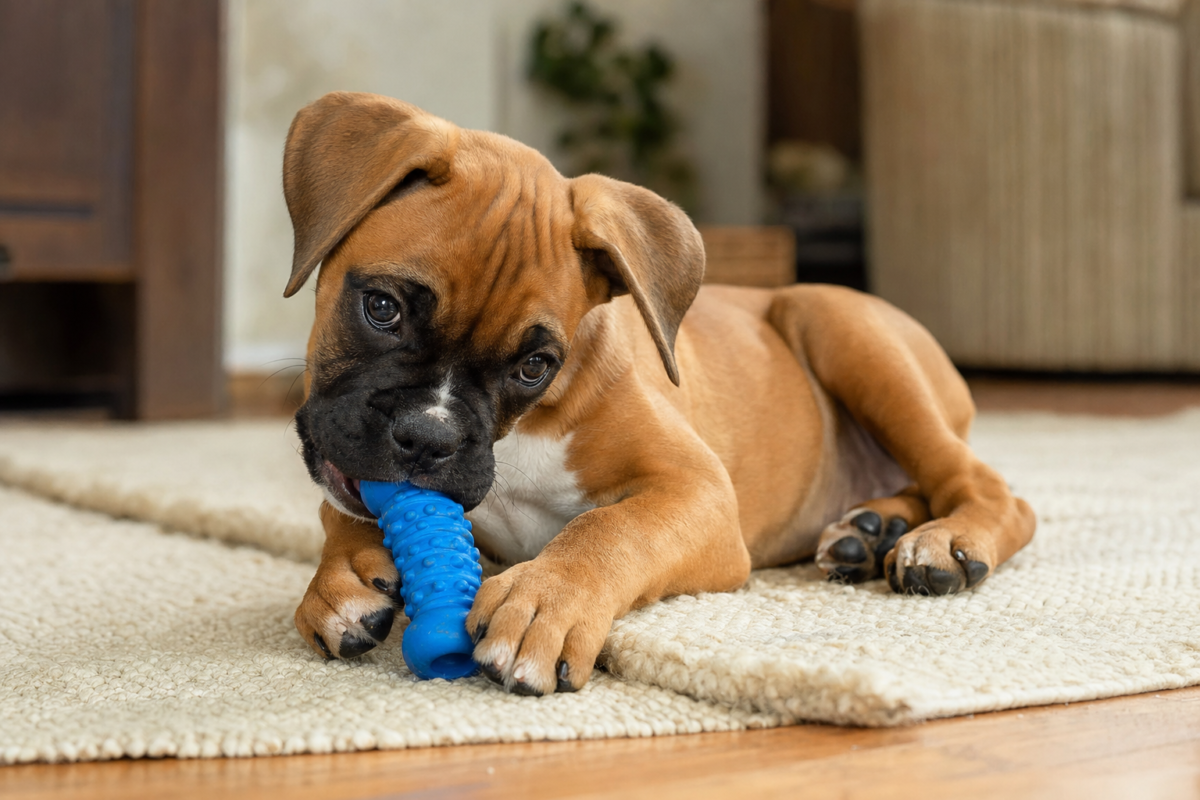
Bite inhibition is a puppy’s learned control over how hard its mouth closes. You teach it by letting your big puppy mouth gently during play, then ending play the instant pressure gets too hard: a calm “ouch”, hands go still, and you step away for 20 to 30 seconds. Repeat this every time, offer a chew toy in place of skin, and gradually lower the pressure you accept. The most important window is before about 4 to 5 months, while the puppy teeth are still in, and most big puppies stop mouthing people by 6 to 9 months.
If your big puppy has turned your hands, sleeves and ankles into chew toys, you are in good company. Mouthing is one of the most normal things a young dog does, and it is also one of the best teaching opportunities you will ever get. A large breed puppy who learns a soft mouth now grows into a powerful adult who knows exactly how gentle to be with people, children and other dogs. This guide walks you through what bite inhibition really is, a calm step by step method that works for big puppies, a timeline by age, and the everyday habits that keep your puppy happy, tired and learning while that frame is still growing.
How do I teach bite inhibition to a big puppy?
You teach bite inhibition to a big puppy by giving honest, immediate feedback every time its mouth presses too hard, and by making gentle play the only kind of play that continues. When teeth press hard, say a calm “ouch”, let your hand go limp, and pause all play for 20 to 30 seconds. When play resumes and your puppy stays soft, keep the fun going. Over a few weeks, your puppy learns that soft mouths keep the game alive and hard mouths end it, and you slowly raise the bar until any tooth pressure on skin ends the game.
The goal is not to stop mouthing on day one. The goal is to teach the puppy how much pressure a human can take, first, and then to teach it that people are not for mouthing at all. Puppies learn this naturally from littermates and their mother, who yelp and walk away from a rough bite. Your job is to continue that lesson in your home, consistently, with every person in the family playing by the same rules.
Why bite inhibition matters more for a big puppy
Every puppy mouths, but size changes the stakes. A small breed puppy with a hard mouth is an irritation. A large or giant breed puppy with a hard mouth becomes an adult with a strong jaw, a heavy head and the reach to put its mouth on almost anyone. Bite inhibition is the safety margin that sits underneath all of that power.
Behaviourists often describe bite inhibition as the single most important lesson a puppy learns, because it shapes what happens in the rare moment when an adult dog is startled, hurt or frightened. A dog with a well trained soft mouth tends to warn with a gentle, inhibited grab rather than a damaging bite. For a 90 pound adult, that difference matters enormously, and it is learned almost entirely in puppyhood.
Big puppies also grow fast. A Labrador, Boxer or Great Dane can double in weight between 3 and 6 months, and the puppy who was cute and nibbly at 10 weeks is suddenly strong enough to pull a sleeve or knock a child over during play. Starting early means your puppy’s self control keeps pace with its body, rather than falling behind it.
A bite inhibition timeline by age
Use this as a friendly guide rather than a strict schedule. Every puppy develops at its own pace, and breed, temperament and how much time the puppy spent with littermates all play a part.
| Age | What is happening | Your focus |
|---|---|---|
| 8 to 10 weeks | New home, sharp puppy teeth, mouthing everything | Calm “ouch” and pause on hard bites, lots of chew toys |
| 10 to 12 weeks | Play gets livelier, mouthing peaks in the evening | Short play sessions, planned naps, consistent family rules |
| 3 to 4 months | Prime learning window, pressure still easy to shape | Gradually accept softer and softer mouthing only |
| 4 to 6 months | Teething, adult teeth arrive, strong urge to chew | Chilled chews, trade games, end all mouthing on skin |
| 6 to 9 months | Adolescence, testing limits, much stronger jaw | Stay consistent, reward a calm mouth, keep training short |
| 9 to 18 months | Maturing, mouthing on people should be rare | Maintain gentle play rules and soft mouth habits for life |
When does puppy biting stop?
Most big puppies mouth people much less by about 6 months, once teething eases and the lessons have had time to settle, and the habit usually fades almost completely by 9 months with consistent practice. Some exuberant breeds, especially retrievers and Boxers, keep a mouthy streak through adolescence, so a bit of gentle grabbing at 8 or 10 months is not a sign that training has failed. It simply means the lesson needs another round of calm, consistent repetition.
The key point is that bite inhibition itself is learned early, ideally before about 4 to 5 months, while puppy teeth are sharp but the jaw is still weak. Sharp teeth give the puppy clear feedback, because a hard bite produces a real yelp, and a weak jaw means those lessons cost you very little. Once adult teeth arrive and the jaw strengthens, the feedback window is still open but each mistake carries more weight.
Teething and the growth window
Teething in large breeds usually runs from around 3 to 4 months until 6 or 7 months. During this time the urge to chew is intense, and gums can feel sore and itchy. That is happening at the same time as the fastest part of your puppy’s growth, when bones, cartilage and the soft growth plates at the ends of the long bones are developing quickly. Good chewing outlets and calm, controlled play are good for both the mouth and the frame.
Rough Hand Play
Wrestling with bare hands teaches a big puppy that skin is a toy. Keep a tug or plush toy between you and those teeth.
Harsh Punishment
Scruffing, shouting or holding the mouth shut tends to raise arousal and fear, which usually makes biting worse, not better.
The Overtired Puppy
Many bitey spells are really a tired puppy. A big puppy needs 18 to 20 hours of sleep a day, and missed naps show up as teeth.
Mixed Messages
If one person allows mouthing and another ends play, the lesson blurs. Agree on one set of rules for the whole household.
The step by step method for a big puppy
This method works because it copies how puppies learn from each other. It relies on timing and consistency rather than force, which makes it safe for every member of the family to use. Keep sessions short and upbeat.
- Start with soft play. Play gently with your puppy using your hands and a toy. Allow light mouthing at first. You are teaching pressure, so the puppy needs a chance to practise a soft mouth.
- Mark the hard bite. The moment teeth press hard, say a short, calm “ouch” in a normal voice. A high pitched squeal can excite some big puppies even more, so a flat, surprised tone often works better.
- Go still, then step away. Let your hand go limp and stop all play. If your puppy keeps mouthing, stand up, turn away or step behind a baby gate for 20 to 30 seconds.
- Resume calmly. Come back and invite play again. If your puppy is soft, the game continues and you can praise quietly. If it bites hard again, repeat the pause.
- Raise the bar slowly. Over the next few weeks, treat lighter and lighter pressure as “too hard”. By around 4 to 5 months, any tooth pressure on skin should end the game.
- Redirect to a chew. Offer a chew toy whenever your puppy wants to mouth, and praise it for chewing the right thing. Keep a toy in every room so one is always within reach.
- Teach a calm alternative. Reward sitting, a hand target or a settle on a mat. A puppy can’t mouth your hands while it is nose touching your palm for a treat.
How to spot an overtired biter in ten seconds
Many families find that the worst biting happens at the same time every evening. That pattern usually points to fatigue, not defiance. Check these three signs before you reach for more play.
- Eyes. Glassy, wide or slightly unfocused eyes often mean a puppy that has gone past tired.
- Speed. Frantic zooming, grabbing at clothes and ignoring cues it knows well all point to an overloaded puppy.
- Pressure. If the mouth suddenly gets harder than it was an hour ago, your puppy needs a nap more than a lesson.
When you see these signs, guide your puppy to its crate or pen with a stuffed chew and let it sleep. For more on building that off switch, see our guide to teaching a big puppy to settle.
Chewing, play and growth safe outlets
A big puppy needs somewhere to put all that mouth energy. The better your outlets, the less your hands, shoes and furniture get used instead. Choose activities that satisfy the mouth and the mind without asking too much of growing joints.
- Offer a rotation of chews in different textures: firm rubber, rope, and chilled teething toys for sore gums. Swap them every couple of days to keep them interesting.
- Feed some meals from puzzle feeders or stuffed rubber toys, which turn chewing into calm, focused work.
- Play tug with clear rules: your puppy takes the toy on a cue, lets go on a cue, and the game pauses if teeth touch skin.
- Keep fetch short and on soft grass, and avoid repeated jumping for toys, which is a lot to ask of an open growing frame.
- Use scent games and short training sessions, which tire a big puppy out as much as a run.
Supporting the whole puppy through the growth window
Bite inhibition is part of raising a sound, well mannered big dog, and the same months that shape a soft mouth also shape the joints that will carry a heavy frame for years. Good habits work together: calm play, plenty of sleep, lean feeding and sensible exercise all support comfortable movement as your puppy grows, and many Dog Parents add daily joint support during this stage.
Alongside those habits, MoveGuard Growth is a daily chew made for large and giant breed puppies across the roughly 8 to 30 month growth window. It combines nine actives, including New Zealand Green Lipped Mussel, glucosamine, chondroitin, MSM and hyaluronic acid, to support healthy joint development while the frame is still forming. You dose by expected adult weight: two chews a day for dogs expected to reach 50 to 80 pounds, and three for those heading past 80 pounds. It comes in a chicken liver flavour that most puppies treat as a reward, ships as 90 chews, is made in the USA in an NSF facility, and is backed by a 60 day guarantee.
Support a Growing Frame
Give your big puppy daily joint support built for large and giant breeds. Explore MoveGuard Growth.
Signs bite inhibition is working
Progress is rarely a straight line, but you should see a clear trend over two to four weeks. Look for a puppy who mouths more softly during play, stops quickly when you go still, and turns to a toy on its own when it feels the urge to chew. Fewer evening frenzies, more relaxed naps and a puppy who takes treats gently from your fingers are all good signs.
By 5 or 6 months, you want a puppy that rarely puts teeth on skin at all and, when it does, does so with a soft, careful mouth. If biting is getting harder rather than softer, seems tied to fear or guarding food and toys, or comes with stiffness, growling or freezing, it is worth speaking with your veterinarian or a qualified positive reinforcement trainer early.
A simple bite inhibition game plan, stage by stage
You do not need a complicated program. You need the right emphasis at the right time, and the patience to repeat it.
8 weeks to 3 months. Foundation stage. Allow soft mouthing during gentle play and end play on hard bites with a calm “ouch” and a short pause. Build a strong nap routine, keep chew toys everywhere, and start socialisation with calm, friendly people and dogs so your puppy keeps learning how others react to its mouth.
3 to 5 months. The key teaching window. Gradually lower the pressure you accept until any teeth on skin end the game. Add trade games, a reliable “drop it” and calm alternatives like a hand target. This is also when teething ramps up, so chilled chews and puzzle feeders earn their keep.
5 to 9 months. Adult teeth are in and the jaw is getting strong. Stay completely consistent. Keep play structured, reward a calm mouth, and manage greetings so your puppy does not practise grabbing hands or sleeves. Adolescence can bring a small step backward, which is normal.
9 months to 2 years. Mouthing on people should now be rare. Keep tug and play rules in place for life, keep exercise moderate while the frame finishes growing, and keep rewarding the gentle, steady behaviour you want to see in a big adult.
Common bite inhibition mistakes to avoid
Most biting problems in big puppies come from a handful of habits that are easy to change once you see them.
- Stopping all mouthing too early. A puppy that never gets to practise a soft mouth never learns where the limit is. Teach soft first, then teach none.
- Playing with bare hands. Hands that wrestle become hands that get bitten. Keep a toy between you and your puppy.
- Pulling your hand away fast. A hand that whips away looks like prey and invites a chase. Let it go still instead.
- Using physical punishment. Tapping the nose or holding the mouth shut can create fear and hand shyness in a dog that will one day weigh 100 pounds.
- Skipping naps. An overtired big puppy is a bitey big puppy. Protect sleep as carefully as you plan play.
- Letting children run the lessons. Kids squeal and run, which is exciting. Supervise every interaction, and see our guide on whether big dogs are good with children for safe household routines.
How breed type shapes a big puppy’s mouth
Every big puppy mouths, but breed type shapes how it shows up. Retrievers such as Labradors and Golden Retrievers were bred to carry things gently, and they often love having something in their mouths all day long. That makes them easy to redirect to a toy, but also persistent grabbers of sleeves and leashes. Give them plenty of approved carrying toys and they tend to settle well.
Boxers, Dobermans and many working breeds play with their mouths and front paws at high speed, so their games can tip into rough play quickly. Short sessions, frequent pauses and lots of calm training suit them best. Herding breeds may nip at ankles and moving feet, which is instinct rather than aggression; teaching a solid “leave it” and keeping children from running past an excited puppy helps a great deal.
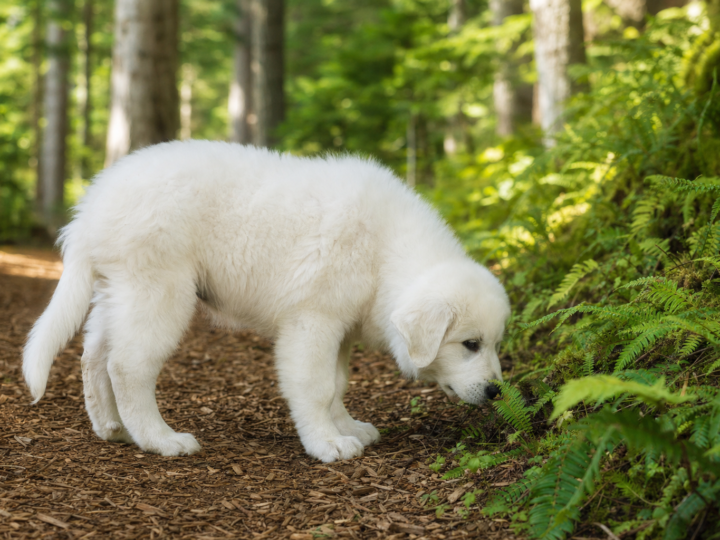
Guardian and mastiff types, such as Cane Corsos, Rottweilers, Bullmastiffs and Great Pyrenees, are often calmer mouthers but mature into very powerful adults, which makes early bite inhibition especially valuable. These breeds also benefit from patient handling practice, so they learn to accept hands on paws, ears and mouth calmly. Whatever the breed, the method is the same: soft mouth first, no mouth on skin second, and consistency throughout.
Frequently asked questions
At what age do big puppies stop biting?
Most large breed puppies mouth people far less by about 6 months, once teething eases, and the habit usually fades by around 9 months with consistent training. Exuberant breeds such as retrievers and Boxers can stay mouthy a little longer through adolescence.
Is it normal for a large breed puppy to bite a lot?
Yes. Mouthing is normal puppy behaviour and is how puppies explore and play. It becomes a concern only if biting gets harder over time, seems linked to fear or guarding, or comes with stiffness and growling, in which case a qualified trainer can help.
Should I yelp when my puppy bites?
A short, calm “ouch” followed by stillness and a brief pause in play works well for most puppies. A loud, high pitched yelp can excite some big puppies further, so if yours gets more wound up, skip the sound and simply go still and step away.
How long does it take to teach bite inhibition?
Most families see softer mouthing within two to four weeks of consistent practice. Building a reliable soft mouth and ending mouthing on skin usually takes until around 4 to 6 months of age, with occasional refreshers during adolescence.
Does teething make puppy biting worse?
Teething usually increases the urge to chew, especially from around 3 to 4 months until 6 or 7 months. Offer chilled chews, rubber toys and puzzle feeders during this stage, and keep the same calm rules for mouthing on skin.
The bottom line
Teaching bite inhibition to a big puppy is one of the most valuable things you will ever do for your dog. Let your puppy practise a soft mouth, end play calmly whenever teeth press too hard, redirect to chews, protect naps, and keep every person in the household on the same page. Do the bulk of this before 4 to 5 months, stay consistent through teething and adolescence, and you will raise a powerful adult with a gentle, trustworthy mouth.
Want the simple roadmap in one place? Grab our free Big Dog Growth Guide for the growth window checklist, feeding framework and joint safe exercise limits, all written for large and giant breeds.
Support Big Breed Joints from Day One
Large and giant breeds carry more load through every growth stage. MoveGuard Growth supports developing joints in young big dogs (8 to 30 months); MoveGuard Adult keeps grown big dogs moving comfortably.

Leave a Reply