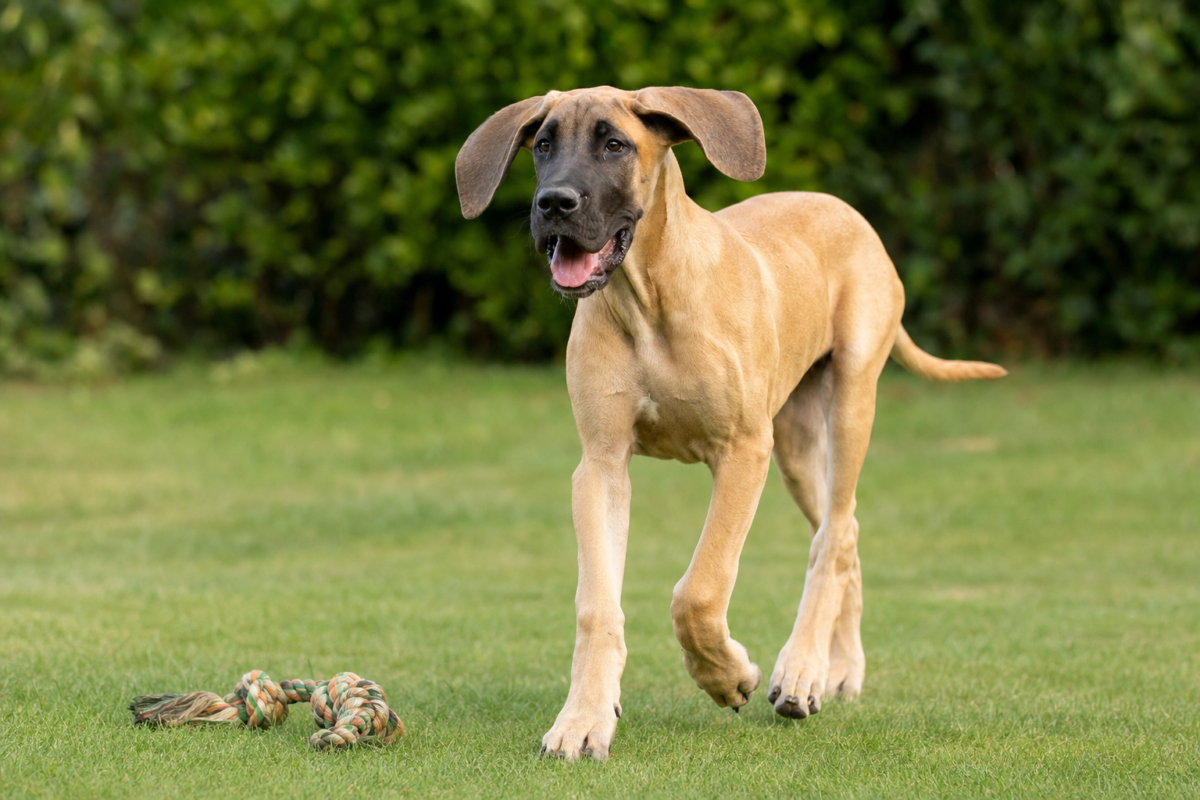
Play with a giant breed puppy in short, calm sessions on soft, grippy ground, and keep four feet on the floor. Favour sniffing games, gentle chase on grass, flat tug at chest height and puzzle work over jumping, twisting, hard sprinting and wrestling with big adult dogs. A Great Dane puppy carries adult weight on a baby frame, so ten happy minutes followed by a real rest is far kinder to growing joints than one long free for all in the yard.
Watching a giant breed puppy play is one of the great joys of big dog life. It is also the moment most Dog Parents quietly wonder whether all that enthusiasm is doing any harm. Safe play is not about saying no. It is about choosing the right games, on the right surface, for the right length of time. Get those three things right and your puppy gets all the fun of a good session, while the frame underneath stays protected through the long growing years.
How should I safely play with a giant breed puppy?
Safely playing with a giant breed puppy means keeping sessions short, calm and low impact. Aim for five to fifteen minutes of active play at a time, on grass, carpet or another surface with grip, and stop while your puppy still has energy left. Choose games that keep all four feet close to the ground, such as sniffing hunts, gentle recall chases, flat tug and food puzzles. Save repeated jumping, tight turns, long fetch sessions, slippery floors and rough wrestling with adult dogs for later, once the frame has finished forming.
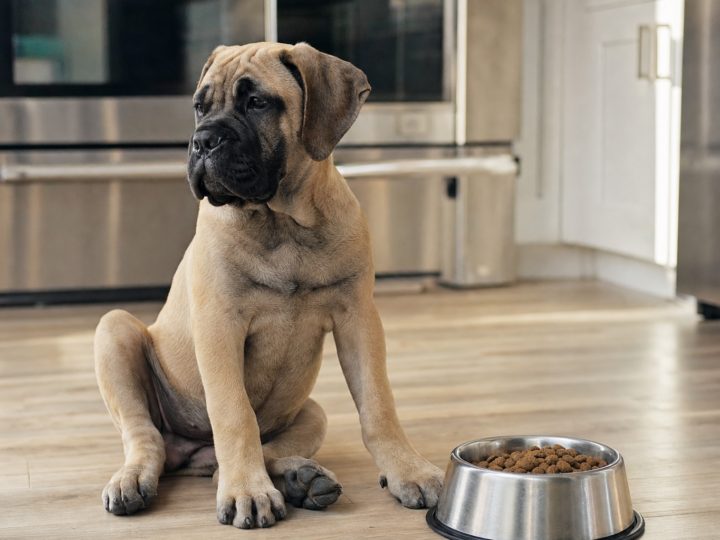
A giant breed puppy is not simply a big puppy. At six months a Great Dane can already weigh as much as a fully grown Labrador while running on joints that will not finish maturing for well over another year. That mismatch between weight and readiness is the whole reason play needs managing.
What makes play different for a giant breed puppy
Great Danes and other giant breeds grow faster, for longer, and to a far greater final size than almost any other dog. A Dane puppy can multiply its birth weight more than a hundred times in its first year, and all of that new bone and cartilage is laid down while the puppy is already tall, heavy and comically uncoordinated.
There is also the leverage question. Long legs and a deep chest mean that when a Dane puppy lands from a jump or slips on a tiled floor, the forces travelling through those young joints are far larger than they would be on a smaller dog doing the same thing. None of that means a fragile dog. Giant breed puppies are robust, playful and full of character. It simply means the way they play is worth a few minutes of thought.
Safe play by age, month by month
Use this as a friendly guide rather than a rulebook. Weights are typical for a male Great Dane, with females usually running ten to fifteen percent lighter. What matters is the pattern: as weight climbs, impact stays low and rest stays generous.
| Age | Typical weight | What safe play looks like |
|---|---|---|
| 2 months | 25 to 35 lb | Gentle indoor games on rugs, soft toys, very short garden pottering |
| 3 months | 45 to 60 lb | Sniffing hunts, flat tug, five minute bursts, calm greetings |
| 4 months | 60 to 80 lb | Short recall chases on grass, puzzle feeders, long naps between |
| 6 months | 85 to 105 lb | Ten minute play blocks, soft ground only, no repeated jumping |
| 9 months | 105 to 125 lb | Structured games with pauses, scent work, no hard turns |
| 12 months | 115 to 145 lb | Longer walks, moderate play, no sustained sprinting |
| 18 months | 130 to 165 lb | Gradual build up in duration, impact still moderate |
| 2 years plus | 140 to 175 lb | Adult play, built up slowly on sensible surfaces |
The American Kennel Club’s Chief Veterinary Officer, Dr. Jerry Klein, DVM, has written extensively on the slower growth and development timeline of large and giant breeds. Read more from the AKC’s guidance on caring for large-breed dogs.
When do Great Danes stop growing?
A Great Dane reaches most of its adult height by around 18 to 24 months, then keeps filling out through the chest and hindquarters until roughly two and a half to three years of age. That is a long adolescence, and it is why the play rules on this page apply for far longer than a new Dane parent expects.
As a rough guide across the giant breeds, dogs with an expected adult weight of 130 pounds or more keep developing for roughly 24 to 30 months. Because so much of that frame is being built during the first two years, this is your prime window for building habits around food, movement and joint support.
Why the growth window matters for play
Through this window your puppy is laying down the bone, cartilage and connective tissue that will carry a very large adult for life. Growth plates, the softer zones near the ends of the long bones, stay open through much of the first year and beyond in the biggest breeds. While they are open, hard landings, sharp twists and extra body weight all ask more of a structure still under construction.
Slippery Floors
Tile and laminate turn an ordinary skid into a splayed leg. Runners on the routes your puppy sprints are one of the best changes you can make.
Repeated Jumping
Jumping off sofas, in and out of cars and up for toys stacks landings onto young joints. A ramp solves most of it.
Mismatched Playmates
A big adult dog who body slams for fun is a poor partner for a growing giant. Choose calm friends.
Play Past Tired
An overtired giant puppy gets clumsy fast, and clumsy is when awkward landings happen. Stop early, every time.
How feeding shapes safe play
Every extra pound your puppy carries travels through the joints during every game, so food and play are the same conversation. Giant breed puppies do best on steady, moderate growth, and a lean puppy simply plays more comfortably.
- Choose a complete food formulated for large breed puppies, which controls calories, calcium and phosphorus for a slower, steadier growth curve.
- Split the daily amount into three meals while young, then two as an adult.
- Leave about an hour either side of meals before active play, and keep games calm around feeding times.
- Feed to a lean body condition rather than a number on a chart, and confirm portions with your veterinarian at every checkup.
How to check body condition in ten seconds
The scale tells you weight. Body condition tells you whether that weight suits your dog, and you can check it at home in seconds.
- Ribs. Run flat hands along both sides. You should feel the ribs easily under a thin covering. If you have to press, ease back on portions.
- Waist. Look down from above. A clear waist should tuck in behind the ribs rather than running straight.
- Tuck. From the side, the belly should rise up toward the back legs instead of hanging level with the chest.
Check every couple of weeks through the growing years and adjust gently with your veterinarian guiding the changes.
Games that are genuinely good for a giant breed puppy
Safe play is not boring play. The games below give a giant puppy real satisfaction while keeping the load low, and most tire the brain as much as the body.
- Scatter feeding and sniffing hunts. Toss a handful of kibble into the grass and let your puppy work the ground. Ten minutes of sniffing satisfies more than twenty of running.
- Flat tug at chest height. Keep the toy low and still, let your puppy do the pulling, and never lift or shake the head from side to side.
- Gentle recall chases. Two people on grass and a happy trot between them. Stop before it becomes a flat out sprint.
- Puzzle feeders and snuffle mats. Perfect for rainy days and for the evening restlessness giant puppies are famous for.
- Training as a game. Sit, touch and find it build focus and body awareness without impact.
Games worth saving for later include long fetch with hard stops, frisbee catching in the air, stair sprints, agility equipment and repeated jumping of any kind. None are forbidden forever. They simply belong to an adult body.
Supporting the joints your puppy plays on
Giant breed puppies spend two full years building a frame that will carry more weight than most dogs ever reach. Supporting healthy joint development while that happens is a quiet habit that fits naturally alongside lean feeding and thoughtful play.
Many big dog parents add a daily joint support chew made specifically for large and giant breeds. MoveGuard Growth is built for this stage. It combines nine actives, including New Zealand Green Lipped Mussel, glucosamine, chondroitin, MSM, krill oil and hyaluronic acid, to support the developing joints of young large breed dogs across the roughly 8 to 30 month growth window. You dose by expected adult weight, so a Great Dane usually sits at three chews a day while smaller large breeds take two. It ships as 90 chicken liver flavour chews, is made in the USA in an NSF facility, and is backed by a 60 day guarantee.
Support Every Play Session
Give your growing giant daily joint support built for large and giant breeds. Explore MoveGuard Growth.
Signs your giant breed puppy is playing within its limits
You do not need a stopwatch to know whether a session went well. A puppy who played within its limits comes back with a loose, easy gait, settles quickly and gets up smoothly an hour or two later. Movement looks the same at the end of play as at the start.
The signs to watch for point the other way. Sitting down during play, a stiff or short stride afterwards, soreness the next morning, or a puppy who becomes wild and uncoordinated rather than pleasantly tired. Any limping or persistent stiffness deserves a conversation with your veterinarian, because catching things early keeps small things small.
A simple play game plan, stage by stage
You do not need a complicated program. You need the right emphasis at the right time.
8 weeks to 4 months. Foundation stage. Very short sessions, soft surfaces and lots of sleep. Put rugs down on slippery routes now, and start teaching four feet on the floor at greetings, because a habit built at 40 pounds is worth a great deal at 150.
4 to 8 months. The gangly stretch, when your puppy grows faster than its coordination. Keep sessions to about ten minutes, keep them on grass, and add a car ramp before the jumping habit sets. This is the natural point to begin a daily joint support routine that carries through the rest of the growth window.
8 to 18 months. Adult size arrives while the frame is still finishing. Longer sniffy walks work beautifully. Keep play structured with real pauses and keep sprinting and hard turns to a minimum.
18 months to 3 years. Growth slows and muscle fills in. Build duration and intensity gradually as your veterinarian advises, and many parents keep the joint support routine going into adulthood.
Common play mistakes to avoid
Most play related trouble in giant breeds comes from a short list of very ordinary habits. Avoid these and you are already ahead.
- Treating a big puppy as an adult. Size is not maturity. A 100 pound six month old is still a baby underneath.
- Playing on slippery ground. Tile, laminate and wet decking are where the awkward moments happen. Grass and rugs are your friends.
- Letting the session run long. Giant puppies rarely stop themselves, so ending while there is fuel in the tank is a skill worth building.
- Encouraging jumping up. It is charming at 40 pounds and unmanageable at 150, and every landing loads the front end.
- Waiting for a problem before supporting joints. The growth window is the ideal time to support developing joints, not the moment after something looks wrong.
The Great Dane temperament and how it shapes play
Great Danes are famously gentle, people focused and a little theatrical. That sweet nature is a real advantage during the growing years, because a Dane wants to play with you rather than run in circles alone, which makes calm, structured games easy to teach.
The flip side is sensitivity. Danes read household energy quickly and can get wound up when play becomes chaotic, and a wound up giant puppy is a clumsy one. Short sessions with clear beginnings and endings suit the breed better than open ended excitement. Ask for a sit before the toy comes out and finish with something calm. Build the manners alongside the frame and you get the gentle giant the breed is loved for.
Frequently asked questions
How long should a giant breed puppy play at one time?
Five to fifteen minutes of active play at a time suits most giant breed puppies, followed by a proper rest. Several short sessions across the day are kinder to growing joints than one long one, and leave a puppy satisfied rather than overtired.
Can a Great Dane puppy play fetch?
Short, gentle fetch on grass is fine, but keep it to a few relaxed throws. Repeated hard stops, turns and jumps for the ball are what to avoid while the growth plates are still open, so roll the toy along the ground instead of throwing it high.
Is rough play with other dogs safe for a giant breed puppy?
Calm social play with well matched dogs is valuable, but body slamming and wrestling with much larger or rougher dogs is a lot for a developing frame. Choose steady playmates, supervise, and build in regular pauses so the energy never runs away.
When can a giant breed puppy start running with me?
Most giant breeds are not ready for sustained running until well after 18 months, and many veterinarians prefer to wait until closer to two years. Build distance gradually and only after your veterinarian confirms your individual dog has finished the main part of its growth.
What surface is best for a giant breed puppy to play on?
Grass is the ideal surface, with carpet or rugs indoors. Tile, laminate and polished wood offer little grip, which turns an ordinary turn into a slip. Adding runners along the routes your puppy sprints indoors is one of the simplest safety upgrades available.
The bottom line
Safe play for a giant breed puppy comes down to short sessions, soft ground, low impact games and honest rest. Your Great Dane will spend two years or more building a frame that has to carry an enormous adult, and the games you choose during that time are one of the few parts you control completely. Keep four feet near the floor, feed for lean and steady growth, and support those developing joints daily. Do that and you get a puppy who plays with everything it has, and an adult who moves with comfort for years.
Want the Simple Roadmap in One Place?
Grab our free Big Dog Growth Blueprint for the growth window checklist, feeding framework and joint safe exercise limits, all written for large and giant breeds.
This article is for general educational purposes only and is not veterinary advice. It is not intended to diagnose, treat, cure or prevent any disease. Always consult your veterinarian about your dog’s individual health, nutrition and supplement needs. These statements have not been evaluated by the Food and Drug Administration.
Support Big Breed Joints from Day One
Large and giant breeds carry more load through every growth stage. MoveGuard Growth supports developing joints in young big dogs (8 to 30 months); MoveGuard Adult keeps grown big dogs moving comfortably.
Leave a Reply