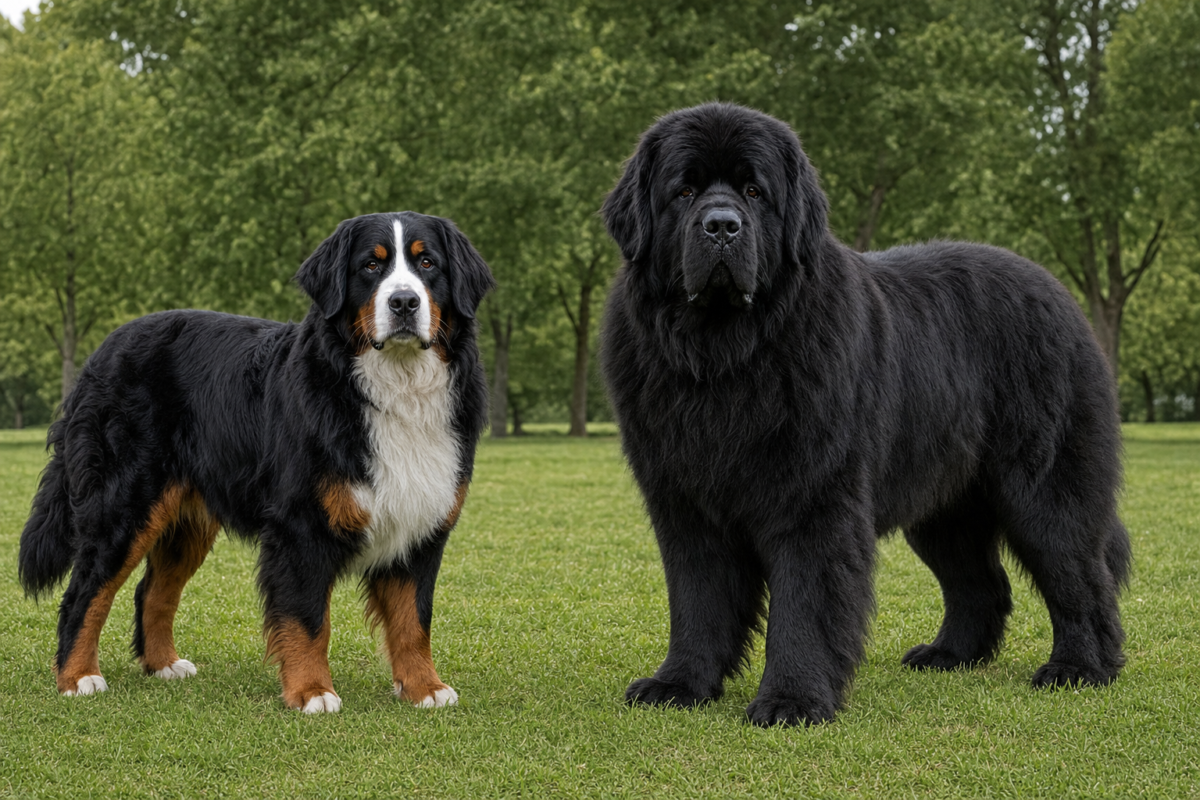
The Newfoundland is the bigger dog. Males typically stand about 28 inches and weigh 130 to 150 pounds, while a male Bernese Mountain Dog stands 25 to 27 inches and weighs 80 to 115 pounds. Both are gentle, family focused working breeds with heavy double coats, but the Newfoundland is a calm water rescue dog bred for swimming and hauling, while the Bernese is a livelier Swiss farm dog that carts, hikes and stays busier around the house.
Choosing between a Bernese Mountain Dog and a Newfoundland is a lovely problem to have. Both are big, soft natured, deeply people focused dogs that make wonderful family companions, and both ask a great deal in coat care, space and time. The differences are real though, and they show up in daily life more than the photographs suggest. This guide walks through size, growth, temperament, grooming, exercise and cost so you can picture what each breed actually looks like in your home.
What is the difference between a Bernese Mountain Dog and a Newfoundland?
The clearest difference is size and purpose. A Newfoundland is a giant water rescue breed that reaches 100 to 150 pounds and moves through life at a slow, deliberate pace. A Bernese Mountain Dog is a large Swiss draught and farm breed that reaches 70 to 115 pounds and carries noticeably more energy and playfulness into adulthood.
Coat colour separates them too. The Bernese is always tricolour, a glossy black body with rust markings and a white chest and blaze. The Newfoundland comes in solid black, brown or grey, plus the striking black and white Landseer pattern. Newfoundlands also have webbed feet and a water resistant outer coat, which the Bernese does not.
Size and build side by side
Both breeds look substantial in a photograph. In a hallway the difference is obvious.
| Trait | Bernese Mountain Dog | Newfoundland |
|---|---|---|
| Male height | 25 to 27.5 inches | About 28 inches |
| Female height | 23 to 26 inches | About 26 inches |
| Male weight | 80 to 115 lb | 130 to 150 lb |
| Female weight | 70 to 95 lb | 100 to 120 lb |
| Coat | Long silky tricolour double coat | Heavy water resistant double coat |
| Typical lifespan | 7 to 10 years | 9 to 10 years |
| Origin and job | Swiss farm dog, draught and drover work | Canadian water rescue and hauling |
| Energy level | Moderate, playful into adulthood | Low to moderate, calm and steady |
The American Kennel Club’s Chief Veterinary Officer, Dr. Jerry Klein, DVM, has written extensively on the slower growth and development timeline of large and giant breeds. Read more from the AKC’s guidance on caring for large-breed dogs.
Growth chart, month by month
Use this as a friendly guide rather than a report card. Males sit at the top of each range and females toward the bottom.
| Age | Bernese Mountain Dog | Newfoundland |
|---|---|---|
| 2 months | 20 to 25 lb | 25 to 35 lb |
| 3 months | 30 to 40 lb | 40 to 50 lb |
| 4 months | 40 to 50 lb | 50 to 65 lb |
| 6 months | 55 to 70 lb | 70 to 90 lb |
| 9 months | 70 to 85 lb | 90 to 110 lb |
| 12 months | 75 to 100 lb | 100 to 125 lb |
| 18 months | 80 to 110 lb | 110 to 140 lb |
| 2 years plus | 70 to 115 lb | 100 to 150 lb |
When do they stop growing?
A Bernese Mountain Dog reaches most of its adult height by around 18 months and finishes filling out through the chest and shoulders by roughly two years. A Newfoundland takes longer at both ends, reaching adult height nearer 18 to 24 months and continuing to add substance until two and a half years or even three. If you want the detail on the giant breed timeline, our Newfoundland growth chart breaks it down stage by stage.
Why the growth window matters for both
As a rough guide, a dog with an expected adult weight of 80 to 100 pounds keeps developing for about 20 to 24 months, and one heading past 130 pounds may still be building at 24 to 30 months. Through that window both breeds are laying down the cartilage, bone and connective tissue that carry an adult body for a decade. Growth plates, the soft areas at the ends of the long bones, stay open through much of it, which is why lean feeding and moderate exercise matter so much more in these two breeds than in a spaniel.
Growing Too Fast
Both breeds gain weight quickly. Aim for a steady, even curve rather than the biggest puppy in the litter photo.
Heat Sensitivity
Two heavy double coats. Newfoundlands in particular struggle in hot weather, so walk early and late in summer.
Slippery Floors
Big puppies skid on tile and wood. Runners and rugs save a lot of awkward landings.
Shorter Lifespans
Both breeds give you fewer years than a small dog, which is exactly why early habits count.
Temperament and daily life
Both breeds are famously gentle with children and both are deeply attached to their people. Neither does well left alone for long days.
The Bernese is the busier of the two. It keeps a playful, slightly goofy streak well into adulthood, enjoys a job such as carting or hiking, and can be reserved with strangers until it knows them. It is sensitive, so training goes best when it is warm, patient and consistent.
The Newfoundland is famously placid, often described as a sweet natured giant who prefers to lie across your feet. It is slower to react, unbothered by household chaos, and drawn to water in a way that will surprise you the first time it walks into a lake. It is also a serious drooler, which the Bernese mostly is not.
Grooming, shedding and climate
Neither breed is low maintenance and both shed heavily, especially twice a year.
- Bernese. A long silky coat that mats behind the ears and under the legs. Brush two or three times a week and expect hair on everything.
- Newfoundland. A dense water resistant coat with a thick undercoat. Plan on a proper brush out several times a week and a longer session during a coat blow.
- Climate. Both were built for cold work. Air conditioning, shade and early morning walks are not luxuries in a warm climate, they are the plan.
- Water and drool. A Newfoundland brings the lake home with it. Keep towels by the door and accept the drool as part of the deal.
Feeding two very large puppies
Both breeds do best with steady, moderate growth rather than fast growth, and a lean body condition is the single most useful thing you can give either one.
- Choose a complete food formulated for large breed puppies, which balances calories, calcium and phosphorus for slower growth.
- Split the daily amount into three meals while young, then two as an adult. Neither breed should eat one large meal a day.
- Feed to condition rather than to the number on the bag, and reassess as activity changes.
- Ask your veterinarian to confirm portions at each checkup, since the right amount changes fast in the first year.
How to check body condition in ten seconds
- Ribs. Run your hands along the sides. You should feel the ribs easily under a thin layer, even through a heavy coat.
- Waist. Look down from above. You want a clear waist that tucks in behind the ribs.
- Tuck. From the side, the belly should rise toward the back legs rather than hanging level.
Exercise needs compared
Neither breed is an athlete, but the Bernese wants more of your day than the Newfoundland does.
An adult Bernese enjoys an hour or so of walking, hiking or carting, split across the day, plus something to think about. An adult Newfoundland is generally content with two moderate walks and a swim when the opportunity arises. For both, the puppy rule is the same: about five minutes of structured walking per month of age, once or twice a day, with free play on soft ground on top and no repeated jumping while the frame is still building.
Supporting two big frames
Both breeds carry a great deal of weight through the same joints for a whole lifetime, and both spend two years or more building the frame that has to do it. Supporting healthy joint development early is one of the simplest habits a giant breed parent can adopt.
Alongside lean feeding and sensible movement, many big dog parents add a daily chew made for large and giant breeds. MoveGuard Growth is built for the growth window, combining nine actives including New Zealand Green Lipped Mussel, glucosamine, chondroitin, MSM and hyaluronic acid to support developing joints across the roughly 8 to 30 month window. You dose by expected adult weight, so most Bernese and every Newfoundland sit at three chews a day. Once your dog is grown, MoveGuard Adult carries the same idea into adulthood. Both are made in the USA in an NSF facility and backed by a 60 day guarantee.
Support A Giant Frame
Daily joint support built for large and giant breeds. Explore MoveGuard Growth.
Which one is right for you?
Choose the Bernese Mountain Dog if you want a large but manageable dog with a playful streak, you enjoy hiking or a bit of dog sport, and you would rather not deal with heavy drool. It is the better fit for a household that wants a companion who joins in rather than settles down.
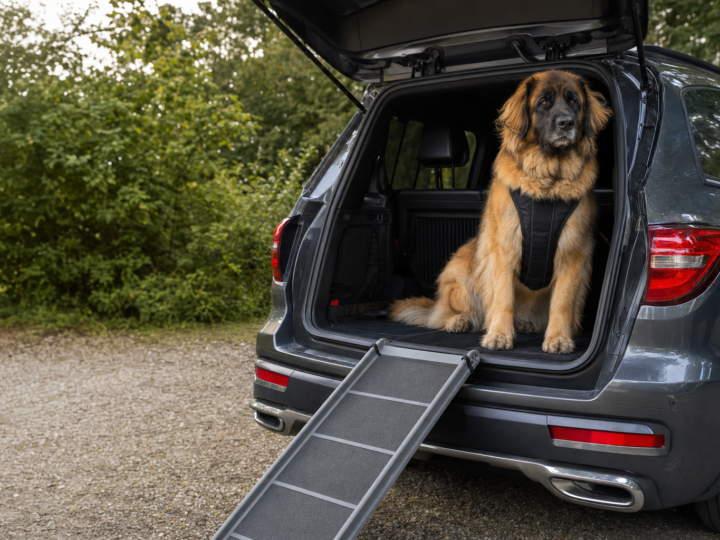
Choose the Newfoundland if you want the calmest possible giant, you live near water, and the sheer scale of the dog appeals rather than worries you. Be honest about the practical side first: a 150 pound dog is harder to lift into a car, more expensive to feed and medicate, and needs a home that can absorb the mess.
Cost is worth thinking through as well. Everything scales with the dog, from food and grooming to bedding, boarding and any medication your veterinarian prescribes by weight. A Newfoundland eats more than a Bernese, needs a larger crate and car space, and is genuinely difficult to lift if it ever needs helping. Both breeds also benefit from regular veterinary checkups, and a good breeder will be open with you about the health testing behind their line.
If you are torn, visit both. Fifteen minutes standing next to an adult Newfoundland tells you more than any article can, and an hour with an adolescent Bernese tells you whether the energy suits your household.
A simple growth game plan, stage by stage
The plan is broadly the same for both breeds. The Newfoundland simply spends longer in every stage.
8 weeks to 4 months. Foundation stage. A complete large breed puppy food, three calm meals a day, early socialisation with people, surfaces and sounds, and short bursts of free play on grass. Start grooming now, in short friendly sessions, so a 20 pound puppy learns to enjoy what a 120 pound adult has to accept.
4 to 8 months. Growth is quick and your puppy may look gangly and out of proportion. Keep feeding lean, keep walks moderate, and teach a calm routine for stairs and car entry before your dog is too heavy to lift. This is a natural point to begin a daily joint support routine that runs through the whole growth window.
8 to 18 months. Height nears its peak while muscle and chest fill in. Adolescence brings a wobble in focus and a big jump in strength, so keep training short, warm and consistent. Match portions to body condition rather than appetite, and keep surfaces varied.
18 months to 3 years. The Bernese finishes first, usually around two years. The Newfoundland keeps adding substance well past that. Build activity up as your veterinarian advises, and keep the daily habits that carried you through the growth window.
Common mistakes to avoid with either breed
- Overfeeding for size. A heavy puppy is not a healthier one. Extra weight loads a frame that is still forming.
- Underestimating the coat. Both breeds need real grooming time every week, not a brush when you remember.
- Too much hard exercise, too young. Long hikes and repeated jumping are a lot to ask of open growth plates in a giant breed.
- Ignoring heat. Both dogs overheat far more easily than their owners expect.
- Skipping early training. Manners are easy to teach at 30 pounds and difficult to retrofit at 130.
Frequently asked questions
Which is bigger, a Bernese Mountain Dog or a Newfoundland?
The Newfoundland. A male Newfoundland typically weighs 130 to 150 pounds against 80 to 115 pounds for a male Bernese Mountain Dog, and stands about an inch or two taller at the shoulder.
Which breed is calmer around children?
Both are known for being gentle, but the Newfoundland is generally the calmer of the two. The Bernese keeps more puppyish energy into adulthood, which many families enjoy and some find boisterous around toddlers.
Do Newfoundlands drool more than Bernese Mountain Dogs?
Yes, and it is not close. Newfoundlands have looser lips and are serious droolers, especially after drinking. Bernese Mountain Dogs drool very little by comparison.
Which breed sheds more?
Both shed heavily. The Newfoundland has the denser undercoat and drops more volume during a coat blow, while the longer Bernese coat is more prone to matting. Neither suits a household hoping to avoid hair.
Which lives longer, a Bernese Mountain Dog or a Newfoundland?
Newfoundlands average around 9 to 10 years and Bernese Mountain Dogs around 7 to 10 years. Both are shorter lived than smaller dogs, which is why lean weight, steady growth and daily joint support matter so much.
The bottom line
The Newfoundland is the bigger, calmer, wetter dog and the Bernese Mountain Dog is the livelier, tidier, slightly smaller one. Both are gentle giants that need serious grooming, real space, cool conditions and a family who is home. Feed for lean, steady growth, keep exercise moderate while the frame builds, support those joints from the growth window onward, and either breed will give you some of the best years a dog can offer.
Want the Simple Roadmap in One Place?
Grab our free Big Dog Growth Blueprint for the growth window checklist, feeding framework and joint safe exercise limits, all written for large and giant breeds.
This article is for general educational purposes only and is not veterinary advice. It is not intended to diagnose, treat, cure or prevent any disease. Always consult your veterinarian about your dog’s individual health, nutrition and supplement needs. These statements have not been evaluated by the Food and Drug Administration.
Support Big Breed Joints from Day One
Large and giant breeds carry more load through every growth stage. MoveGuard Growth supports developing joints in young big dogs (8 to 30 months); MoveGuard Adult keeps grown big dogs moving comfortably.
Leave a Reply