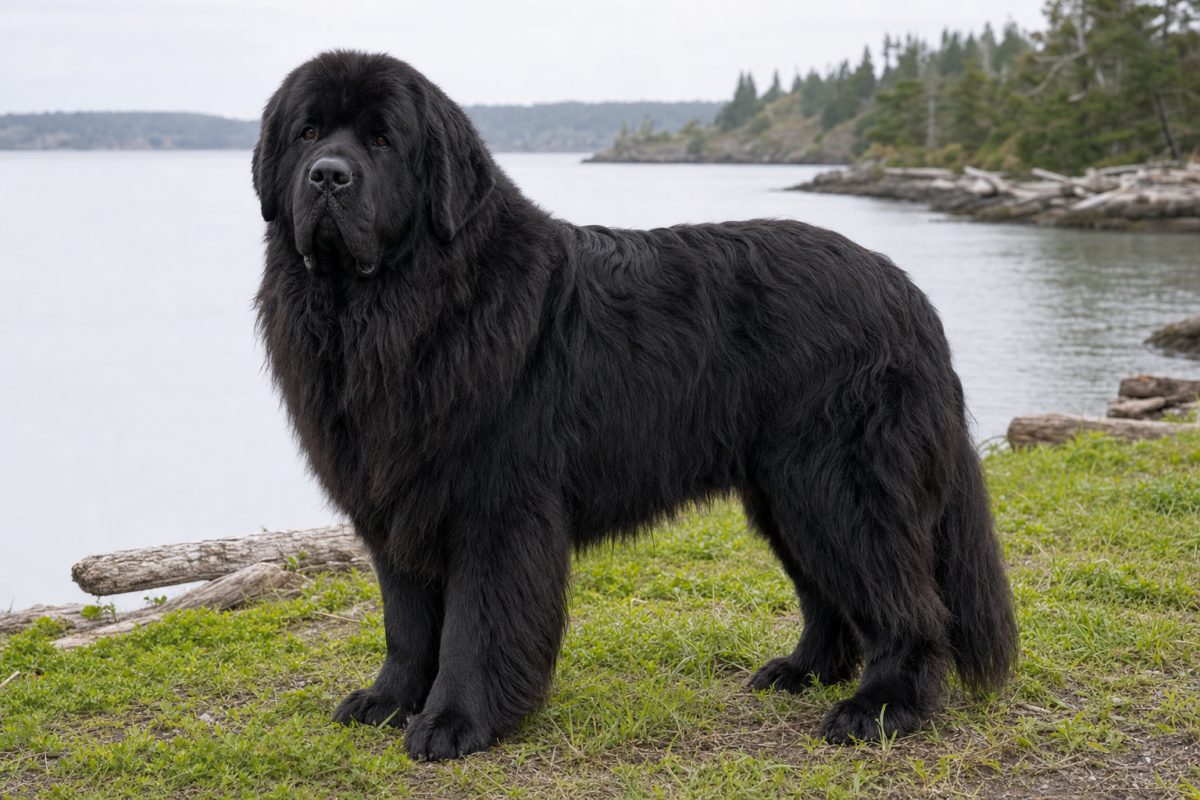
A fully grown male Newfoundland usually stands about 28 inches at the shoulder and weighs 130 to 150 pounds. Females typically reach about 26 inches and 100 to 120 pounds. Most Newfoundlands reach close to their adult height by around 18 months, then keep filling out through the chest, shoulders and coat until roughly two and a half to three years of age.
If you are watching a fluffy black bear of a puppy take over your living room and wondering just how large that dog is going to be, you are asking the right question early. The Newfoundland is a true giant breed, and the way you feed and move your puppy through the first two years shapes the calm, sound adult you end up with. This guide gives you a clear picture of Newfoundland weight by age, the timeline for when growth finishes, and the daily habits that help a giant frame come together well.
How much should a Newfoundland weigh by age?
A fully grown male Newfoundland usually weighs 130 to 150 pounds and stands about 28 inches at the shoulder. Females typically weigh 100 to 120 pounds and stand about 26 inches. Growth is quick through the first year, with a puppy often passing 100 pounds between nine and twelve months, then slows into a long finishing phase of muscle, chest depth and coat that runs to roughly two and a half to three years of age.
Individual dogs vary, and some healthy adult males comfortably exceed 150 pounds. Treat the numbers below as a dependable guide rather than a target to hit, because with a giant breed how your puppy gets to its adult size matters far more than the figure on the scale.
What makes a Newfoundland grow the way it does
Newfoundlands were developed on the cold Atlantic coast to haul nets and swim in heavy surf beside fishermen, and that job history explains the body you are raising. A Newfoundland is built for power and buoyancy rather than speed, with heavy bone, a deep barrel chest, a broad skull, webbed feet and a thick double coat made to shed icy water.
All of that mass has to be built, and building it takes time. A Newfoundland puppy adds weight remarkably fast in the first six months, then the pace changes. Height largely settles, and the second year is about substance, with the chest broadening, the shoulders thickening and the adult coat coming in heavy and full. Because so much weight arrives so early, a young Newfoundland can look out of proportion for months at a time. Big paws and a loose gangly frame are normal, and there is no reward for rushing what comes next.
Newfoundland growth chart, month by month
Use this chart as a friendly guide, not a report card. A puppy who tracks a little above or below these numbers while moving easily and staying lean under that coat is usually doing just fine.
| Age | Male weight | Female weight |
|---|---|---|
| 2 months | 20 to 25 lb | 15 to 20 lb |
| 3 months | 33 to 40 lb | 28 to 35 lb |
| 4 months | 50 to 60 lb | 40 to 50 lb |
| 6 months | 75 to 90 lb | 65 to 75 lb |
| 9 months | 100 to 115 lb | 85 to 95 lb |
| 12 months | 110 to 130 lb | 95 to 105 lb |
| 18 months | 125 to 145 lb | 100 to 115 lb |
| 2 years plus | 130 to 150 lb | 100 to 120 lb |
The American Kennel Club’s Chief Veterinary Officer, Dr. Jerry Klein, DVM, has written extensively on the slower growth and development timeline of large and giant breeds. Read more from the AKC’s guidance on caring for large-breed dogs.
When do Newfoundlands stop growing?
Newfoundlands reach most of their adult height by around 18 months. After that the change is about substance rather than stature. Your Newfoundland broadens through the chest and shoulders, adds the muscle that gives the breed its quiet strength, and grows the dense adult coat, usually until two and a half to three years of age. A tall, narrow eighteen month old who still looks adolescent is right on schedule.
As a rough guide, dogs with an expected adult weight of 130 to 180 pounds keep developing for roughly 24 to 30 months. Because the frame itself is largely set in the first year and a half, that stretch is your prime window to build strong habits around food, movement and joint support.
Why the growth window matters so much for a giant breed
During this window your Newfoundland is building the cartilage, bone and connective tissue that will carry well over a hundred pounds for life. Growth plates, the soft areas at the ends of the long bones, stay open through much of the first year and close later in giant breeds than in smaller dogs. While they are open, hard impact and every extra pound ask more of a frame that is still forming, which is why lean feeding and sensible exercise matter so much here.
Growing Too Fast
Rapid growth asks a great deal of developing joints. Aim for a steady, even curve rather than a fast one.
Excess Weight
Every extra pound loads young joints, and on a dog this size they add up quickly. Lean now means comfortable later.
Too Much Impact
Long runs, stairs and jumping down from cars on open growth plates are best kept to a minimum while young.
Heat Load
That double coat traps heat. Move your puppy in the cool parts of the day so activity stays comfortable rather than exhausting.
How much should a Newfoundland puppy eat while growing?
Giant breed puppies do best with steady, moderate growth. An even growth curve supports comfortable movement now and for years to come, and a few practical habits make a real difference:
- Choose a complete food formulated for large breed puppies, which balances calories, calcium and phosphorus for slower, steadier growth.
- Split the daily amount into three meals while young, then two meals as an adult, to keep energy even.
- Feed to a lean body condition rather than to the bag. You should feel the ribs easily under a light layer. If you cannot, ease back on portions.
- Skip calcium and mineral extras unless your veterinarian recommends them, because a giant breed puppy food is already balanced for a growing frame.
- Let your veterinarian confirm the daily amount at each checkup, since the right portion changes quickly through the first year.
How to check your Newfoundland’s body condition in ten seconds
The scale tells you weight, but body condition tells you health, and on a coated breed your hands are more reliable than your eyes.
- Ribs. Run your hands along the sides, pressing through the coat. You should feel the ribs under a thin layer. If you have to hunt for them, ease back on food.
- Waist. Look down from above, and if the coat hides the outline, run your hands along the flanks. You want a clear narrowing behind the ribs.
- Tuck. From the side, the belly should rise toward the back legs rather than hanging level.
Check every couple of weeks through the growth years and adjust portions with your veterinarian’s guidance. A hands on check catches quiet weight gain long before the coat lets it show.
Growth safe exercise for a Newfoundland puppy
Newfoundlands are calmer than most giant breeds, which is a gift during the growth years. What they need is regular, moderate movement that builds condition without pounding on a frame that is still forming.
- Favor free play, gentle exploring and short walks on soft ground such as grass or sand.
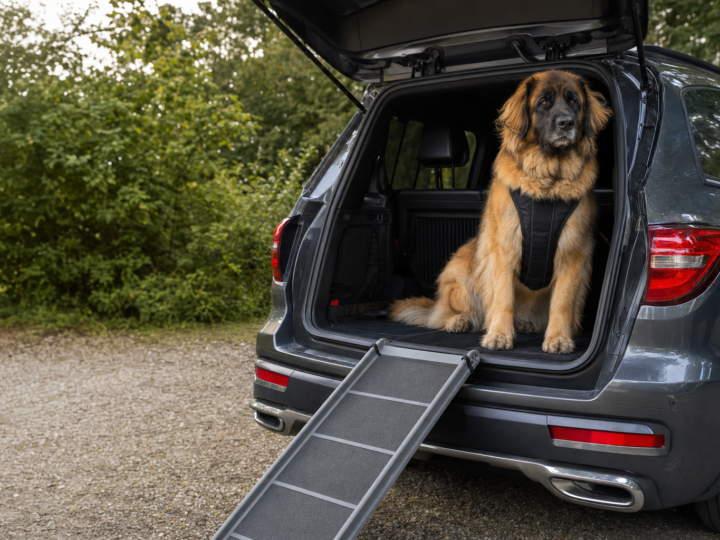
- Keep long runs, repeated stairs and jumping out of vehicles to a minimum while the growth plates are still open. A ramp is a kind investment for a dog this heavy.
- Swimming suits this breed beautifully once your veterinarian gives the go ahead, because water carries the weight while the muscles work.
- Exercise in the cool of the morning or evening, with shade and water nearby. A thick double coat and a hot afternoon are a poor combination.
- Let your puppy rest fully between bursts of activity, because that rest is when growth happens.
Protecting a giant frame from the start
Every pound your Newfoundland carries travels through its joints with every step and every rise from the floor. Supporting healthy joint development while your dog is still building that frame is one of the simplest habits a giant breed parent can adopt.
Alongside lean feeding and sensible exercise, many big dog parents add a daily joint support chew made for large and giant breeds. MoveGuard Growth is built for exactly this stage. It combines nine actives, including New Zealand Green Lipped Mussel, glucosamine, chondroitin, MSM, krill oil and hyaluronic acid, to support the developing joints of young large breed dogs across the roughly 8 to 30 month growth window. You dose by expected adult weight, so a Newfoundland sits at three chews a day. It is made in the USA, ninety chews to a jar, and is backed by a 60 day guarantee.
Support A Giant Frame
Give your growing Newfoundland daily joint support built for large and giant breeds. Explore MoveGuard Growth.
Signs your Newfoundland is growing on track
You do not need a weekly weigh in to know things are going well. Look for a bright, contented puppy with ribs you can feel through the coat under light pressure, a narrowing you can trace behind the ribs, easy fluid movement, and a healthy but not frantic appetite. Even, unhurried growth with good muscle tone is exactly what you want to see.
If you ever notice limping, stiffness after a nap, reluctance to rise, swelling around a joint, or growth that seems suddenly very fast, a quick conversation with your veterinarian lets you adjust food or activity early rather than late.
A simple growth game plan, stage by stage
You do not need a complicated program. You need the right emphasis at the right time.
8 weeks to 4 months. Foundation stage. Focus on a complete large breed puppy food, three calm meals a day, early socialisation and short bursts of free play on soft ground. Start leash manners now while your puppy weighs forty pounds rather than a hundred and forty.
4 to 8 months. The fastest stretch of the whole journey. Keep feeding lean, keep exercise moderate, and set the habits that protect the frame now, including a ramp for the car. This is a natural point to begin a daily joint support routine that carries through the whole growth window.
8 to 18 months. Height nears its ceiling while weight keeps building. Match portions to a lean body condition, since a big appetite can easily outpace need. Add structured activity gradually and favour soft surfaces.
18 months to 3 years. The lanky adolescent becomes a broad, powerful adult as chest, muscle and coat continue to develop. Build activity up as your veterinarian advises, keep the body condition checks going, and many parents carry the joint support routine straight into adulthood.
Common growth mistakes to avoid
Most growth trouble in giant breeds traces back to a few avoidable habits.
- Overfeeding for size. A heavy young Newfoundland is not a healthier one. Feed lean and let the size arrive on its own timeline.
- Skipping large breed puppy food. Standard formulas can push growth faster than a giant frame wants. Confirm the right food with your veterinarian.
- Adding calcium. Well meant mineral supplements can upset the balance a complete puppy food already provides. Ask before you add anything.
- Too much hard exercise, too young. Long runs, repeated stairs and jumping from height are a lot to ask of open growth plates on a dog this heavy.
- Letting the coat hide the truth. A thick double coat conceals weight changes, so check by hand rather than by eye.
- Waiting for a problem before supporting joints. The growth window is the ideal time to support developing joints, not after signs appear.
The Newfoundland temperament and the growth years
The Newfoundland is famous for its temperament, and the breed standard says so plainly: sweetness of disposition is the hallmark of the breed. These are patient, gentle, deeply people oriented dogs who would rather lean against your leg than run laps around the yard. That calmness is a genuine advantage while you are protecting a growing frame, because your puppy is rarely asking for the kind of wild activity a young working breed demands.
It also brings responsibilities. A dog that will weigh well over a hundred pounds needs to learn manners while it is still small enough to guide, so teach a reliable settle, polite greetings and calm loose leash walking during the first year. Newfoundlands are sensitive and respond beautifully to gentle, positive training. Short sessions, scent games and puzzle feeders all satisfy that thoughtful mind without pounding on young joints. Build the mind and the frame together and you get the calm, devoted giant the breed is loved for.
How the Newfoundland compares with similar breeds
The Newfoundland is usually weighed against the other giant gentle breeds. Next to the Bernese Mountain Dog it is clearly the bigger dog, 130 to 150 pounds against 80 to 115 pounds for a Bernese male. Next to the Saint Bernard it is the lighter of the two, since a Saint Bernard male runs 140 to 180 pounds, and the Newfoundland brings the swimming background and the water resistant coat. Read Bernese Mountain Dog vs Newfoundland and Newfoundland vs Saint Bernard, or browse our big dog breed comparisons page.
Frequently asked questions
At what age is a Newfoundland full grown?
Most Newfoundlands reach their adult height by around 18 months, then keep filling out in chest, muscle and coat until roughly two and a half to three years of age. Height comes first and substance comes later.
How much does a full grown Newfoundland weigh?
A fully grown male Newfoundland usually weighs 130 to 150 pounds and a female weighs 100 to 120 pounds, though individual dogs vary with genetics, line and body condition. Some healthy males comfortably exceed 150 pounds.
How big is a Newfoundland at 6 months?
At 6 months a male Newfoundland often weighs around 75 to 90 pounds and a female around 65 to 75 pounds. They still have a great deal of chest, muscle and coat to build, so a loose gangly look at this age is completely normal.
Are Newfoundlands prone to joint issues?
As a giant breed carrying a lot of weight on a frame that takes years to finish, Newfoundlands place real demand on their joints. Steady growth, a lean body condition, sensible exercise and daily joint support during the growth window are all sensible ways to support long term comfort. Speak with your veterinarian about your individual dog.
What should I feed a Newfoundland puppy?
A complete food formulated for large breed puppies is the safest choice, because it balances calories and minerals for slow, steady growth. Feed to a lean body condition, avoid extra calcium, and confirm portions with your veterinarian at each visit.
The bottom line
Your Newfoundland will most likely mature into a 100 to 150 pound gentle giant who reaches adult height by around 18 months and finishes building chest, muscle and coat by two and a half to three years. Feed for lean, steady growth, keep exercise moderate and cool, support the growth window with the right daily habits, and teach calm manners early. That is how you raise a sound Newfoundland who moves easily for many years.
Want the Simple Roadmap in One Place?
Grab our free Big Dog Growth Blueprint for the growth window checklist, feeding framework and joint safe exercise limits, all written for large and giant breeds.
This article is for general educational purposes only and is not veterinary advice. It is not intended to diagnose, treat, cure or prevent any disease. Always consult your veterinarian about your dog’s individual health, nutrition and supplement needs. These statements have not been evaluated by the Food and Drug Administration.
Support Big Breed Joints from Day One
Large and giant breeds carry more load through every growth stage. MoveGuard Growth supports developing joints in young big dogs (8 to 30 months); MoveGuard Adult keeps grown big dogs moving comfortably.

Leave a Reply