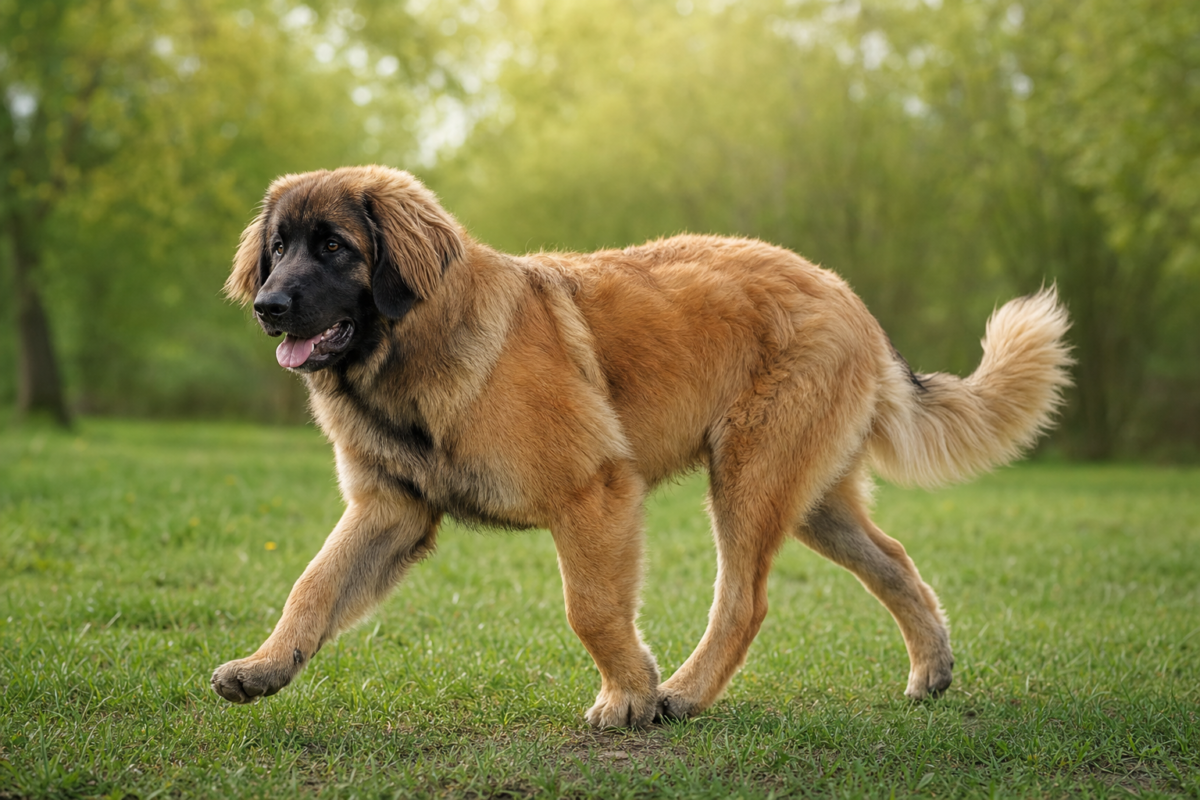
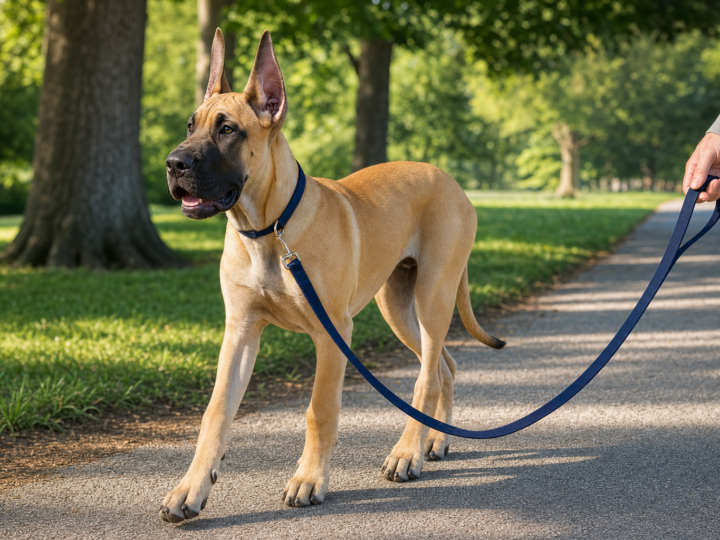
The most widely used starting point for a large breed puppy is five minutes of structured exercise per month of age, once or twice a day. That puts a three month old at about fifteen minutes of lead walking at a time, a six month old at about thirty, and a twelve month old at about an hour. Structured means activity you control and time, such as a lead walk or a training session, rather than pottering about the garden. Free play is a separate and far more forgiving budget, because a puppy choosing its own pace stops when it needs to. Intensity matters more than the minutes. Steady, varied movement supports a growing frame, while repeated hard impact asks more than it is ready to give.
A large breed puppy needs roughly five minutes of structured exercise per month of age, once or twice a day, on top of free play. That is about fifteen minutes twice daily at three months, thirty minutes at six months, and around an hour by twelve months. Free play, sniffing and gentle exploring sit outside that total. Most large breeds are ready for adult style exercise between 18 and 24 months, and giant breeds closer to 24 to 30 months.
If you have a big puppy who wants to run all day and a nagging feeling that all that running might be too much, you are asking exactly the right question. Large and giant breed puppies carry more weight on a frame that takes far longer to finish than a small dog does, and the movement they get in that window shapes how comfortably they move for years. This guide gives you an age by age picture of how much is enough, what kind of activity suits each stage, and the daily habits that keep a growing big dog satisfied and sound.
How much exercise does a large breed puppy need by age?
The most widely used starting point is five minutes of structured exercise per month of age, once or twice a day. A three month old gets about fifteen minutes of lead walking at a time, a six month old about thirty, and a twelve month old about an hour. Structured means activity you control and time, such as a lead walk or a training session, rather than pottering about the garden.
Free play is a separate and far more forgiving budget. A puppy choosing its own pace will stop when it needs to, so short bursts of play and sniffing can happen several times a day. What matters most is not the minutes but the intensity. Steady, varied movement supports a growing frame. Repeated hard impact asks more than it is ready to give.
What makes a large breed puppy different
A small dog reaches its adult frame in under a year. A large breed takes 18 to 24 months, and a giant breed 24 to 30 months. For most of that time the puppy carries a body that is heavy for its age on joints that are still forming, which is a very different situation from a ten pound terrier doing the same activity.
Two things drive the difference. The first is load. Every jump, turn and landing sends force through the joints, and that force scales with body weight, so a seventy pound adolescent lands far harder than a twenty pound one doing the same movement. The second is timing. Growth plates, the soft areas at the ends of the long bones where new bone is added, stay open through much of the first year and later still in the largest breeds.
None of that means a big puppy should sit still. Movement builds muscle, coordination and confidence. It means the shape of the exercise matters more than the volume.
Large breed puppy exercise chart by age
Use this chart as a guide rather than a rulebook. A puppy who does a little more or less while staying keen and comfortable is doing fine.
| Age | Structured walk, per session | Sessions per day | Best focus at this stage |
|---|---|---|---|
| 8 to 12 weeks | 5 to 10 minutes | 1 to 2 | Socialisation on soft ground |
| 3 months | 15 minutes | 2 | Lead manners, new surfaces |
| 4 months | 20 minutes | 2 | Recall games, gentle play |
| 6 months | 30 minutes | 2 | Sniffing walks, easy hills |
| 9 months | 45 minutes | 2 | Varied terrain, swimming |
| 12 months | 60 minutes | 2 | Stamina on soft ground |
| 18 months | 60 to 75 minutes | 2 | Large breeds near adult activity |
| 24 months plus | Adult level | 2 | Giant breeds arrive last |
The American Kennel Club’s Chief Veterinary Officer, Dr. Jerry Klein, DVM, has written extensively on the slower growth and development timeline of large and giant breeds. Read more from the AKC’s guidance on caring for large-breed dogs.
When can a large breed puppy exercise like an adult?
Most large breeds are ready for adult style exercise between 18 and 24 months, and the largest giant breeds closer to 24 to 30 months. It depends on expected adult weight rather than a birthday, because a heavier dog finishes later.
As a rough guide, an expected adult weight of 50 to 65 pounds finishes at around 16 to 18 months, 65 to 80 pounds at 18 to 22 months, 80 to 100 pounds at 20 to 24 months, and 130 pounds and up at 24 to 30 months or beyond. Match the timeline to that number rather than to the calendar, and ask your veterinarian where your individual dog sits.
Why the growth window matters so much
During this window your puppy is laying down the cartilage, bone and connective tissue that will carry it for a decade or more. Growth plates stay open through much of the first year, and in giant breeds later still. While they are open, hard impact and excess body weight ask more of a frame that has not finished forming, which is why lean feeding, sensible activity and daily joint support all matter more for a big dog than a small one.
Repeated Impact
Long runs, sprints and repetitive jumping load open growth plates. Keep them moderate until the frame finishes.
Forced Distance
A puppy keeps going to stay with you long after it should have stopped. You set the distance.
Hard Surfaces
Concrete and tarmac return more force than grass or woodland trail. Favour soft ground while young.
Under Stimulation
Too little activity turns into chewing, pacing and frustration. The answer is more variety, not more distance.
How feeding and exercise work together
Exercise and food are two halves of the same job. A puppy carrying extra weight loads its joints on every step, so no amount of careful walking makes up for generous portions.
- Choose a complete food formulated for large breed puppies, which balances calories, calcium and phosphorus for steadier growth.
- Split the daily amount into three meals while young, then two as an adult.
- Leave about an hour either side of a meal before vigorous activity.
- Feed to a lean body condition rather than the number on the bag, and confirm portions with your veterinarian at every checkup.
How to check body condition in ten seconds
The scale tells you weight. Body condition tells you whether that weight suits the dog in front of you.
- Ribs. Run your hands along the sides. You should feel the ribs easily under a thin layer. If you have to press, ease back on food.
- Waist. Look down from above. You want a clear waist that tucks in behind the ribs.
- Tuck. From the side, the belly should rise toward the back legs rather than hanging level.
Check every couple of weeks through the growth years and adjust portions with your veterinarian’s guidance.
What kind of exercise is best while they grow
Not all minutes are equal, and the right activity does more for a growing big dog than extra distance ever will.
- Sniffing walks. A slow walk where the puppy chooses the route tires a big dog more than a brisk one and asks almost nothing of the joints.
- Free play on grass. Self directed play with rest breaks lets the puppy set its own limit.
- Swimming. Once your veterinarian is happy, water gives real conditioning with almost no impact.
- Training and scent games. Ten minutes of thinking settles a big puppy like half an hour of walking.
- Gentle hills. A slow uphill walk builds hindquarter muscle without the pounding of a sprint.
What to keep moderate for now: repeated jumping, sprinting after a ball thrown over and over, running beside a bicycle, and full flights of stairs at speed. None are forbidden forever, but they ask a lot of a frame that has not finished.
Supporting the joints through the growth years
Every walk, turn and landing travels through the joints, and a big puppy does that with more body weight behind it than a small one ever will. Supporting healthy joint development while the frame is still being built is one of the simplest habits a big dog parent can keep going.
Alongside lean feeding and sensible activity, many big dog parents add a daily joint support chew made for large and giant breeds. MoveGuard Growth is built for exactly this stage. It combines nine actives, including New Zealand Green Lipped Mussel, glucosamine, chondroitin, MSM and hyaluronic acid, to support the developing joints of young large breed dogs across the roughly 8 to 30 month growth window. You dose by expected adult weight, so a puppy heading for 50 to 80 pounds takes two chews a day and one heading for 80 to 100 pounds or more takes three. It ships as 90 chews, is made in the USA in an NSF facility, and is backed by a 60 day guarantee.
Support A Growing Frame
Give your growing big dog daily joint support built for large and giant breeds. Explore MoveGuard Growth.
Signs you have the exercise load right
You do not need a stopwatch to know whether the balance is working. The puppy tells you, mostly the following morning.
A well exercised big puppy settles within twenty minutes of coming home, sleeps soundly, and gets up the next morning loose and keen rather than stiff. It moves evenly on all four legs and does not spend the evening pacing.
The signs of too much are just as readable. Lagging on a walk, stiffness after a nap, limping, or a flat day after a big outing all mean the last session asked too much. Ease off, give a couple of quiet days, and speak with your veterinarian if anything persists or a limp appears.
Too little shows up differently. Chewing, restlessness and difficulty settling are usually a puppy asking for more to do rather than more ground to cover. Reach for a training session before a longer walk.
A simple exercise game plan, stage by stage
8 weeks to 4 months. Foundation stage. Very short lead walks, plenty of free play on grass, and as much calm socialisation as you can manage. Begin lead manners now while the dog is still small enough to guide easily, because a large breed that learns to pull at four months is far harder to teach at ten.
4 to 8 months. Growth is fast and your puppy may look leggy. Keep sessions moderate and frequent rather than long, stay on soft ground, and build calm habits around stairs and the car. This is the natural point to begin a daily joint support routine.
8 to 18 months. Stamina arrives and the temptation to use it is strong. Add distance gradually, roughly ten percent a week, and introduce varied terrain. Swimming and gentle hills are excellent here.
18 months to 3 years. The adolescent becomes an adult, and running, hiking and sport can build properly under your veterinarian’s guidance. Giant breeds arrive last, so give them the extra months.
Common exercise mistakes to avoid
Most exercise problems in big puppies come from a handful of avoidable habits.
- Treating a big puppy like a small adult. A six month old that stands as tall as a grown spaniel is still a baby underneath.
- The endless ball thrower. Repetitive sprint, skid and turn is among the highest impact things a young big dog can do.
- Running beside a bicycle too early. It removes the puppy’s ability to set the pace, on a hard surface, for a long distance.
- Answering boredom with distance. A frustrated puppy usually needs a thinking task rather than another mile.
- Waiting for a problem before supporting joints. The growth window is the moment to support developing joints, not after something shows up.
Energy, boredom and the thinking dog
Almost every popular large breed was bred to do a job. Retrievers worked all morning in cold water, herding breeds moved and thought for hours, and the mastiff types held a position with steady patience. That heritage does not disappear because the dog now lives with a sofa, and it explains why a big puppy who has had a decent walk can still be impossible by evening.
The answer is variety rather than volume. A puzzle feeder at breakfast, a five minute training session before lunch, a scatter feed in the grass and a chew in the evening add up to a genuinely tired dog without an extra mile on those growing joints. Big dog parents who lean on mental work through the growth years find the adolescent months easier.
Frequently asked questions
How long should I walk a large breed puppy?
A good starting point is five minutes of structured walking per month of age, once or twice a day. That is about fifteen minutes at three months and thirty minutes at six months. Free play and sniffing time sit outside that budget and can happen more often.
Can a large breed puppy run with me?
Not for distance while the frame is still growing. Short bursts of self chosen running in play are fine, but sustained running beside a person or a bicycle is best saved until growth has finished, around 18 to 24 months for most large breeds and later for giant breeds.
Is it possible to over exercise a puppy?
Yes. Because a puppy will keep going to stay with you, the limit has to come from you rather than from the dog. Lagging on walks, stiffness after rest, or a flat and reluctant day after a big outing are all signs the last session asked too much.
When can my big puppy use stairs safely?
Occasional careful stair use is normal in most homes, but repeated flights at speed are best limited while the growth plates are still open. Carry very young puppies where you can and teach a slow pace.
How much exercise does a giant breed puppy need?
Giant breeds follow the same five minute per month guide but stay in the growth window longer, often 24 to 30 months. Keep sessions moderate and on soft ground for longer, and build distance slowly once growth is finished.
The bottom line
A large breed puppy needs roughly five minutes of structured exercise per month of age, once or twice a day, with free play, sniffing and training layered on top. Keep the surfaces soft and the impact moderate, build distance gradually, and let expected adult weight rather than the calendar tell you when adult activity begins. Feed lean, support the joints daily through the growth window, and give that big brain plenty to do.
Want the Simple Roadmap in One Place?
Grab our free Big Dog Growth Blueprint for the growth window checklist, feeding framework and joint safe exercise limits, all written for large and giant breeds.
This article is for general educational purposes only and is not veterinary advice. It is not intended to diagnose, treat, cure or prevent any disease. Always consult your veterinarian about your dog’s individual health, nutrition and supplement needs. These statements have not been evaluated by the Food and Drug Administration.
Support Big Breed Joints from Day One
Large and giant breeds carry more load through every growth stage. MoveGuard Growth supports developing joints in young big dogs (8 to 30 months); MoveGuard Adult keeps grown big dogs moving comfortably.
Leave a Reply