
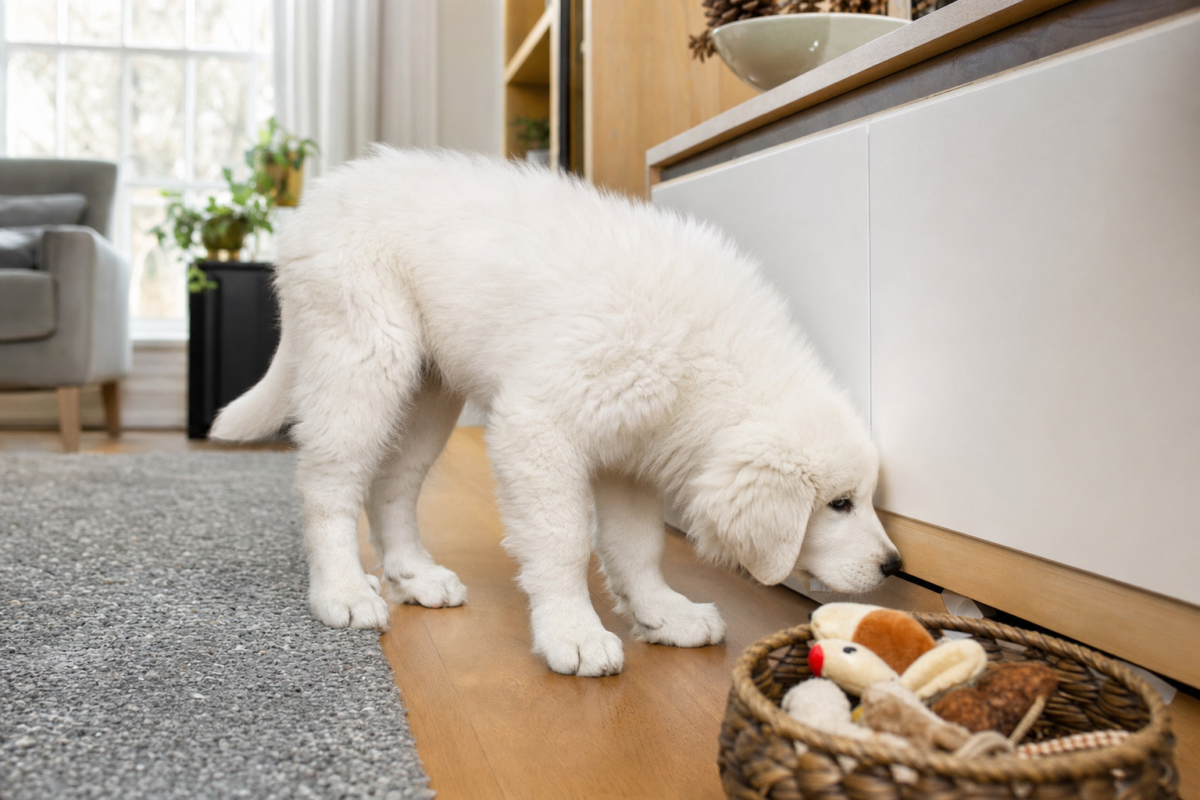
To puppy proof your home for a large breed puppy, secure three zones rather than one. Clear the floor of anything swallowable, then clear every surface a tall puppy can reach standing up, which for a giant breed means counters and tables by six months. Add traction on slippery floors, gate the stairs, block access to furniture your puppy will want to leap off, and secure heavy items that a growing body can topple. Big puppies reach higher, pull harder and hit the floor with more force than small ones, so the goal is a home that protects developing joints as much as it protects your belongings.
Bringing home a large breed puppy is one of the best days there is, and it comes with a very specific kind of homework. A big puppy is not simply a small puppy scaled up. Within a few months your eight week old bundle can look over the kitchen counter and slide the length of a hallway on a polished floor. Getting the house ready before that happens gives those growing joints a gentle place to grow up in. This is the room by room checklist for any new big dog parent.
How do I puppy proof my home for a large breed puppy?
Puppy proof a large breed puppy by working in three layers. First the floor layer, where you remove cords, small objects, toxic plants and anything a mouthy puppy could swallow. Second the reach layer, which climbs from knee height at eight weeks to counter height by around six months, so food, medication and cleaning products move higher than you think they need to. Third the movement layer, which is the one most people skip. Add runners on slippery floors, gate the stairs, make furniture harder to leap off, and keep a clear path between the door, the water bowl and the bed.
That third layer matters because a large breed puppy carries real weight on a frame that is still forming. A slip on tile or a repeated jump off a sofa asks a lot of joints that have not finished developing, and managing the environment works every day whether you are watching or not.
What makes puppy proofing different for a large breed
Every puppy chews, explores and gets into trouble. What changes with a large breed is scale, speed and force. A Labrador puppy gains roughly its own body weight every few weeks through the first months, and a giant breed can go from ten pounds to a hundred inside a year. Your safety margin keeps shrinking while the puppy stays mentally young.
Reach is the first thing that surprises people. A four month old large breed puppy can rest its chin on a coffee table, and by six months many can plant both front paws on a counter and take whatever sits nearest the edge. Meanwhile the brain is still a puppy brain, curious and impulsive, so you cannot rely on training alone during this stretch.
Strength is the second, so anything tall and light needs anchoring against a shoulder check from a dog that does not know its own size. The third difference is the one you cannot see. Underneath all that growth, the growth plates at the ends of the long bones stay open through much of the first year. While they are open, hard impact and slippery footing ask more of a frame that is still forming. That is why puppy proofing a big dog home is partly a household safety job and partly a joint care job.
Room by room puppy proofing checklist
Work through the house one room at a time. Sit on the floor and look around at puppy eye level, then check again at counter level, because your puppy will reach both before long.
| Room | What to secure | Why it matters for a big puppy |
|---|---|---|
| Kitchen | Bin with a locking lid, low cupboard latches, cleaning products moved high, nothing left near the counter edge | Counter surfing arrives early and food theft is a common reason big puppies see a vet |
| Living room | Cords bundled, remote controls away, bookcases and lamps anchored, rugs on slippery floor | Tall furniture topples easily and hard floors offer no grip |
| Stairs and hallway | Sturdy gate at the top and bottom, runner on polished treads, clear walkway | Repeated stair use on open growth plates is best limited |
| Bedroom | Shoes and laundry away, bedside medication out of reach, low bed frames considered | Fabric and shoe swallowing is an emergency risk at this size |
| Bathroom | Door closed or latched, bin lidded, medication and razors up high | A curious head reaches every surface by five months |
| Garage and utility | Antifreeze, fertiliser, pest bait and tools locked away, door kept shut | The most concentrated household toxins live here |
| Garden | Fence height checked and gaps closed, toxic plants removed, pool or pond fenced | A growing dog clears a low fence long before it is grown |
The American Kennel Club’s Chief Veterinary Officer, Dr. Jerry Klein, DVM, has written extensively on the slower growth and development timeline of large and giant breeds. Read more from the AKC’s guidance on caring for large-breed dogs.
When does the chewing and exploring stage end?
Most large breed puppies chew hardest between three and seven months while adult teeth come in, then settle noticeably after the first year. Full mental maturity often arrives closer to two years, and later still in a giant breed. Plan for the physical proofing to stay in place for the first year, then relax supervision gradually rather than on a single birthday.
Why the growth window matters here
Large and giant breeds keep building bone, cartilage and connective tissue across a growth window of roughly 8 to 30 months, depending on expected adult weight. Across that window good footing, limited stairs, fewer hard landings and a lean body condition all support healthy joint development.
Slippery Floors
Tile, laminate and polished wood give a heavy puppy no grip. Splayed legs and skidding stops load young joints hard.
Furniture Leaps
Jumping down from a sofa or bed is a real drop for a growing frame. Steps, ramps or a firm no beat repeated landings.
Swallowed Objects
A big mouth swallows socks, corn cobs and toys whole. This is the most common household emergency in big puppies.
Toppling Items
Bookcases, floor lamps and televisions come down easily under a shoulder from a dog that does not know its own weight.
Flooring and footing, the step most people skip
If you only do one thing from this guide, make it this one. Smooth flooring is the most overlooked hazard in a big dog home, because nothing dramatic happens on any given day. What happens instead is hundreds of small slips through the months when the frame is forming.
- Lay runners with grippy backing along the routes your puppy actually uses, which usually means the hallway, the kitchen path and the landing spot by the door.
- Keep the fur between the paw pads trimmed. Long tufts act like little skis on smooth floors.
- Trim nails often. Long nails change how the paw meets the ground and reduce grip.
How to check your floors in ten seconds
Call your puppy across the room and watch the last three strides.
- Feet. If the back feet scrabble or the legs slide outward as your puppy stops, the surface is too slick.
- Turns. Watch a corner. A puppy that swings wide to avoid losing grip is telling you the floor is a problem.
- Confidence. A puppy that creeps low instead of walking normally has already learned not to trust that surface.
Any of those three is a signal to add a runner along that route today.
Setting up safe movement around the home
Once the hazards are handled, look at how your puppy moves through the day. The goal is gentle activity with far fewer hard impacts.
- Gate the stairs at both ends and carry small puppies where you safely can. See stairs and big breed puppies before you settle on a routine.
- Discourage jumping off sofas and beds. A comfortable floor bed nearby makes the sofa less appealing.
- Use a car ramp rather than letting your puppy leap from the boot.
- Give your puppy a quiet space, such as a crate or pen with good bedding, so rest is genuinely restful.
Daily habits that support growing joints
A well proofed home does its work quietly. Alongside it, the daily routine you build in the first year carries just as much weight. Feed a complete food formulated for large breed puppies, keep your puppy lean enough to feel the ribs under a light layer, and keep exercise steady and moderate rather than long and hard.
Many big dog parents also add a daily joint support chew made specifically for large and giant breeds. MoveGuard Growth is built for this stage. It brings together nine actives, including New Zealand Green Lipped Mussel, glucosamine, chondroitin, MSM and hyaluronic acid, to support healthy joint development across the roughly 8 to 30 month growth window. You dose by expected adult weight, so a puppy heading for 50 to 80 pounds takes two chews a day and one heading for 80 to 100 pounds or more takes three. It ships as 90 chicken liver flavour chews, is made in the USA in an NSF facility, and is backed by a 60 day guarantee.
Start The Growth Window Right
Give your growing puppy daily joint support built for large and giant breeds. Explore MoveGuard Growth.
Signs your setup is working
You will know the house is right when the day stops feeling like a chase. Your puppy moves confidently across every floor, the bin stays shut, nothing goes missing from the counters, and you find yourself saying no far less often.
Watch your puppy move as well. Smooth strides and an easy sit and stand are good signs. If you notice limping, stiffness after a nap or a sudden avoidance of a floor your puppy used to cross happily, mention it to your veterinarian early.
A stage by stage puppy proofing plan
You do not have to do everything on day one. Match the work to the stage your puppy is actually in.
8 weeks to 4 months. Floor level stage. Clear cords, small objects and toxic plants, set up the crate or pen, lay your first runners and fit the stair gates. Supervision does most of the work here, so keep your puppy in the room you are in.
4 to 8 months. Reach stage. Everything moves higher. Clear the counters, anchor bookcases and lamps, latch the low cupboards and lid the bins. Chewing peaks here, so rotate safe chews and keep laundry off the floor.
8 to 18 months. Strength stage. Recheck fence height and gaps, since a growing puppy can clear a barrier that held last month. Keep the traction and stair rules going. Your dog looks adult now but the frame is still finishing.
18 months and beyond. Relax gradually. Chewing risk fades and judgement improves, so latches and pens can come out. Keep the runners, the car ramp and the no jumping habits. Those pay off across adult life.
Common puppy proofing mistakes to avoid
Most of the trouble we hear about comes from a short list of very fixable oversights.
- Proofing once and calling it done. What was out of reach in March is not in June, so walk the house again every month.
- Forgetting the vertical. People clear the floor beautifully and leave the counters loaded. For a big breed the counter is the more important surface.
- Ignoring the floors. Slippery footing is invisible as a hazard because nothing bad happens in one moment.
- Relying on training instead of management. A gate works when you are asleep. A recall cue does not, and furniture jumping that is adorable at twelve weeks is a hundred pound habit at eighteen months.
- Leaving the bin accessible. Food theft from bins sends more big puppies to the clinic than almost anything else in the home.
The big puppy mind and why management beats correction
Large breeds are smart, social and highly motivated by food and company. That is a wonderful combination in an adult and a demanding one in a puppy. A bright big puppy left alone with an interesting counter will experiment, and if the experiment works once it becomes a habit that is hard to undo.
This is why the household setup matters more than correction does. Every time your puppy fails to reach the bin or fails to find a shoe, you are not just avoiding one incident. You are preventing a rewarding behaviour from ever taking root. Management is not a shortcut around training. It is what makes training possible, because your puppy spends the first year practising the habits you want instead of the ones you do not. Pair it with short, positive training sessions and plenty of chewing outlets, and Dog Parents usually find the whole first year calmer than they expected.
Frequently asked questions
How high should I move things for a large breed puppy?
Plan for kitchen counter height, roughly 36 inches, by six months for most large breeds. Giant breeds reach higher still on their back legs, so treat high shelves as the genuinely safe zone for medication and food.
Do I really need baby gates for a big puppy?
Yes, especially at the stairs. Gates limit repeated stair use while growth plates are open and they keep your puppy in the room you are in. Choose a tall, pressure rated gate rather than a light plastic one.
What household items are most dangerous for large breed puppies?
The bin, medication, cleaning products, antifreeze, cooked bones, corn cobs and socks are the usual culprits. A large mouth can swallow whole what a small dog would only chew, which makes blockage a real risk. Ask your veterinarian immediately if you suspect your puppy has swallowed something.
Are slippery floors really a problem for puppies?
Smooth flooring gives a heavy growing puppy very little grip, which leads to skidding stops and splayed legs. Runners with grippy backing, trimmed paw fur and short nails improve footing and support comfortable movement while the frame develops.
When can I stop puppy proofing my house?
Most large breeds are far less destructive after the first year, but reach and strength keep growing. Retire the pens and latches gradually after 18 months, and keep the runners, the car ramp and the no jumping habits for life.
The bottom line
Puppy proofing for a large breed is a moving target rather than a single weekend job. Clear the floor, then clear every surface your puppy will reach next month, then fix the footing and the stairs so the home itself supports a growing frame. Walk the house again each month, keep feeding lean, and build the daily habits that carry through the growth window. Do that and the first year brings fewer emergencies and a big dog who grows up moving comfortably in a home built to fit.
Want the Simple Roadmap in One Place?
Grab our free Big Dog Growth Blueprint for the growth window checklist, feeding framework and joint safe exercise limits, all written for large and giant breeds.
This article is for general educational purposes only and is not veterinary advice. It is not intended to diagnose, treat, cure or prevent any disease. Always consult your veterinarian about your dog’s individual health, nutrition and supplement needs. These statements have not been evaluated by the Food and Drug Administration.
Support Big Breed Joints from Day One
Large and giant breeds carry more load through every growth stage. MoveGuard Growth supports developing joints in young big dogs (8 to 30 months); MoveGuard Adult keeps grown big dogs moving comfortably.
Leave a Reply