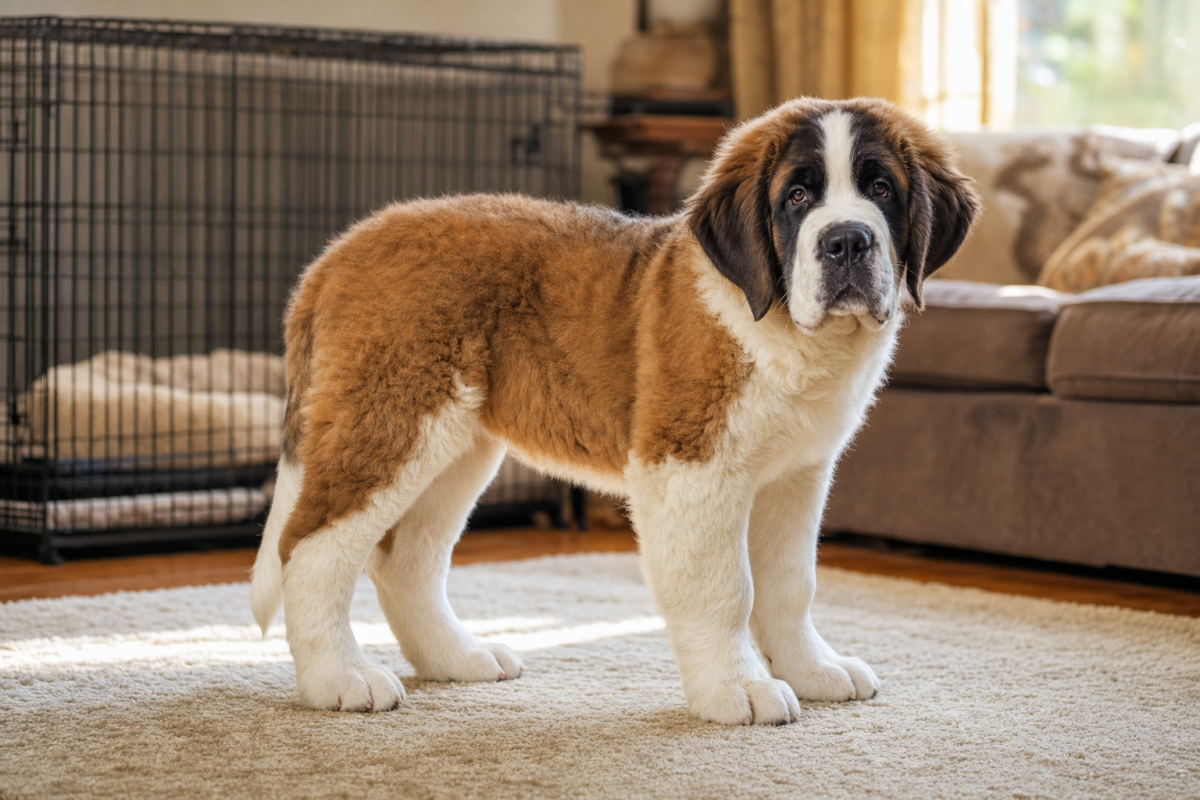
A new large breed puppy needs a crate sized for the adult dog with a divider, a supportive bed, a large breed puppy food, adjustable collar and lead, non slip rugs over hard floors, a car ramp or harness, baby gates for stairs, big durable chew toys, grooming basics, and a first veterinary appointment booked before arrival. Buy the crate and the bed for the dog your puppy will become, not the one who arrives.
Bringing home a puppy who will one day weigh more than a person is a different exercise from bringing home a small dog. Half the usual puppy list is wrong within a month, because everything you buy is outgrown at speed, and a few items that barely matter for a small breed genuinely matter here. This checklist is built for large and giant breeds, sorted by what to buy before arrival, what to size for the adult, and what to leave until later.
What do I need for a new large breed puppy?
You need eight essentials before your puppy walks through the door: a crate sized for the adult dog with a divider, a supportive bed, a complete large breed puppy food, food and water bowls, an adjustable collar with identification, a fixed length lead, non slip rugs on any hard floors, and baby gates to block stairs. Everything else can follow in the first fortnight.
The one habit that separates a smooth first month from an expensive one is buying for the adult size wherever the item allows it. A crate, a bed and a set of gates bought at puppy scale will be replaced twice before your dog is a year old.
Buy before your puppy arrives
The Day One Essentials
- Crate in adult size with a divider panel, so the space grows with your puppy
- Supportive bed large enough to lie flat on one side, with a washable cover
- Complete food formulated for large or giant breed puppies
- Sturdy food and water bowls, ideally the kind that will not slide or tip
- Adjustable collar with an identification tag, plus a fixed length lead
- Non slip rugs or runners across tile, laminate and polished wood
- Baby gates for stairs and for any room you want to keep puppy free
- Enzymatic cleaner, poop bags and a stack of old towels
Book the first veterinary appointment before your puppy comes home rather than after. Practices fill up, and the first visit sets the vaccination and weighing schedule that everything else hangs off.
Buy for the adult, not the puppy
Some gear should be bought once, at adult size. Other items genuinely need to fit today. Getting that split right saves a surprising amount of money across the first year.
| Item | Buy for now or for adult size | Why |
|---|---|---|
| Crate | Adult size with divider | A giant breed crate is an expensive item to buy twice |
| Bed | Adult size | Puppies grow into them quickly and sprawl from the start |
| Baby gates | Adult height | A tall adolescent steps over a short gate without breaking stride |
| Collar | Now, adjustable | Expect to replace it two or three times in the first year |
| Harness | Now, adjustable | Fit matters more than longevity, and shoulders must move freely |
| Car ramp | Adult size | You will need the full length sooner than you think |
| Food bowls | Now | Cheap to replace, and portion size changes constantly |
The American Kennel Club’s Chief Veterinary Officer, Dr. Jerry Klein, DVM, has written extensively on the slower growth and development timeline of large and giant breeds. Read more from the AKC’s guidance on caring for large-breed dogs.
What large breed puppies need that others do not
A few items sit near the bottom of a general puppy list and near the top of this one, purely because of size and the speed of growth.
The Big Dog Additions
- Traction on floors. Rugs, runners and mats around food bowls stop a heavy puppy splaying on smooth surfaces
- A car ramp or a lift assist, so your puppy never has to leap down onto hard ground
- A long training line for recall practice, since a big adolescent is not a dog you improvise with
- Chew toys sized generously for a big mouth, because anything small becomes a hazard fast
- A bathroom scale and a note on your phone, so you can track the growth curve every two weeks
- Daily joint support for the growth window, started early rather than after signs appear
- Nail clippers or a grinder built for thick nails, and a brush suited to the coat
Two more worth raising with your veterinarian at the first visit. Ask whether a raised bowl suits your breed, since opinions differ for deep chested dogs, and ask about the timing of neutering or spaying, because it can influence when growth plates close and therefore final height.
Puppy proofing at big dog height
Standard puppy proofing assumes a dog who can reach about a foot off the floor. Your puppy will clear a kitchen counter on their back legs before their first birthday, so it pays to proof twice: once for the puppy who arrives and once for the adolescent who turns up a few months later.
Proof For The Adolescent
- Clear counters and the hob of anything edible, and move the bin behind a door or into a cupboard
- Secure loose cables, phone chargers and anything trailing at nose height
- Move houseplants well out of reach and check which of them are safe around dogs
- Latch low cupboards, especially the one holding cleaning products or the food bin
- Walk the garden fence line looking for gaps, loose panels and gates that do not latch
- Decide now whether the sofa and the bed are allowed, because a 100 pound dog will hold you to the answer
Slippery Floors
Bare tile and polished wood cause splayed legs and awkward landings. Traction is the cheapest fix on this list.
Stairs And Jumping
Gates while young and a ramp for the car. Repeated leaping loads open growth plates.
The Wrong Food
Standard puppy formulas are richer than a big breed needs. Large breed formulas control calcium and calories.
Small Toys
What is a chew toy for a small dog is a swallowing hazard for a mouth this size. Buy generously.
How much should a large breed puppy eat?
Large and giant breed puppies do best on steady, moderate growth. A few habits make a real difference:
- Choose a complete food formulated for large or giant breed puppies, which balances calories, calcium and phosphorus for steadier growth.
- Split the daily amount into three meals while young, then two as an adult.
- Feed to a lean body condition. You should feel the ribs easily under a light layer.
- Change food gradually over a week, mixing the new into the old, since a sudden switch upsets most puppies.
- Ask your veterinarian to confirm the daily amount at each checkup.
How to check body condition in ten seconds
The scale tells you weight, but body condition tells you health.
- Ribs. Run your hands along the sides. You should feel the ribs under a thin layer. If you have to press, ease back on food.
- Waist. From above, you want a clear waist that tucks in behind the ribs.
- Tuck. From the side, the belly should rise toward the back legs rather than hang level.
Growth safe exercise from day one
Big puppies need movement, but during the fast growth months the goal is regular, moderate activity rather than repeated hard impact.
- Favour free play, sniffing walks and gentle exploring on soft ground such as grass.
- Keep long runs, forced jogging and repeated jumping moderate while the growth plates are open.
- Lift or ramp your puppy in and out of the car rather than letting them leap down.
- Add early training and scent games, which satisfy a young dog without pounding on joints.
- Let your puppy rest fully between bursts.
The item most new parents add late
Joint support is the one thing people tend to buy in year three, having wished they had started it in year one. Every pound your puppy gains travels through joints that are still forming, and the growth window is the moment that support is most useful.
Alongside lean feeding and sensible exercise, many big dog parents add a daily joint support chew made for large and giant breeds. MoveGuard Growth is built for exactly this stage. It combines nine actives, including New Zealand Green Lipped Mussel, glucosamine, chondroitin, MSM and hyaluronic acid, to support the developing joints of young large and giant breed dogs across the roughly 8 to 30 month growth window. You dose by expected adult weight, so 50 to 80 pounds is two chews a day and 80 to 100 pounds and above is three. It is made in the USA, arrives as a 90 chew jar at about $39.99 on subscription, and is backed by a 60 day guarantee.
Start The Habit Early
Add daily joint support built for large and giant breeds to your puppy checklist. Explore MoveGuard Growth.
The first week, day by day
The kit matters less than the routine you build with it. Keep the first week calm and predictable.
Day one. Quiet arrival, one room, the crate open and comfortable. Let your puppy explore at their own pace and resist inviting the neighbourhood round. Offer the food the breeder was using.
Days two and three. Establish the rhythm. Three meals at set times, frequent trips outside, short handling sessions so nail trims and ear checks feel ordinary later. Start crate rest as a normal part of the day rather than a punishment.
Days four to seven. First veterinary visit and first weigh in. Begin gentle recall in the garden, introduce the car with the ramp and a short trip, and start socialisation carefully as your veterinarian advises.
Admin To Sort In Week One
- Register the microchip in your name, which is the step most often missed
- Put your phone number on the identification tag, not the dog’s name
- Arrange insurance early, before anything is on record
- File the breeder paperwork, vaccination card and any pedigree together
- Note the sire and dam weights while you remember them, since they are the best guide to adult size
- Start the weight log and add a fortnightly reminder to your calendar
Common first month mistakes to avoid
Most trouble in the first month comes from a few avoidable habits.
- Buying small. A puppy sized crate and bed will be outgrown before you finish paying for them.
- Overfeeding for size. A heavy puppy is not a healthier one. Extra weight loads joints at the wrong moment.
- Leaving floors bare. Traction is the single cheapest protective purchase you will make.
- Skipping the training line. Recall is far easier to teach at 30 pounds than at 110.
- Letting jumping become normal. Off the sofa, out of the car, up at visitors. All of it is harder to undo later.
What it costs to get started
Kitting out a big puppy properly costs more than the small dog equivalent, mostly because the crate, the bed and the gates are all larger. Expect the crate to be the single biggest line, followed by the bed, with food running higher every month as portions climb. Rough guidance for the one off items looks like this.
| Item | Typical spend | Bought once or repeatedly |
|---|---|---|
| Adult size crate with divider | Highest single item | Once |
| Supportive adult bed | Second highest | Once, plus spare covers |
| Car ramp | Moderate | Once |
| Baby gates | Moderate, more if you need several | Once |
| Collar, harness and lead | Low each time | Two or three times in year one |
| Rugs and runners | Low | Once, replaced as they wear |
| Food and joint support | Ongoing, rising with size | Monthly |
The good news is that the adult size items are bought once. Spend there, keep collars and bowls cheap and replaceable, and skip the boutique extras until you know what your puppy actually likes. Most big dogs turn out to want a solid chew, a soft place to sprawl and your company, in that order.
Frequently asked questions
What do I need for a new large breed puppy?
The eight essentials are a crate in adult size with a divider, a supportive bed, a large breed puppy food, sturdy bowls, an adjustable collar with identification, a fixed length lead, non slip rugs on hard floors, and baby gates for stairs. Book the first veterinary appointment before arrival.
What size crate does a large breed puppy need?
Buy the crate your adult dog will need and use a divider to shrink it for now. Most large breeds settle in a 48 inch crate and most giant breeds need 54 inches. Your dog should be able to stand, turn around and lie flat on one side.
When should a large breed puppy start joint support?
Many big dog parents begin during the fast growth months rather than waiting, since the growth window runs from roughly 8 to 30 months in large and giant breeds. Dose by expected adult weight and speak with your veterinarian about your individual dog.
What should I feed a new large breed puppy?
A complete food formulated for large or giant breed puppies, because those formulas control calcium and calories for steadier growth. Start with whatever the breeder was feeding and change over across a week to avoid an upset stomach.
How much exercise does a large breed puppy need?
Regular, moderate activity rather than long or hard sessions. Free play, sniffing walks and gentle exploring on soft ground suit a growing frame, while long runs and repeated jumping are best kept moderate while the growth plates are open.
The bottom line
Buy the crate, the bed and the gates for the dog your puppy is going to become. Put rugs down before the first zoomies. Feed a large breed puppy formula to a lean body condition, keep exercise gentle while the frame is forming, and start the joint routine early rather than late. Get those five right and the rest of the list is detail.
Want the Simple Roadmap in One Place?
Grab our free Big Dog Growth Blueprint for the growth window checklist, feeding framework and joint safe exercise limits, all written for large and giant breeds.
This article is for general educational purposes only and is not veterinary advice. It is not intended to diagnose, treat, cure or prevent any disease. Always consult your veterinarian about your dog’s individual health, nutrition and supplement needs. These statements have not been evaluated by the Food and Drug Administration.
Support Big Breed Joints from Day One
Large and giant breeds carry more load through every growth stage. MoveGuard Growth supports developing joints in young big dogs (8 to 30 months); MoveGuard Adult keeps grown big dogs moving comfortably.
Leave a Reply