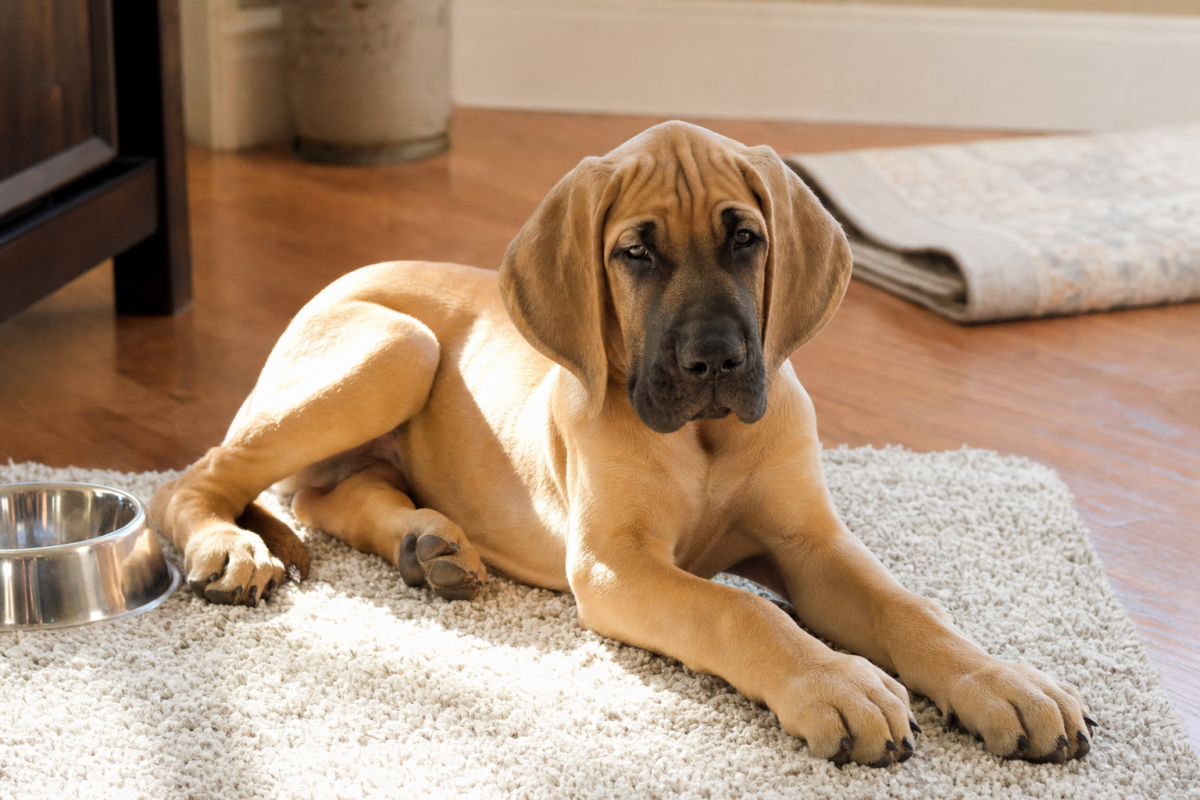
In the first month with a giant breed puppy, expect rapid growth, three meals a day, broken nights for the first week or two, and a puppy who may gain 15 to 25 pounds in those four weeks alone. Your priorities are a complete large breed puppy food, secure footing on slippery floors, gentle and frequent socialisation, short bursts of free play rather than structured walks, and a calm routine your puppy can predict. Everything else can wait.
Bringing home a giant breed puppy is one of the great joys of dog ownership, and one of the busiest months of your year. That soft, sleepy bundle will grow faster in the next four weeks than a small breed dog grows in six months, which means the habits you set now travel with your dog for the next decade. This guide walks you through what to expect week by week, what genuinely matters, and what you can safely ignore.
What should I expect in the first month with a giant breed puppy?
Expect fast growth, a lot of sleep, and a steep learning curve for everyone. A giant breed puppy typically comes home at eight weeks weighing somewhere between 18 and 30 pounds and can add 4 to 7 pounds every week through the first month. Alongside that growth you should expect three meals a day, house training accidents, some crying at night for the first week, and roughly 18 to 20 hours of sleep across each 24 hour period.
What you should not expect is a training schedule. In month one your job is simply to be predictable and kind. Feed on time, sleep in the same place, keep the floor safe underfoot, and let your puppy meet the world in small, positive doses. Structure matters far more than ambition at this age.
What makes the first month different for a giant breed
Every puppy needs food, sleep and safety. What changes with a giant breed is scale and speed. A puppy destined to weigh 130 pounds is building bone at a pace no other companion animal matches, and that skeleton is soft, flexible and easily overloaded while it forms. Two practical consequences follow.
First, the way you feed matters enormously. Growing too fast is a genuine concern in giant breeds, and it is driven almost entirely by calories and calcium in the bowl. Second, the way your puppy moves matters. A clumsy, top heavy baby sliding across a tiled kitchen or bouncing down a full flight of stairs is asking a great deal of joints that are still soft. Neither problem needs an expensive solution. Both need attention from day one.
There is a third difference that catches new giant breed parents by surprise, and it is emotional rather than physical. Your puppy will change shape almost weekly, and a body that seems perfectly proportioned one week can look leggy, knock kneed or oddly narrow the next. That uneven, slightly awkward look is normal in fast growing breeds. What matters is the overall trend and the body condition underneath, not any single week.
Week by week through the first month
Here is a realistic map of what those four weeks usually look like. Every puppy runs on its own clock, so treat this as a rhythm rather than a schedule.
| Week | What is happening | Your focus |
|---|---|---|
| Week 1 | Settling in, broken nights, cautious appetite | Routine, safe footing, crate as a calm den |
| Week 2 | Confidence rises, play gets bolder, appetite climbs | House training rhythm, first vet visit, gentle handling |
| Week 3 | Fast growth, sharper teeth, testing boundaries | Socialisation in small doses, calm rules around food |
| Week 4 | Noticeably bigger, more coordinated, longer awake periods | Short outings, portion review, steady joint habits |
The American Kennel Club’s Chief Veterinary Officer, Dr. Jerry Klein, DVM, has written extensively on the slower growth and development timeline of large and giant breeds. Read more from the AKC’s guidance on caring for large-breed dogs.
Nights and house training in week one
The first few nights are usually the hardest part of the whole month, and they pass faster than you expect. Your puppy has just left a warm pile of siblings, so some crying is normal and it is not manipulation. Place the crate beside your bed for the first week so your puppy can hear and smell you, then move it gradually if you want it elsewhere. Most puppies settle within three to five nights when they are not left alone to cry.
House training runs on the same principle of predictability. Take your puppy out on waking, after every meal, after play and roughly every hour in between, and reward the moment it finishes rather than when it comes back inside. Accidents are information, not failure. Clean them with an enzyme cleaner so the scent does not invite a repeat, and simply increase the frequency of trips for a day or two. Most giant breed puppies are reliable through the night by around twelve to sixteen weeks, once bladder capacity catches up with the rest of that fast growing body.
Before your puppy comes home: the setup that matters
Giant breed puppies grow into their surroundings faster than you expect, so buy for the adult wherever you sensibly can. A short list covers most of it:
- Traction. Runners or rugs across any tile, laminate or polished wood your puppy will cross daily. This is the single highest value purchase of month one.
- A crate sized for the adult with a divider, so it grows with your puppy rather than being replaced twice.
- A stair gate at the top and bottom of stairs. Carrying is fine now and impossible in three months, so gate instead.
- A complete large breed puppy food confirmed with your breeder and veterinarian, along with a plan to transition slowly.
- A flat collar and a well fitted harness, plus a lead you are happy to hold when the dog weighs a hundred pounds.
Our new large breed puppy checklist covers the full list if you would like to tick items off as you go.
Slippery Floors
Splayed legs on hard flooring load young joints awkwardly. Rugs and runners solve it for the price of a bag of food.
Stairs And Jumping
Repeated impact on open growth plates is a lot to ask. Gate the stairs and lift into the car.
Overfeeding
A chubby giant puppy is not a thriving one. Extra weight rides on a frame that is still forming.
Too Much Too Soon
Long walks, busy places and endless visitors overwhelm a young puppy. Short and positive beats long and stressful.
Feeding a giant breed puppy in month one
Feeding is where you have the most influence and the least room for improvisation. Giant breed puppies do best on steady, moderate growth, which comes from the right food in the right amount rather than from more of it.
- Feed a complete food formulated for large breed puppies. These formulas control calcium, phosphorus and calorie density for slower, steadier growth.
- Split the daily amount into three meals while your puppy is young, moving to two meals later in the first year.
- Transition from the breeder food over seven to ten days by mixing gradually, which keeps the gut settled during an already unsettling week.
- Do not add calcium supplements or extra meat to a complete puppy food. The balance is already set and adding to it works against you.
- Review portions every two weeks. What was right a fortnight ago is rarely right today at this growth rate.
If you want portions mapped against weight as your puppy grows, our large breed puppy feeding chart by weight lays it out clearly.
How to check body condition in ten seconds
The scale tells you weight. Body condition tells you whether that weight suits your puppy.
- Ribs. Run your hands along the sides. You should feel the ribs under a thin layer. If you have to press, ease back on food.
- Waist. Look down from above. You want a clear waist that tucks in behind the ribs.
- Tuck. From the side, the belly should rise toward the back legs rather than hanging level.
Check every couple of weeks through the growth years and adjust portions gently with your veterinarian’s guidance.
Movement and play in the first four weeks
A giant breed puppy at eight to twelve weeks does not need walks. It needs safe surfaces, freedom to potter, and permission to sleep whenever it wants. Formal exercise arrives later and in small amounts.
- Favour free play in a garden or a safe room over structured walks on pavement.
- Skip stairs, repeated jumping and long distances entirely this month.
- Carry your puppy in and out of the car while you still comfortably can.
- Let sleep happen. Growth is built during rest, and an overtired puppy behaves far worse than a rested one.
Supporting joints from the very beginning
The first month is when the frame that will carry your dog for a decade starts taking shape. Traction underfoot, lean feeding and unhurried movement do most of the work, and they cost nothing but attention. This is also the natural moment to think about long term joint support rather than waiting until your dog is fully grown.
Many big dog parents add a daily joint chew as part of that routine. MoveGuard Growth is built for this stage. It combines nine actives, including New Zealand Green Lipped Mussel, glucosamine, chondroitin, MSM and hyaluronic acid, to support the developing joints of young large breed dogs across the roughly 8 to 30 month growth window. You dose by expected adult weight rather than current weight, so a puppy heading for 100 pounds or more sits at three chews a day. It ships as 90 chews in a chicken liver flavour, is made in the USA, and is backed by a 60 day guarantee. Confirm timing with your veterinarian at that first checkup.
Start The Habit Early
Give your growing giant daily joint support built for large and giant breeds. Explore MoveGuard Growth.
Signs your giant puppy is settling in well
Four weeks in, a puppy who is thriving eats keenly, sleeps deeply, plays in bursts and recovers quickly, and shows curiosity rather than fear about new things. Stools are firm, movement is loose and even, and you can feel ribs under a thin layer of covering.
Speak with your veterinarian if you see limping, stiffness after rest, reluctance to bear weight on a leg, persistent loose stools, or a puppy who seems flat rather than simply sleepy. At this age problems are much easier to address early.
Socialisation and training in month one
Socialisation is the highest value thing you will do this month, and it is widely misunderstood. It does not mean meeting as many dogs as possible. It means letting your puppy experience the ordinary world in small, positive, low pressure doses so that none of it becomes frightening later.
Introduce surfaces, sounds, hats, umbrellas, the vacuum, car journeys and calm adult dogs, always at a distance your puppy can handle. Reward calm curiosity. Never flood a puppy with something it finds scary in the hope it will adjust. A giant breed adult that is fearful of the world is a genuinely difficult dog to live with, and month one is when you prevent that.
Formal training can stay simple. Name recognition, a hand target, sitting for food and settling on a mat are plenty. Keep sessions to two or three minutes and end while your puppy is still enjoying it. It is also worth teaching handling now, while your puppy is small enough to hold comfortably. Touch the paws, look in the ears, run a hand along the legs and reward calm acceptance. A hundred pound adult who has always had its feet handled is a very different veterinary appointment from one who has not.
Common first month mistakes to avoid
Almost every first month problem traces back to a handful of habits.
- Free feeding. Leaving food down all day removes your ability to manage growth. Measure meals and take the bowl up.
- Buying puppy sized gear. Crates, beds and bowls sized for the puppy in front of you will be outgrown within weeks.
- Skipping traction. Slippery flooring is the most overlooked hazard in a giant breed home.
- Too many visitors. A parade of excited guests in week one delays settling and teaches your puppy that arrivals mean chaos.
- Waiting to socialise. The window is open now. Ask your veterinarian how to socialise safely before the vaccination course is complete.
Frequently asked questions
How much does a giant breed puppy grow in the first month?
Most giant breed puppies gain roughly 4 to 7 pounds a week between eight and twelve weeks of age, so a total gain of about 15 to 25 pounds across the first month at home is typical. Growth rate varies with breed, sex and individual line.
How many meals a day should a giant breed puppy have?
Three meals a day suits most giant breed puppies through the first several months, moving to two meals later in the first year. Measured meals at set times give you far more control over growth rate than leaving food available all day.
When can a giant breed puppy start going for walks?
Formal walks usually begin once the vaccination course is complete, and they should stay short at first. During month one, free play on safe footing and carrying your puppy to new places for socialisation are more appropriate than structured walking on pavement.
Should I let my giant breed puppy use the stairs?
Most veterinarians suggest limiting stairs while growth plates are open, especially repeated trips up and down. Gating the stairs and carrying your puppy while it is still light is the simplest approach in the first month.
Is it normal for a giant breed puppy to sleep all day?
Yes. A puppy of this age typically sleeps 18 to 20 hours across a 24 hour period, and that sleep is when growth happens. A puppy who is difficult to rouse, or flat rather than sleepy, is worth a conversation with your veterinarian.
The bottom line
Month one with a giant breed puppy is not about training milestones. It is about traction underfoot, measured meals of the right food, generous sleep, gentle socialisation and a routine your puppy can rely on. Do those five things well and you will finish the month with a confident, comfortable puppy and habits that support the whole growth window ahead.
Want the simple roadmap in one place? Grab our free Big Dog Growth Blueprint for the growth window checklist, feeding framework and joint safe exercise limits.
This article is for general educational purposes only and is not veterinary advice. It is not intended to diagnose, treat, cure or prevent any disease. Always consult your veterinarian about your dog’s individual health, nutrition and supplement needs. These statements have not been evaluated by the Food and Drug Administration.
Support Big Breed Joints from Day One
Large and giant breeds carry more load through every growth stage. MoveGuard Growth supports developing joints in young big dogs (8 to 30 months); MoveGuard Adult keeps grown big dogs moving comfortably.
Leave a Reply