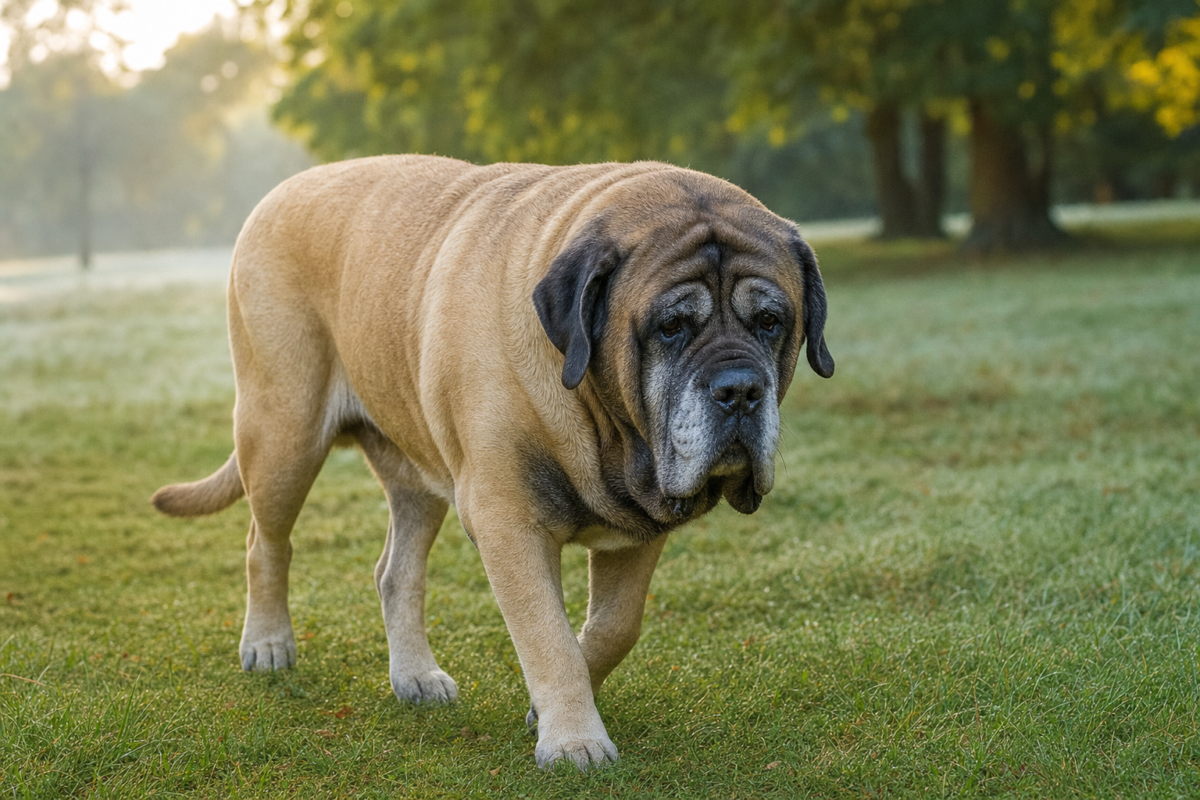
Most senior large breed dogs do best on 30 to 60 minutes of gentle activity a day, broken into two or three shorter outings rather than one long walk. Aim for steady walking on soft, even ground, add swimming or gentle hill work where your dog enjoys it, and finish every session before your dog wants to stop. The goal changes with age: you are no longer building fitness, you are maintaining muscle, keeping joints moving comfortably and protecting a body that recovers more slowly than it used to.
There is a particular moment every big dog parent recognises. Your dog still meets you at the door with the lead in their mouth, still loves the walk, and yet somewhere on the way home the spring has gone out of the step, and the next morning they are slower getting up. Nothing is wrong exactly. Your dog is simply older, and the routine that suited a five year old does not quite fit a ten year old. This guide is about rebuilding that routine so your senior keeps moving, keeps muscle, and keeps the joy of the walk without paying for it the following day.
How much exercise does a senior large breed dog need?
A senior large breed dog generally needs 30 to 60 minutes of gentle activity a day, split across two or three shorter sessions. Twenty minutes in the morning, twenty in the evening and a short sniff around the garden at midday suits most big seniors far better than a single hour long march. Keep the pace steady, the surface soft and even, and the duration well inside what your dog can comfortably repeat tomorrow.
Individual dogs vary enormously, so treat that range as a starting point and let your dog’s recovery set the real number. The test is not how your dog looks during the walk. It is how they rise from their bed the next morning. A senior who gets up easily the day after is being asked exactly the right amount.
When does a large breed dog become a senior?
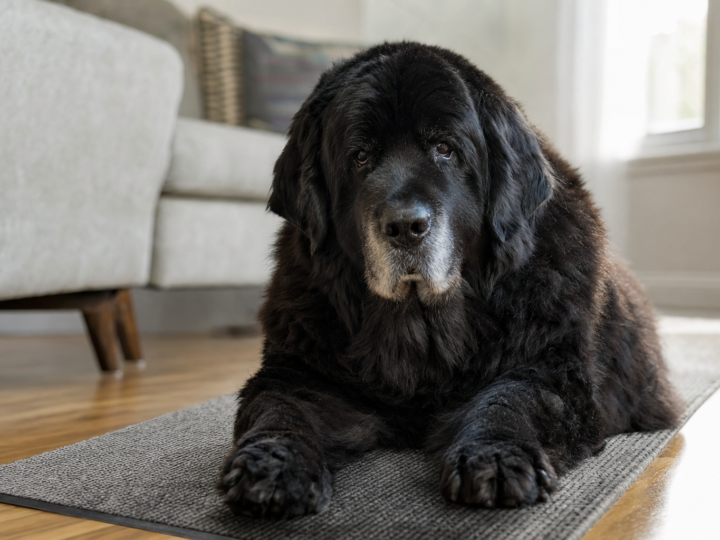
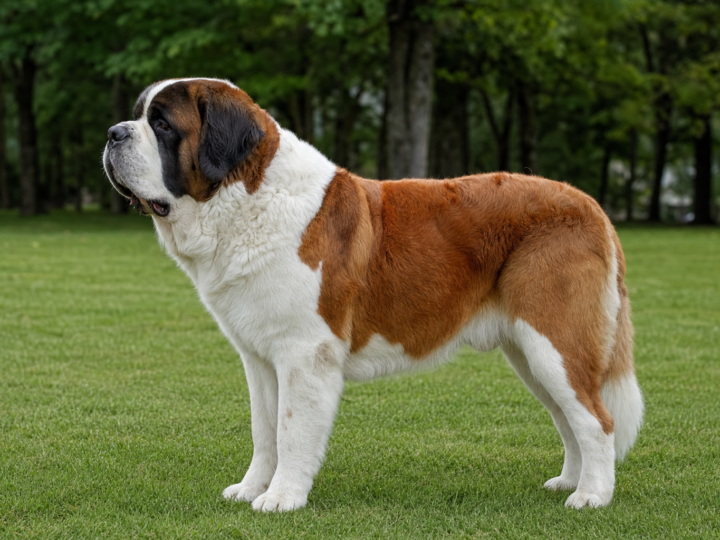
Big dogs age earlier than small ones. Large breeds are generally considered senior somewhere around 6 to 8 years, and giant breeds such as Great Danes, Saint Bernards and Irish Wolfhounds often reach that stage at 5 to 6 years. A ten year old Labrador and a ten year old terrier are in genuinely different chapters of life, which is why generic dog advice tends to short change big seniors.
Ageing does not arrive on a birthday. It shows up as small changes in movement: a slower rise from lying down, a preference for the ramp over the jump, a shorter loop chosen at the end of the road. Our guide to when a large breed dog is considered senior goes through those signals in more detail. The important thing is that these changes are a reason to adjust the routine, never a reason to stop it.
How much exercise, by age and size
Use this as a starting frame and adjust to the dog in front of you. The totals are daily and assume gentle, steady activity rather than hard running.
| Stage | Large breed age | Giant breed age | Daily gentle activity |
|---|---|---|---|
| Mature adult | 5 to 7 years | 4 to 5 years | 60 to 90 minutes, mixed pace |
| Early senior | 7 to 9 years | 5 to 7 years | 45 to 60 minutes across 2 or 3 outings |
| Senior | 9 to 11 years | 7 to 8 years | 30 to 45 minutes across 2 or 3 outings |
| Advanced senior | 11 years and over | 8 years and over | 20 to 30 minutes in short, frequent strolls |
Notice what does not change down the column: the number of outings stays at two or three. Frequency is what keeps joints moving and muscle on the frame. It is duration and intensity that come down with age, not how often your dog gets out of the door.
The best gentle exercises for a big senior
Low impact does not mean low value. These are the activities that give a senior large breed the most benefit for the least wear.
- Steady walking on soft ground. Grass, forest trail and packed dirt are kinder than pavement. A flat, even route beats an interesting but uneven one.
- Swimming. Water carries the body weight while the muscles still work, which is why it is the gold standard for big seniors. Warm water, a gentle entry and a buoyancy aid if your dog is unsure.
- Sniffing walks. Let your dog set the route and stop as often as they like. Twenty minutes of scenting tires an old dog beautifully without a single hard step.
- Gentle slopes. Walking up a mild incline builds hindquarter muscle, which is usually the first muscle a senior loses. Keep it mild and keep the descent slow.
- Controlled indoor work. Slow figure eights around furniture, stepping over a broom handle laid flat, or a few paces backwards all build balance and awareness.
- Short play, often. Two minutes of gentle tug or a rolled ball at walking pace keeps the spark alive without the twisting and braking of a proper chase.
Our round up of the best low impact exercise for big dogs covers each of these in more depth if you want to build a full programme.
The Weekend Warrior
Quiet all week then a two hour hike on Saturday is the pattern most likely to leave a senior sore.
Slippery Floors
A scrabbling start on polished boards asks more of an old frame than the whole walk does.
Stopping Altogether
Rest feels kind and costs muscle fast. Less movement, more often, is the answer.
Heat And Cold
Big seniors handle temperature extremes poorly. Shift the walk to the cool of the day.
Building a routine that actually works
Consistency beats ambition with an older dog. A predictable rhythm lets the body adapt and lets you spot changes early, because you are comparing like with like.
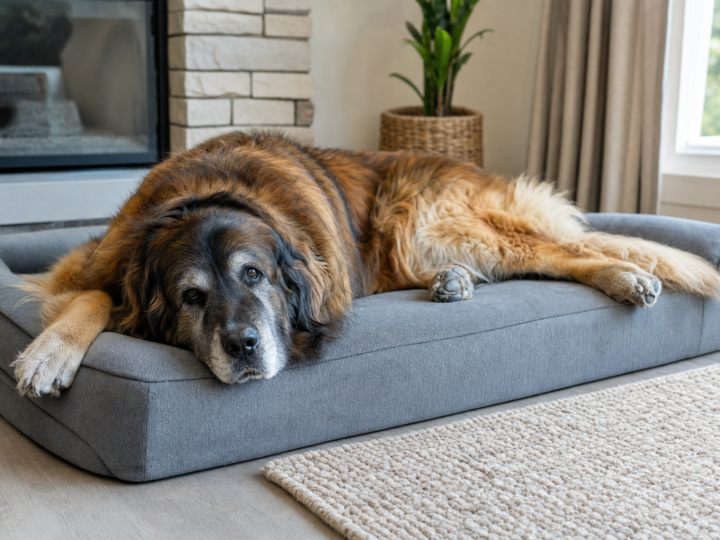
Morning. The longest of the day’s outings, once your dog has been up and moving for twenty minutes or so. Old joints move better after a little gentle activity than straight out of bed.
Midday. A short garden potter or a five minute stroll. This one exists to break up the day, not to achieve anything.
Evening. A steady walk at a similar length to the morning, finished early enough that your dog settles rather than stiffens.
Rest days. Not a whole day of nothing. A rest day is a day of shorter, slower versions of the same three outings.
The five minute warm up
Older muscles and joints need a moment to get going, and this habit costs almost nothing.
- Walk the first five minutes at half your normal pace, on the flat, on a loose lead.
- Let your dog stretch naturally. Most dogs do a full body stretch within the first minute if you give them the chance.
- Save any slope, any steps and anything brisk until after those five minutes.
- Finish the same way. Five slow minutes at the end settles the body far better than arriving home mid stride.
Weight is still the biggest lever
Nothing you can do for a senior big dog matters more than keeping them lean. Every extra pound travels through the joints with every step, and on a large frame those pounds add up fast. A senior at a healthy weight simply moves more comfortably, and that comfort is what makes the daily walk possible.
Check body condition with your hands once a month, and remember that a senior usually needs fewer calories than the same dog did at five, because activity has dropped even if appetite has not.
- Ribs. Run your hands along the sides. You should feel the ribs easily under a thin layer. If you have to press, ease back on food.
- Waist. Look down from above. You want a clear waist that tucks in behind the ribs.
- Tuck. From the side, the belly should rise toward the back legs rather than hanging level.
One caution specific to older dogs: a senior can lose muscle over the spine and hindquarters while still carrying fat over the ribs. If your dog feels bony along the back but soft over the ribcage, mention it at the next appointment, because muscle loss and weight gain need different answers.
Daily habits that support comfortable movement
Movement is one half of a comfortable old age. The home environment and the daily routine are the other half. Traction underfoot matters enormously, and something as simple as a runner rug along the route from bed to door removes the scrabble that starts every day badly. Our guide to why floor traction matters for large breed dogs covers the cheap fixes that make the most difference.
Alongside lean weight, steady movement and a home set up for an older body, many big dog parents keep a daily joint support chew in the routine. MoveGuard Adult is made for grown medium and large breed dogs. It is a six ingredient joint formula built around clinically studied eggshell membrane and New Zealand Green Lipped Mussel, together with glucosamine, chondroitin, MSM and hyaluronic acid, to support comfortable movement and help maintain healthy cartilage and connective tissue. It ships as 60 chicken liver flavour soft chews, is made in the USA in an NSF registered facility, and is backed by a 60 day guarantee. If your dog is still growing, MoveGuard Growth covers the roughly 8 to 30 month window instead. Either way it belongs alongside the walking, the weight and the traction rather than in place of them, and there is more on the subject in our guide to joint support for big dogs.
Keep The Daily Walk Comfortable
Daily joint support built for adult medium and large breed dogs. Explore MoveGuard Adult.
Signs you have the amount right
Your dog will tell you whether the routine fits, as long as you know what to watch.
The amount is right when your dog rises easily the morning after, settles calmly rather than collapsing, keeps a steady pace throughout the walk rather than fading in the last five minutes, and still shows enthusiasm when the lead comes out. Muscle tone over the hindquarters holding steady month to month is another quiet sign that the work is doing its job.
Dial it back when you see a slower rise from bed the next day, a shortened stride, lagging behind on the way home, reluctance at the door, or a dog who sleeps unusually heavily after a normal outing. None of these means stop. They mean shorter and more often, starting tomorrow.
Some things warrant a call rather than an adjustment: limping that lasts more than a day or two, a sudden change in how your dog moves, reluctance to put weight on a leg, or any collapse. Your veterinarian would far rather hear about it early. Keeping a note of what you see is genuinely useful, and helping your senior big dog stay active goes further into tracking those changes over time.
A gentle plan through the seasons
Big seniors feel the weather more than they used to, and a routine that ignores that will be abandoned by February.
Spring and autumn. The easy seasons. Take the longest outings of the year here, on soft ground, and use the good conditions to build the muscle that carries your dog through the harder months.
Summer. Move both walks to early morning and late evening. Heat is harder on big dogs than on small ones, and a heavy coated senior struggles most of all. Swap distance for shade, water and sniffing.
Winter. Cold stiffens older joints, so the five minute warm up matters more than ever, and a coat on a short coated senior is practical rather than decorative. Keep the outings short and frequent, and add indoor balance work on the worst days.
After any illness or procedure. Rebuild from well below where you left off, adding roughly ten percent a week, and follow your veterinarian’s guidance on timing rather than your dog’s enthusiasm.
Common mistakes to avoid
Most of what goes wrong with senior exercise comes from good intentions pointed slightly wrong.
- Letting the dog decide. Many big seniors will happily overdo it and pay for it tomorrow. You are in charge of the duration.
- Cutting exercise out entirely. Muscle is what supports a joint. A dog who stops moving loses that support quickly, and it is hard won back.
- One long walk instead of several short ones. The same total time, split up, is far kinder to an older frame.
- Ignoring the surface. Pavement, polished floors and deep sand each ask something different and none of them is ideal for an old dog.
- Skipping the warm up. Five slow minutes at each end of the walk is the cheapest thing on this list.
- Waiting for a problem before supporting joints. Daily habits that support comfortable movement belong in the routine before anything changes, not afterwards.
The mind ages too
There is a part of senior exercise that has nothing to do with joints. An older dog who stops going out loses more than fitness. They lose the smells, the small decisions, the low level problem solving that a walk quietly provides, and mental decline in older dogs tends to accelerate when the day becomes featureless.
This is why the sniffing walk deserves a place in the routine on its own merit. Letting a senior take twenty minutes to cover two hundred yards, choosing where to stop and what to investigate, is genuine enrichment at a pace their body can manage. Food puzzles, a scatter of kibble in the grass and short training sessions using tricks your dog has known for a decade all do the same job indoors.
Keep the social side going too, in a gentler form. Many big seniors have stopped enjoying boisterous dog park chaos long before their parents notice, but they still love a quiet walk with one familiar friend. Match the company to the dog your dog is now, and the walk stays the best part of the day.
Frequently asked questions
How much exercise does a senior large breed dog need each day?
Most senior large breed dogs do well on 30 to 60 minutes of gentle activity daily, split into two or three shorter outings. Early seniors sit at the upper end and advanced seniors at the lower end. Let recovery the following morning, rather than enthusiasm during the walk, set the final number.
Is swimming good exercise for a senior big dog?
Swimming is one of the best options for a big senior, because the water supports body weight while the muscles still work. Use warm water, a gentle sloped entry and a buoyancy aid if your dog is uncertain, keep sessions short at first, and check with your veterinarian before starting if your dog has any existing condition.
Should a senior large breed dog still go for long walks?
Long walks are usually better replaced by several shorter ones covering a similar total. Frequency keeps joints moving and muscle on the frame, while a single long outing tends to be the thing a big senior feels the next morning. Save longer outings for cool, soft ground days and build up to them gradually.
How do I know if my senior big dog is doing too much?
Watch the morning after. A slower rise from bed, a shortened stride, lagging on the way home or reluctance at the door all mean the routine is slightly too much. Shorten the outings and add one more rather than stopping. Limping that lasts more than a day or two warrants a call to your veterinarian.
At what age is a large breed dog considered senior?
Large breeds are generally considered senior around 6 to 8 years and giant breeds around 5 to 6 years, which is earlier than small dogs. The clearer signal is behavioural: a slower rise from rest, choosing the ramp over the jump, and picking the shorter loop at the end of the road.
The bottom line
Gentle exercise for a senior large breed dog means 30 to 60 minutes a day, split into two or three short outings, on soft even ground, with five slow minutes at each end. Keep your dog lean, keep the surfaces kind, keep the sniffing walks in the routine, and judge every session by how easily your dog gets up the next morning. Do that and you are not slowing your dog down. You are keeping them going.
Want the simple roadmap in one place? Grab our free Big Dog Mobility Guide for the daily comfort checklist, weight framework and low impact movement ideas, all written for large and giant breeds.
This article is for general educational purposes only and is not veterinary advice. It is not intended to diagnose, treat, cure or prevent any disease. Always consult your veterinarian about your dog’s individual health, nutrition and supplement needs. These statements have not been evaluated by the Food and Drug Administration.
Support Big Breed Joints from Day One
Large and giant breeds carry more load through every growth stage. MoveGuard Growth supports developing joints in young big dogs (8 to 30 months); MoveGuard Adult keeps grown big dogs moving comfortably.
Leave a Reply