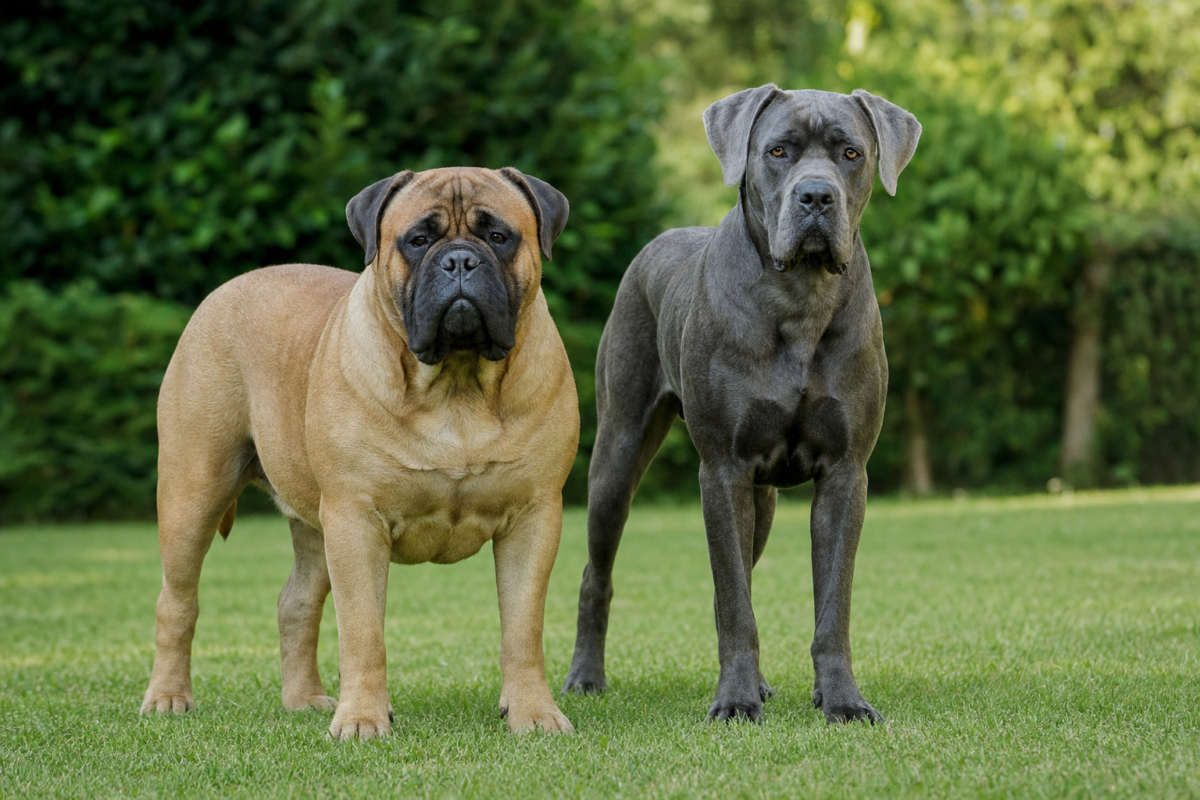
The Bullmastiff is the heavier, calmer of the two. Males stand 25 to 27 inches and weigh 110 to 130 pounds, with a broad mastiff head and a famously low key indoor manner. The Cane Corso is the taller, leaner and far more driven breed. Males stand 25 to 27 inches and weigh 99 to 110 pounds on an athletic frame that wants a job every day. Both are powerful guardian breeds that need early socialisation and confident handling, but the Bullmastiff suits a quieter home while the Cane Corso needs an active one with real training commitment.
These two get compared constantly, and it is easy to see why. Both are big, short coated, seriously powerful guardian breeds with an imposing head and a devoted streak. Stand them side by side, though, and the differences are immediate. One is built like a wall and behaves like a sofa. The other is built like an athlete and behaves like one. Choosing between them is less about which breed is better and much more about which daily life you actually want.
What is the difference between a Bullmastiff and a Cane Corso?
The core difference is build and drive. The Bullmastiff is heavier and stockier, carrying 110 to 130 pounds on a broad, square frame, and is content with a moderate daily walk and a great deal of napping. The Cane Corso is lighter and more athletic at 99 to 110 pounds, with a longer leg and a working temperament that needs daily physical and mental exercise to stay balanced.
They differ in origin too. The Bullmastiff was developed in nineteenth century England by crossing the Mastiff with the Bulldog, bred to find and hold poachers on large estates without harming them. The Cane Corso descends from Roman working dogs and served as a farm guardian, drover and hunting dog across southern Italy. That history still shows: one was bred to wait quietly and act decisively, the other to work all day.
Bullmastiff and Cane Corso side by side
| Trait | Bullmastiff | Cane Corso |
|---|---|---|
| Male height | 25 to 27 inches | 25 to 27.5 inches |
| Male weight | 110 to 130 lb | 99 to 110 lb |
| Female weight | 100 to 120 lb | 88 to 99 lb |
| Build | Broad, heavy, square | Tall, muscular, athletic |
| Coat | Short, fawn, red or brindle with a black mask | Short, black, grey, fawn, red or brindle |
| Energy level | Low to moderate | Moderate to high |
| Exercise need | Two moderate walks a day | Daily work plus training and problem solving |
| Typical lifespan | 7 to 9 years | 9 to 12 years |
| Origin | England, nineteenth century | Italy, ancient Roman lineage |
The American Kennel Club’s Chief Veterinary Officer, Dr. Jerry Klein, DVM, has written extensively on the slower growth and development timeline of large and giant breeds. Read more from the AKC’s guidance on caring for large-breed dogs.
Size and build in practice
On paper the two stand at a similar height, which surprises people. The difference is what hangs on the frame. A Bullmastiff carries twenty or thirty pounds more than a Corso of the same height, most of it through the chest, neck and head, and moves with a rolling, unhurried gait. A Cane Corso is drawn out and cut, closer to a heavyweight boxer than a sumo wrestler, and covers ground quickly when it decides to.
That extra mass has consequences beyond the scale. A heavier dog loads its joints harder with every step, and it heats up faster in summer. Both breeds are short faced enough to feel the heat, but the Bullmastiff feels it sooner. In a hot climate that alone can decide the choice.
Temperament and energy
The Bullmastiff is one of the quieter giants. Indoors it is famously undemanding, happy to occupy a large section of floor and watch the room. It is affectionate with its family, reserved with strangers, and slow to escalate, but it is also stubborn in a distinctly Bulldog way. It will consider your instruction, weigh it, and then decide.
The Cane Corso is a different proposition. It is intelligent, intensely bonded to its people, and genuinely needs a job. A Corso with nothing to do invents work, and the work it invents is rarely what you had in mind. It is also more reactive to its environment and more inclined to make decisions on your behalf, which is why the breed is usually recommended for people with previous experience of a large guardian dog.
Both breeds are protective by design rather than by accident. Neither needs guard training, and neither benefits from it. What they need is early, broad and continued socialisation, so that a dog with this much physical authority learns what is normal and does not have to guess.
Training and socialisation
- Start immediately. The window for easy socialisation closes early, and both breeds are large enough by six months that mistakes get heavy fast.
- Train the handler too. A 120 pound dog that pulls is a genuine safety issue. Loose lead walking is not optional here.
- Use reward based methods. Both breeds shut down or dig in under harsh handling, and a stubborn dog that has decided you are unfair is very hard to move.
- Give the Corso a job. Scent work, obedience, tracking or structured play all count. Ten minutes of thinking is worth a mile of walking.
- Keep sessions short with the Bullmastiff. This breed bores quickly and works best in brief, positive bursts.
Growth and when they stop growing
Both breeds grow for a long time. Expect most of the adult height by around 12 to 15 months, with the frame continuing to broaden and the chest to drop through the second year. A Cane Corso is usually mature at around two years. A Bullmastiff often needs closer to two and a half years to finish filling out, because there is simply more dog to build.
Why the growth window matters so much here
Growth plates, the soft cartilage bands at the ends of the long bones, stay open through much of the first year and beyond in breeds this size. As a rough guide by expected adult weight, a dog headed for 100 to 130 pounds is still developing at 22 to 26 months. That is a long stretch to carry a growing frame, and it is exactly why lean feeding, sensible exercise and daily joint support matter more in these two breeds than in almost any others.
Growing Too Fast
Pushing size early asks a great deal of a developing frame. A steady curve serves both breeds far better than a fast one.
Excess Weight
Every extra pound is carried through young joints. Lean is not unkind, it is the whole point.
Heat
Both breeds carry short muzzles and heavy bodies. Walk early or late in summer and never push a hot dog to keep going.
Under Socialisation
A powerful guardian breed that has not met the world becomes a dog that guesses. Broad early exposure is essential.
Feeding a Bullmastiff or a Cane Corso puppy
Feeding is where most large breed growth problems begin and end. Both breeds do best on steady, moderate growth rather than the fastest possible growth.
- Feed a complete food formulated for large breed puppies, which controls calories, calcium and phosphorus for a slower curve.
- Split the daily ration across three meals while young, then two as an adult. Neither breed should eat one huge meal.
- Feed to body condition rather than to the bag, and reassess every few weeks as growth changes the requirement.
- Keep treats inside the daily total, since training treats add up quickly in breeds that need this much training.
How to check body condition in ten seconds
- Ribs. Run a flat hand along the side. You should feel each rib under a thin covering without pressing hard.
- Waist. From above, there should be a visible narrowing behind the ribcage, even on a broad Bullmastiff.
- Tuck. From the side, the belly line should rise toward the back legs rather than running level.
Exercise needs compared
This is the practical difference that shapes daily life. A grown Bullmastiff is generally content with two moderate walks a day and a garden to patrol, and will happily spend the rest of the day asleep. A grown Cane Corso wants considerably more: a solid walk or run, plus training, plus something to think about, most days of the week.
While either breed is growing, the rules are the same for both. Favour free play on soft ground over forced distance, keep jumping and hard sprinting moderate while the growth plates are open, and let a young dog rest fully between bursts. Our guide to safe exercise for large breed puppies sets out the limits by age.
Supporting the joints of a heavy breed
Both breeds ask a great deal of their joints simply by existing at this size, and both carry that load for a long developmental window followed by a working adulthood. Alongside lean feeding and sensible exercise, many big dog parents run a daily joint support chew through the growth years and then into adult life.
MoveGuard Growth is built for the young stage. It brings together nine actives, including 250mg of New Zealand Green Lipped Mussel, 400mg of glucosamine HCl, 300mg of chondroitin, 250mg of MSM and 15mg of hyaluronic acid, to support healthy joint development across the roughly 8 to 30 month growth window. Dosing follows expected adult weight, so both of these breeds sit at three chews a day. For grown dogs, MoveGuard Adult is a six ingredient formula for medium and large breeds from 25 to 75 pounds, pairing green lipped mussel and eggshell membrane with glucosamine, chondroitin, MSM and hyaluronic acid. Both are made in the USA in an NSF registered, GMP facility and carry a 60 day guarantee, and both contain shellfish, fish and soy.
Support A Heavy Frame Early
Give your growing guardian breed daily joint support built for large and giant breeds. Explore MoveGuard Growth.
Which breed suits which home
Choose the Bullmastiff if you want a calm, heavy presence that is genuinely low energy indoors, if your walks are moderate rather than ambitious, and if you can live with a stubborn dog and a shorter lifespan. It suits a quieter household, and it suits people who want a guardian who mostly guards by being visibly enormous.
Choose the Cane Corso if you have handled a large guardian breed before, if you want a training partner as much as a companion, and if you can commit to real daily exercise and mental work for a decade. It rewards that investment with an extraordinarily responsive dog, and it punishes neglect of it with behaviour that is hard to live with.
Choose neither if the household is very busy, the training time is scarce, or nobody is prepared to be the person who does the work. Both breeds are wonderful in the right hands and a serious problem in the wrong ones.
Common mistakes with both breeds
- Overfeeding for size. A heavier puppy is not a better one. Extra weight loads a frame that is still forming.
- Skipping socialisation because the puppy is friendly. Friendly at four months and confident at four years are different achievements.
- Treating a big adolescent as an adult. At twelve months both breeds look finished and are nowhere near it.
- Underestimating the Corso. Buying the look without the workload is the most common reason these dogs are rehomed.
- Exercising in the heat. Both breeds overheat more readily than their size suggests.
- Waiting for stiffness before supporting joints. The growth window is the moment for daily support.
Frequently asked questions
Which is bigger, a Bullmastiff or a Cane Corso?
The two stand at a similar height, but the Bullmastiff is heavier. Males typically weigh 110 to 130 pounds against 99 to 110 pounds for a male Cane Corso, and the Bullmastiff carries that weight on a broader, squarer frame.
Which breed is calmer indoors?
The Bullmastiff, clearly. It is known for being undemanding in the house and content with moderate daily exercise. A Cane Corso needs physical work and mental stimulation most days, and becomes restless and difficult without it.
Are Bullmastiffs and Cane Corsos good family dogs?
Both can be devoted family dogs in experienced hands, with early socialisation and consistent training. Their size alone means supervision around small children is sensible, and neither breed suits a household with no time for training.
How long do Bullmastiffs and Cane Corsos live?
Bullmastiffs typically live 7 to 9 years and Cane Corsos 9 to 12 years. As with all giant breeds, lean body condition, steady growth and regular veterinary care all support a longer, more comfortable life.
When do these breeds stop growing?
Both reach most of their adult height by around 12 to 15 months, then continue broadening. A Cane Corso is usually mature near two years and a Bullmastiff often takes closer to two and a half, since there is more frame to fill out.
The bottom line
The Bullmastiff and the Cane Corso look like variations on a theme and live like two different commitments. The Bullmastiff gives you a heavier, calmer, more sedentary dog with a shorter life and a stubborn streak. The Cane Corso gives you a lighter, faster, sharper dog that will meet whatever training you bring and demand more. Both need early socialisation, confident handling, lean feeding and a long patient growth window. Pick the one that matches the life you actually lead, then give it the daily habits that keep a heavy frame comfortable for as long as possible.
Want the Simple Roadmap in One Place?
Grab our free Big Dog Growth Blueprint for the growth window checklist, feeding framework and joint safe exercise limits, all written for large and giant breeds.
This article is for general educational purposes only and is not veterinary advice. It is not intended to diagnose, treat, cure or prevent any disease. Always consult your veterinarian about your dog’s individual health, nutrition and supplement needs. These statements have not been evaluated by the Food and Drug Administration.
Support Big Breed Joints from Day One
Large and giant breeds carry more load through every growth stage. MoveGuard Growth supports developing joints in young big dogs (8 to 30 months); MoveGuard Adult keeps grown big dogs moving comfortably.

Leave a Reply