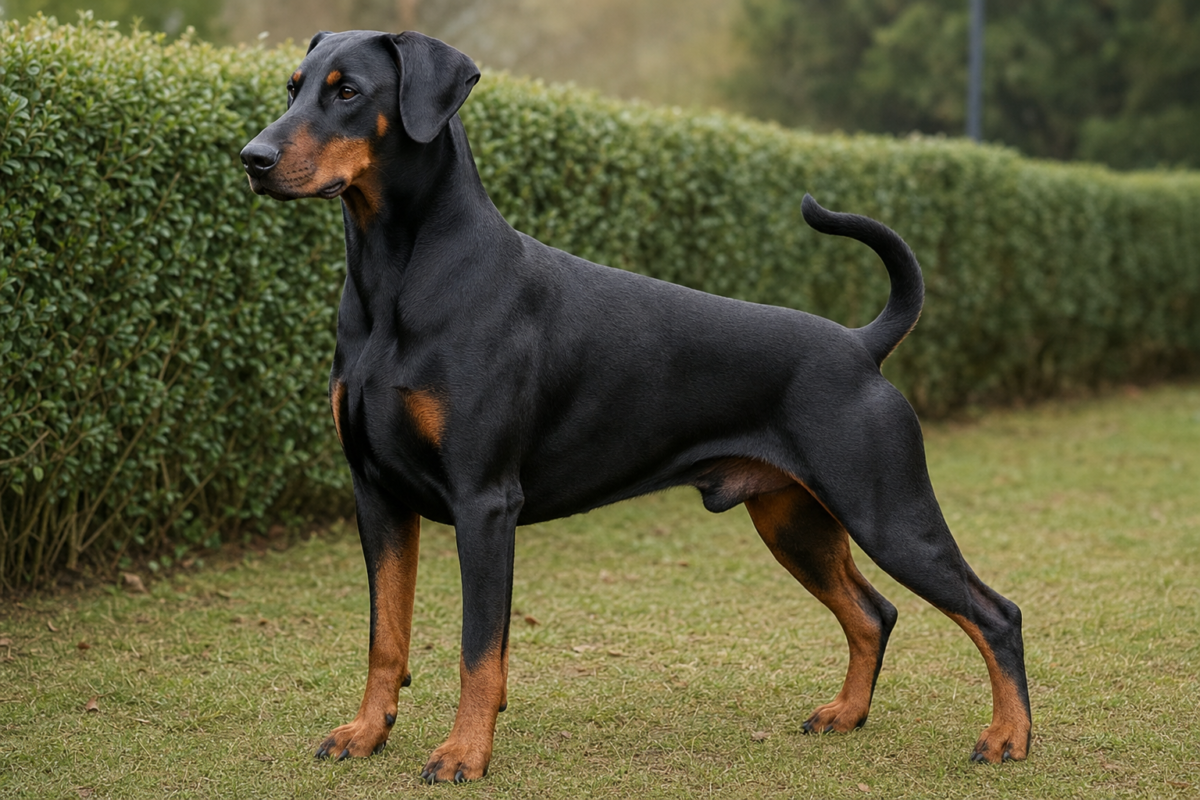
A Doberman moves through four growth stages: fast early growth from 8 weeks to 4 months, a leggy adolescent surge from 4 to 8 months, height finishing between 8 and 12 months, and a long filling out phase from 12 months to around 3 years. A fully grown male stands 26 to 28 inches and weighs 75 to 100 pounds, while a female stands 24 to 26 inches and weighs 60 to 90 pounds.
Almost every Doberman parent goes through the same worry at about ten months, when their once chunky puppy has turned into a tall, narrow creature with visible ribs and a chest that has not arrived yet. It looks alarming and it is almost always normal. The Doberman is a breed that grows in a very particular order, and once you know that order you stop panicking at the lean stage and start focusing on the habits that actually build a sound adult.
What are the growth stages of a Doberman?
A Doberman grows in four clear stages. From 8 weeks to 4 months the puppy grows fastest, often doubling its weight in a matter of weeks. From 4 to 8 months the legs and height surge ahead of everything else. Between 8 and 12 months the height reaches its ceiling. From 12 months to roughly 3 years the dog slowly fills out through the chest, neck and shoulders into the powerful outline the breed is known for.
The order matters more than the dates. A Doberman builds its skeleton first and its substance last, which is why a yearling can look tall, narrow and unfinished while being perfectly on track. Individual dogs vary with genetics, sex and line, so treat the stages as the map and your own dog as the traveller.
What makes a Doberman grow the way it does
The Doberman was created in Germany in the late nineteenth century as a compact, agile working guardian, and the standard asks for a squarely built dog of great endurance and speed. That brief produced an athlete: a wedge shaped head, a long elegant neck, a deep chest, a tight tucked waist and a short smooth coat that hides absolutely nothing.
The short coat is a genuine advantage while you are raising one. Where a coated breed can conceal weight gain for months, every rib and every muscle on a Doberman is on display. It also explains why so many Doberman parents worry: you are simply seeing a normal adolescent frame that a fluffier breed would keep hidden. The famous chest and the heavy muscling over the shoulders are the last things to arrive, and on many dogs they are still developing well into the third year.
Doberman growth chart, month by month
Use this chart as a friendly guide, not a report card. A puppy who tracks a little above or below these numbers while moving easily and looking lean and athletic is usually doing just fine.
| Age | Male weight | Female weight |
|---|---|---|
| 2 months | 18 to 25 lb | 15 to 20 lb |
| 3 months | 30 to 38 lb | 25 to 33 lb |
| 4 months | 40 to 50 lb | 35 to 44 lb |
| 6 months | 60 to 70 lb | 50 to 60 lb |
| 9 months | 70 to 83 lb | 58 to 70 lb |
| 12 months | 73 to 90 lb | 60 to 80 lb |
| 18 months | 75 to 95 lb | 60 to 85 lb |
| 2 years plus | 75 to 100 lb | 60 to 90 lb |
The American Kennel Club’s Chief Veterinary Officer, Dr. Jerry Klein, DVM, has written extensively on the slower growth and development timeline of large and giant breeds. Read more from the AKC’s guidance on caring for large-breed dogs.
When do Dobermans stop growing?
Dobermans reach their adult height at around 12 months. After that the change is entirely about substance. The chest deepens, the neck thickens and muscle builds across the shoulders and hindquarters, typically until two and a half to three years of age. A tall, narrow eighteen month old who still looks like a teenager is right on schedule and simply has not finished the last stage yet.
As a rough guide, dogs with an expected adult weight of 80 to 100 pounds keep developing for roughly 20 to 24 months, with muscle filling in beyond that. Because the frame is largely set in the first year, that stretch is your prime window to build strong habits around food, movement and joint support.
Why the growth window matters for an athletic guardian
During this window your Doberman is building the cartilage, bone and connective tissue that will carry a fast, powerful dog through a lifetime of sprinting, turning and jumping. Growth plates, the soft areas at the ends of the long bones, stay open through much of the first year. While they are open, hard impact and extra weight ask more of a frame that is still forming, which is why lean feeding and sensible exercise matter for a breed built to move at speed.
Growing Too Fast
Rapid growth asks more of developing joints. Aim for a steady, even curve rather than a fast one.
Feeding To Fill Out
The classic Doberman mistake. Extra food does not build chest, it only adds weight to young joints. Substance arrives with age.
Too Much Impact
Sprinting, hard turns and repeated jumping on open growth plates are best kept moderate while young.
An Idle Mind
Dobermans are working dogs. Without an outlet that intelligence turns into restlessness, so train the mind as well as the body.
How much should a Doberman puppy eat while growing?
Large breed puppies do best with steady, moderate growth, and an even curve supports comfortable movement for years to come. A few practical habits make a real difference:
- Choose a complete food formulated for large breed puppies, which balances calories, calcium and phosphorus for slower, steadier growth.
- Resist the urge to feed extra because your puppy looks lean. Portions build weight, not bone structure.
- Split the daily amount into three meals while young, then two as an adult, and count treats inside that total.
- Feed to a lean, athletic body condition. You should see a waist and feel the ribs easily under a thin layer.
- Let your veterinarian confirm the daily amount at each checkup, since the right portion changes quickly through the first year.
How to check your Doberman’s body condition in ten seconds
The scale tells you weight, but body condition tells you health. With a short coated breed you can do most of this by eye, then confirm with your hands.
- Ribs. Run your hands along the sides. You should feel the ribs easily under a thin layer. Seeing the last rib or two on a young Doberman is normal, but a row of clearly visible ribs means it is worth a conversation with your veterinarian.
- Waist. Look down from above. You want a clear waist behind the ribs, which this breed shows plainly.
- Tuck. From the side, the belly should rise sharply toward the back legs. A Doberman is built with a pronounced tuck, so do not read that as underweight on its own.
Check every couple of weeks through the growth years and adjust portions with your veterinarian’s guidance.
Growth safe exercise for a Doberman puppy
Dobermans are fast, agile and tireless, and a young one will happily do far more than its joints are ready for. During the growth months the aim is regular, moderate activity with plenty of thinking mixed in.
- Favor free play, exploring and short walks on soft ground rather than long structured runs.
- Keep sprinting, hard turns and repeated jumping moderate while the growth plates are still open.
- Hold off on serious sport work such as agility jumps or protection training until your veterinarian confirms the frame is ready.
- Add early obedience and scent games, which satisfy a Doberman without pounding on young joints.
- Let your puppy rest fully between bursts of activity, because that rest is when growth happens.
Protecting a fast, powerful frame
A Doberman spends its life accelerating, turning and stopping hard, and every one of those movements travels through the joints. Supporting healthy joint development while your dog is still building its frame is a simple habit that pays off across an active lifetime.
Alongside lean feeding and sensible exercise, many big dog parents add a daily joint support chew made for large and giant breeds. MoveGuard Growth is built for exactly this stage. It combines nine actives, including New Zealand Green Lipped Mussel, glucosamine, chondroitin, MSM, krill oil and hyaluronic acid, to support the developing joints of young large breed dogs across the roughly 8 to 30 month growth window. You dose by expected adult weight, so most Dobermans sit at two chews a day, with larger males at three. It is made in the USA, ninety chews to a jar, and is backed by a 60 day guarantee.
Support A Working Frame
Give your growing Doberman daily joint support built for large and giant breeds. Explore MoveGuard Growth.
Signs your Doberman is growing on track
You do not need a weekly weigh in to know things are going well. Look for a bright, alert dog with clean easy movement, a visible waist, ribs you can feel under light pressure, a glossy coat and a steady appetite. Even, unhurried growth with slowly improving muscle tone is exactly what you want to see, even when the chest still looks shallow.
If you ever notice limping, stiffness after rest, reluctance to move, sudden weight loss, or growth that seems suddenly very fast, a quick conversation with your veterinarian lets you adjust food or activity early rather than late.
A simple growth game plan, stage by stage
You do not need a complicated program. You need the right emphasis at the right time.
8 weeks to 4 months. Foundation stage. Focus on a complete large breed puppy food, three calm meals a day, thorough socialisation and short bursts of free play on soft ground. Start gentle training now, because a Doberman that learns to think early becomes a far easier adult.
4 to 8 months. The leggy surge. Height races ahead and your puppy may look all limbs. Keep feeding lean, keep exercise moderate, and build habits around stairs and car entry. This is a natural point to begin a daily joint support routine that carries through the whole growth window.
8 to 12 months. Height reaches its ceiling and the narrow phase peaks. Match portions to a lean body condition rather than to how thin your dog looks, and keep training short, positive and frequent.
12 months to 3 years. The long finish. The chest deepens, the neck thickens and real muscle arrives. Build activity up as your veterinarian advises, add sport work only when the frame is ready, and many parents carry the joint support routine straight into adulthood.
Common growth mistakes to avoid
Most growth trouble in Dobermans traces back to a few avoidable habits.
- Overfeeding a lean adolescent. The single most common one. A narrow yearling is normal, and extra food loads joints instead of building the chest you are waiting for.
- Adding supplements to speed growth. Calcium and mineral extras can upset the balance a complete puppy food already provides. Ask your veterinarian before adding anything.
- Hard sport work, too young. Agility jumps, sprint drills and protection work are a lot to ask of open growth plates.
- Neglecting the mind. A bored Doberman becomes a stressed, destructive one. Training protects the household as much as the dog.
- Waiting for a problem before supporting joints. The growth window is the ideal time to support developing joints, not after signs appear.
The Doberman temperament and the growth years
A Doberman is an intensely people focused dog. This is the breed that follows you from room to room, leans against your legs and watches the front door on your behalf without ever being asked. That devotion is the great joy of living with one, and during the growth years it is also your most useful training tool, because a Doberman genuinely wants to get it right.
They are sensitive with it. Harsh corrections land hard on this breed and tend to produce a worried dog rather than a polite one, while short, upbeat sessions produce a confident thinker. Thorough socialisation through the first year matters enormously, since a naturally watchful dog needs plenty of ordinary, positive experience of the world to grow into a steady adult rather than a reactive one. Give that quick mind daily work, keep your puppy close to the family, and the gangly adolescent becomes the elegant, loyal companion the breed is famous for.
How the Doberman compares with similar breeds
The Doberman and the German Shepherd are the two breeds most often weighed against each other for the same home. The Doberman is the taller, leaner dog at 26 to 28 inches and 75 to 100 pounds for a male, with a short single coat that needs almost no grooming and a sensitive nature that bonds hard to one household. The Shepherd is slightly shorter, heavier boned and carries a thick double coat. German Shepherd vs Doberman covers the full picture, and our big dog breed comparisons page lists every pairing.
Frequently asked questions
At what age is a Doberman full grown?
A Doberman reaches full height at around 12 months, then keeps filling out through the chest, neck and shoulders until two and a half to three years of age. Height comes first and substance comes last.
How much does a full grown Doberman weigh?
A fully grown male Doberman usually weighs 75 to 100 pounds and a female weighs 60 to 90 pounds, though individual dogs vary with genetics, line and body condition.
How big is a Doberman at 6 months?
At 6 months a male Doberman often weighs around 60 to 70 pounds and a female around 50 to 60 pounds. They are usually at their leggiest around this age, with the chest and muscle still to come.
Why does my Doberman look so skinny?
A lean, narrow look through adolescence is normal for the breed, because a Doberman builds height first and substance last, and a short coat hides nothing. Feed to a lean body condition rather than to appearance, and if the ribs, hips and spine are all clearly visible or your dog is losing weight, speak with your veterinarian.
What should I feed a Doberman puppy?
A complete food formulated for large breed puppies is the safest choice, because it balances calories and minerals for slow, steady growth. Measure meals, avoid adding extra calcium, and confirm portions with your veterinarian at each visit.
The bottom line
Your Doberman will grow in four stages: fast early growth, a leggy surge, height finishing at about a year, then a long fill out that runs to roughly three years. Expect a narrow adolescent and do not try to feed your way past it. Keep meals measured, keep exercise moderate while those joints develop, support the growth window with the right daily habits, and give that sharp mind daily work. That is how you raise the athletic, elegant Doberman the breed is built to be.
Want the Simple Roadmap in One Place?
Grab our free Big Dog Growth Blueprint for the growth window checklist, feeding framework and joint safe exercise limits, all written for large and giant breeds.
This article is for general educational purposes only and is not veterinary advice. It is not intended to diagnose, treat, cure or prevent any disease. Always consult your veterinarian about your dog’s individual health, nutrition and supplement needs. These statements have not been evaluated by the Food and Drug Administration.
Support Big Breed Joints from Day One
Large and giant breeds carry more load through every growth stage. MoveGuard Growth supports developing joints in young big dogs (8 to 30 months); MoveGuard Adult keeps grown big dogs moving comfortably.
Leave a Reply