
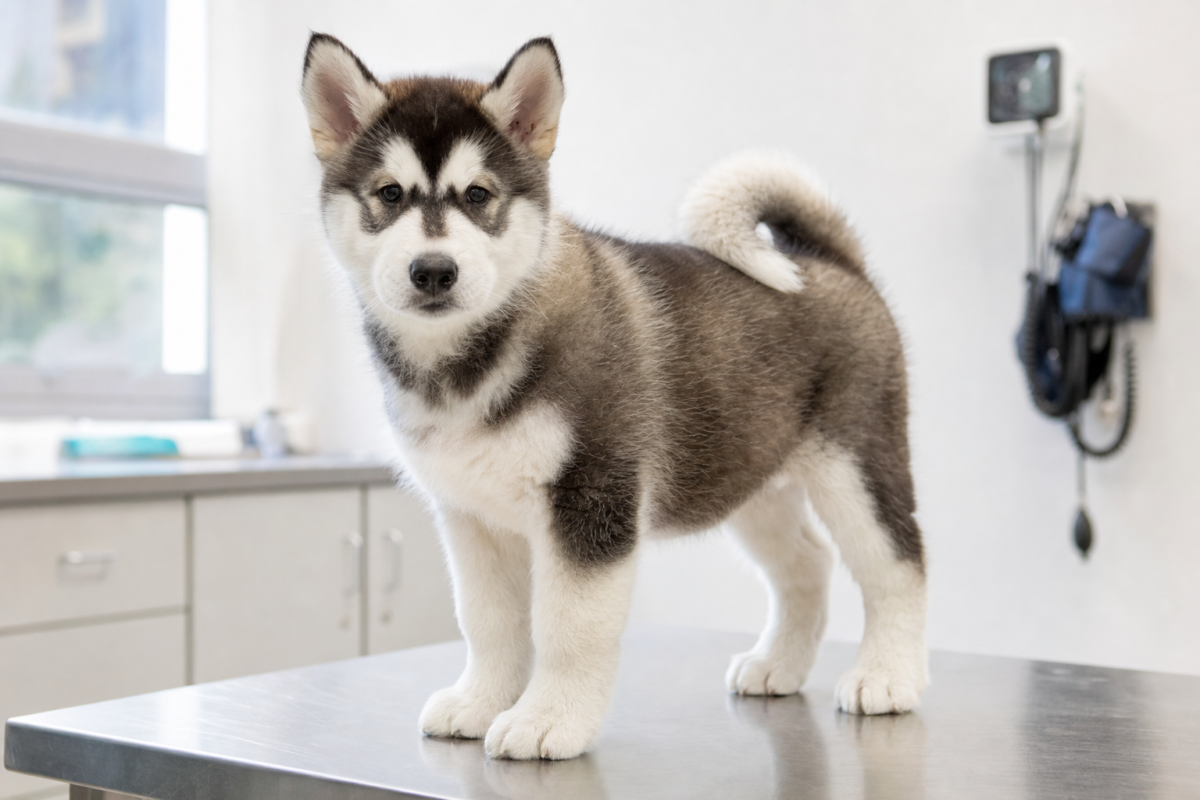
The first veterinary visit for a large breed puppy is a full nose to tail physical examination plus a baseline weight, a check for parasites, the first or next round of core vaccinations, and a conversation about food, exercise and growth. Most practices ask to see a new puppy within 3 to 7 days of coming home, and the appointment usually runs 20 to 40 minutes. For a large or giant breed puppy the growth conversation matters as much as the needles, because the feeding and exercise plan set at this visit shapes the next two years.
Bringing home a large breed puppy is joyful and slightly overwhelming at the same time, and booking that first veterinary appointment is one of the most useful things you will do in the first week. It is not only a health check. It is the moment you start a working relationship with the person who will help you raise a sound, comfortable big dog, and it is your best early chance to get the growth plan right. This guide walks you through exactly what happens, what to bring, what to ask, and how to make the whole thing calm for a puppy who is about to become very large indeed.
What happens at the first veterinary visit for a large breed puppy?
At the first visit your veterinarian weighs your puppy, performs a complete physical examination from nose to tail, checks a stool sample for intestinal parasites, gives the vaccinations that are due for that age, and starts parasite prevention. They then review the breeder or shelter paperwork, confirm the microchip, and talk you through feeding, exercise and the growth timeline. You leave with a written vaccination schedule and a date for the next appointment.
The examination itself is quick and gentle. What takes the time, and what makes the visit worth booking early, is the conversation. A large breed puppy grows for far longer and gains far more weight than a small dog, so portions, food choice and activity limits all need different answers, and this is where you get them.
Why the first visit matters more for a big puppy
A small breed puppy reaches adult size in under a year and gains perhaps fifteen pounds along the way. A large breed puppy may add eighty pounds or more, and a giant breed puppy can gain well over a hundred, over a window that stretches to two years and beyond. Everything about that journey is more demanding on a frame that is still forming.
That is why the advice you receive at this first appointment carries so much weight. A feeding portion that is slightly generous for a small dog is a rounding error. The same generosity applied to a puppy who will finish at 130 pounds compounds month after month into a heavy adolescent carrying extra load on joints that are still developing. Getting the plan right at week one is far easier than correcting course at month eight.
The same is true of exercise. Your veterinarian can tell you, for your individual puppy, how much activity is sensible right now and what to hold back on while the growth plates are still open. That is guidance you simply cannot get from a generic puppy article, because it depends on your puppy, your breed and your home.
What the veterinarian checks, step by step
Nothing at this appointment should come as a surprise. Here is the whole examination, in the order most practices work through it, and what each part means for a big puppy specifically.
| Check | What the veterinarian looks at | Why it matters for a big puppy |
|---|---|---|
| Weight and body condition | Scale reading plus a hands on feel of ribs, waist and tuck | Sets the baseline every future visit is measured against |
| Eyes, ears and nose | Discharge, redness, clarity, ear canal health | Drop eared and heavy jowled breeds need early ear habits |
| Mouth and teeth | Bite alignment, gum colour, baby teeth | Large breeds lose baby teeth later and chew harder |
| Heart and lungs | Listening with a stethoscope for murmurs and breathing sounds | Catches sounds worth rechecking as the chest deepens |
| Abdomen | Gentle palpation for hernias and discomfort | Umbilical hernias are common and easy to plan around |
| Skin and coat | Fleas, mites, dryness, hot spots | Thick double coats hide skin issues from casual view |
| Legs and joints | Range of motion, stance, how the puppy moves | The earliest picture of how your big dog carries itself |
| Stool sample | Microscope check for worms and protozoa | Parasites quietly drain a puppy building a large frame |
| Vaccinations | Core puppy series, timed to age | Protection while socialisation is at its most important |
| Microchip | Scan to confirm it reads and is registered to you | A large dog that bolts covers ground fast |
When should the first visit happen?
Book the appointment for 3 to 7 days after your puppy comes home. Most breeders and rescues ask for a veterinary check within that window as a condition of their health guarantee, and it is genuinely the right timing. It is early enough to catch anything that needs attention and late enough that your puppy has had a few nights to settle rather than arriving at the clinic straight from a car journey.
If your puppy came home at 8 weeks, the first visit usually lands somewhere between 8 and 9 weeks of age. From there, core vaccinations continue every 2 to 4 weeks until roughly 16 weeks, so you will see your veterinary team three or four times over the first couple of months. Our full vet visit schedule for a large breed puppy maps out how the whole first year looks.
Why the growth window shapes the whole conversation
Large and giant breed puppies keep developing across a growth window of roughly 8 to 30 months, depending on expected adult weight. A dog headed for 65 to 80 pounds is largely done filling out by around 18 to 22 months. A dog headed for 130 pounds or more may keep building frame and muscle until 30 months. Your veterinarian will estimate that expected adult weight at this first visit, and everything else follows from it: portion size, what food to choose, when to switch to adult food, and how much activity is reasonable at each stage.
Ask for that number out loud and write it down. It is the single most useful figure you will take home, and it is what turns generic puppy advice into a plan that fits your actual dog.
Skipping The Stool Sample
Arriving without one usually means a second trip. Bring a fresh sample from that morning in a sealed bag.
Overfeeding From Day One
Bag guidelines run generous for big puppies. Confirm the portion with your veterinarian, not the label.
Too Much Too Soon
Long walks and hard play on open growth plates ask a lot of a frame that is still forming.
A Frightening First Visit
A big dog who fears the clinic is hard to handle at 120 pounds. Make this trip a good memory.
What to bring and how to prepare
A little preparation turns a hectic appointment into a productive one. Pack these the night before and the morning stays calm.
- All the paperwork. Breeder or shelter records, any vaccinations already given, deworming dates and the microchip number.
- A fresh stool sample. Collected that morning if possible, in a sealed bag. This saves an extra visit and gets you a same day answer.
- The food you are feeding. A photo of the bag, including the ingredient panel and the feeding guide, lets your veterinarian comment on the actual formula.
- High value treats. Something your puppy loves, for the waiting room and the examination table.
- A towel or mat that smells of home. A familiar surface on a cold steel table settles a nervous puppy quickly.
- Your written questions. You will forget them otherwise. Three or four specific questions beat a vague chat every time.
The feeding questions worth asking
Feeding is where the first visit earns its keep for a large breed puppy. Steady, moderate growth supports comfortable movement now and for years to come, and fast growth is the thing to avoid. Bring these questions with you.
- Is this food a complete food formulated for large breed puppies, with calcium and calories balanced for slower, steadier growth?
- How many cups a day right now, split across how many meals? Three meals a day is usual while young, dropping to two as an adult.
- What expected adult weight are we planning around, and when should we switch to adult food?
- What treats are reasonable, and how do they count against the daily total?
- How often should we reweigh, and what would a growth curve that is moving too fast actually look like?
How to check body condition in ten seconds
Ask your veterinarian to show you this at the visit, hands on, so you know what correct feels like. Then you can repeat it at home every couple of weeks.
- Ribs. Run your hands along the sides. You should feel the ribs easily under a thin layer. If you have to press, ease back on food.
- Waist. Look down from above. You want a clear waist that tucks in behind the ribs.
- Tuck. From the side, the belly should rise toward the back legs rather than hanging level.
The scale tells you weight. Body condition tells you whether that weight is right for your individual puppy, which is the number that actually matters.
Exercise and handling questions to raise
The other half of the growth conversation is movement. Large breed puppies need activity for confidence, muscle and sanity, but during the fast growth months the goal is regular moderate activity rather than repeated hard impact.
- How much walking is sensible at this age, and how should that build month by month?
- When can we start longer outings, running and structured sport?
- What about stairs, slippery floors and jumping in and out of the car?
- When is my puppy protected enough to meet other dogs and walk in public spaces?
- Are there breed specific screenings you would recommend later, and at what age?
That last question is worth asking early even though the answer sits years away. Knowing the plan in advance removes the guesswork, and it tells you what to watch for in the meantime.
Supporting joints from the very first visit
While your puppy is building bone, cartilage and connective tissue, the daily habits you set now travel with them. Lean feeding, sensible exercise and steady growth are the foundation, and many big dog parents add a daily joint support chew made for large and giant breeds as part of the same routine.
MoveGuard Growth is built for exactly this stage. It combines nine actives, including New Zealand Green Lipped Mussel, glucosamine, chondroitin, MSM and hyaluronic acid, to support the developing joints of young large breed dogs across the roughly 8 to 30 month growth window. You dose by expected adult weight, which is why that number from your veterinarian is so useful: puppies headed for 50 to 80 pounds take two chews a day, and those headed for 80 to 100 pounds or more take three. It ships as 90 chicken liver flavour chews, is made in the USA in an NSF registered facility, and is backed by a 60 day guarantee. Mention it at the visit so your veterinarian can fold it into the plan alongside everything else, and read more about joint support for big dogs if you want the longer picture.
Start The Habit Early
Give your growing puppy daily joint support built for large and giant breeds. Explore MoveGuard Growth.
Signs the visit went well
A good first appointment leaves you with more than a vaccinated puppy. You should walk out holding four things: a recorded weight, a written vaccination schedule with dates, a specific daily feeding amount, and a clear answer on how much exercise is appropriate right now. If any of those is missing, ask before you leave the room.
You should also feel that you can call. The practice that will look after your dog for the next ten years should feel approachable on day one, and a team that handles a wriggling puppy kindly is a team that will handle a nervous 120 pound adult kindly too.
Mild tiredness or a slightly sore spot at the injection site for a day afterwards is normal and expected. If you see persistent vomiting, facial swelling, hives or real lethargy, call the practice straight away rather than waiting to see.
A simple veterinary plan, stage by stage
You do not need a complicated schedule. You need the right emphasis at the right age.
8 weeks to 4 months. Visits cluster here. Core vaccinations every 2 to 4 weeks until roughly 16 weeks, deworming, parasite prevention and a microchip check. Weigh at every visit and confirm the feeding amount each time, because the correct portion changes fast. Keep the clinic a happy place with treats and short, positive trips.
4 to 8 months. Growth is quick and your puppy may look leggy and unfinished. This is the visit to discuss neutering timing, which is a genuinely different conversation for large breeds than for small ones, and to confirm that the growth curve looks steady rather than steep. A natural point to begin a daily joint support routine.
8 to 18 months. Height nears its peak while muscle arrives. Appointments spread out to roughly every six months. Recheck body condition, since an adolescent appetite easily outpaces need, and agree when to move from puppy food to adult food.
18 months to 3 years. Your puppy is an adult. Annual checks become the rhythm, with a baseline blood panel often suggested around this point so there is something to compare against later. Build activity up as your veterinarian advises, and many parents keep the joint support routine going into adulthood.
Common first visit mistakes to avoid
Most of what goes wrong at a first appointment is avoidable with a little foresight.
- Arriving with no paperwork. Without the breeder records your veterinarian is guessing at what has already been given and may repeat it unnecessarily.
- Feeding a big meal beforehand. A light meal a few hours earlier keeps a nervous puppy comfortable and leaves room for treats.
- Letting the puppy loose in the waiting room. Other patients may be unwell or frightened. Keep your puppy on your lap or on a mat at your feet.
- Not asking the growth questions. The examination is the easy part. The feeding and exercise plan is why you came.
- Leaving without the next date booked. The vaccination series only works on schedule, so book the follow up before you walk out.
- Waiting for a problem before supporting joints. The growth window is the ideal time to support developing joints, not after signs appear.
Temperament, handling and the vet room
Here is the part that is easy to underestimate. Whatever your puppy learns about the veterinary clinic now, they will still believe when they weigh over a hundred pounds. A small dog who dislikes the table can be lifted and held. A large breed adult who has decided the clinic is frightening is a genuine handling problem for everyone, including your dog.
So treat the first visit as training as much as medicine. Feed treats in the car park, feed treats in the waiting room, feed treats on the table. Ask the team to give your puppy a moment to sniff before anything happens. Many practices will happily let you drop in for a weight check and a biscuit with no examination at all, and a couple of those visits in the first months build an adult dog who walks through the door with a wagging tail.
Handling practice at home does the same job. Paws, ears, mouth, tail, each leg, a few seconds a day in a calm moment. It costs nothing now and it makes every future examination, nail trim and wound check easier for the rest of your dog’s life.
Frequently asked questions
When should a large breed puppy have its first veterinary visit?
Book the first appointment for 3 to 7 days after your puppy comes home, which usually falls between 8 and 9 weeks of age. Most breeders and rescues require a veterinary check within that window, and core vaccinations then continue every 2 to 4 weeks until roughly 16 weeks.
What vaccines does a large breed puppy need at the first visit?
Most puppies receive a core combination vaccine covering distemper, adenovirus, parvovirus and parainfluenza, given as a series every 2 to 4 weeks until about 16 weeks. Rabies is usually given between 12 and 16 weeks depending on local rules. Your veterinarian will advise on extras such as leptospirosis or kennel cough based on your area and lifestyle.
How long does the first puppy veterinary visit take?
Plan for 20 to 40 minutes. The physical examination itself is quick, but a good first appointment includes time for the feeding, exercise and growth conversation, which matters more for a large breed puppy than for a small one.
What should I bring to the first puppy appointment?
Bring all breeder or shelter paperwork, the microchip number, a fresh stool sample collected that morning, a photo of your puppy food bag including the ingredient panel, high value treats, a towel that smells of home, and a written list of your questions.
How much does the first veterinary visit for a puppy cost?
Costs vary widely by region and practice, but a first puppy appointment including the examination, a stool check and the first vaccinations commonly falls somewhere around $75 to $200. Ask the practice for a breakdown when you book, and ask whether they offer a puppy package that bundles the whole first year.
The bottom line
The first veterinary visit for a large breed puppy is a full physical examination, a baseline weight, a parasite check, the first core vaccinations and, most valuably, the conversation that sets your growth plan. Book it within a week of bringing your puppy home. Bring the paperwork, a stool sample and your questions. Leave with a weight, a vaccination schedule, a feeding amount and an exercise limit written down. Do that, and the rest of the first two years gets very much easier.
Want the simple roadmap in one place? Grab our free Big Dog Growth Guide for the growth window checklist, feeding framework and joint safe exercise limits, all written for large and giant breeds.
This article is for general educational purposes only and is not veterinary advice. It is not intended to diagnose, treat, cure or prevent any disease. Always consult your veterinarian about your dog’s individual health, nutrition and supplement needs. These statements have not been evaluated by the Food and Drug Administration.
Support Big Breed Joints from Day One
Large and giant breeds carry more load through every growth stage. MoveGuard Growth supports developing joints in young big dogs (8 to 30 months); MoveGuard Adult keeps grown big dogs moving comfortably.
Leave a Reply