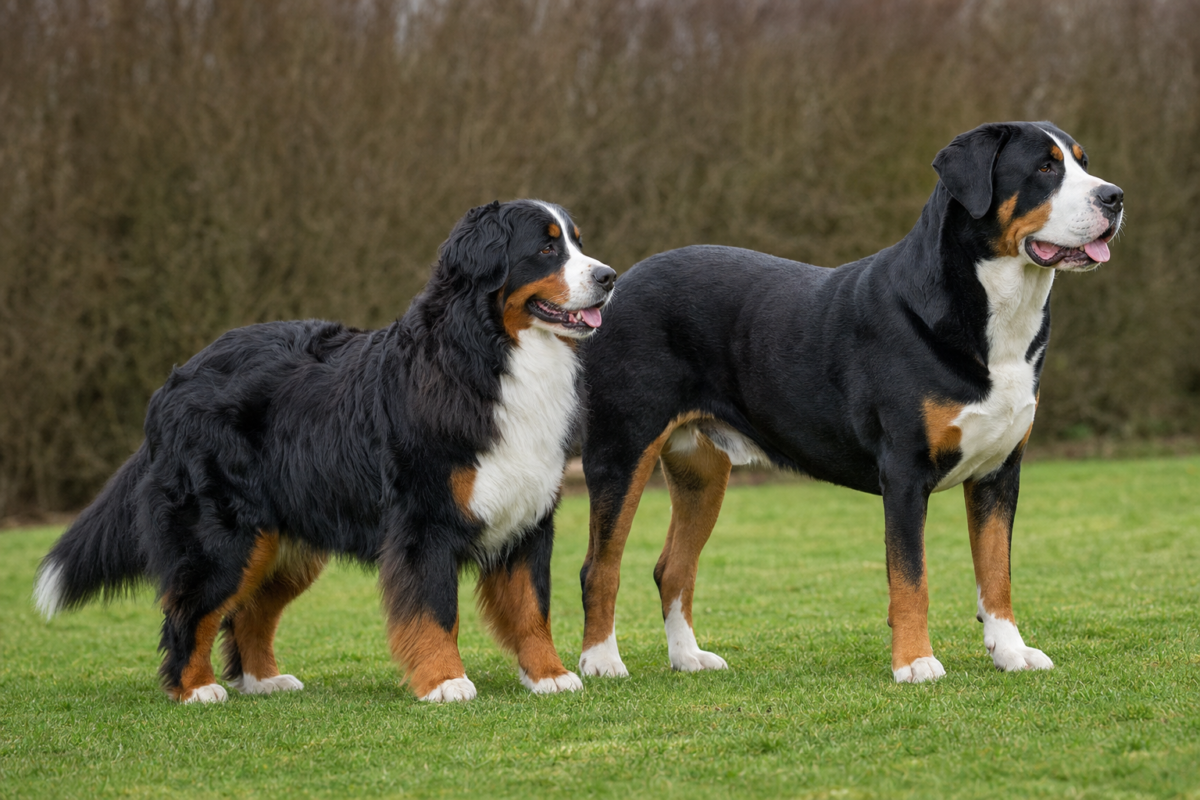
The Greater Swiss Mountain Dog is the bigger, shorter coated one. A Swissy male stands 25.5 to 28.5 inches and weighs 115 to 140 pounds, with a dense short double coat that needs little grooming. A Bernese Mountain Dog male stands 25 to 27.5 inches and weighs 80 to 115 pounds, with a long silky coat that sheds heavily and needs brushing several times a week. Both wear the same black, rust and white tricolour. The Bernese is generally the softer, more sensitive companion, while the Swissy is bolder, more confident and more physically powerful.
Put these two breeds side by side and most people see one dog in two coat lengths. They are closely related, they come from the same corner of Switzerland and they share the striking tricolour pattern, so the confusion is completely fair. But they are genuinely different dogs to live with, in size, in coat care, in energy and in temperament, and the differences matter a great deal when you are choosing which one is going to share your house for the next decade. Here is an honest comparison of both, including how each one grows and what that means for your first two years together.
What is the difference between a Bernese Mountain Dog and a Greater Swiss Mountain Dog?
The two clearest differences are coat and size. The Bernese Mountain Dog has a long, silky, moderately wavy coat, while the Greater Swiss Mountain Dog has a short, dense double coat. The Swissy is also the larger breed, typically 115 to 140 pounds for a male against 80 to 115 pounds for a Bernese male. Beyond that, the Bernese tends to be gentler and more sensitive, with a softer response to correction and a strong need for family closeness. The Swissy is more outgoing and more assertive, with a noticeable working drive and a deep booming bark. The Swissy also tends to live a little longer, at roughly 8 to 11 years against 7 to 10.
Where these two breeds come from
Both are Swiss mountain dogs, part of a family of four farm breeds known collectively as the Sennenhund. The Greater Swiss is the largest and the oldest of the four, a general purpose farm dog used for droving cattle, guarding the homestead and pulling loaded carts to market. The Bernese comes from the canton of Bern and did much the same work on a smaller scale, most famously hauling milk carts for dairy farmers.
The family resemblance is not a coincidence, and the long coat is the single feature that separates the Bernese from its three relatives. Of the four Sennenhund breeds, only the Bernese carries it. Everything else about the pattern, the white blaze up the face, the white chest cross, the rust markings above the eyes and along the legs, is shared family property.
Bernese Mountain Dog vs Greater Swiss Mountain Dog at a glance
The table below is the fast version. The sections after it explain what each row actually means for daily life.
| Trait | Bernese Mountain Dog | Greater Swiss Mountain Dog |
|---|---|---|
| Male height | 25 to 27.5 inches | 25.5 to 28.5 inches |
| Male weight | 80 to 115 lb | 115 to 140 lb |
| Female height | 23 to 26 inches | 23.5 to 27 inches |
| Female weight | 70 to 95 lb | 85 to 110 lb |
| Coat | Long, silky, slightly wavy | Short, dense double coat |
| Grooming | Several times a week, heavy seasonal shedding | Weekly brushing, still sheds |
| Energy | Moderate, enjoys a settled home | Moderate to high, wants a job |
| Temperament | Gentle, sensitive, affectionate | Confident, bold, watchful |
| Typical lifespan | 7 to 10 years | 8 to 11 years |
| Growth window | Roughly 22 to 26 months | Roughly 24 to 30 months |
Size and growth, breed by breed
Both are slow maturing dogs that spend far longer building a frame than a medium breed does, and the Swissy takes the longest.
A Bernese male typically finishes at 80 to 115 pounds and 25 to 27.5 inches at the shoulder, with females at 70 to 95 pounds and 23 to 26 inches. Height is largely set by around 18 months, and the chest and shoulders keep filling out until roughly two years or a little beyond.
A Greater Swiss male typically finishes at 115 to 140 pounds and 25.5 to 28.5 inches, with females at 85 to 110 pounds and 23.5 to 27 inches. That extra bone and substance takes longer to arrive, so a Swissy is often still thickening through the chest at two and a half years while a same age Bernese looks finished.
What the growth window means in practice
Dogs with an expected adult weight of 100 to 130 pounds keep developing for roughly 22 to 26 months, and dogs heading past 130 pounds can take 24 to 30 months. During that whole stretch the growth plates at the ends of the long bones stay open for much of the first year, and the skeleton is still forming well after your puppy looks like an adult. That is a long runway, and it is why feeding and exercise decisions carry more weight with these two breeds than they would with a smaller dog.
Growing Too Fast
Both breeds do best on a steady curve. Fast growth asks more of joints that are still forming.
Excess Weight
A heavy adolescent loads a developing frame. Lean is the goal all the way through the growth window.
Heat Sensitivity
Swiss mountain coats were built for cold. Both breeds struggle in heat, and the Bernese coat compounds it.
Hard Impact Too Young
Repeated jumping, stairs and long runs are a lot to ask of a big puppy still two years from finished.
Feeding each breed through the growth years
The feeding approach is nearly identical for both, with the Swissy simply eating more of it for longer. Steady, moderate growth is the goal, not fast growth.
- Choose a complete food formulated for large breed puppies, which controls calories and the calcium to phosphorus balance for slower, more even growth.
- Split the daily amount into three meals while young, then two meals as an adult. Both breeds are deep chested, so unhurried eating and a rest after meals are sensible habits.
- Feed to a lean body condition rather than to the number on the bag chart, which runs generous for most big dogs.
- Expect a Swissy to need noticeably more food than a Bernese of the same age, and confirm portions with your veterinarian at every checkup during the first two years.
How to check body condition in ten seconds
A long coat hides a lot, which makes this check more important for a Bernese than for almost any other big breed. Use your hands rather than your eyes.
- Ribs. Run your hands along the sides. You should feel the ribs easily under a thin covering. On a Bernese you are feeling through coat, so press gently and pay attention.
- Waist. Look down from above for a clear waist behind the ribs rather than a straight outline.
- Tuck. From the side, the belly should rise toward the back legs rather than hanging level.
Check every couple of weeks through the growth years and adjust portions gently with your veterinarian guidance.
Exercise needs and how they differ
This is where the two breeds part company most obviously in daily life. A Bernese is content with a decent walk, some garden time and the company of its people, and will happily spend the rest of the day lying across your feet. A Greater Swiss has more engine and more drive, and a bored Swissy finds its own work, which is rarely the work you had in mind.
- Favour free play, exploring and walks on soft ground while the skeleton is developing.
- Keep long runs, repeated jumping and forced exercise moderate through the first eighteen months for either breed.
- Give a Swissy a job. Cart pulling, drafting, scent work and structured training all suit the breed and satisfy it without pounding on joints.
- Watch the heat with both. Early morning and evening outings beat the middle of the day for a dog wearing a Swiss mountain coat.
Supporting joints on a frame this large
Both breeds carry a great deal of dog on four joints, and both are still building those joints long after they look grown. Steady growth, a lean body condition and sensible exercise do most of the work. A daily joint support routine is the habit many big dog parents add alongside them.
MoveGuard Growth is made for this stage. It combines nine actives, including 250mg of New Zealand Green Lipped Mussel, glucosamine, chondroitin, MSM, krill oil and hyaluronic acid, to support healthy joint development in young large and giant breed dogs across the roughly 8 to 30 month growth window. You dose by expected adult weight rather than current weight, so most Bernese puppies sit at three chews a day and a Swissy headed past 130 pounds does too. It ships as 90 chews, is made in the USA in an NSF certified facility, and comes with a 60 day guarantee. Once either breed is fully grown, MoveGuard Adult carries the same routine into adulthood.
Support A Growing Frame
Give your Swiss mountain puppy daily joint support built for large and giant breeds. Explore MoveGuard Growth.
Which one fits your home?
Neither breed is easier than the other overall. They are demanding in different places, so the honest question is which set of demands suits your life.
Choose a Bernese if you want a softer, more sensitive companion who wants to be in the room with you, you can commit to brushing several times a week and living with a lot of shed coat, and a moderate exercise routine suits your household. Bernese are famously gentle with children and settle well into family life.
Choose a Greater Swiss if you want a larger, more robust dog with a working mind, you would rather do more training and activity than more grooming, and a confident, watchful dog with a serious bark fits your home. Swissies are good natured with family but more naturally alert to strangers.
Two things are true for both. Each is a very large dog that grows slowly and costs real money to feed, insure and care for, and each is happiest close to its people rather than left alone in a yard.
A simple growth game plan, stage by stage
The plan is the same for both breeds. The Swissy simply stays in each stage a little longer.
8 weeks to 4 months. Foundation stage. A complete large breed puppy food in three calm meals, early socialisation, short bursts of free play on soft ground, and a start on handling and grooming so coat care is never a fight later.
4 to 8 months. Growth is quick and your puppy may look leggy and unfinished. Keep feeding lean, keep exercise moderate, and manage stairs and car entry deliberately. This is a natural point to begin a daily joint support routine.
8 to 18 months. Height nears its peak while substance starts to arrive. Portions need watching, since appetite often outpaces need. Build training and structured activity gradually, favouring soft surfaces.
18 months to 3 years. The adolescent becomes an adult. A Bernese is largely finished around two, while a Swissy keeps thickening through the chest and shoulders closer to two and a half. Build activity up as your veterinarian advises.
Common mistakes with both breeds
- Assuming they are the same dog. Choosing a Swissy expecting Bernese energy, or a Bernese expecting Swissy toughness, is the most common disappointment with these two.
- Underestimating the coat. A Bernese sheds constantly and blows coat seasonally. Weekly brushing is not enough.
- Overfeeding for size. A heavy giant breed puppy is not a healthier one. Let the size arrive on its own schedule.
- Too much hard exercise, too young. Both breeds are still building bone well past their first birthday.
- Ignoring the heat. Neither breed handles hot weather well, and heat is a genuine welfare issue for both.
- Waiting for a problem before supporting joints. The growth window is the moment to build the habit, not after signs appear.
Temperament, side by side
A Bernese Mountain Dog is a gentle soul in a very large body. The breed is affectionate, deeply attached to its family and unusually sensitive to tone, which means harsh handling backfires badly and patient, positive training works beautifully. Bernese tend to be reserved rather than bold with strangers and are often described as slow to mature mentally, staying puppyish in outlook well into the second year.
A Greater Swiss Mountain Dog is a more confident animal. The breed is friendly and good natured with its own people but naturally watchful, and it carries a loud, deep bark it is happy to use. Swissies are enthusiastic and physical as adolescents, which combined with their size makes early training non negotiable rather than optional. Give one a job and it is a superb companion. Leave one under employed and you will hear about it.
Both breeds are strongly people oriented and neither does well as an outdoor only dog. The difference is not affection, which both have in abundance. It is intensity.
Frequently asked questions
Which is bigger, a Bernese Mountain Dog or a Greater Swiss Mountain Dog?
The Greater Swiss Mountain Dog is bigger. A Swissy male typically weighs 115 to 140 pounds against 80 to 115 pounds for a Bernese male, and stands slightly taller at 25.5 to 28.5 inches. The Swissy is also heavier boned through the chest and shoulders.
Are Bernese Mountain Dogs and Greater Swiss Mountain Dogs related?
Yes. Both belong to the Swiss Sennenhund family of four farm breeds, alongside the Appenzeller and the Entlebucher. The Greater Swiss is the largest and oldest of the four, and the Bernese is the only one of the four with a long coat.
Which breed is easier for a first time big dog parent?
Neither is a beginner dog, but many people find the Bernese gentler to live with because it is softer and less driven. The trade is heavy coat care. A Swissy asks for less grooming and more training, and its size and confidence reward experience.
How long do Bernese Mountain Dogs and Greater Swiss Mountain Dogs live?
Bernese Mountain Dogs typically live 7 to 10 years and Greater Swiss Mountain Dogs typically live 8 to 11 years. Both are shorter lived than smaller breeds, which is common across the giant breeds. Speak with your veterinarian about health screening for your individual dog.
When do these breeds stop growing?
A Bernese Mountain Dog reaches most of its height by around 18 months and finishes filling out near two years. A Greater Swiss Mountain Dog often keeps adding substance until two and a half years, so plan on a growth window of roughly 22 to 26 months for a Bernese and 24 to 30 months for a Swissy.
The bottom line
These two Swiss cousins share a country, a colour pattern and a job history, but they are not interchangeable. The Greater Swiss Mountain Dog is the larger, shorter coated, bolder working dog that wants a task. The Bernese Mountain Dog is the gentler, long coated companion that wants your company and a good brush. Both grow slowly, both need lean feeding and sensible exercise through a long growth window, and both reward the parent who plans for the dog they will be at three rather than the puppy in front of them today.
Want the simple roadmap in one place? Grab our free Big Dog Growth Guide for the growth window checklist, feeding framework and joint safe exercise limits, all written for large and giant breeds.
This article is for general educational purposes only and is not veterinary advice. It is not intended to diagnose, treat, cure or prevent any disease. Always consult your veterinarian about your dog’s individual health, nutrition and supplement needs. These statements have not been evaluated by the Food and Drug Administration.
Support Big Breed Joints from Day One
Large and giant breeds carry more load through every growth stage. MoveGuard Growth supports developing joints in young big dogs (8 to 30 months); MoveGuard Adult keeps grown big dogs moving comfortably.
Leave a Reply