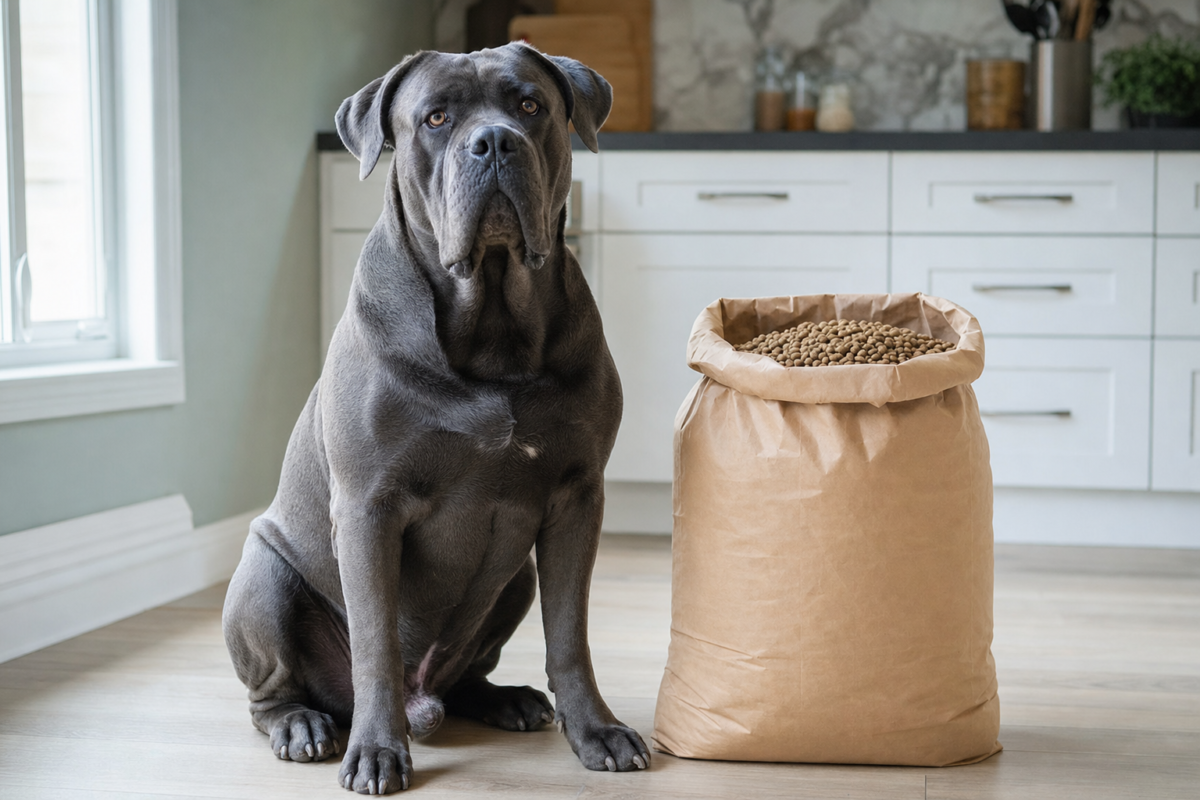
To read a large breed dog food label, start at the back of the bag, not the front. Find the AAFCO nutritional adequacy statement and check that it names the right life stage and, for a puppy, says the food is suitable for the growth of large size dogs weighing 70 pounds or more as adults. Then read the guaranteed analysis for protein, fat, calcium and phosphorus, scan the first five or six ingredients, and check the calorie content statement so you know how much energy is in a cup. The feeding chart is the last thing you read, and it is only a starting point.
Standing in a pet food aisle with a big puppy at home is one of the more overwhelming moments of big dog parenting. Every bag is shouting at you in bold type, and almost none of it is the part that matters. The information you actually need is standardised and always in the same few places, so once you know where to look you can size up any bag in under a minute. This guide walks you through every panel, tells you which numbers matter for a big frame and which are marketing, and gives you a routine you can use on any bag you pick up.
How do I read a large breed dog food label?
Read a large breed dog food label from the back forward. The AAFCO nutritional adequacy statement tells you who the food is for and is the single most important sentence on the bag. The guaranteed analysis gives you minimum protein and fat, maximum fibre and moisture, and on most puppy formulas the calcium and phosphorus levels that matter so much for a growing big dog. The ingredient list tells you what the food is made from, in order of weight before cooking. The calorie content statement tells you how much energy a cup actually delivers. The feeding chart converts that into portions, and the front of the bag tells you almost nothing you can rely on.
What makes a large breed food label different
A big dog grows for far longer and gets far heavier than a small one, and the label reflects that in two specific ways that no other size of dog has to worry about.
The first is the large size growth wording in the AAFCO statement. Since the nutrient profiles were updated, a food intended for puppies has to declare whether it is suitable for the growth of large size dogs, defined as dogs expected to reach 70 pounds or more as adults. A bag can be a perfectly good puppy food and still not carry that phrase, which means it was never formulated with a big frame in mind.
The second is mineral control. Large and giant breed puppies are unusually sensitive to excess calcium during the growth window, because they cannot regulate how much they absorb the way an adult dog can. That is why a good complete food formulated for large breed puppies keeps calcium inside a tighter band and keeps calorie density moderate, so growth stays steady rather than fast. Everything else on the label matters for every dog. These two things matter because your dog is big.
The six parts of a dog food label, decoded
Every bag sold in the United States carries the same required panels. Here is what each one is really telling you, and what to look for when the dog eating it is a large breed.
| Panel | What it tells you | What to look for on a big dog food |
|---|---|---|
| Product name | How much of the named ingredient is in the food | Beef Dog Food means at least 70 percent beef. Beef Dinner or Beef Entree means at least 10 percent. With Beef means as little as 3 percent |
| AAFCO statement | Which life stage the food is complete for | For a puppy, the words growth of large size dogs, 70 lb or more as an adult |
| Guaranteed analysis | Minimum protein and fat, maximum fibre and moisture | Moderate fat, plus calcium and phosphorus listed on puppy formulas |
| Ingredient list | Everything in the food, in order of weight before cooking | A named protein early, and whether the same grain appears three times in different forms |
| Calorie content | Energy as kcal per kilogram and per cup | Around 350 to 400 kcal per cup on most large breed formulas |
| Feeding guide | Suggested daily amount by weight | A starting point only. Most charts run generous for a lean big dog |
Two more lines are worth finding. The manufacturer statement tells you whether the company made the food or had someone else make it, and the lot code and best by date let you match your bag to a recall notice if one is ever issued. Photograph both when you open a new bag. It takes three seconds and it is the only record you will have once the bag is empty.
The AAFCO statement is the most important line on the bag
If you only read one sentence on a dog food label, read this one. It is usually printed small, near the guaranteed analysis or the feeding chart, and it takes one of two forms. Either the food is formulated to meet the nutrient levels established by the AAFCO Dog Food Nutrient Profiles for a named life stage, or animal feeding tests using AAFCO procedures substantiate that it provides complete and balanced nutrition. The second is a higher bar, because the food was actually fed to dogs rather than only calculated on paper.
Then check the life stage it names. Growth means puppies. Maintenance means adults. All life stages means the food meets the growth profile, which is the more demanding of the two, so an all life stages food is rich for a sedentary adult even though it is safe for a puppy. And for any bag you are considering for a big puppy, look for the large size growth wording. If it is absent, the food may be complete and balanced and still be the wrong choice for a dog who will finish at 90 or 140 pounds.
Why the growth window makes this line matter so much
A large breed puppy is building bone and cartilage across a growth window of roughly 8 to 30 months, far longer than a small dog spends growing at all. Through much of that time the growth plates at the ends of the long bones are still open and the skeleton is still forming. Food is the raw material for all of it, which is why the one sentence that confirms the formula was designed for a big frame earns its place at the top of your checklist.
Ingredient Splitting
The same grain listed as flour, gluten and bran sits lower separately than it would combined. Read the first six ingredients as a group.
Wet Weight Ordering
Fresh meat is mostly water, so it ranks high before cooking and shrinks afterwards. A named meal is a more concentrated protein source than it looks.
Unregulated Front Claims
Premium, holistic and human grade carry little defined meaning. Judge the food by the back panels, not the artwork.
Generous Feeding Charts
Bag charts are built on averages and often overshoot. Feed to body condition and adjust from there.
The numbers that matter in the guaranteed analysis
The guaranteed analysis is four required figures and, on most large breed puppy formulas, a few voluntary ones. Here is how to read them for a big dog.
- Crude protein, minimum. Most large breed puppy foods sit around 23 to 30 percent. Protein does not make puppies grow too fast. Calories do.
- Crude fat, minimum. This is the lever that controls energy density. Large breed puppy formulas usually run moderate, often 12 to 16 percent, precisely so that growth stays steady.
- Calcium. The number to check. Look for roughly 1.2 to 1.5 percent on a dry matter basis for a growing big dog, and be cautious above 1.8 percent. A food that lists a maximum as well as a minimum is telling you the formulator took this seriously.
- Phosphorus. Read it alongside calcium. A ratio somewhere between 1 to 1 and 2 to 1 is the widely published target, and most well formulated foods land there.
- Crude fibre and moisture, maximum. Fibre affects stool quality. Moisture matters most when you are comparing a canned food to a dry one.
One catch worth knowing. Those percentages are as fed, not dry matter, so a canned food at 78 percent moisture looks far lower in protein than it is. To compare fairly, divide the percentage by the dry portion of the food. A canned food with 10 percent protein and 78 percent moisture is 10 divided by 22, which is about 45 percent protein on a dry matter basis. Our guide to calcium and phosphorus for big breed puppies goes deeper on the mineral side if you want the full picture.
How to check body condition in ten seconds
No label can tell you how much to feed your individual dog. Your hands can, and the check takes seconds.
- Ribs. Run your hands along the sides. You should feel the ribs easily under a thin layer of covering. If you have to press, ease back on portions.
- Waist. Look down from above. You want a clear waist that tucks in behind the ribs rather than a straight outline.
- Tuck. From the side, the belly should rise toward the back legs rather than hanging level.
Check every couple of weeks through the growth years, adjust portions gently, and confirm the plan with your veterinarian at each visit.
Reading the ingredient list without getting fooled
Ingredients are listed by weight before cooking, which is the single fact that explains most of the confusion around them. Fresh chicken is about 70 percent water, so it weighs a lot at mixing time and much less once the food is extruded. Chicken meal has already had the water removed, so a bag listing chicken meal second may well contain more actual chicken protein than one listing fresh chicken first.
Watch for the same base ingredient appearing in several forms. Rice, brewers rice and rice bran on one label are all rice, and listing them separately keeps each one further down the list than the combined total would be. None of this makes a food bad. It just means the order alone does not tell you as much as it appears to.
A few practical habits help. Look for a named protein source rather than a generic one, so chicken or lamb rather than meat. Treat named byproduct meals as neutral rather than alarming, since organ meat is nutritious. And remember that the presence of a sprinkle of blueberries at the very bottom of a long list has almost no effect on the food your dog actually eats.
Turning the calorie statement into a real portion
The calorie content statement is the most useful and least read line on the bag. It gives you kilocalories per kilogram of food and, almost always, kilocalories per cup. That second number lets you compare two bags honestly, because a cup of one food can carry a hundred more calories than a cup of another while the feeding charts look similar. Weigh the food rather than scooping it if you can, since a heaped cup and a level cup can differ by a quarter.
Matching the label to your dog life stage
The right label changes as your dog does, and the transitions are where big dogs most often get fed the wrong thing.
- Puppy. A growth formula carrying the large size growth wording, fed to a lean body condition across the long big dog growth window.
- Adolescent. Same food, smaller relative portions. Appetite often outpaces need somewhere after the first year.
- Adult. A maintenance formula, or an all life stages food fed carefully, since the growth profile is richer than a settled adult needs. Our guide on when to switch from puppy food to adult food covers the timing.
- Senior. Senior is not a defined AAFCO life stage, so a senior bag is legally an adult maintenance food with a marketing name. Read the guaranteed analysis and the calories rather than trusting the word.
Supporting the joints those calories are building
Reading labels well is really about one thing. You are trying to give a big frame what it needs to develop steadily, because a dog who grows at a moderate pace and stays lean carries less load through every joint for the rest of a long life. Food does most of that work. A daily joint support routine is the habit many big dog parents add alongside it.
MoveGuard Growth is built for the growth window specifically. It combines nine actives, including 250mg of New Zealand Green Lipped Mussel, glucosamine, chondroitin, MSM, krill oil and hyaluronic acid, to support healthy joint development in young large and giant breed dogs. You dose by expected adult weight rather than current weight, so a puppy headed for 50 to 80 pounds takes two chews and one headed past 80 pounds takes three. It ships as 90 chews, is made in the USA in an NSF certified facility, and is backed by a 60 day guarantee. Once your dog is fully grown, MoveGuard Adult carries the same idea into adulthood. A note for label readers with allergies in the house. The chews contain shellfish, fish and soy, and the flavour is chicken liver.
Support A Growing Frame
Give your big puppy daily joint support built for large and giant breeds. Explore MoveGuard Growth.
Signs the food you chose is working
A label gets you to a sensible choice. Your dog tells you whether it was the right one. Over the four to six weeks after a switch, look for a steady body condition you can still feel the ribs through, firm and consistent stools, a coat with some shine to it, and an energy level that matches your dog normal self.
What you do not want to see is rapid weight gain, a puppy who suddenly looks heavy through the shoulders, persistent loose stools, or a dull coat that does not recover. Any of those is worth a conversation with your veterinarian, who can look at the label with you and at your individual dog at the same time.
A simple label reading routine, aisle by aisle
Once you have done this a few times it takes less than a minute per bag, and the order is what makes it fast.
Step one, flip the bag. Ignore the front entirely on the first pass. Everything you need is on the back and side panels.
Step two, find the AAFCO statement. Confirm the life stage, and for a puppy confirm the large size growth wording. If it is missing, put the bag back. You have just saved yourself the other four steps.
Step three, read the guaranteed analysis. Protein, fat, and on a puppy food the calcium and phosphorus. Check that the calcium sits in a sensible band rather than as high as the formulator could take it.
Step four, scan the first six ingredients. Look for a named protein near the top and notice whether one base ingredient has been split across several entries.
Step five, read the calorie statement and the chart. Note the kcal per cup, then treat the suggested portion as an opening estimate you will adjust by feel over the next two weeks.
Common label mistakes to avoid
Almost every big dog feeding mistake we hear about starts with one of these.
- Buying on the front panel. The artwork and the adjectives are the least regulated part of the bag and tell you the least about the food.
- Missing the large size growth line. A puppy food without it was not formulated with a big frame in mind, however good it is otherwise.
- Adding a calcium supplement on top of a complete food. A balanced growth formula already has what a big puppy needs, and more is not better here. Ask your veterinarian before adding any mineral.
- Following the feeding chart to the gram. Charts are averages. Your dog is not an average, and a lean body condition beats a printed number every time.
- Comparing wet and dry percentages directly. Without converting to a dry matter basis the comparison is meaningless.
- Trusting the word senior. It has no legal definition in the nutrient profiles, so the numbers are the only guide.
Why big dogs deserve the extra minute
A giant breed puppy can multiply its birth weight a hundred times over in less than two years, and every one of those pounds is built from what is in the bag. A small dog finishes growing before most feeding mistakes have time to matter, while a big dog is still building for two years or more, which gives a small daily error a long time to compound.
Frequently asked questions
What does the AAFCO statement on a dog food bag mean?
It is the sentence that says the food is complete and balanced for a named life stage, either because it was formulated to meet the AAFCO nutrient profiles or because it passed a feeding trial. For a large breed puppy, it should also say the food is suitable for the growth of large size dogs weighing 70 pounds or more as adults.
How much calcium should a large breed puppy food contain?
Most guidance puts a growing large breed puppy at roughly 1.2 to 1.5 percent calcium on a dry matter basis, with caution above 1.8 percent, and a calcium to phosphorus ratio between 1 to 1 and 2 to 1. A food that publishes a maximum as well as a minimum is giving you more information to work with. Confirm the right choice with your veterinarian.
Is the first ingredient on the label the most important one?
Less than it appears. Ingredients are ordered by weight before cooking, so fresh meat that is mostly water ranks higher than it will once the food is made. A named meal listed second can contribute more protein than fresh meat listed first.
Should I follow the feeding guide printed on the bag?
Use it as a starting point, not a rule. Bag charts are built on averages and often run generous. Feed the suggested amount for a fortnight, then adjust up or down based on your dog body condition and your veterinarian guidance.
Does a dog food need to say large breed on the front to be suitable?
No. The front panel is marketing and carries no defined meaning. What matters is the AAFCO statement on the back, the calcium and phosphorus levels in the guaranteed analysis, and a moderate calorie density. A bag can say large breed and still be a poor fit, and the reverse is also true.
The bottom line
A large breed dog food label looks complicated because the useful part is hidden behind the marketing, not because it is genuinely hard. Flip the bag, check the AAFCO statement for the life stage and the large size growth wording, read the calcium and phosphorus alongside protein and fat, scan the first six ingredients as a group, and note the calories per cup before you look at the chart. Then feed the dog in front of you and adjust by body condition. That routine takes a minute in the aisle and gives your big dog the steady growth a large frame needs.
Want the simple roadmap in one place? Grab our free Big Dog Growth Guide for the growth window checklist, feeding framework and joint safe exercise limits, all written for large and giant breeds.
This article is for general educational purposes only and is not veterinary advice. It is not intended to diagnose, treat, cure or prevent any disease. Always consult your veterinarian about your dog’s individual health, nutrition and supplement needs. These statements have not been evaluated by the Food and Drug Administration.
Support Big Breed Joints from Day One
Large and giant breeds carry more load through every growth stage. MoveGuard Growth supports developing joints in young big dogs (8 to 30 months); MoveGuard Adult keeps grown big dogs moving comfortably.
Leave a Reply