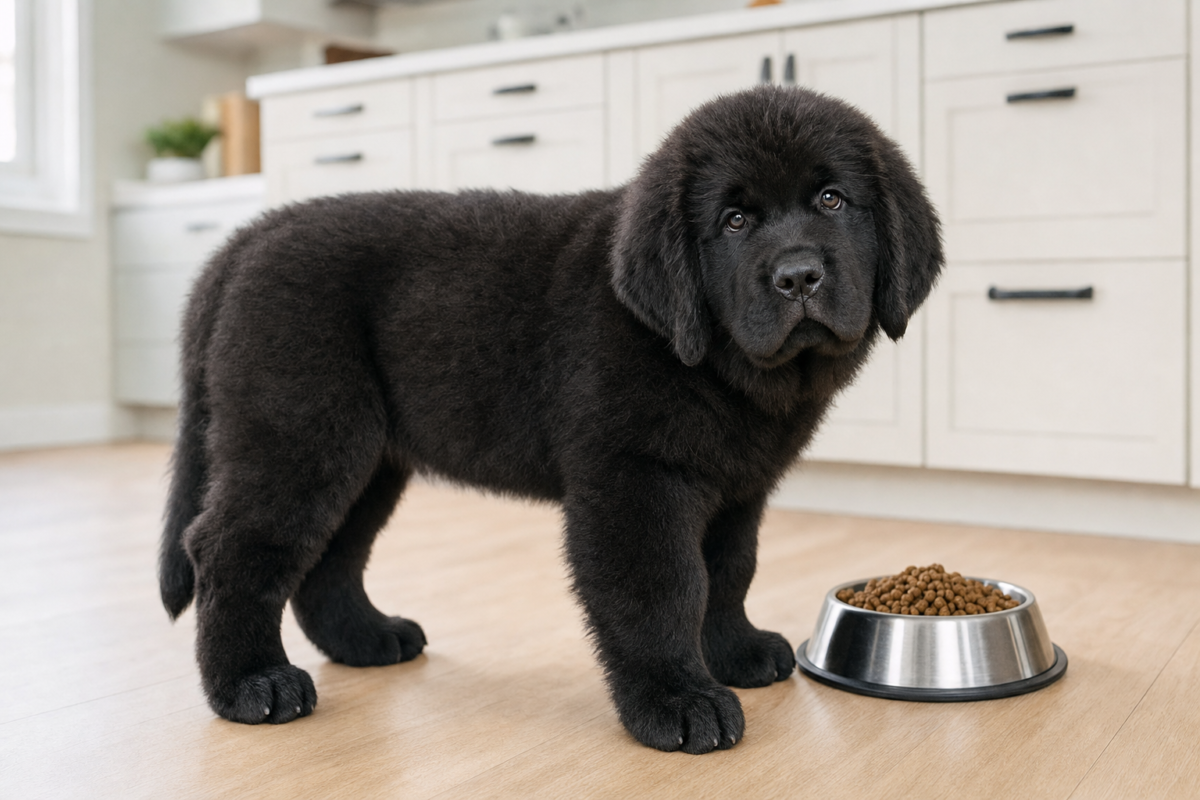
The best food for a giant breed puppy is a complete large breed puppy formula whose label carries an AAFCO statement for growth including large size dogs, meaning 70 pounds or more as an adult. Look for controlled calcium of roughly 1.0 to 1.5 percent on a dry matter basis, a calcium to phosphorus ratio near 1.1 to 1 or 1.2 to 1, moderate calorie density and moderate fat. Those numbers are what slow the growth curve down, and a slower curve is exactly what a giant breed frame needs.
Bringing home a giant breed puppy comes with one decision that matters more than almost any other, and it happens at the food bowl. A puppy heading for 120 pounds is going to multiply its birth weight many times over in about two years, and the food you choose decides how quickly that happens. The good news is that this is a simple decision once you know what to look at on the bag. This guide walks you through exactly what a giant breed puppy needs, how to read the label, how much to feed, and the habits that turn a good food into steady, comfortable growth.
What is the best food for giant breed puppies?
The best food for a giant breed puppy is a complete, balanced large breed puppy formula that carries an AAFCO nutritional adequacy statement for growth including large size dogs, 70 pounds or more as an adult. That single line on the back of the bag is the most important thing you will read, because it means the food has been formulated with the controlled calcium and moderate energy density that a fast growing giant frame needs.
Beyond that statement, the strongest choices offer roughly 1.0 to 1.5 percent calcium on a dry matter basis, a calcium to phosphorus ratio close to 1.1 to 1, moderate fat rather than a very rich formula, and a sensible calorie density so that a filling portion does not deliver excess energy. Brand matters far less than those numbers. A mid priced food that hits them will serve your puppy better than a premium food that does not.
Why giant breed puppies need a different food
A giant breed puppy is not simply a big version of a small one. A toy breed puppy reaches its adult weight in under a year and multiplies its birth weight perhaps twenty times. A Great Dane or Newfoundland can multiply it a hundred times and keep building for two years or more. That is an enormous construction project, and the raw materials arrive through the food bowl.
Two things go wrong when a giant puppy eats a standard puppy food. The first is energy. Regular puppy formulas are rich, and a rich diet fed to a giant breed produces fast growth, which loads joints and bone that are still forming. The second is calcium. Young large and giant breed puppies cannot regulate how much calcium they absorb the way adult dogs can, so an excess passes straight through into a developing skeleton whether the body needs it or not. That is precisely why controlled growth matters for giant breeds, and why a proper large breed puppy formula controls calcium rather than maximising it.
The goal is not a smaller adult dog. Your puppy will reach the same adult size either way. The goal is arriving there on a steadier curve, with a frame that had time to build properly along the way.
What to look for on a giant breed puppy food label
Turn the bag over. Everything you need is on the back, and the front of a bag is marketing. Here is what to check and why it matters.
| What to check | What you want | Why it matters |
|---|---|---|
| AAFCO statement | Growth, including large size dogs, 70 lb or more as an adult | The single best indicator that the food is formulated for a giant frame |
| Calcium | About 1.0 to 1.5 percent dry matter | Young giant puppies absorb calcium they do not need, so controlled is better than high |
| Calcium to phosphorus ratio | Roughly 1.1 to 1 up to 1.4 to 1 | The balance matters as much as the amount for developing bone |
| Calorie density | Moderate, often around 340 to 400 kcal per cup | Lets you feed a satisfying volume without overshooting energy |
| Protein | About 23 to 30 percent | Supports lean muscle. Protein is not what drives fast skeletal growth, energy is |
| Fat | About 12 to 18 percent | Moderate fat keeps the calorie load sensible |
| DHA | Listed in the analysis | Supports normal brain and vision development in puppies |
The World Small Animal Veterinary Association’s Global Nutrition Committee publishes evidence-based guidance for evaluating dog food and feeding practices. Read more from the WSAVA Global Nutrition Guidelines.
If a bag does not publish its calcium level or its calorie density, the manufacturer will tell you if you call or check the website. A company that makes those numbers hard to find is telling you something too. Our deeper guide to calcium and phosphorus for big breed puppies explains the chemistry in plain language if you want the full picture.
Adult Food Too Early
Switching a giant puppy to adult food before the frame is built shortchanges a growing dog. Time the change with your veterinarian.
Calcium Supplements
Never add calcium, bone meal or a mineral supplement to a complete puppy food unless your veterinarian specifically asks you to.
Free Feeding
Leaving a full bowl down all day removes the one control that matters most on a giant breed. Measure and serve.
Feeding For Size
A chunky giant puppy is not a healthier one. Extra weight loads joints that are still forming.
How much should a giant breed puppy eat?
Start with the feeding guide on the bag, matched to your puppy’s expected adult weight rather than current weight, then adjust to what you see and feel. Bag guidelines are generous by design, so most giant breed puppies end up somewhere below the printed figure rather than above it.
- Weigh or measure every meal with a proper cup rather than judging by eye. Guessing on a giant breed compounds quickly.
- Feed three meals a day up to around six months, then two meals a day from there on. Two meals suit deep chested breeds better than one large one.
- Recheck the portion every two to three weeks during the fastest growth, because the right amount changes faster than you expect.
- Count treats and training rewards inside the daily total, not on top of it.
- Let food settle before and after hard play rather than feeding either side of it.
- Confirm the amount with your veterinarian at each puppy visit. Our giant breed puppy feeding guide walks through portions by age in more detail.
How to check body condition in ten seconds
The bag tells you an average. Your hands tell you about your dog. This check is the real feeding instruction, and it beats any chart.
- Ribs. Run your hands along the sides. You should feel the ribs easily under a thin layer of covering. If you have to press to find them, ease back on portions.
- Waist. Look down from above. You want a clear waist that tucks in behind the ribs rather than a straight line from chest to hip.
- Tuck. From the side, the belly should rise toward the back legs rather than hanging level.
Check every couple of weeks through the growth years. On heavily coated breeds do it entirely by feel, because a plush coat hides a great deal. Adjust portions in small steps of about ten percent and give each change a couple of weeks before judging it, with your veterinarian’s guidance.
Wet, dry, raw and the questions parents actually ask
Most giant breed parents feed dry food, and there are practical reasons for that beyond cost. Dry food is easy to measure precisely, which matters enormously when portion control is the whole game, and a complete formula takes the guesswork out of balancing minerals for a growing skeleton.
- Adding wet food. Perfectly reasonable as a topper for a fussy eater, as long as you subtract the equivalent calories from the dry portion. Our comparison of wet and dry food for large breed dogs covers the trade offs.
- Grain free. The FDA has investigated reports linking some grain free diets high in peas, lentils and other legumes with heart changes in dogs, and that work is ongoing rather than settled. Unless your veterinarian has recommended grain free for a specific reason, there is no advantage to choosing it for a giant breed puppy.
- Home prepared and raw. Balancing calcium and phosphorus by hand for a growing giant breed is genuinely difficult, and getting it wrong during the growth window matters more than at any other time of life. If you want to go this route, work with a board certified veterinary nutritionist rather than a recipe found online.
- Puppy food versus adult food. Giant breeds usually stay on a large breed puppy formula longer than other dogs, often to somewhere between 18 and 24 months. Our guide to puppy food versus adult food covers how to time the change.
Feeding through the growth window, stage by stage
The food itself changes very little. What changes is the portion and your attention.
8 weeks to 4 months. Three measured meals a day of a large breed puppy formula. Keep whatever the breeder was feeding for the first week, then transition over seven to ten days by mixing gradually. Weigh your puppy at every veterinary visit so you have a curve rather than a snapshot.
4 to 8 months. The fastest growth of your puppy’s life. Portions climb quickly, so recheck them every couple of weeks. This is where overfeeding does the most damage and where the hands on condition check earns its keep. Move to two meals a day around six months.
8 to 18 months. Height nears its peak while the body fills out. Appetite often outpaces need here, so hold the line on lean condition even when your dog acts starving. Portions may need to come down rather than up as growth slows.
18 months to 2 years and beyond. Talk to your veterinarian about moving to an adult formula. Giant breeds are usually the last to make this change. Once you switch, expect the daily amount to drop, and keep running the same body condition check every few weeks.
Feeding habits that support developing joints
Steady feeding does most of the work in supporting a giant breed puppy through the growth window, and the daily habits around it do the rest. Keeping your puppy lean, splitting meals sensibly, avoiding repeated hard impact and building a calm routine all support the same goal, which is comfortable movement while the frame is still forming.
Alongside lean feeding and sensible exercise, many big dog parents add a daily joint support chew made for large and giant breeds. MoveGuard Growth is built for exactly this stage. It combines nine actives, including New Zealand Green Lipped Mussel, glucosamine, chondroitin, MSM and hyaluronic acid, to support the developing joints of young large breed dogs across the roughly 8 to 30 month growth window. You dose by expected adult weight, so a puppy heading for 80 to 100 pounds or more sits at three chews a day. It ships as 90 chews, is made in the USA in an NSF facility, and is backed by a 60 day guarantee.
Support A Growing Frame
Give your giant breed puppy daily joint support built for large and giant breeds. Explore MoveGuard Growth.
Signs the food is working
You do not need a weekly weigh in to know a diet is suiting your puppy. Look for ribs you can feel with light pressure, a visible waist from above, firm well formed stools, a glossy coat, good energy that settles into proper rest, and a growth curve that climbs steadily rather than in dramatic jumps.
Worth raising with your veterinarian: persistently loose stools, a puppy who is always ravenous despite generous portions, sudden weight gain, limping or stiffness after normal play, or a puppy who seems reluctant to move. None of these mean something is wrong. All of them are easier to sort out early, and diet is often part of the answer.
Common feeding mistakes to avoid
Most feeding problems in giant breeds come from good intentions. Avoid these and you are well ahead.
- Buying a regular puppy food. The bag may say puppy in large letters, but without the large size growth statement it is the wrong formula for a giant frame.
- Adding calcium or supplements to a complete food. A balanced puppy food is already balanced, and additions upset it rather than improve it.
- Free feeding. A full bowl left down all day removes your only real control over the growth curve.
- Feeding to the bag rather than the dog. Bag guidelines are averages. Your individual puppy may need noticeably more or less.
- Switching foods abruptly or often. Change over seven to ten days, and give any new food several weeks before judging it.
- Rewarding the sad eyes. Giant breeds are magnificent beggars. Extra food is not extra love, and lean is genuinely kinder.
- Moving to adult food too early. Giant breeds need their puppy formula longer than most. Time the change with your veterinarian, not with a birthday.
Building a calm routine around the bowl
Food is also a training opportunity, and giant breeds are the dogs where good manners around the bowl pay the biggest dividends. A 30 pound puppy who barges the kitchen is amusing. The same behaviour at 130 pounds is not, and the habits form now.
Ask for a simple sit before the bowl goes down, every single meal, so that patience becomes the default rather than something you negotiate. Feed in the same quiet spot away from foot traffic, and let your puppy eat undisturbed rather than practising taking food away, which teaches guarding rather than trust. If there are children in the house, the rule that nobody touches the dog while eating is simple, fair and protects everyone. Pick the bowl up when the meal is finished, and if your puppy walks away from a portion, note it rather than topping it up with something tastier, because a fussy giant breed is very often a puppy who learned that waiting produces better food.
Handled this way, mealtimes become two calm, predictable moments in the day rather than a scramble, and predictable is exactly what a growing giant breed does best on.
Frequently asked questions
What is the best food for giant breed puppies?
A complete large breed puppy formula carrying an AAFCO statement for growth including large size dogs, 70 pounds or more as an adult. Look for controlled calcium of roughly 1.0 to 1.5 percent dry matter, a calcium to phosphorus ratio near 1.1 to 1, and moderate calorie density and fat.
Can a giant breed puppy eat regular puppy food?
It is not the best choice. Standard puppy formulas are richer in energy and often higher in calcium than a giant breed puppy needs, which encourages faster growth than a developing frame benefits from. Choose a formula labelled for the growth of large size dogs instead.
How long should a giant breed puppy stay on puppy food?
Usually longer than other dogs, commonly somewhere between 18 and 24 months, because giant breeds keep building well past their first birthday. Confirm the timing with your veterinarian based on how your individual dog is developing.
Should I add calcium to my giant breed puppy food?
No, not unless your veterinarian specifically directs it. A complete puppy food is already balanced, and young large breed puppies absorb extra calcium they do not need, which is exactly what a controlled formula is designed to avoid.
How many times a day should a giant breed puppy eat?
Three measured meals a day up to around six months of age, then two meals a day from there into adulthood. Two meals suit deep chested breeds better than one large meal and keep energy steadier through the day.
The bottom line
Choosing food for a giant breed puppy comes down to one line on the back of the bag and one habit at home. Pick a complete large breed puppy formula stating growth for large size dogs, check that calcium sits in the controlled range with a sensible calcium to phosphorus ratio, then measure every meal and let your hands rather than the bag decide the portion. Feed for a lean, steady curve, keep the puppy formula going as long as your veterinarian advises, and support the growth window with the right daily habits. Do that and your puppy grows into exactly the dog they were always going to be, with a frame that had the time to build properly.
Want the Simple Roadmap in One Place?
Grab our free Big Dog Growth Blueprint for the growth window checklist, feeding framework and joint safe exercise limits, all written for large and giant breeds.
This article is for general educational purposes only and is not veterinary advice. It is not intended to diagnose, treat, cure or prevent any disease. Always consult your veterinarian about your dog’s individual health, nutrition and supplement needs. These statements have not been evaluated by the Food and Drug Administration.
Support Big Breed Joints from Day One
Large and giant breeds carry more load through every growth stage. MoveGuard Growth supports developing joints in young big dogs (8 to 30 months); MoveGuard Adult keeps grown big dogs moving comfortably.
Leave a Reply