
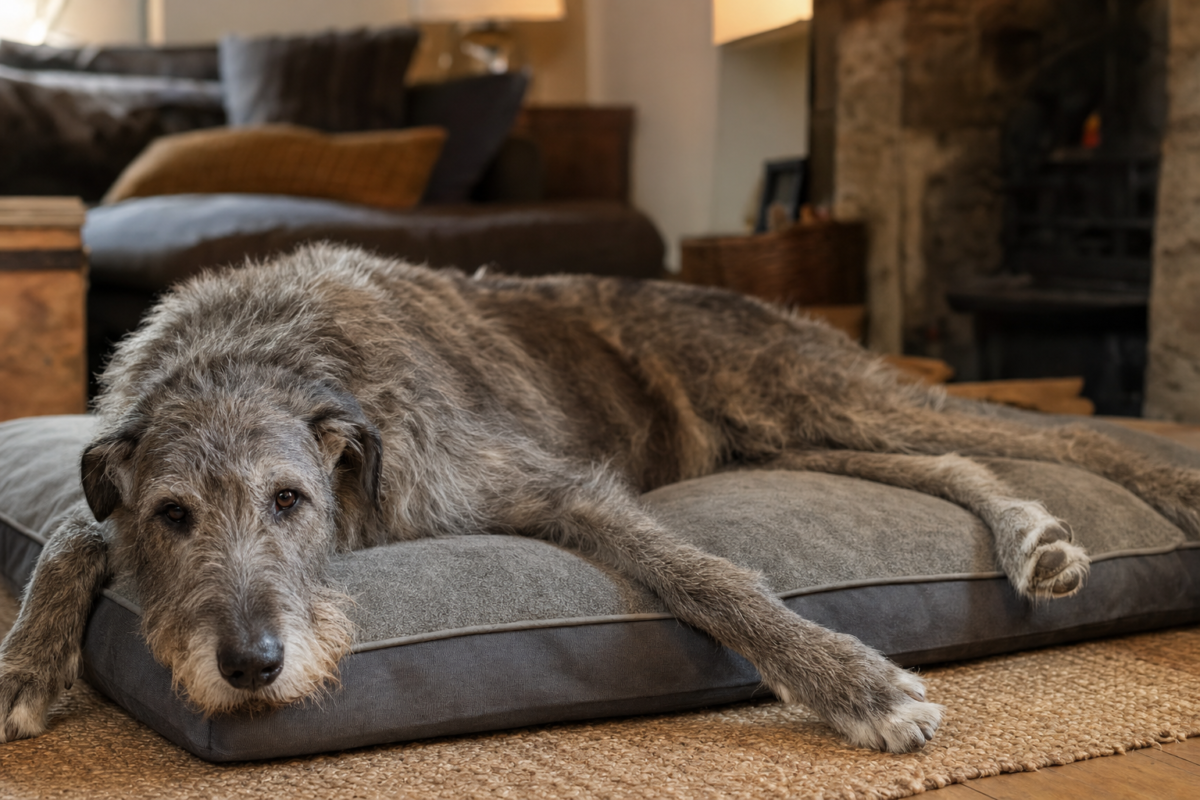
The comfort routines that help aging giant breeds are daily, small and repeatable: a slow warm up before the first walk, two or three shorter walks instead of one long one, traction on every floor your dog crosses, a large supportive bed away from draughts, meals measured to hold a lean body condition, a weekly grooming and nail check, daily joint support, and a predictable rhythm to the day. Consistency does the work. A giant breed does far better with the same gentle routine every day than with an easy week followed by a big weekend.
Giant breeds give you a shorter run than most dogs, and they arrive at their senior years while still looking magnificent. That combination catches a lot of us out. The good news is that the things which keep an old giant comfortable are not expensive or complicated. They are routines: the same handful of choices repeated every day, built around a body that carries a great deal of weight and no longer bounces back the way it once did. Here is what those routines look like in practice.
What comfort routines help aging giant breed dogs?
The routines that matter most are a gentle warm up before activity, shorter and more frequent walks, non slip footing throughout the house, a properly sized orthopaedic bed in a warm draught free spot, portions measured to keep your dog lean, ramps instead of jumps, regular nail and paw care, daily joint support, and mental engagement that does not depend on the body. Layer those and you have covered the great majority of what a senior giant needs from you day to day.
What ties them together is predictability. An older giant breed copes best when meals, walks and rest land at roughly the same times, on the same surfaces, in the same order. Routine reduces the number of hard moments in a day, and hard moments are what wear an old dog down.
Why giant breeds age differently
A giant breed is considered a senior far earlier than a small dog, often from around six years of age, and sometimes sooner for the very largest breeds. That is not a failure of care. It is simply what happens when an animal carries a hundred and fifty pounds on a frame that finished growing only a few years earlier.
Scale changes the daily maths. Every rise from the floor, every step onto a slick hallway, every jump into the car asks more of a giant than of a medium dog doing exactly the same thing. It also means small improvements pay unusually well. A runner in the right hallway or two pounds off the waistline changes more for a Great Dane than it ever would for a spaniel.
The comfort routine through the day
Use this as a template and shape it around your own household rather than following it to the minute.
| Time of day | Routine | Why it helps |
|---|---|---|
| On waking | Five slow minutes indoors before going out | Lets a stiff body warm up before it meets steps or cold ground |
| Morning | A short, flat, unhurried walk | Movement early keeps the day loose without a big single effort |
| Midday | A measured meal and a proper rest | Steady portions hold body condition, and deep rest matters more with age |
| Afternoon | A sniffing walk or a scent game at home | Tires the mind without loading the joints |
| Evening | Second measured meal, gentle handling check | You notice changes early when you touch your dog every day |
| Night | Supportive bed, warm spot, water within reach | Good sleep is where an old body does its recovery |
The American Veterinary Medical Association notes that larger breeds are generally considered senior earlier than small breeds, given their shorter typical lifespans. Read more from the AVMA’s guidance on caring for senior pets.
The morning routine
Mornings are the hardest part of the day for most old giants, and the easiest to improve. A dog who has been lying still for eight hours needs a few minutes to warm up before being asked to walk downstairs onto a cold path.
- Let your dog rise on a rug rather than on a bare floor. A bed with a grippy base beside a runner is ideal.
- Spend five slow minutes moving around indoors before the first outing.
- Take the first walk short, flat and slow. Save any longer outing for later in the day.
- In cold weather, keep a coat by the door for thin coated giants and take the edge off the first ten minutes.
The movement routine
Old giants still need to move. Muscle is part of what holds a joint steady, and a dog who stops walking loses condition quickly. The aim is little and often rather than rare and big.
- Split the daily total into two or three short walks instead of one long one.
- Choose grass, dirt and sand over pavement whenever you can.
- Use low impact exercise such as gentle swimming, slow hill walking and sniffing games.
- Let your dog set the pace, and turn for home before you see the pace drop.
- Judge the dose by how your dog looks the next morning, not by how the walk itself went.
Slippery Floors
Hard smooth flooring makes an old giant brace on every rise. Runners on the daily routes change how your dog lives at home.
Creeping Weight
Activity drops with age while portions stay the same. Lean body condition is the highest leverage thing you control.
A Bed That Is Too Small
Most beds sold as large are short for a giant. Your dog should stretch out fully without a limb hanging off the edge.
The Big Weekend
Five quiet days and one huge Saturday is harder on an old frame than the same distance spread evenly.
The feeding routine
Keeping an aging giant lean is the most valuable thing on this page. Weight that arrives slowly through the senior years travels through every joint on every stride, and it is far easier to prevent than to remove.
- Measure every meal rather than filling the bowl, and feed at the same times each day.
- Reset the amount when activity drops. An old dog walking half as far does not need the same portion.
- Count treats and chews in the daily total.
- Raise bowls only if your veterinarian suggests it for your individual dog, and use a rug so your dog is not braced on slick tile while eating.
- Confirm a healthy target weight and a suitable body condition with your veterinarian, then check against it every few months.
How to check body condition in ten seconds
- Ribs. Run your hands along the sides. You should feel the ribs easily under a thin layer. If you have to press, ease back on food.
- Waist. Look down from above. You want a clear waist that tucks in behind the ribs.
- Tuck. From the side, the belly should rise toward the back legs rather than hanging level.
The rest and sleep routine
Older dogs sleep more, and the quality of that sleep shapes how the next day goes. For a giant breed this is mostly a furniture problem.
Buy the bed by measuring your dog rather than by the label. Lay a tape from nose to base of tail and add a comfortable margin, because a dog whose elbows or hips hang over the edge onto a hard floor is not resting properly. Choose real orthopaedic foam rather than a stuffed cushion that flattens, and check it every few months. Put the bed somewhere warm and out of the draught, away from the door but still where the family is, since most dogs would rather be near you than perfectly positioned. Two beds in two rooms is often better than one perfect bed, because it removes a long walk from an old dog who wants to follow you.
Keep water within easy reach of the resting spot, and if your dog sleeps upstairs, think about moving the whole arrangement to the ground floor. A staircase taken twice a day for years is a large amount of loading you can simply remove.
The grooming and paw routine
A weekly ten minute session catches most of the small problems that make an old giant uncomfortable.
- Nails. Long nails change where the foot lands and how the toes grip. Trim little and often rather than rarely and hard.
- Paw fur. Trim the hair between the pads. On a smooth floor it acts like a sock on polished wood.
- Coat and skin. Brush through and run your hands over the whole body. You are checking for lumps, sore spots and thickened elbows.
- Ears and teeth. A quick look each week means changes get to your veterinarian early.
Daily joint support
Alongside lean feeding, good footing and steady movement, many big dog parents keep a daily joint support chew in the routine, given at the same meal each day so it never gets forgotten.
MoveGuard Adult is built for medium and large breed adult dogs from 25 to 75 pounds. It brings together glucosamine, chondroitin, MSM, New Zealand Green Lipped Mussel, eggshell membrane collagen, hyaluronic acid and vitamins C and E to support cartilage, connective tissue and comfortable movement. Dosing follows weight, so a dog from 25 to 50 pounds takes one chew a day and a dog from 50 to 75 pounds or more takes two, with the label advising senior dogs aged seven and over to use the higher amount for their weight and to allow six to eight weeks. It ships as 60 chicken liver flavoured chews, is made in the USA in an NSF registered facility, and carries a 60 day guarantee.
Support Comfortable Movement
Give your older big dog daily joint support made for medium and large breeds. Explore MoveGuard Adult.
Keeping the mind busy
When the body slows, the mind still wants a job, and a bored old dog is a restless one. The best senior enrichment is nose work, because scenting is tiring in the best way and costs the joints almost nothing.
- Scatter part of a meal in the grass and let your dog hunt for it.
- Hide treats around one room and release your dog to find them.
- Take a walk with no destination where sniffing sets the pace.
- Keep training short and gentle. Old dogs enjoy learning and it steadies confidence.
Common mistakes to avoid
- Stopping exercise completely. Rest has a place, but sustained inactivity costs muscle, and muscle supports the joint.
- Feeding the same amount forever. Portions that suited a five year old rarely suit a nine year old doing half the distance.
- Ignoring the floors. Runners are cheap and change every rise your dog makes.
- Asking for the car jump. A ramp costs less than a single vet visit and removes a hard landing from the week.
- Filing everything under old age. Age explains a slow decline, not a sudden change. Sudden changes belong in a clinic.
When to call your veterinarian
Routines are for the ordinary days. Book a visit if you see limping that lasts more than a day or two, a leg your dog will not use, a sudden change in how your dog moves, yelping when a joint is handled, swelling or heat around a joint, appetite loss, laboured breathing, or a dog who becomes withdrawn and does not want to be touched. Take a short phone video of your dog rising from the floor and walking away from the camera, because those changes often vanish in an exam room. With a giant breed it is also worth asking about a senior check every six months rather than every twelve, since a lot can change in a year at this stage of life.
Frequently asked questions
At what age is a giant breed dog considered senior?
Most giant breeds are considered senior from around six years of age, and some of the very largest a little earlier. It is a guide rather than a rule, so use it as a prompt to start senior routines and to ask your veterinarian about more frequent wellness checks.
How much exercise does an aging giant breed need?
Little and often works best. Two or three shorter walks a day on soft ground usually suits an old giant better than one long outing. Let your dog set the pace, and judge the amount by how your dog looks the following morning rather than by distance.
What kind of bed is best for an old giant breed dog?
A genuinely orthopaedic bed that is long enough for your dog to stretch out fully with no limb hanging onto the floor. Measure your dog rather than trusting the size on the label, place it somewhere warm and free of draughts, and replace the foam once it flattens.
Should I stop letting my senior giant use the stairs?
Many big dog parents reduce stair trips rather than banning them, often by moving the bed and water to the ground floor so the staircase is used a couple of times a day instead of a dozen. If your dog is already hesitating at the bottom, discuss it with your veterinarian.
Can a daily joint chew help an older giant breed dog?
A daily joint chew is nutritional support rather than a treatment. Ingredients such as glucosamine, chondroitin, MSM, green lipped mussel and hyaluronic acid are used to support cartilage, connective tissue and comfortable movement. Talk to your veterinarian about your individual dog, especially if how your dog moves has changed.
The bottom line
Comfort for an aging giant is not one big intervention. It is a warm up before the first walk, two or three short outings instead of one long one, runners on the floors your dog crosses, a bed long enough to stretch out on, measured meals that hold a lean body condition, a weekly ten minutes on nails and paws, a daily joint support habit, and nose work to keep the mind busy. Repeat that quietly every day and you give your old giant the two things that matter most: a body that is asked for only what it can comfortably give, and a rhythm it can rely on.
Want the simple roadmap in one place? Grab our free Big Dog Mobility Guide for the everyday signs checklist, the home setup fixes and the low impact activity plan, all written for large and giant breeds.
This article is for general educational purposes only and is not veterinary advice. It is not intended to diagnose, treat, cure or prevent any disease. Always consult your veterinarian about your dog’s individual health, nutrition and supplement needs. These statements have not been evaluated by the Food and Drug Administration.
Support Big Breed Joints from Day One
Large and giant breeds carry more load through every growth stage. MoveGuard Growth supports developing joints in young big dogs (8 to 30 months); MoveGuard Adult keeps grown big dogs moving comfortably.

Leave a Reply