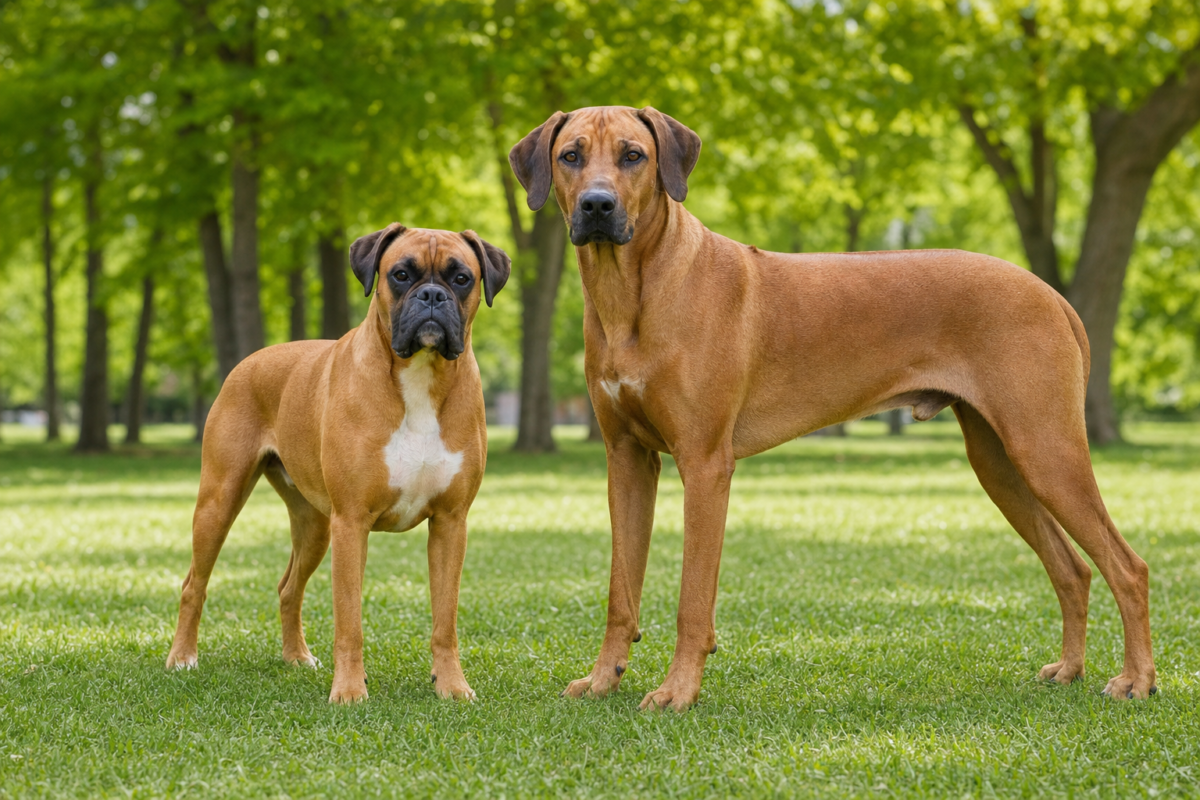
A Rhodesian Ridgeback is the bigger, quieter and more independent of the two, standing 24 to 27 inches and weighing 70 to 85 pounds, with a short wheaten coat and the famous ridge of backward growing hair along the spine. A Boxer stands 21 to 25 inches and weighs 50 to 80 pounds, with a square short muzzled head and a playful, endlessly social temperament. The Boxer wants to be in the middle of family life. The Ridgeback wants a job, a run and then some peace.
Choosing between a Boxer and a Rhodesian Ridgeback is not really a choice about size, even though the Ridgeback is the larger dog. It is a choice about the kind of company you want at home for the next twelve years. Both are athletic, short coated, low grooming breeds that suit an active household, and both grow slowly enough that the first two years need care. Where they part ways is temperament, and that difference is bigger than any number on a chart.
What is the difference between a Boxer and a Rhodesian Ridgeback?
The main difference is temperament and size. Rhodesian Ridgebacks are larger, more independent and more reserved with strangers, standing 24 to 27 inches and weighing 70 to 85 pounds, with a strong prey drive inherited from their history as African tracking hounds. Boxers are a little smaller at 21 to 25 inches and 50 to 80 pounds, and they are famously playful, expressive and people focused, staying puppyish in outlook well into adulthood.
Both are short coated and easy to groom, both need real daily exercise, and both take roughly two years to finish growing. If you want a dog woven into every part of family life, the Boxer is the natural fit. If you want a calm, dignified companion who is happy to lie quietly once the exercise is done, the Ridgeback suits better.
Size and build compared
Use these ranges as a dependable guide rather than a fixed rule, since individual dogs vary with genetics and line.
| Trait | Boxer | Rhodesian Ridgeback |
|---|---|---|
| Male height | 23 to 25 inches | 25 to 27 inches |
| Female height | 21 to 24 inches | 24 to 26 inches |
| Male weight | 65 to 80 lb | 80 to 90 lb |
| Female weight | 50 to 65 lb | 65 to 75 lb |
| Coat | Short, fawn or brindle, often with white markings | Short, wheaten, with a ridge along the spine |
| Growth window | About 18 to 22 months | About 20 to 24 months |
| Typical life span | 10 to 12 years | 10 to 12 years |
| Grooming | Low, weekly brush | Low, weekly brush |
The American Kennel Club’s Chief Veterinary Officer, Dr. Jerry Klein, DVM, has written extensively on the slower growth and development timeline of large and giant breeds. Read more from the AKC’s guidance on caring for large-breed dogs.
Two very different histories
The Boxer was developed in Germany from hunting and holding dogs, then refined into a courageous, athletic working companion. That history shows up as a dog that is brave, physical and deeply attached to its people, with a square head, a short muzzle and an expressive face that seems built for comedy.
The Rhodesian Ridgeback came from southern Africa, where settlers crossed European hunting breeds with a ridged native dog to create a hound that could track large game across hard country, work in heat, and hold its ground without help. That produced an athlete with real stamina, a strong prey drive, considerable independence and the calm confidence of a dog bred to make its own decisions.
Read those two backgrounds and the temperament differences stop being surprising. One breed was built to work beside people. The other was built to work ahead of them.
Temperament, side by side
The Boxer is the extrovert. Expect a dog that greets everyone, invents games, leans on your legs, and stays playful long after the body has finished growing. Boxers are typically excellent with children and thrive on being included, and they do not enjoy long stretches alone. Training is easy in the sense that a Boxer wants to be with you, and harder in the sense that enthusiasm often arrives before focus does.
The Ridgeback is the quiet professional. At home an adult Ridgeback is famously calm, often described as a couch dog once exercised, but that calm sits on top of real independence. Ridgebacks are reserved with strangers rather than unfriendly, and they think for themselves, which means training rewards consistency and patience rather than repetition. The prey drive is genuine, so reliable recall and secure fencing matter more with this breed than with most.
Boxer And Heat
A short muzzled breed manages heat less easily. Walk early or late in summer and keep hard exercise out of the midday sun.
Ridgeback Prey Drive
A hound bred to track will follow a scent. Build recall early and treat secure fencing as essential rather than optional.
Long Adolescence
Both breeds stay adolescent into the second year. Keep training steady and expectations realistic through that stretch.
Growing Too Fast
Rapid growth asks more of developing joints in either breed. Feed for a steady curve rather than a fast one.
Growth timelines compared
Both breeds finish growing at roughly the same point, but they get there differently. A Boxer reaches close to adult height by around 14 to 18 months and spends the following months filling out through the chest and shoulders, so a lanky, unfinished looking yearling is completely normal. A Ridgeback grows taller for longer, usually reaching full height near 18 months and continuing to add substance and muscle until about two years of age.
In practice that means the growth window you need to protect runs to roughly 18 to 22 months for a Boxer and 20 to 24 months for a Ridgeback. Both fall in the band where expected adult weight sits between 65 and 90 pounds, which is exactly the range where steady feeding and moderate loading pay the biggest dividends. Weigh monthly through the first year, track the shape of the curve rather than any single number, and adjust portions gently as the rate of growth slows.
Feeding either breed while it grows
Both breeds do best on steady, moderate growth rather than fast growth, and the feeding rules are almost identical.
- Choose a complete food formulated for large breed puppies, which balances calories, calcium and phosphorus for a slower curve.
- Split the daily amount into three meals while young, then two as an adult.
- Feed to a lean body condition rather than to the number on the bag, and count treats in the daily total.
- Confirm portions with your veterinarian at each checkup, since the right amount changes quickly in the first year.
How to check body condition in ten seconds
Both breeds are naturally lean and athletic, which makes body condition easy to read once you know what you are feeling for.
- Ribs. Run your hands along the sides. You should feel the ribs easily under a thin layer. If you have to press, ease back on food.
- Waist. Look down from above. You want a clear waist that tucks in behind the ribs.
- Tuck. From the side, the belly should rise toward the back legs rather than hanging level.
Exercise needs compared
Both are athletic breeds that need real daily activity, but the shape of that activity differs.
A Boxer burns energy in bursts. Play, games, training and social walks suit the breed better than long steady distance, and a Boxer that gets mental work alongside physical work settles far more easily at home. A Ridgeback is a distance athlete with genuine stamina, and an adult Ridgeback happily covers ground for an hour or more, then sleeps deeply for the rest of the day.
While either puppy is growing, keep the loading moderate. Long runs, repeated jumping and hard sprinting on open growth plates are best saved for a finished adult, and free play on soft ground gives you most of the benefit at a fraction of the demand.
Supporting an athletic frame
Both breeds live through their joints. A Boxer twists, springs and lands on every play session, and a Ridgeback covers real distance at speed. Supporting healthy joint development while the frame is being built, then keeping that joint support habit into adulthood, is a simple thing to get right for either dog.
Alongside lean feeding and sensible exercise, many Dog Parents add a daily chew made for large breeds. MoveGuard Growth is built for the puppy stage, bringing together nine actives including New Zealand Green Lipped Mussel, glucosamine, chondroitin, MSM and hyaluronic acid to support the developing joints of young large breed dogs across the roughly 8 to 30 month growth window. Dosing follows expected adult weight, so most Boxers and Ridgebacks sit at two chews a day, with the largest males at three. For grown dogs, MoveGuard Adult covers medium and large breeds from 25 to 75 pounds with every active amount printed on the label. Both are made in the USA in an NSF registered facility and carry a 60 day guarantee.
Support An Athletic Dog
Daily joint support built for large breeds, in a growth formula and an adult formula. Explore MoveGuard Growth.
Which breed suits which home?
Neither breed is easier than the other. They are demanding in different places, and honest answers to a few questions usually settle it.
Choose a Boxer if you want a dog fully involved in family life, you have people at home for much of the day, you enjoy an expressive and physically affectionate companion, and you can commit to short daily training that channels a lot of enthusiasm. Households with children often find the Boxer temperament a natural fit.
Choose a Rhodesian Ridgeback if you want a calmer presence indoors, you can commit to real daily exercise, you have secure fencing and a serious approach to recall training, and you appreciate a dog that is affectionate on its own terms rather than constantly. First time Dog Parents can absolutely succeed with a Ridgeback, but the independence deserves respect.
Common mistakes when choosing between them
- Reading calm as low energy. An adult Ridgeback is quiet at home because the exercise happened, not instead of it.
- Reading playful as untrainable. Boxers train well. They simply need short, upbeat sessions rather than long formal ones.
- Underestimating adolescence. Both breeds hit a busy, testing stage around eight to eighteen months. Consistency through that period does most of the work.
- Skipping recall work with a hound. A Ridgeback that has never had recall built properly is a Ridgeback on a long line for life.
- Exercising a Boxer hard in the heat. A short muzzled dog needs cooler hours and shorter efforts when the weather turns warm.
Living with each breed day to day
The everyday experience of these two dogs is genuinely different. A Boxer follows you from room to room, greets the day at full volume, and treats the sofa as shared property. There is a lot of noise, a lot of movement and a great deal of affection, and the breed keeps that outlook well past the point most dogs settle down.
A Ridgeback is quieter company. Expect a dog that finds the warmest spot in the house and stays there between outings, watches visitors carefully before deciding they are acceptable, and shows affection in leans and quiet proximity rather than constant motion. Once the daily exercise is done, most Ridgebacks are strikingly easy to live with indoors.
Both breeds are short coated and shed year round, both dislike being left alone for long stretches, and both reward early socialisation with a confident adult. Whichever one you choose, the first two years of steady feeding, sensible exercise and consistent training shape the dog you live with for the next decade.
Frequently asked questions
Which is bigger, a Boxer or a Rhodesian Ridgeback?
The Rhodesian Ridgeback is the bigger breed. Males stand 25 to 27 inches and weigh 80 to 90 pounds, while male Boxers stand 23 to 25 inches and weigh 65 to 80 pounds. Females of both breeds run smaller.
Which breed is better with children?
Boxers have the stronger reputation with children thanks to their playful, people focused nature, though their exuberance means supervision around toddlers is sensible. Well socialised Ridgebacks are also good family dogs, but they are more reserved and less endlessly playful.
Which breed is easier to train?
The Boxer is usually easier for a first time Dog Parent because it wants to work with you, provided sessions are short and upbeat. The Ridgeback is intelligent but independent, so training rewards consistency, patience and early recall work.
Do both breeds need a lot of exercise?
Yes, both are athletic breeds that need real daily activity as adults. The Boxer prefers play, games and training in bursts, while the Ridgeback is a distance athlete that enjoys covering ground for an hour or more.
When do Boxers and Rhodesian Ridgebacks stop growing?
Boxers reach adult height by around 14 to 18 months and finish filling out by roughly two years. Ridgebacks take slightly longer, reaching height around 18 months and continuing to add substance until about two years of age.
The bottom line
The Rhodesian Ridgeback is the larger, quieter and more independent dog, an athletic hound that gives you calm company indoors in exchange for real exercise and serious recall training. The Boxer is the smaller, louder and more sociable of the two, a playful family companion that wants to be part of everything. Both are short coated, both need around two years to finish growing, and both reward steady feeding, sensible exercise and daily joint support during that window. Choose the temperament that fits your household and the rest follows.
Want the Simple Roadmap in One Place?
Grab our free Big Dog Growth Blueprint for the growth window checklist, feeding framework and joint safe exercise limits, all written for large and giant breeds.
This article is for general educational purposes only and is not veterinary advice. It is not intended to diagnose, treat, cure or prevent any disease. Always consult your veterinarian about your dog’s individual health, nutrition and supplement needs. These statements have not been evaluated by the Food and Drug Administration.
Support Big Breed Joints from Day One
Large and giant breeds carry more load through every growth stage. MoveGuard Growth supports developing joints in young big dogs (8 to 30 months); MoveGuard Adult keeps grown big dogs moving comfortably.

Leave a Reply