
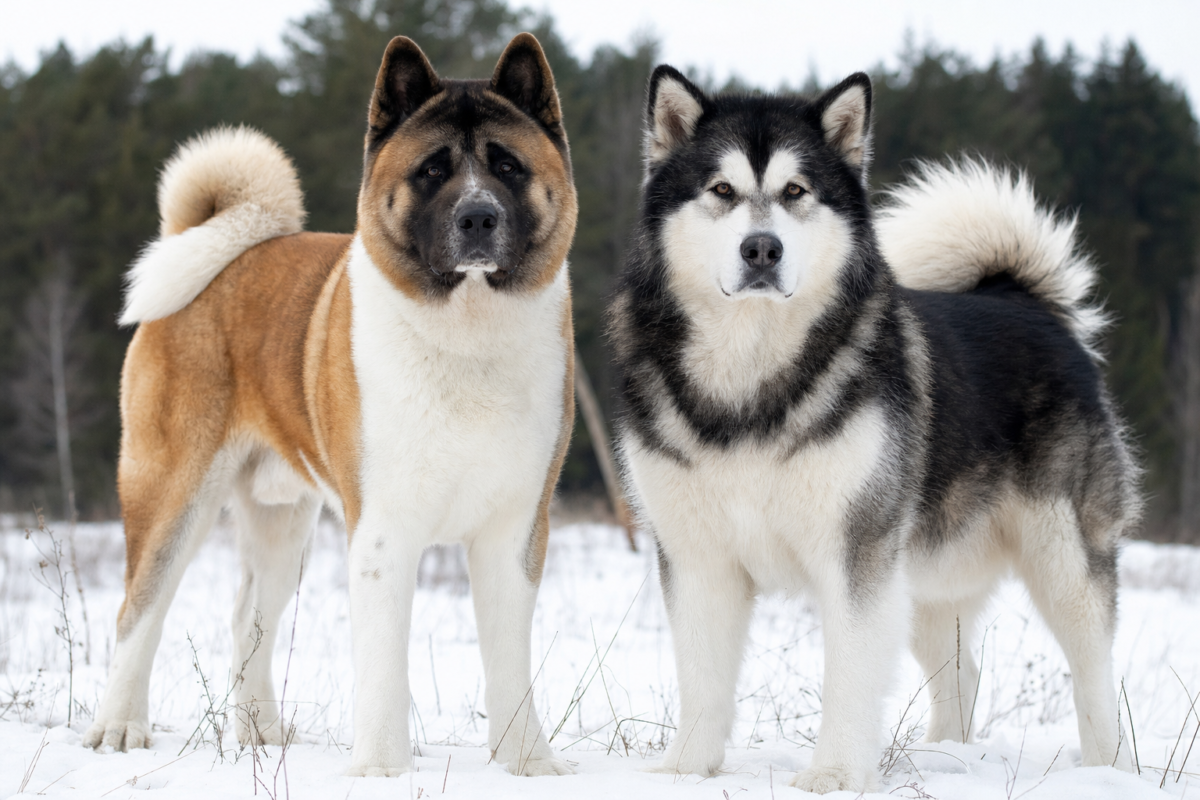
The Akita and the Alaskan Malamute are both powerful spitz breeds with thick double coats and curled tails, but they were bred for very different jobs. The Akita is a Japanese guardian and hunting dog: heavier, more reserved with strangers, protective and often intolerant of other dogs. The Malamute is an Arctic freight sled dog: friendly with nearly everyone, pack minded, vocal and in need of far more daily exercise. Male Akitas typically weigh 100 to 130 pounds, while male Malamutes usually weigh 80 to 95 pounds.
Put an Akita and an Alaskan Malamute side by side in a photograph and plenty of people would call them cousins. Both are big, handsome, snow ready dogs with a plush coat and a tail that curls over the back. Live with one, though, and the differences show up on day one. One greets the delivery driver like an old friend, the other watches quietly from the window. This guide walks through size, growth, temperament and daily care in plain terms, so you can choose the breed that genuinely fits your home and raise it into a sound, comfortable adult.
What is the difference between an Akita and an Alaskan Malamute?
The biggest difference is purpose. The Akita was developed in the mountains of northern Japan to guard property and hunt large game, so it is a loyal, protective, independent dog that bonds deeply with its own family and keeps its distance from everyone else. The Alaskan Malamute was developed by the Mahlemut people of western Alaska to haul heavy loads across long distances as part of a team, so it is sociable, cooperative with other dogs, tireless and famously talkative.
Physically, the Akita is usually the heavier dog, with a broad bear like head and small, thick upright ears. The Malamute is usually a little lighter but carries heavy bone, a wider muzzle, distinctive facial markings and a plumed tail. Both shed heavily, both struggle in hot weather, and both need an experienced, consistent Dog Parent.
Where each breed came from
The Akita takes its name from Akita Prefecture on the island of Honshu, where for centuries it guarded homes and helped hunt boar, deer and even bear. It became a national symbol of loyalty in Japan, largely through the story of Hachiko, who waited at a train station for his late owner every day for nearly ten years. Dogs brought to the United States after the Second World War were bred larger and heavier, which is why the American Akita you see today is often bigger and more heavily built than its Japanese cousin.
The Alaskan Malamute is one of the oldest Arctic sled breeds. It was built for strength and stamina rather than speed, pulling freight over snow and ice in harsh conditions. Malamutes served in polar expeditions and as working dogs during the Second World War, and that heritage still shapes them: they are strong, cooperative with a team, and happiest when they have work to do.
Akita vs Alaskan Malamute, side by side
Use this table as a quick overview. Individual dogs vary with lines, sex and body condition, so treat these as dependable ranges rather than fixed rules.
| Trait | Akita | Alaskan Malamute |
|---|---|---|
| Male height | 26 to 28 inches | About 25 inches |
| Male weight | 100 to 130 lb | 80 to 95 lb |
| Female height | 24 to 26 inches | About 23 inches |
| Female weight | 70 to 100 lb | 70 to 80 lb |
| Build | Massive, broad head, deep chest | Heavy boned, compact, powerful |
| Coat | Short, dense double coat in many colors | Coarse, thick double coat, usually grey, black, sable or red with white |
| Energy | Moderate | High, with great stamina |
| With strangers | Reserved and watchful | Friendly and outgoing |
| With other dogs | Often intolerant, especially same sex | Usually sociable, but may compete for rank |
| Voice | Quiet, barks with purpose | Vocal, with howls and a famous woo |
| Typical lifespan | 10 to 13 years | 10 to 14 years |
The American Kennel Club’s Chief Veterinary Officer, Dr. Jerry Klein, DVM, has written extensively on the slower growth and development timeline of large and giant breeds. Read more from the AKC’s guidance on caring for large-breed dogs.
For a closer look at each breed’s size on its own, see how big an Akita gets and our Alaskan Malamute growth chart.
When do Akitas and Alaskan Malamutes stop growing?
Both breeds reach most of their adult height in the first year to year and a half, then spend another year or more filling out. Most Malamutes are close to full height around 12 months and finish adding muscle and chest by about two years. Akitas, especially large males, often keep gaining height until 15 months or so and may not look fully mature until two and a half to three years of age.
As a rough guide, dogs with an expected adult weight of 80 to 100 pounds keep developing for about 20 to 24 months, while dogs heading to 100 to 130 pounds keep going for 22 to 26 months. That puts most Malamutes in the first group and many Akita males in the second.
Why the growth window matters for both
Through the growth window, both breeds are building the cartilage, bone and connective tissue that will carry a heavy, active body for a decade or more. Growth plates, the soft areas near the ends of long bones, stay open for much of this time. Steady growth, a lean body condition and sensible exercise all support a sound frame, and good breeders will share hip and elbow screening results for both parents so you start on the right foot.
Growing Too Fast
Heavy spitz puppies can pack on weight quickly. Aim for a steady, even growth curve rather than a fast one.
Excess Weight
A thick coat hides extra pounds. Check body condition by feel, not by eye, in both breeds.
Too Much Pulling Too Young
A Malamute loves to pull. Save harness work and weight pulling until growth has finished and your veterinarian agrees.
Heat and Overexertion
Both breeds are built for cold. Exercise in the cool of the day and watch closely for heavy panting in warm weather.
Feeding a growing Akita or Malamute
Both breeds do best on steady, moderate growth. Malamutes in particular are known for being food motivated and efficient with calories, so portions that suit another breed of the same size can easily be too much.
- Choose a complete food formulated for large breed puppies, which balances calories, calcium and phosphorus for steady growth.
- Split the daily amount into three meals while young, then two meals as an adult, and avoid vigorous exercise straight after eating.
- Feed to a lean body condition and weigh your puppy regularly, since a dense coat can hide both weight gain and weight loss.
- Feed an Akita apart from other pets. Many Akitas guard food, and a calm, separate space avoids tension at mealtimes.
How to check body condition in ten seconds
With a coat this thick, your hands tell you more than your eyes.
- Ribs. Press your fingers through the coat along the sides. You should feel the ribs easily under a thin layer.
- Waist. Part the coat and feel from above for a waist that tucks in behind the ribs.
- Tuck. From the side, feel for a belly that rises toward the back legs rather than hanging level.
Exercise, training and containment
This is where the two breeds differ most in daily life. An adult Malamute needs around two hours of activity a day, while an adult Akita is usually content with about an hour of walks and play. During the growth months, both need moderate, varied activity rather than repeated hard impact.
- Favor free play, sniffing walks and gentle hiking on soft ground for puppies of both breeds.
- Keep long runs, hard sprints, jumping and pulling work moderate while the growth plates are still open.
- Build secure fencing. Malamutes dig and climb, and Akitas may patrol and defend a boundary.
- Use short, positive training sessions. Neither breed responds well to harsh handling, and both get bored with repetition.
Supporting the joints of two powerful breeds
A heavy Akita and a hard working Malamute both put real demand on their joints, one through sheer mass and the other through miles of movement. Lean feeding and sensible exercise form the foundation, and many big dog parents add a daily joint support chew made for large and giant breeds.
For puppies and adolescents, MoveGuard Growth is built for the roughly 8 to 30 month growth window. It combines nine actives, including New Zealand Green Lipped Mussel, glucosamine, chondroitin, MSM and hyaluronic acid, to support healthy joint development in young large breed dogs. You dose by expected adult weight, so most female Malamutes and smaller female Akitas sit at two chews a day, while males of both breeds usually sit at three. It comes as 90 chews, is made in the USA in an NSF facility, and is backed by a 60 day guarantee. Once growth has finished, MoveGuard Adult carries the same daily habit into the mature years, when an active Malamute or a heavy Akita still asks a lot of its joints.
Support a Powerful Frame
Give your growing Akita or Malamute daily joint support built for large and giant breeds. Explore MoveGuard Growth.
Temperament and daily life compared
An Akita is dignified, quiet and intensely loyal. It tends to attach to one family and treat outsiders with polite suspicion, which makes it a natural watchdog. Many Akitas do not enjoy other dogs, particularly dogs of the same sex, and dog parks are rarely a good idea. Early, ongoing socialisation and calm, confident leadership are essential.
A Malamute is affectionate, playful and sociable. It usually welcomes guests, which makes it a poor guard dog, and it often gets along with other dogs, although it may test its place in the household pack. It is also stubborn, strongly prey driven toward small animals, and noisy in the most charming way, with howls, grumbles and conversational woos. A bored Malamute can reshape a garden in an afternoon.
In short, the Akita suits a calm, experienced home that values a devoted protector. The Malamute suits an active, outdoorsy home that wants a friendly, adventurous companion and does not mind a little chaos.
Grooming, climate and household fit
Both breeds blow their undercoat heavily once or twice a year and shed steadily in between. Plan on brushing a few times a week, and daily during a coat blow. The Malamute’s longer, coarser coat usually takes more work. Neither breed should be shaved, because the double coat helps regulate temperature.
Both handle cold weather with ease and struggle in heat, so hot climates call for air conditioning, shade and early morning walks. Neither breed is a great fit for small cats or pocket pets, and both are too strong for a novice to walk comfortably without training. For a comparison with another popular working breed, see Alaskan Malamute vs German Shepherd.
A simple growth game plan, stage by stage
8 weeks to 4 months. Focus on a complete large breed puppy food, three calm meals a day, and short bursts of free play on soft ground. Socialise widely and gently. For an Akita, this is the single most important window for meeting people and well mannered dogs.
4 to 8 months. Growth is fast and both breeds can look gangly. Keep feeding lean, keep exercise moderate, and begin loose lead training before your puppy gets strong. This is a natural point to begin a daily joint support routine.
8 to 18 months. Adolescence arrives, with testing behaviour in both breeds. Stay consistent, keep portions matched to a lean body condition, and build structured activity gradually on soft surfaces. Hold off on pulling work for a Malamute.
18 months to 3 years. Muscle and chest fill in, and Akitas continue to mature for longer. Build activity up as your veterinarian advises and keep a joint support routine going into adulthood.
Common mistakes to avoid
- Choosing on looks alone. These breeds are similar in a photo and very different at home. Match the temperament to your household.
- Skipping socialisation with an Akita. A poorly socialised Akita can become difficult to manage as a powerful adult.
- Underexercising a Malamute. Pent up energy turns into digging, howling and escape attempts.
- Overfeeding under a thick coat. Check by feel every couple of weeks, not by appearance.
- Starting hard exercise too young. Pulling, long runs and repeated jumping are a lot to ask of open growth plates.
Frequently asked questions
Which is bigger, an Akita or an Alaskan Malamute?
The Akita is usually bigger. Male Akitas typically weigh 100 to 130 pounds and stand 26 to 28 inches tall, while male Malamutes usually weigh 80 to 95 pounds and stand about 25 inches tall. Some Malamute lines run larger, but the Akita is the heavier breed on average.
Which breed is better with other dogs?
The Alaskan Malamute is generally more sociable with other dogs because it was bred to work in a team, although it may compete for rank. Many Akitas are intolerant of other dogs, especially of the same sex, so a single dog home often suits them best.
Is an Akita or a Malamute better for a first time dog parent?
Neither is an easy first dog. The Malamute is friendlier but stubborn, strong and very energetic. The Akita is calmer indoors but protective and selective with other dogs. A first time dog parent should work with a good trainer from day one with either breed.
At what age are Akitas and Malamutes full grown?
Most Malamutes reach adult height around 12 months and finish filling out by about two years. Akitas often keep growing in height until about 15 months and may keep maturing until two and a half to three years of age.
Do both breeds need joint support?
Both are large, powerful breeds that put real demand on their joints, so steady growth, a lean body condition, sensible exercise and daily joint support through the growth window and beyond are sensible ways to support long term comfort. Speak with your veterinarian about your individual dog.
The bottom line
The Akita and the Alaskan Malamute share a spitz silhouette, but they are built for different lives. Choose an Akita for a loyal, quiet, protective companion in a calm and experienced home. Choose a Malamute for a friendly, tireless, talkative adventurer in an active household. Whichever you bring home, feed for lean and steady growth, keep exercise sensible while the joints develop, and invest early in training. That is how you raise a big spitz that moves with comfort for years.
Want the Simple Roadmap in One Place?
Grab our free Big Dog Growth Blueprint for the growth window checklist, feeding framework and joint safe exercise limits, all written for large and giant breeds.
This article is for general educational purposes only and is not veterinary advice. It is not intended to diagnose, treat, cure or prevent any disease. Always consult your veterinarian about your dog’s individual health, nutrition and supplement needs. These statements have not been evaluated by the Food and Drug Administration.
Support Big Breed Joints from Day One
Large and giant breeds carry more load through every growth stage. MoveGuard Growth supports developing joints in young big dogs (8 to 30 months); MoveGuard Adult keeps grown big dogs moving comfortably.
Leave a Reply