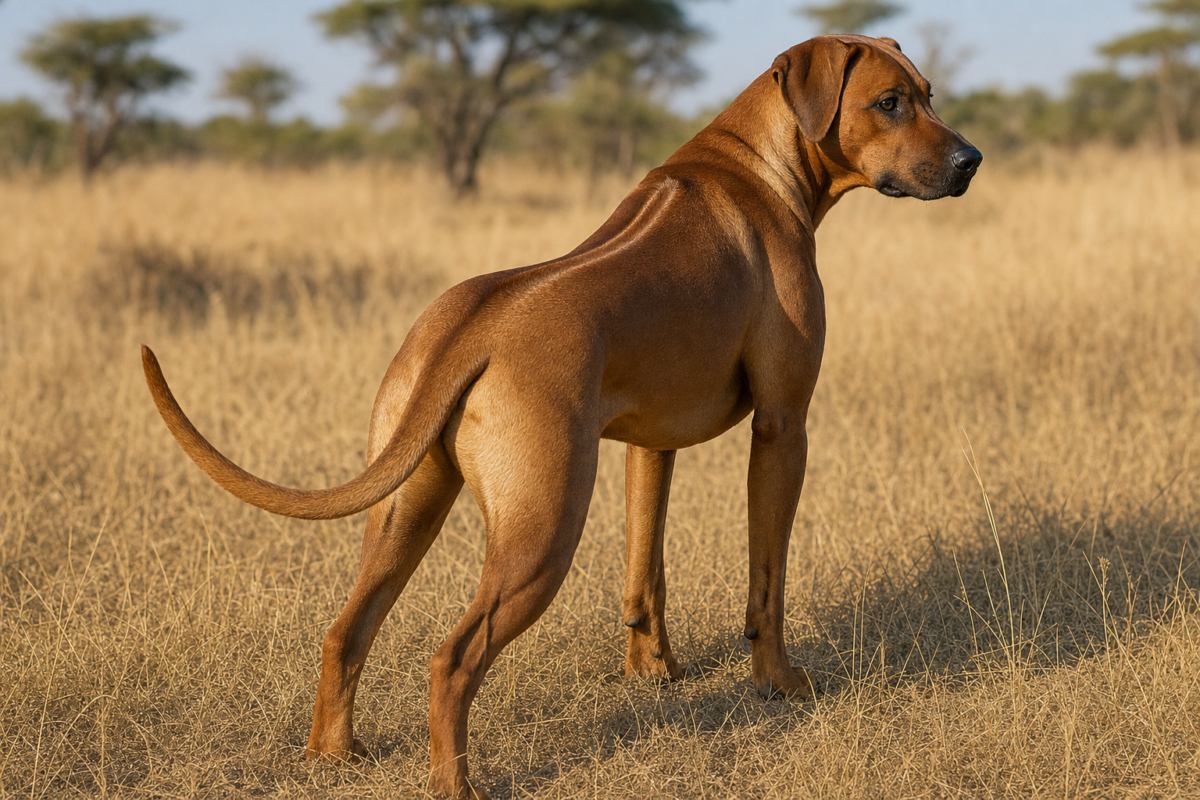
A Rhodesian Ridgeback moves through four growth stages: a fast foundation stage from 8 weeks to 4 months, a rapid build stage from 4 to 8 months, a lanky adolescent stage from 8 to 14 months, and a filling out stage that runs to roughly two and a half years. Adult males stand 25 to 27 inches and weigh 80 to 90 pounds. Females stand 24 to 26 inches and weigh 65 to 75 pounds.
If you are watching a Rhodesian Ridgeback puppy shoot upward one month and look all legs and ears the next, you are seeing exactly what this breed is supposed to do. Ridgebacks grow in clear stages rather than one smooth line, and knowing which stage you are in tells you how to feed, how much to exercise and what to expect next. This guide walks through every stage with real weight ranges and the daily habits that help your Ridgeback finish as the lean, tireless athlete the breed is famous for.
What are the growth stages of a Rhodesian Ridgeback?
A Rhodesian Ridgeback grows through four recognisable stages. From 8 weeks to 4 months your puppy roughly doubles in weight every few weeks and grows fastest of all. From 4 to 8 months the frame builds quickly and the puppy becomes tall and loose limbed. From 8 to 14 months height reaches its ceiling while the body stays narrow and adolescent. From 14 months to about two and a half years muscle, chest and coat substance arrive and your dog finally looks adult.
Adult size lands at 80 to 90 pounds and 25 to 27 inches for males, and 65 to 75 pounds and 24 to 26 inches for females. Genetics, sex and nutrition all move the final number, so treat these as dependable ranges rather than targets. With a lean athletic hound, how your Ridgeback reaches adult size matters more than the number itself.
What makes a Rhodesian Ridgeback grow the way it does
The Ridgeback was developed in southern Africa as a versatile farm and tracking hound, expected to cover rough ground all day in real heat and then guard the homestead at night. That job produced a dog built for endurance rather than bulk: deep chest, long legs, dense short coat and the distinctive ridge of backward growing hair along the spine that is present from birth.
Because the breed is built for stamina, a growing Ridgeback puts its energy into height and length before it puts anything into width. That is why a nine month old can look almost gangly, with a deep chest that has not yet dropped and a tuck that seems exaggerated. It is also why so many Dog Parents worry their Ridgeback is too thin at exactly the age when lean is correct.
The second thing worth knowing is that the drive matures faster than the joints. A six month old Ridgeback has the stamina to run for an hour and the tracking instinct to want to. Managing that gap between willingness and readiness is the single most useful thing you can do during the growth years.
Rhodesian Ridgeback growth chart, month by month
Use this chart as a friendly guide rather than a report card. A puppy tracking slightly above or below these ranges while looking lean and moving freely is usually doing fine.
| Age | Male weight | Female weight |
|---|---|---|
| 2 months | 20 to 26 lb | 17 to 22 lb |
| 3 months | 30 to 38 lb | 26 to 33 lb |
| 4 months | 40 to 48 lb | 35 to 43 lb |
| 6 months | 55 to 65 lb | 48 to 58 lb |
| 9 months | 68 to 78 lb | 58 to 66 lb |
| 12 months | 75 to 85 lb | 62 to 72 lb |
| 18 months | 78 to 88 lb | 64 to 74 lb |
| 2 years plus | 80 to 90 lb | 65 to 75 lb |
The American Kennel Club’s Chief Veterinary Officer, Dr. Jerry Klein, DVM, has written extensively on the slower growth and development timeline of large and giant breeds. Read more from the AKC’s guidance on caring for large-breed dogs.
When do Rhodesian Ridgebacks stop growing?
Rhodesian Ridgebacks reach most of their adult height between 14 and 16 months. After that the change is about substance rather than size. The chest deepens, the shoulders and thighs fill with muscle, and the whole outline gains the balance the breed is known for, usually until about two and a half years of age.
As a rough guide, dogs with an expected adult weight of 65 to 90 pounds keep developing their frame for roughly 18 to 22 months, with muscle continuing to arrive after that. Because the skeleton is largely set inside that stretch, this is your prime window to build strong habits around food, movement and joint support.
Why the growth window matters for an endurance breed
Through this window your Ridgeback is laying down the cartilage, bone and connective tissue that will absorb years of running, turning and jumping. Growth plates, the soft areas at the ends of the long bones, stay open through much of the first year. While they are open, hard repeated impact and extra weight ask a great deal of a frame that is still forming, which is exactly why a breed this willing needs limits set for it.
Doing Too Much Too Soon
A Ridgeback will run as long as you let it. Long runs and cycling belong after the frame has finished, not during it.
Growing Too Fast
Rapid weight gain asks more of developing joints. Aim for a steady curve rather than a fast one.
Hard Turns And Jumps
Repeated jumping and sharp twisting play on open growth plates add up quickly in an agile breed.
Boredom
An unstimulated Ridgeback invents its own job. Scent games and training protect both the household and the joints.
How much should a Rhodesian Ridgeback eat while growing?
Large breed puppies do best with steady, moderate growth. An even curve supports comfortable movement now and for years to come, and with a Ridgeback it also preserves the lean athletic outline the breed should carry. A few habits make the difference:
- Choose a complete food formulated for large breed puppies, which balances calories, calcium and phosphorus for slower, steadier growth.
- Split the daily amount into three meals while young, then two as an adult, so energy stays even across the day.
- Expect a lean dog and do not correct it with food. Visible tuck and a hint of last rib is normal in this breed.
- Watch the treat total. Ridgebacks are clever thieves and counter surfers, and stolen calories still count.
- Ask your veterinarian to confirm the daily amount at each checkup, since the right portion changes quickly in the first year.
How to check body condition in ten seconds
The scale tells you weight, but body condition tells you whether that weight suits your dog. The short Ridgeback coat makes this easy.
- Ribs. Run your hands along both sides. You should feel the ribs easily under a thin layer. If you have to press to find them, ease back on food.
- Waist. Look down from above. You want a clear waist that tucks in behind the ribs.
- Tuck. From the side, the belly should rise toward the back legs. In a Ridgeback this tuck is pronounced and correct.
Check every couple of weeks through the growth years and adjust portions gently with your veterinarian to guide you.
Growth safe exercise at each stage
This is where Ridgeback parents need the most discipline, because the puppy will always volunteer for more. The aim is frequent moderate movement that builds fitness without pounding a frame that is still forming.
- Favour free play, sniffing walks and exploring on soft ground over structured distance work.
- Keep repeated jumping, hard sprints and sharp turning games moderate while the growth plates are still open.
- Save running alongside a bike or a jogger until your veterinarian confirms the frame has finished.
- Use scent work and training to drain the mind, which tires a Ridgeback as effectively as a run.
- Watch the heat. A dark wheaten coat absorbs sun, so walk in the cooler hours and bring water.
Protecting an athletic frame from the start
A Ridgeback spends its life in motion, and every stride, turn and leap travels through the joints. Supporting healthy joint development while the frame is still being built is a simple habit that pays off across a long active life.
Alongside lean feeding and sensible movement, many big dog parents add a daily joint support chew made for large and giant breeds. MoveGuard Growth is built for exactly this stage. It combines nine actives, including 250mg New Zealand Green Lipped Mussel, 400mg glucosamine, 300mg chondroitin, MSM, krill oil and hyaluronic acid, to support the developing joints of young large breed dogs across the roughly 8 to 30 month growth window. You dose by expected adult weight, so most Ridgeback females sit at two chews a day and most males at three. It is made in the USA, 90 chews to a jar, and is backed by a 60 day guarantee.
Support A Growing Athlete
Give your growing Ridgeback daily joint support built for large and giant breeds. Explore MoveGuard Growth.
Signs your Rhodesian Ridgeback is growing on track
You do not need a weekly weigh in to know things are going well. Look for a bright, alert puppy with a visible waist, ribs you can feel under light pressure, smooth free movement, a clean glossy coat and a healthy appetite. Even, unhurried growth with good muscle tone is the picture you want.
Worth a conversation with your veterinarian: limping, stiffness after rest, reluctance to rise or jump into the car, a sudden growth spurt, or a puppy who tires far sooner than usual. Raising these early means adjustments to food or activity stay simple.
The four growth stages in practice
You do not need a complicated programme to raise a sound Ridgeback. You need the right emphasis at the right stage.
Stage one, 8 weeks to 4 months. Foundation. A complete large breed puppy food in three calm meals, wide social exposure, and short bursts of free play on soft ground. Start lead manners and recall now, because a Ridgeback that learns to check in early is far easier to live with once the prey drive matures.
Stage two, 4 to 8 months. The fast build. Height and length arrive quickly and your puppy may look loose and uncoordinated. Keep feeding lean, keep sessions short and frequent, and set house rules around furniture and car entry. This is a natural point to begin a daily joint support routine.
Stage three, 8 to 14 months. The lanky adolescent. Height nears its ceiling while the body stays narrow, and testing behaviour often peaks alongside it. Stay patient and consistent, match portions to body condition rather than appetite, and build activity gradually on forgiving surfaces.
Stage four, 14 months to two and a half years. Filling out. The chest drops, muscle arrives across the shoulders and thighs, and the adult outline finally appears. Increase distance and intensity as your veterinarian advises, keep the adult lean, and many parents carry a joint support routine into adulthood.
Common growth mistakes to avoid
Most growth trouble in athletic breeds comes from a handful of avoidable habits.
- Treating a fit puppy like a fit adult. Stamina arrives long before the skeleton finishes. Willingness is not readiness.
- Feeding to fill out the frame. A heavier young Ridgeback is not a stronger one. Feed lean and let substance arrive on its own timeline.
- Skipping large breed puppy food. These formulas control calcium and calories for steady growth. Confirm the right food with your veterinarian.
- Repetitive impact. Daily ball chasing on hard ground stacks up sharp stops and turns on young joints.
- Waiting for a problem before supporting joints. The growth window is the ideal time to support developing joints, not after signs appear.
The Ridgeback temperament through the growth years
A Rhodesian Ridgeback is confident, quietly affectionate with its family and reserved with strangers. This is a thinking hound rather than a biddable worker, so it will weigh up whether your request is worth following. That independence is part of the charm and it shapes how you train through the growth years.
Short, positive, genuinely interesting sessions work. Repetition and heavy handed correction do not, and a Ridgeback that feels bullied simply switches off. Because the breed is sensitive underneath the confidence, patience during the adolescent stage matters more than firmness. Scent games, puzzle feeders and tracking work give that busy mind a job without asking anything of growing joints, which is a real advantage in a dog who would otherwise run all afternoon. Keep socialising through the whole first year too, because a well exposed Ridgeback carries calm judgement into a powerful adulthood.
How the Rhodesian Ridgeback compares with similar breeds
The Ridgeback is most often weighed against the Boxer, and the two are easy to tell apart once you know what to look for. The Ridgeback is the bigger, quieter and more independent dog at 24 to 27 inches and 70 to 85 pounds, with a short wheaten coat and the ridge of backward growing hair along the spine. The Boxer is smaller, square headed and openly playful. Boxer vs Rhodesian Ridgeback covers both, and our big dog breed comparisons page lists every pairing.
Frequently asked questions
At what age is a Rhodesian Ridgeback full grown?
Most Rhodesian Ridgebacks reach adult height between 14 and 16 months, then keep filling out in muscle and chest until roughly two and a half years of age. Height comes first and substance comes later.
How much does a full grown Rhodesian Ridgeback weigh?
An adult male Rhodesian Ridgeback usually weighs 80 to 90 pounds and stands 25 to 27 inches. A female usually weighs 65 to 75 pounds and stands 24 to 26 inches.
How big is a Rhodesian Ridgeback at 6 months?
At 6 months a male often weighs around 55 to 65 pounds and a female around 48 to 58 pounds. Puppies at this age look tall and lean with a deep tuck, which is normal for the breed.
When can a Rhodesian Ridgeback start running long distances?
Save distance running, cycling alongside you and structured endurance work until your veterinarian confirms the growth plates have closed, which is often somewhere between 15 and 20 months. Until then choose frequent short outings on soft ground.
Why does my Rhodesian Ridgeback puppy look so thin?
A visible waist, a deep tuck and a hint of the last rib are correct for this lean endurance breed. Check body condition with your hands rather than your eyes, and confirm portions with your veterinarian rather than adding food to change the outline.
The bottom line
Your Rhodesian Ridgeback will most likely mature into a 65 to 90 pound athlete who reaches adult height between 14 and 16 months and finishes filling out by about two and a half years. Feed lean, keep exercise frequent and moderate while the frame is forming, give that clever mind a proper job, and support the growth window with the right daily habits. That is how you raise a Ridgeback who moves with comfort and confidence for years.
Want the Simple Roadmap in One Place?
Grab our free Big Dog Growth Blueprint for the growth window checklist, feeding framework and joint safe exercise limits, all written for large and giant breeds.
This article is for general educational purposes only and is not veterinary advice. It is not intended to diagnose, treat, cure or prevent any disease. Always consult your veterinarian about your dog’s individual health, nutrition and supplement needs. These statements have not been evaluated by the Food and Drug Administration.
Support Big Breed Joints from Day One
Large and giant breeds carry more load through every growth stage. MoveGuard Growth supports developing joints in young big dogs (8 to 30 months); MoveGuard Adult keeps grown big dogs moving comfortably.

Leave a Reply