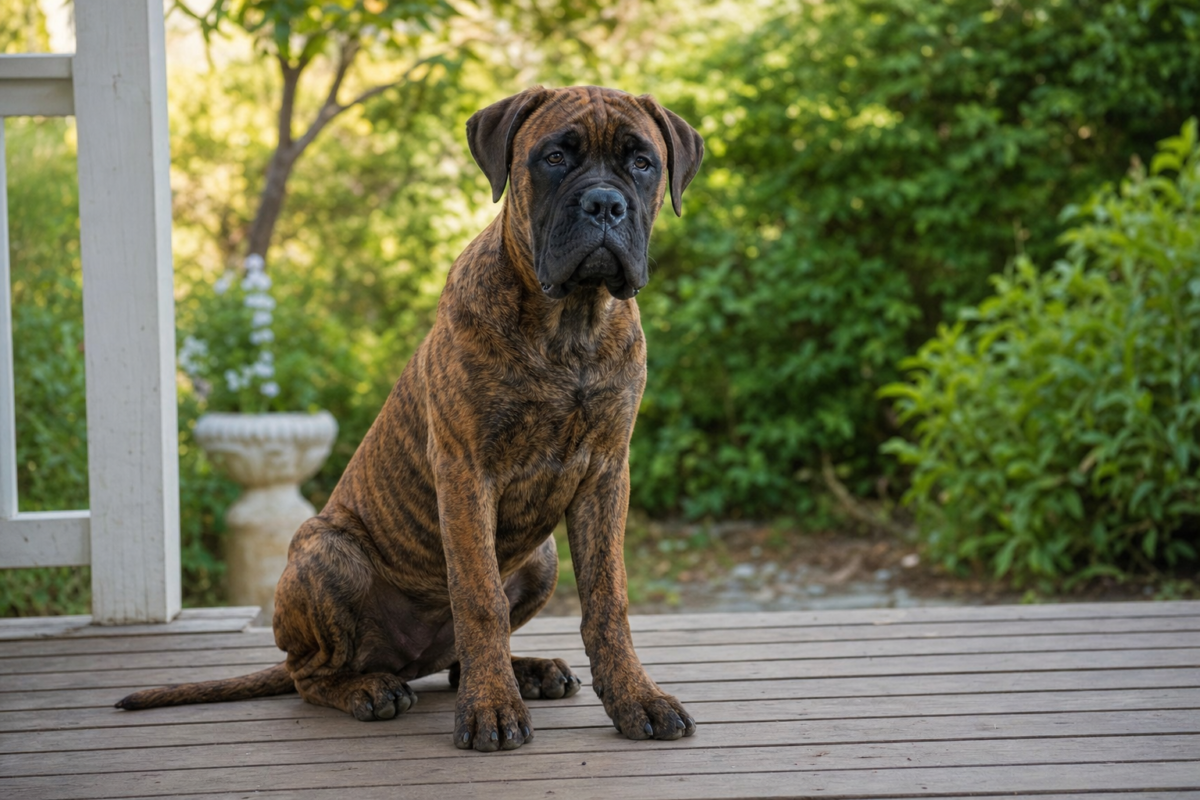
A fully grown male Bullmastiff usually stands 25 to 27 inches at the shoulder and weighs 110 to 130 pounds. Females typically reach 24 to 26 inches and 100 to 120 pounds. Most Bullmastiffs are close to their adult height by 12 to 15 months, then keep adding width, chest and head until roughly two and a half to three years of age. Your own puppy will most likely land near its parents, with males sitting toward the top of the range.
If you are looking at a wrinkled, heavy pawed Bullmastiff puppy and trying to picture the dog it will become, you are in good company. This is one of the most powerful breeds a family can bring home, and the size question matters for everything from the car you drive to the crate you buy. The reassuring news is that Bullmastiff growth follows a predictable pattern. This guide shows you how big your Bullmastiff will get, how tall and how heavy at each stage, how to estimate your own puppy’s final size, and the daily habits that help that big frame grow into a sound, comfortable adult.
How big will my Bullmastiff get?
Your Bullmastiff will most likely grow into a 100 to 130 pound dog standing 24 to 27 inches at the shoulder. Males usually finish at 110 to 130 pounds and 25 to 27 inches, while females finish at 100 to 120 pounds and 24 to 26 inches. Height arrives first, mostly within the first 15 months, and the famous Bullmastiff bulk keeps building until two and a half to three years of age.
Within those ranges, the best predictor of your own puppy’s size is its parents. Sex, bloodline, nutrition and overall health all shift the final number, so treat the breed range as a dependable guide rather than a promise. What matters far more than hitting a particular figure is reaching it steadily, because a heavy breed that grows evenly carries its weight far more comfortably for life.
What makes a Bullmastiff grow the way it does
The Bullmastiff was developed in nineteenth century England by gamekeepers who wanted a dog fast enough to catch a poacher and heavy enough to pin one down without biting. The cross of roughly 60 percent Mastiff and 40 percent Bulldog produced exactly that: a compact, dense, enormously strong dog that is big without being towering.
That heritage explains the shape of a Bullmastiff’s growth. It is a short coupled, heavy boned breed, so it puts on weight quickly in the first year and then spends a long second phase filling out through the chest, shoulders and that broad, wrinkled head. A young Bullmastiff often looks leggy, loose skinned and a little out of proportion around eight to twelve months. That is normal. The solid, square adult outline usually arrives somewhere in the third year.
Bullmastiff size chart, height and weight by age
Use this chart as a friendly guide, not a report card. A puppy tracking a little above or below these figures while staying lean and moving well is usually doing just fine. Heights are measured at the top of the shoulder blades.
| Age | Male weight | Female weight | Shoulder height |
|---|---|---|---|
| 2 months | 22 to 30 lb | 18 to 26 lb | 11 to 13 in |
| 3 months | 35 to 45 lb | 30 to 40 lb | 14 to 17 in |
| 4 months | 50 to 62 lb | 45 to 55 lb | 16 to 19 in |
| 6 months | 75 to 90 lb | 65 to 80 lb | 20 to 23 in |
| 9 months | 93 to 110 lb | 83 to 98 lb | 22 to 25 in |
| 12 months | 100 to 120 lb | 90 to 108 lb | 23 to 26 in |
| 18 months | 105 to 128 lb | 95 to 115 lb | 24 to 27 in |
| 2 years plus | 110 to 130 lb | 100 to 120 lb | 24 to 27 in |
For the full month by month weight picture, our Bullmastiff growth chart covers every stage in more detail.
How to estimate your own Bullmastiff’s adult size
No method is exact, but a few honest clues will get you close.
- Look at the parents. This is the strongest clue you have. Ask your breeder for both parents’ weights and heights. Most puppies finish within a few pounds of the parent of the same sex.
- Consider sex. Males typically finish about ten pounds heavier and an inch taller than females from the same litter.
- Use the six month mark. A Bullmastiff at six months has usually reached roughly two thirds of its adult weight. A 78 pound male at six months is on course for the middle of the adult range.
- Do not rely on paws. Big paws are standard equipment on every Bullmastiff puppy. They tell you the dog is a Bullmastiff, not how big this particular one will be.
- Track the trend. Weigh every two to four weeks and compare against the chart. A steady line tells you more than any single number.
If you would like a projection rather than a guess, our large breed puppy growth calculator estimates expected adult weight from your puppy’s current age and weight.
When do Bullmastiffs stop growing?
Bullmastiffs reach most of their adult height between 12 and 15 months. After that, the change is about substance rather than height. Your dog keeps adding width through the chest, depth through the body and mass in the head until roughly two and a half to three years of age. So a tall, slightly narrow eighteen month old who still looks like a teenager is right on schedule.
Dogs with an expected adult weight of 100 to 130 pounds usually keep developing for roughly 22 to 26 months, with muscle and chest filling in well beyond that. Because so much of the frame is set early, the first two years are the prime time to build habits around food, movement and joint support.
Why the growth window matters for a heavy breed
Few breeds put on weight as fast as a Bullmastiff. Going from around 25 pounds at eight weeks to over 100 pounds before the first birthday asks a great deal of the cartilage, bone and connective tissue that are still forming. Growth plates, the soft areas at the ends of the long bones, stay open through much of the first year and beyond. While they are open, excess weight and hard impact add load to a frame that is still being built, which is why steady growth carries real weight for this breed.
Growing Too Fast
Rapid weight gain asks more of developing joints. A steady, even growth curve suits a heavy boned breed far better than a fast one.
Excess Weight
Every spare pound sits on young joints. A lean Bullmastiff with a visible waist moves more comfortably now and later.
Too Much Impact
Stairs, jumping from the car and rough play on hard ground load open growth plates. Keep them limited while young.
Heat And Effort
A short muzzle and heavy body make Bullmastiffs sensitive to heat. Exercise in the cool of the day and stop well before your puppy tires.
How much should a Bullmastiff eat while growing?
Large and giant breed puppies do best with moderate, steady growth rather than fast growth. A few practical habits make a real difference:
- Choose a complete food formulated for large breed puppies, which balances calories, calcium and phosphorus for slower, steadier growth.
- Split the daily amount into three meals while young, then two meals as an adult. Smaller meals also suit a deep chested breed.
- Avoid vigorous exercise for an hour before and after meals, which is a sensible habit for any deep chested big dog.
- Do not add extra calcium or supplements meant for people. A complete puppy food already supplies the right balance.
- Ask your veterinarian to confirm portions at each visit, because the right amount changes quickly in the first year.
How to check your Bullmastiff’s body condition in ten seconds
The scale tells you weight, but body condition tells you health. Loose skin can hide a lot on this breed, so use your hands as well as your eyes.
- Ribs. Run your hands along the sides under the skin. You should feel the ribs easily under a thin layer. If you have to press, ease back on food.
- Waist. Look down from above. You want a visible waist behind the ribs, even on a broad dog.
- Tuck. From the side, the belly should rise slightly toward the back legs rather than hanging level.
Check every couple of weeks through the growth years and adjust portions gently with your veterinarian’s guidance.
Growth safe exercise for a Bullmastiff puppy
Bullmastiffs are not marathon dogs, which makes growth safe exercise easier than with many breeds. The goal is regular, gentle activity rather than hard effort.
- Favour short walks and free play on grass or soft ground, a few times a day.
- Limit stairs and lift or ramp your puppy in and out of the car while the frame is forming.
- Skip jogging, forced running and repeated jumping until your veterinarian says the growth plates have closed.
- Keep play with bigger adult dogs calm, since a body slam from a grown dog is a lot for a young joint.
- Use training games and sniff walks to tire the mind without pounding the body.
Protecting a heavy frame from the start
A Bullmastiff carries more than 100 pounds on joints built from the same cartilage and connective tissue as a much smaller dog. Supporting healthy joint development while that frame is still being built is a simple, caring habit that pays off for a lifetime.
Alongside lean feeding and sensible exercise, many big dog parents add a daily joint support chew made for large and giant breeds. MoveGuard Growth is built for exactly this stage. It combines nine actives, including New Zealand Green Lipped Mussel, glucosamine, chondroitin, MSM and hyaluronic acid, to support the developing joints of young large breed dogs across the roughly 8 to 30 month growth window. You dose by expected adult weight, so a Bullmastiff, with an expected adult weight of 100 pounds or more, sits at three chews a day. It ships as 90 chews, is made in the USA in an NSF facility, and is backed by a 60 day guarantee.
Support A Growing Frame
Give your growing Bullmastiff daily joint support built for large and giant breeds. Explore MoveGuard Growth.
Signs your Bullmastiff is growing on track
You do not need a daily weigh in to know things are going well. Look for a bright, curious puppy with a waist you can see from above, ribs you can feel under the loose skin, a steady upward weight trend, and easy, even movement at a walk and a trot. A leggy stage followed by gradual filling out is exactly what you want.
If you notice limping, stiffness after rest, reluctance to stand or climb, or growth that suddenly seems very fast, a quick conversation with your veterinarian brings peace of mind and lets you adjust food or activity early.
A simple growth game plan, stage by stage
Raising a sound Bullmastiff is about the right emphasis at the right time.
8 weeks to 4 months. Foundation stage. A complete large breed puppy food, three calm meals a day, gentle handling and lots of socialisation. Start leash manners now, while your puppy is still small enough to guide easily.
4 to 8 months. The fastest weight gain of your puppy’s life. Keep feeding lean, keep exercise short and soft, and use ramps or a helping lift for the car. This is a natural point to begin a daily joint support routine that carries through the growth window.
8 to 18 months. Height nears its peak and adolescence arrives, often with a stubborn streak. Match portions to body condition rather than appetite, and build longer walks gradually on soft ground.
18 months to 3 years. The lanky teenager becomes the broad, powerful adult. Growth slows while chest and head fill out. Increase activity as your veterinarian advises, and many parents keep a joint support routine going into adulthood.
Common growth mistakes to avoid
- Feeding for size. A heavier Bullmastiff puppy is not a healthier one. Feed lean and let the bulk come on its own timeline.
- Skipping large breed puppy food. These formulas control calcium and calories for steady growth. Confirm the right food with your veterinarian.
- Too many stairs and jumps. Daily stair runs and leaping from the car add up fast on open growth plates.
- Exercising in the heat. This breed overheats easily. Walk early and late in summer and always carry water.
- Waiting to train. A 120 pound adolescent who pulls on the leash is a real problem. Teach manners while your puppy is small.
- Waiting for a problem before supporting joints. The growth window is the ideal time to support developing joints, not after signs appear.
The Bullmastiff temperament and the growth years
Bred to work quietly at night, the Bullmastiff is famously calm, loyal and watchful. Many owners call it a gentle giant at home and a confident guardian at the door. It is affectionate with its own family, often reserved with strangers, and more inclined to lean on you than to bounce around the room.
That calm nature is a gift during the growth years, because a Bullmastiff rarely demands the hard exercise that strains young joints. The challenge is the independent streak. Bullmastiffs think for themselves, so short, positive, food rewarded training sessions work far better than repetition or force. Early socialisation with people, places and other dogs matters just as much, because a well adjusted puppy grows into a steady, trustworthy adult who uses all that size kindly.
Frequently asked questions
How tall is a full grown Bullmastiff?
A full grown male Bullmastiff usually stands 25 to 27 inches at the shoulder and a female stands 24 to 26 inches. Most reach close to that height between 12 and 15 months of age.
How much does a full grown Bullmastiff weigh?
Adult males usually weigh 110 to 130 pounds and adult females 100 to 120 pounds. Individual dogs vary with genetics, sex and body condition, so the parents are your best guide.
When does a Bullmastiff stop growing?
Most Bullmastiffs finish growing in height by 12 to 15 months, then keep adding width, chest and head until roughly two and a half to three years of age.
How big is a Bullmastiff at 6 months?
At 6 months a male Bullmastiff often weighs 75 to 90 pounds and a female 65 to 80 pounds, standing around 20 to 23 inches. That is roughly two thirds of adult weight, with plenty of filling out still to come.
Can you tell how big a Bullmastiff puppy will get from its paws?
Not reliably. Every Bullmastiff puppy has large paws. The size of both parents, your puppy’s sex and its steady weight trend over several months are much better clues to its final size.
The bottom line
Your Bullmastiff will most likely grow into a 100 to 130 pound guardian standing 24 to 27 inches tall, reaching adult height by about 15 months and finishing its bulk by two and a half to three years. Look to the parents for the best estimate, feed for lean and steady growth, keep exercise gentle while the frame develops, support the growth window with good daily habits, and start training early. That is how you raise a big, calm Bullmastiff who moves with comfort and confidence.
Want the simple roadmap in one place? Grab our free Big Dog Growth Guide for the growth window checklist, feeding framework and joint safe exercise limits, all written for large and giant breeds.
This article is for general educational purposes only and is not veterinary advice. It is not intended to diagnose, treat, cure or prevent any disease. Always consult your veterinarian about your dog’s individual health, nutrition and supplement needs. These statements have not been evaluated by the Food and Drug Administration.
Support Big Breed Joints from Day One
Large and giant breeds carry more load through every growth stage. MoveGuard Growth supports developing joints in young big dogs (8 to 30 months); MoveGuard Adult keeps grown big dogs moving comfortably.
Leave a Reply