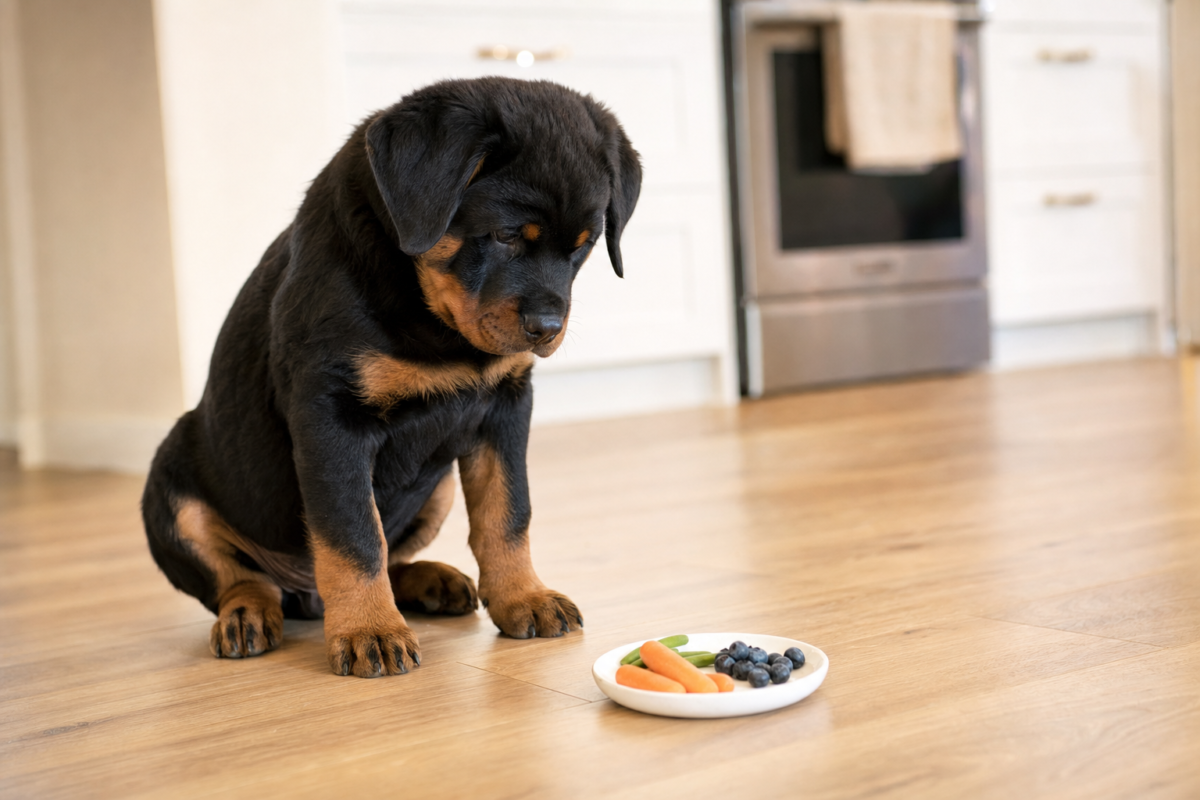
Healthy treats for large breed puppies are small, low calorie, simple foods that fit inside a balanced diet: pieces of their own large breed puppy kibble, baby carrots, green beans, a few blueberries, cored apple slices, plain cooked chicken and small, soft training treats. Keep all treats under 10 percent of daily calories so they do not unbalance the calcium and calorie control of a large breed puppy food, size every treat so it cannot be swallowed whole, and skip grapes, raisins, chocolate, onion, garlic, xylitol and cooked bones entirely.
Treats are one of the happiest parts of raising a big puppy. They turn training into a game, they build trust, and they give you a way to say “yes, that, exactly that” in a language your puppy understands instantly. This guide shows you which treats earn a place in the pocket, how many your puppy can have each day, and the few foods that never belong in the bowl.
What are healthy treats for large breed puppies?
The healthiest treats for a large breed puppy are small, low calorie and simple. The best everyday options are kibble taken from the daily ration, crunchy vegetables such as baby carrots, green beans and cucumber, a few berries or cored apple slices, plain cooked lean meat with no seasoning, and small soft training treats made for puppies. Together, all treats should stay under 10 percent of your puppy’s daily calories.
That 10 percent line matters more for a big puppy than for a small one. Large breed puppy foods are carefully built to deliver controlled calories and a precise balance of calcium and phosphorus, because steady growth supports a sound frame. Every treat you add dilutes that formula a little. Keep treats small and occasional and the formula keeps doing its job.
Why treats matter more for a big puppy
A toy breed puppy who gets a few extra biscuits ends up a little chubby. A large or giant breed puppy who gets a few extra biscuits every day for a year can end up growing faster and heavier than its developing joints would like. Big puppies have more growing to do and a longer runway to do it, often 18 to 30 months depending on their expected adult weight. Small daily excesses compound across that long window.
There is also the simple matter of mouth size. A 30 pound puppy at four months has a big mouth, a big appetite and very little interest in chewing politely. Treats that are perfectly safe for a terrier can be swallowed whole by a young Mastiff or Great Dane. So for big puppies, a healthy treat is not only about what it is made of. It is about how many calories it carries, how it fits the overall diet, and whether its size and texture are safe for an enthusiastic gulper.
The best healthy treats for large breed puppies, compared
Use this table as a practical shortlist. Calorie figures are approximate and vary by brand and portion, so treat them as a guide for planning your daily budget rather than exact values.
| Treat | Approx calories | Why it works for a big puppy |
|---|---|---|
| Kibble from the daily ration | About 4 per piece, depending on food | Zero change to the diet balance, because it is the diet |
| Baby carrot | About 4 each | Crunchy, filling, low calorie; cut lengthwise for small puppies |
| Green beans, plain | About 8 per quarter cup | Bulk with very few calories, fresh, steamed or frozen |
| Cucumber slices | About 2 per few slices | Mostly water, refreshing on warm days |
| Blueberries | About 1 per berry | Small, soft and easy to portion for training |
| Apple slice, cored and seedless | About 6 per thin slice | Sweet crunch; always remove the core and seeds |
| Plain cooked chicken breast | About 45 per ounce | High value reward for hard lessons; no skin, bones or seasoning |
| Plain canned pumpkin | About 5 per tablespoon | Great in a lick mat or frozen toy; plain pumpkin only, never pie filling |
| Small soft training treat | About 3 to 5 each | Built for repetition; pick a puppy formula with a short ingredient list |
| Bully stick or other dense chew | Often 80 to 100 or more per stick | An occasional supervised chew, counted carefully toward the day |
How many treats can a large breed puppy have a day?
Treats, chews and table extras together should stay under 10 percent of your puppy’s total daily calories. Your veterinarian or the feeding guide on your puppy food can tell you the daily calorie target for your puppy’s current age and weight, and that number gives you a simple treat budget.
Here is how it works in practice. Say your four month old large breed puppy needs roughly 1,600 calories a day. Ten percent of that is 160 calories. That budget could be 40 pieces of kibble, or a dozen baby carrots and a handful of blueberries plus a few soft training treats, or a single bully stick with almost nothing else. Same budget, very different days.
When you treat heavily, for example during a big training push, subtract the treat calories from the next meal so the day still adds up. The easiest version of this is to measure the full day of kibble every morning, put a portion of it in a treat pouch, and serve the rest as meals. Whatever is left in the pouch at dinner goes into the bowl.
Calorie Creep
Small daily extras compound over a long growth window. Count every treat and chew toward the day.
Unbalanced Diet
Large breed puppy foods control calcium and calories. Heavy treating dilutes that careful formula.
Choking Hazard
Big puppies gulp. Size treats so they cannot be swallowed whole and supervise every chew.
Toxic Foods
Grapes, raisins, chocolate, onion, garlic and xylitol never belong in a treat pouch at any age.
Foods to never give a large breed puppy as a treat
Some human foods that seem harmless are genuinely dangerous to dogs of any size. Keep these out of reach and out of the treat routine completely:
- Grapes and raisins. Even small amounts can cause serious harm in some dogs, and there is no known safe dose.
- Chocolate and cocoa. Dark and baking chocolate are the most dangerous, but no chocolate is safe.
- Onion, garlic, leeks and chives. Raw, cooked or powdered, including in seasoned leftovers and gravy.
- Xylitol. A sweetener found in some peanut butters, sugar free gum, baked goods and toothpaste. Always read the label before sharing peanut butter.
- Macadamia nuts. Keep all nuts out of the routine, but these in particular.
- Cooked bones. They splinter easily. Never give cooked chicken, pork or beef bones.
- Fatty scraps and fried foods. Bacon, sausage, skin and fat trimmings are rich and hard on a young digestive system.
- Apple cores and fruit pits. Serve fruit flesh only, cored and seedless.
If your puppy ever eats something on this list, call your veterinarian or a pet poison helpline straight away rather than waiting to see what happens.
Choosing a store bought treat for a big puppy
A good commercial treat makes training easy, but the treat aisle is full of products that are more candy than reward. A few simple checks narrow it down quickly.
- A short, readable ingredient list. Real meat or a recognisable protein near the top, and not a long list of colours, sugars and flavour enhancers.
- Calories per treat on the pack. If the calorie count is printed, you can plan. Small training treats of 3 to 5 calories each are ideal for repetition.
- Soft and small for training. Soft treats are eaten in a second, so the lesson keeps moving. Break larger treats into pea sized pieces.
- Labelled for puppies or all life stages. This tells you the treat was designed with growing dogs in mind.
If a treat is so rich that one piece could replace a meal, it is a special occasion chew, not a training treat. Rawhide in particular can swell and soften into pieces a big puppy may swallow, so many Dog Parents of large breeds skip it in favour of safer chew options.
How to check your puppy’s body condition in ten seconds
The best proof that your treat routine is working is your puppy’s body condition, not the scale alone. Check it every couple of weeks.
- Ribs. Run your hands along the sides. You should feel the ribs easily under a thin layer. If you have to press, trim the treats first, then the meals.
- Waist. Look down from above. You want a clear waist tucking in behind the ribs.
- Tuck. From the side, the belly should rise toward the back legs rather than hanging level.
Smart ways to use treats with a large breed puppy
How you treat matters as much as what you treat with. A few habits help you get the most training value from the fewest calories.
- Go tiny. A puppy values the moment of reward far more than the size of it. A pea sized piece works just as well as a whole biscuit.
- Match value to difficulty. Kibble for an easy sit at home, chicken for a recall in the park with other dogs around. Save the best rewards for the hardest lessons.
- Use mealtimes as training time. Hand feeding part of a meal during a short training session turns ordinary food into rewards for free.
- Freeze for teething. Frozen carrots or a frozen lick mat with a thin spread of plain pumpkin give a teething puppy something soothing to work on, and they help a busy big puppy settle in a calm spot.
- Treat calm, not just tricks. Quietly dropping a piece of kibble between the paws of a puppy lying calmly teaches the most useful behaviour a big dog can learn.
- Feed food puzzles from the ration. Puzzle feeders and snuffle mats make the daily kibble last longer and tire the mind without adding a single calorie.
Treats, exercise and growing joints
Treats often travel with exercise, because a pocket of rewards is how most of us teach recall, loose lead walking and polite greetings. That is a lovely pairing, as long as the exercise stays growth safe. A big puppy chasing thrown treats across a hard floor, or leaping up repeatedly to catch them, is putting real impact through open growth plates.
- Deliver treats low, at nose height or on the ground, rather than holding them up so your puppy jumps.
- Roll treats gently along a rug or grass rather than throwing them for a skidding chase on tile or wood.
- Use scent games, where your puppy sniffs out hidden kibble, for mental exercise that asks very little of the joints.
- Keep training sessions short, around five minutes, and stop while your puppy is still keen.
Building a daily routine that supports the growing frame
Healthy treating is one part of a bigger picture. The habits that matter most through the growth window are a complete food formulated for large breed puppies, a lean body condition, sensible exercise and steady joint support while the frame is still forming.
Alongside lean feeding and sensible exercise, many big dog parents add a daily joint support chew made for large and giant breeds. MoveGuard Growth is built for exactly this stage. It combines nine actives, including New Zealand Green Lipped Mussel, glucosamine, chondroitin, MSM and hyaluronic acid, to support the developing joints of young large breed dogs across the roughly 8 to 30 month growth window. It comes in a chicken liver flavour that most puppies take like a treat, but it is dosed rather than handed out freely: you dose by expected adult weight, so most large breeds sit at two chews a day, with larger and giant dogs at three. It ships as 90 chews, is made in the USA in an NSF facility, and is backed by a 60 day guarantee. Because it contains green lipped mussel and krill, check with your veterinarian first if your puppy has a shellfish or fish sensitivity.
Support a Growing Frame
Give your big puppy daily joint support built for large and giant breeds. Explore MoveGuard Growth.
Signs your treat routine is on track
You will know the balance is right when your puppy keeps a visible waist and easily felt ribs, eats meals with a healthy appetite rather than holding out for something better, has firm, regular stools, and stays bright and keen in training. A puppy who starts refusing kibble, looks rounder from above, or has loose stools after new treats is telling you to scale back or simplify.
If you see vomiting, diarrhoea that lasts, signs of discomfort after a chew, or any chance that your puppy swallowed something whole, a quick call to your veterinarian is always the right move.
A simple treat game plan, stage by stage
Treat needs change as your big puppy grows. You do not need a complicated system, just the right emphasis at each stage.
8 weeks to 4 months. Foundation stage. Use mostly kibble from the daily ration and tiny soft treats for early training, name recognition and house training. Introduce one new food at a time, in small amounts, so you can spot anything that does not agree with your puppy. Teething starts toward the end of this stage, so frozen carrots become a favourite.
4 to 8 months. Growth is fast and appetite is huge. This is when calorie creep is most likely, so measure the day of food each morning and draw treats from it. Training gets more ambitious, so bring in higher value rewards such as plain chicken for hard lessons and keep the everyday rewards light.
8 to 18 months. Adolescence. Your puppy may test boundaries, and treats help keep training consistent. Keep checking body condition every couple of weeks, because energy needs can start to level off while the habit of treating stays the same. Adjust portions before the waist fades, not after.
18 months to 3 years. Many large and giant breeds are still finishing their growth, so keep the 10 percent rule and lean condition in place. When your veterinarian advises moving to adult food, revisit the calorie budget, since adult needs per pound are usually lower than puppy needs.
Common treat mistakes to avoid
Most treat problems in big puppies come from a handful of easy habits. Avoid these and you are already ahead.
- Not counting the extras. Chews, table scraps and the bits children drop all count. Everyone in the house needs to know the rule.
- Treats too big for the job. A whole biscuit for a sit is a lot of calories for a second of attention. Break everything down.
- Sharing seasoned leftovers. Gravy, sauces and seasoned meat often contain onion, garlic, salt and fat. Plain is the only safe version.
- Adding calcium rich extras. Large breed puppy foods already set calcium carefully. Avoid adding supplements or lots of dairy unless your veterinarian advises it.
- Unsupervised chews. Big puppies can break off and swallow large pieces. Take chews away once they are small enough to swallow whole.
- Treating attention seeking. Rewarding barking or pawing for food teaches a large adult dog a very large habit.
Why the right treats shape a calmer big dog
Large and giant breed puppies grow into dogs that are physically hard to manage if they have not learned to listen. A well placed treat is how a 20 pound puppy learns to sit politely at the door before it becomes a 120 pound adult who could knock you over. Rewards build focus, confidence and a genuine desire to work with you.
When the treats are small, simple and counted, you can use them generously in training without worrying about the growing frame, and the habits you build now carry straight into a calm, well mannered adult.
Frequently asked questions
What human foods are safe treats for a large breed puppy?
Plain baby carrots, green beans, cucumber, blueberries, cored and seedless apple slices, plain canned pumpkin and plain cooked chicken breast with no skin, bones or seasoning are all popular safe options. Introduce one at a time in small amounts and keep all treats under 10 percent of daily calories.
How many treats should a large breed puppy have per day?
Treats and chews together should stay under 10 percent of total daily calories. For a puppy eating around 1,600 calories a day, that is about 160 calories of treats. Taking treats from the daily kibble ration is the easiest way to stay within budget.
Can I use kibble as a training treat?
Yes, and it is one of the best choices for a large breed puppy. Kibble keeps the diet perfectly balanced because it is the diet. Measure the full day each morning, use some for training, and serve the rest as meals.
Are carrots good for large breed puppies?
Carrots are a popular low calorie treat for big puppies, and frozen carrots are a favourite during teething. Cut them lengthwise or into sticks for young puppies so they cannot be swallowed whole, and supervise while your puppy chews.
Should large breed puppies have bully sticks or rawhide?
Bully sticks can be an occasional supervised chew, but they are calorie dense, so count them toward the daily treat budget and remove the end piece before it can be swallowed. Many Dog Parents of big puppies skip rawhide because softened pieces can be swallowed. Ask your veterinarian which chews suit your puppy.
The bottom line
Healthy treats for a large breed puppy are small, simple and counted. Lean on kibble from the daily ration and crunchy vegetables for everyday rewards, save plain chicken and dense chews for special moments, keep all treats under 10 percent of daily calories, size every piece so it cannot be gulped, and never share the foods on the danger list. Do that and treats become exactly what they should be: a joyful, powerful way to raise a calm, well mannered big dog who grows at a steady, comfortable pace.
Want the simple roadmap in one place? Grab our free Big Dog Growth Guide for the growth window checklist, feeding framework and joint safe exercise limits, all written for large and giant breeds.
This article is for general educational purposes only and is not veterinary advice. It is not intended to diagnose, treat, cure or prevent any disease. Always consult your veterinarian about your dog’s individual health, nutrition and supplement needs. These statements have not been evaluated by the Food and Drug Administration.
Support Big Breed Joints from Day One
Large and giant breeds carry more load through every growth stage. MoveGuard Growth supports developing joints in young big dogs (8 to 30 months); MoveGuard Adult keeps grown big dogs moving comfortably.
Leave a Reply