The best low impact exercises for large breed dogs are steady leash walking on soft ground, swimming, shallow water wading, sniff and scent walks, gentle slope walking, slow pole work over ground poles, and short balance and stretching sessions at home. Each one keeps all four feet loaded evenly, avoids hard landings and sudden turns, and lets a big dog build strength and stamina without pounding the joints. Most adult large breeds do well with 45 to 90 minutes of this kind of movement spread across the day.
Big dogs carry a lot of body over a frame that absorbs every step, and that changes what good exercise looks like. A routine that suits a spaniel can be a lot to ask of a 110 pound dog, while doing too little leaves that same dog stiff and bored. Low impact exercise is the middle path. This guide covers the exercises that work best, how long each should last, and how to fit them into a week.
What are the best low impact exercises for large breed dogs?
The best low impact exercises for large breed dogs are steady leash walking on grass or dirt, swimming, wading in shallow water, sniff walks, gentle uphill and downhill walking, slow ground pole work, and short home sessions of balance and stretching. What these share is the important part. They keep movement smooth and continuous, they load both sides of the body evenly, and they leave out the jumping, skidding and sharp turns that concentrate force into one joint at a time.
Low impact does not mean low effort. A twenty minute swim will tire a fit Rottweiler more thoroughly than an hour of stop and start ball chasing, without a single hard landing.
Why low impact matters more for a big dog
Force through a joint rises with body weight, and again with speed and with the height of a landing. A 30 pound dog jumping off a couch lands with a fraction of the load a 130 pound dog does. Large breeds also have longer levers and more mass sitting above each hock and elbow, so the same movement asks more of the structure underneath.
Age changes the picture too. A young dog still has open growth plates that stay soft well into the first year, so repeated impact lands on a frame still forming. An older dog has years of loading behind it and often less muscle to share the work. Low impact suits both ends of that range, which is why it belongs at the centre of the routine rather than on the edge of it.
The best low impact exercises for big dogs
These are the options worth building a week around, roughly in order of usefulness. You do not need all of them. Pick three or four that suit your dog and rotate.
1. Steady leash walking on soft ground
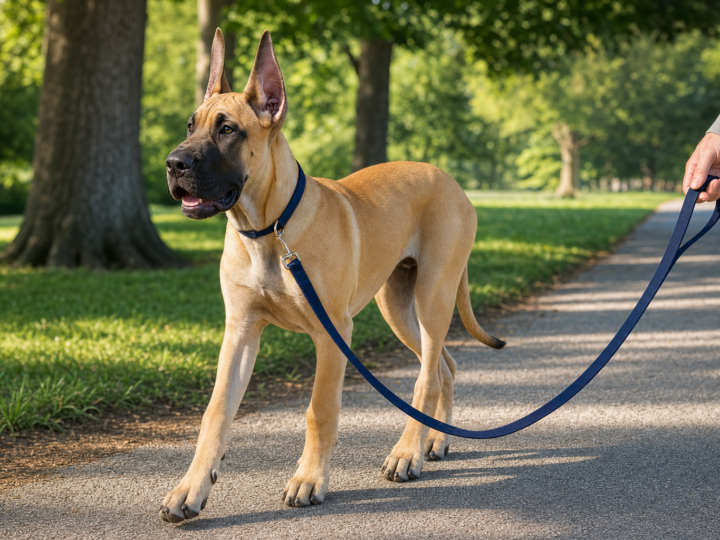
The most underrated exercise there is. A continuous walk at a purposeful pace on grass, dirt trail or wood chip builds fitness and even muscle tone with almost no impact cost. The key word is steady: a walk that stops every eight paces does far less than the same twenty minutes at an unbroken rhythm.
2. Swimming
Water takes almost all the weight off the frame while the muscles work against resistance, which makes swimming the best conditioning exercise for a heavy dog. Start with five minutes and build gradually, always with a canine life vest in open water. Never let a session run until your dog is tired in the water.
3. Shallow water walking
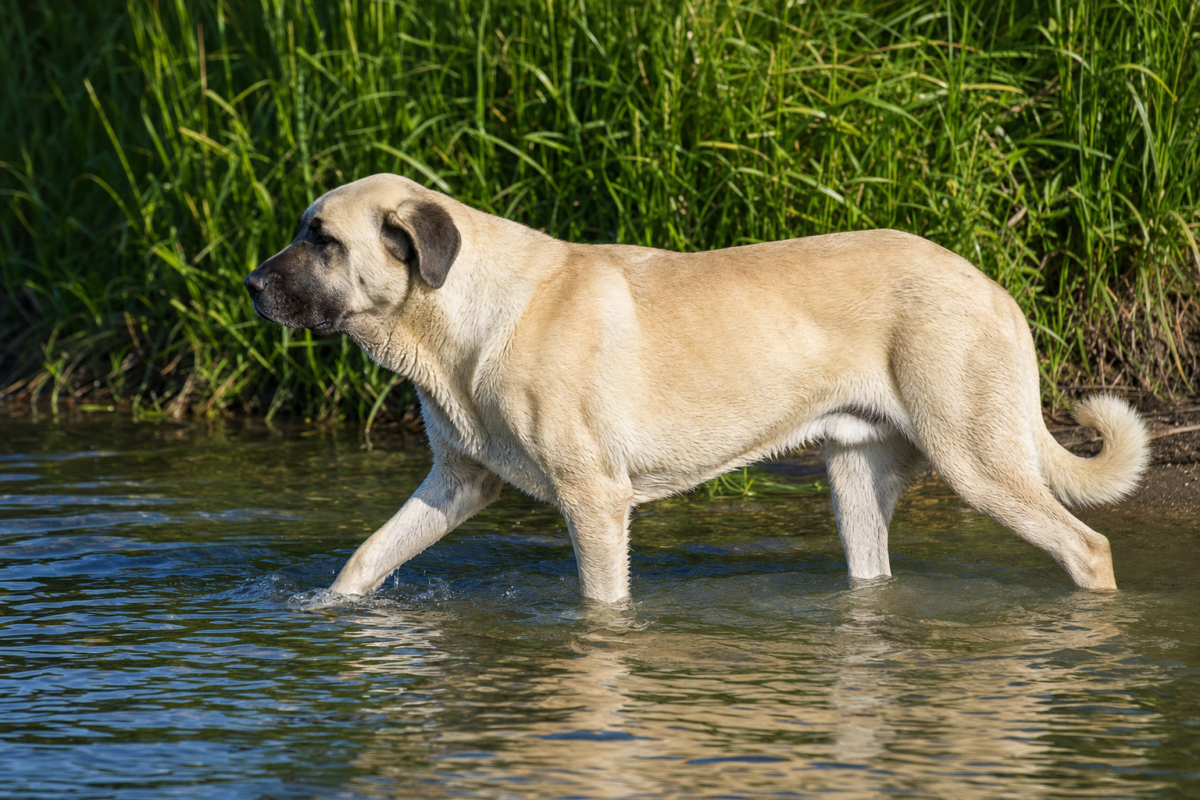
If your dog is not a swimmer, walking through water at hock depth gives many of the same benefits with none of the anxiety. The resistance makes each step deliberate and encourages full range of motion. Ten to fifteen minutes at a calm lake edge is plenty.
4. Sniff walks and scent games
A sniff walk is one where the dog sets the route and the nose sets the pace. It covers less ground than a fitness walk but drains mental energy remarkably well, and for a dog on a restricted movement plan it is the safest way to fill the gap. Twenty minutes leaves most big dogs settled.
5. Gentle slope walking
A gradual incline recruits the hind end strongly with no impact at all, which makes it the most efficient strength builder available on an ordinary walk. Keep the gradient gentle and the pace slow, and favour going up over repeatedly coming down steeply. Six to ten easy climbs is a real session.
6. Slow ground pole work
Lay three or four poles flat on the grass, about a stride apart, and walk your dog over them slowly. Every step becomes a conscious one, which builds coordination and encourages a proper foot lift. Two or three sets of six passes is enough.
7. Figure of eight and serpentine walking
Slow, wide loops around two markers ask your dog to bend gently through the spine and weight each side in turn. It takes five minutes and does a surprising amount for a dog that spends its time moving in straight lines.
8. Balance and stretching at home
Standing on a stable cushion, slow sit to stand repetitions and gentle range of motion work keep the core engaged and the joints moving through their full arc. Five minutes on a non slip surface, a few times a week, is enough. Ask your veterinarian to show you the movements rather than improvising.
| Exercise | Impact level | Typical session | Best for |
|---|---|---|---|
| Steady walking on soft ground | Very low | 30 to 45 minutes | Daily base fitness |
| Swimming | None | 5 to 20 minutes | Strength and stamina |
| Shallow water walking | None | 10 to 15 minutes | Range of motion |
| Sniff walk or scent game | Very low | 20 to 30 minutes | Mental tiredness |
| Gentle slope walking | Low | 6 to 10 climbs | Hind end strength |
| Slow ground pole work | Low | 2 or 3 sets of 6 | Coordination |
| Figure of eight walking | Very low | 5 minutes | Even side loading |
| Balance and stretching | Very low | 5 minutes | Core and mobility |
The American Kennel Club’s Chief Veterinary Officer, Dr. Jerry Klein, DVM, has written extensively on the slower growth and development timeline of large and giant breeds. Read more from the AKC’s guidance on caring for large-breed dogs.
Hard Landings
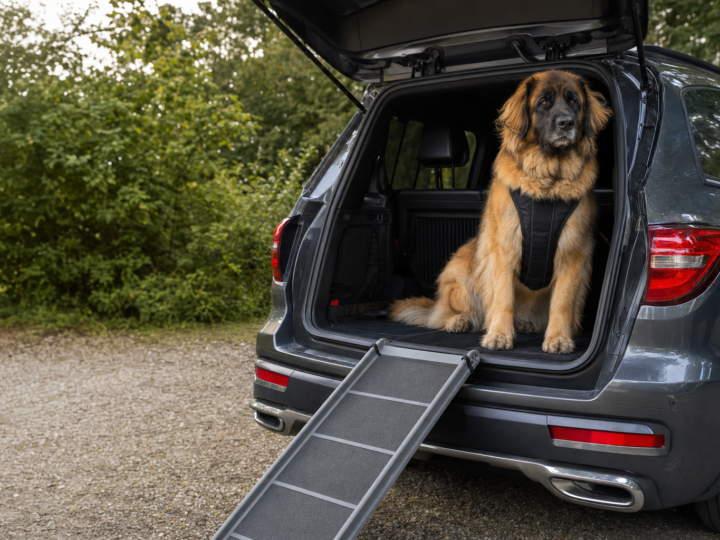
Jumping from a car boot concentrates force into the shoulders and elbows. Use a ramp where you can.
Sharp Turns At Speed
Chasing a thrown ball ends in a skid and a twist. Roll it instead so the turn stays wide.
The Weekend Warrior
Five quiet days then a three hour hike is harder than an even hour every day.
Extra Weight
Every extra pound travels through the joints on every stride. A lean big dog moves more freely.
How to build a weekly low impact routine
You need a rhythm your household can keep. A workable week for a healthy adult large breed looks like this:
- Walk every day. Two outings of 20 to 30 minutes on soft ground beat one long march on pavement.
- Add a strength session twice a week. A swim, a set of slope walks or a pole session all count.
- Slot in a sniff walk on the days your dog is home more, since mental work settles a big dog too.
- Keep five minutes of balance work as a wind down a couple of evenings a week.
- Leave one genuinely easy day. Recovery is part of the plan, not a gap in it.
- Move sessions to the cool ends of the day in warm weather.
Build increases slowly. Add no more than about ten percent to a session length in a week, and hold steady for a few days after any jump.
How to check body condition in ten seconds
No exercise plan can outrun a heavy dog, so body condition is worth checking regularly. It takes seconds.
- Ribs. Run your hands along the sides. You should feel the ribs easily under a thin layer. If you have to press, ease back on portions.
- Waist. Look down from above. You want a clear waist that tucks in behind the ribs.
- Tuck. From the side, the belly should rise toward the back legs rather than hanging level.
Check every couple of weeks and adjust portions with your veterinarian guidance.
Warming up and cooling down
Big dogs benefit from a warm up more than most parents realise.
- Begin with three to five minutes of ordinary walking before anything more demanding.
- Add a few slow figure of eight loops to get the spine bending and the muscles switched on.
- Finish with easy walking rather than stopping dead, which helps a big dog settle rather than stiffen.
Supporting comfortable movement day to day
Exercise is one half of the picture. The daily habits around it are the other half. Lean feeding, non slip flooring, a ramp for the car, a supportive bed off a cold floor and steady joint support all pull in the same direction as a good routine.
Many big dog parents add a daily joint chew alongside that routine. MoveGuard Adult is built for adult medium and large breed dogs from 25 to 75 pounds and combines New Zealand Green Lipped Mussel, glucosamine, chondroitin, MSM, eggshell membrane collagen and hyaluronic acid to support cartilage, connective tissue and comfortable movement. The daily amount is printed on the label and set by weight, with 25 to 50 pound dogs on one chew and larger dogs on two. It ships as 60 chews in chicken liver flavour, is made in the USA in an NSF facility, and carries a 60 day guarantee.
Support Every Stride
Pair a low impact routine with daily joint support built for big dogs. Explore MoveGuard Adult.
Signs the routine is working
A dog on a routine that fits rises easily from a nap, moves with a loose even gait, keeps the same willingness on the last ten minutes of a walk as on the first, and settles properly afterwards. Look for a lean waist, good muscle over the hindquarters and a steady appetite.
If you notice limping, reluctance to use stairs, stiffness lasting beyond the first few minutes of movement, or muscle loss down one side, book a veterinary check rather than adjusting the routine yourself.
A simple plan, stage by stage
The right emphasis changes as your dog does.
Adolescent, roughly 8 to 18 months. The frame is still finishing. Favour free play on soft ground, steady walks and sniff work, and keep long runs and repeated jumping moderate.
Young adult, roughly 18 months to 5 years. The building phase. Swimming, slope work and steady walking can all increase gradually. Hold a lean body condition, because this is the age a well loved big dog quietly gains a few pounds.
Mature adult, roughly 5 to 8 years. Keep the volume, soften the surfaces. Trade pavement for grass and add a warm up as standard.
Senior, 8 years and beyond. Shorter and more frequent wins. Three or four gentle outings beat one long one, and water work becomes even more valuable. Our guide to keeping a senior big dog moving comfortably goes deeper on this stage.
Common low impact exercise mistakes to avoid
Most routines go wrong in a handful of predictable ways.
- Throwing a ball to tire a big dog out. The sprint and skid at the end of every throw is the highest impact thing many big dogs do all week. Roll it instead.
- Walking only on pavement. Hard surfaces send every step straight back up the leg. Route through a park or a trail where you can.
- Confusing calm with fit. Muscle over the hindquarters is a better signal than behaviour at home.
- Stopping movement entirely when a dog seems stiff. Complete rest without veterinary guidance often makes a big dog stiffer. Ask your veterinarian rather than guessing at zero.
- Letting the dog set the intensity. Plenty of big dogs will run past the point that suits them. That call is yours, not theirs.
- Waiting for a problem to start. Put the routine in place while your dog moves well.
Matching the exercise to the breed
The principles hold across every large breed, but the flavour of the plan should follow the dog. Working and herding breeds such as the German Shepherd and Doberman carry a serious engine and need mental work built in, or the physical side will never be enough on its own. Scent work does as much for them as distance does.
Mastiff type breeds such as the English Mastiff and Cane Corso want moderate, unhurried movement on soft ground in cool hours. Water loving breeds like the Labrador Retriever and Newfoundland make swimming easy to plan around. Livestock guardians such as the Anatolian Shepherd prefer long, slow patrolling, so a rambling sniff walk suits them better than structured drills.
Frequently asked questions
How much exercise does a large breed dog need each day?
Most healthy adult large breeds do well with 45 to 90 minutes of movement a day, split across two or three outings rather than done in one block. Age, breed, weather and fitness all shift that number, so use your dog recovery afterwards as the real guide and confirm the right amount with your veterinarian.
Is swimming really the best exercise for a big dog?
Swimming is the best conditioning option for most large breeds because the water carries the body weight while the muscles work against resistance. Build up slowly, use a canine life vest for a deep chested breed in open water, and dry the ears afterwards.
Is walking on pavement bad for large breed dogs?
Pavement is not harmful in small amounts, but it is a hard surface that returns force through the legs with every step, and hot pavement also risks the pads. Grass, dirt trail and wood chip are kinder choices for the bulk of a big dog weekly mileage.
What low impact exercise suits a senior big dog?
Short and frequent works best. Three or four gentle 15 minute walks on soft ground, shallow water walking, sniff games and a few minutes of balance work usually suit a senior far better than one long outing. Always check with your veterinarian before changing a senior routine.
Can low impact exercise still keep a big dog fit?
Yes. Swimming, slope walking and steady continuous walking all build genuine cardiovascular fitness and muscle. Low impact describes the force going through the joints, not the effort going into the session.
The bottom line
The best exercise for a big dog is the kind it can do every day for years without paying for it. Steady walking on soft ground, swimming, shallow water work, sniff walks, gentle slopes, slow pole work and a few minutes of balance training cover everything a large breed needs, and leave out the jumping and skidding that ask the most of a heavy frame. Keep your dog lean, build up slowly, leave a real rest day, and support the joints with good daily habits.
Want the simple roadmap in one place? Grab our free Big Dog Mobility Guide for the weekly movement plan, the home setup checklist and the joint safe exercise limits, all written for large and giant breeds.
This article is for general educational purposes only and is not veterinary advice. It is not intended to diagnose, treat, cure or prevent any disease. Always consult your veterinarian about your dog individual health, nutrition and supplement needs. These statements have not been evaluated by the Food and Drug Administration.
Support Big Breed Joints from Day One
Large and giant breeds carry more load through every growth stage. MoveGuard Growth supports developing joints in young big dogs (8 to 30 months); MoveGuard Adult keeps grown big dogs moving comfortably.
Leave a Reply