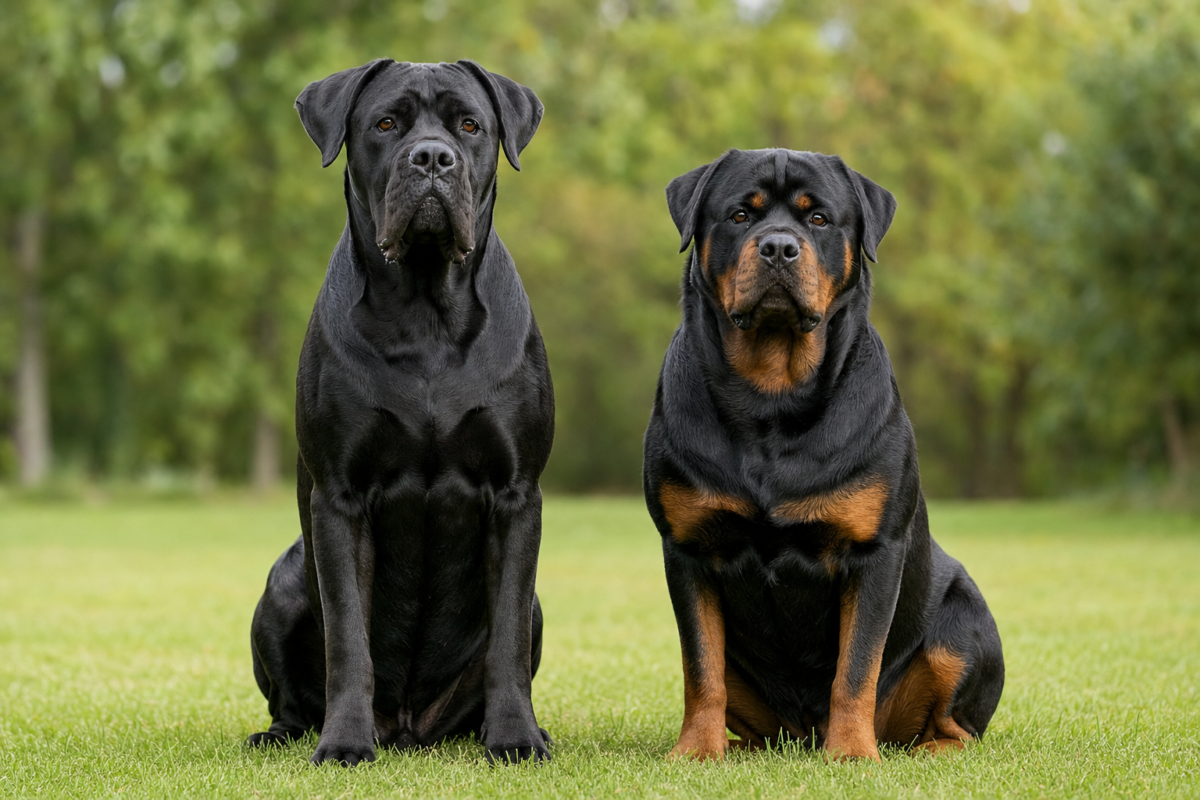
The Cane Corso is the taller, leggier and more athletic of the two, with males standing 25 to 27.5 inches and weighing roughly 99 to 120 pounds. The Rottweiler is shorter and blockier, with males standing 24 to 27 inches and weighing 95 to 135 pounds. The Corso is an Italian guardian bred to patrol and cover ground, while the Rottweiler is a German drover bred to push heavy livestock and pull carts. Both reach adult height by around 18 months and keep thickening until close to three years.
Choosing between a Cane Corso and a Rottweiler is a happy problem, because both are magnificent, loyal, deeply capable dogs. They also ask different things of you. One is a lean, agile patroller with an enormous engine. The other is a compact powerhouse with a famously steady head. This guide sets the two side by side on size, growth, temperament and daily care.
What is the difference between a Cane Corso and a Rottweiler?
The difference comes down to build and job. The Cane Corso is taller, longer in the leg and lighter through the body, built by Italian farmers to patrol land and cover distance. The Rottweiler is shorter, broader and heavier for its height, built by German butchers to drive cattle and pull loaded carts. A Corso male finishes at 25 to 27.5 inches and 99 to 120 pounds. A Rottweiler male finishes at 24 to 27 inches and 95 to 135 pounds on a stockier frame.
Coat sets them apart at a glance. Rottweilers are always black with defined rust markings on the cheeks, chest and legs, while Cane Corsos come in black, grey, fawn, red and brindle, usually with a dark mask. Temperament differs in flavour rather than in kind. Both are confident guardians who bond hard to family, but the Corso is more reserved and independent minded, while the Rottweiler is often goofier at home and more biddable in training.
Cane Corso and Rottweiler at a glance
| Trait | Cane Corso | Rottweiler |
|---|---|---|
| Country of origin | Italy | Germany |
| Original job | Estate guardian and hunter | Cattle drover and cart puller |
| Male height | 25 to 27.5 inches | 24 to 27 inches |
| Female height | 23.5 to 26 inches | 22 to 25 inches |
| Male weight | 99 to 120 lb | 95 to 135 lb |
| Female weight | 85 to 100 lb | 80 to 100 lb |
| Build | Tall, athletic, rangy | Compact, broad, heavy boned |
| Coat | Short, several colours, dark mask | Short, black with rust markings |
| Energy level | High, needs a job and distance | Moderate to high, bursts of power |
| Trainability | Willing but independent | Very biddable, loves structure |
| Typical lifespan | 9 to 12 years | 9 to 10 years |
The American Kennel Club’s Chief Veterinary Officer, Dr. Jerry Klein, DVM, has written extensively on the slower growth and development timeline of large and giant breeds. Read more from the AKC’s guidance on caring for large-breed dogs.
What makes a Cane Corso grow the way it does
The Cane Corso is a working mastiff that never lost its athleticism. Italian farms needed a dog that could cover ground all day and still stand guard at night, so the breed developed length of leg and a light, muscular body rather than bulk. That shape drives the growth curve. A Corso puppy shoots up in height through the first year and can look narrow and leggy at nine or ten months, with a head that seems too big for the body.
Substance arrives later. Through the second year the chest deepens and the blocky head fills out, which is why a two year old Corso looks like a different dog from the same animal at twelve months. Our guide on how big your Cane Corso will get maps the whole curve.
What makes a Rottweiler grow the way it does
The Rottweiler was shaped by very different work. Driving cattle and hauling a butcher cart demanded compact power, low leverage and heavy bone, so the breed grows outward as much as upward. A Rottweiler puppy is dense and solid from the start, often heavier than a Corso of the same age even though the adult stands shorter.
Height finishes early, usually by around 18 months, but the thickening of chest, neck and hindquarters continues into the third year. Our guide on when Rottweilers stop growing covers that second phase.
Cane Corso growth chart, month by month
Treat these figures as a guide rather than a report card. A Corso slightly above or below the range while looking lean and moving well is usually fine.
| Age | Male weight | Female weight |
|---|---|---|
| 2 months | 20 to 26 lb | 18 to 23 lb |
| 3 months | 30 to 38 lb | 26 to 33 lb |
| 4 months | 42 to 52 lb | 36 to 45 lb |
| 6 months | 60 to 72 lb | 52 to 64 lb |
| 9 months | 78 to 92 lb | 68 to 80 lb |
| 12 months | 88 to 105 lb | 75 to 90 lb |
| 18 months | 95 to 115 lb | 80 to 96 lb |
| 2 years plus | 99 to 120 lb | 85 to 100 lb |
Rottweiler growth chart, month by month
Rottweilers usually carry more weight than a Corso at the same age, because bone and muscle arrive earlier on a shorter frame.
| Age | Male weight | Female weight |
|---|---|---|
| 2 months | 22 to 28 lb | 18 to 24 lb |
| 3 months | 33 to 42 lb | 28 to 36 lb |
| 4 months | 45 to 56 lb | 38 to 48 lb |
| 6 months | 65 to 78 lb | 55 to 68 lb |
| 9 months | 82 to 100 lb | 70 to 85 lb |
| 12 months | 90 to 112 lb | 78 to 95 lb |
| 18 months | 95 to 125 lb | 80 to 98 lb |
| 2 years plus | 95 to 135 lb | 80 to 100 lb |
When do Cane Corsos and Rottweilers stop growing?
Both breeds reach close to adult height by around 18 months. After that the change is about substance rather than stature. A Corso spends the second year adding chest depth and head mass, usually finishing between two and two and a half years. A Rottweiler takes it further, often thickening until close to three years of age.
As a rough guide, dogs with an expected adult weight of 100 to 130 pounds keep developing for roughly 22 to 26 months. Because the frame is largely set in the first eighteen months, that window is your prime time to build habits around food, movement and joint support.
Why the growth window matters for powerful guardians
Your puppy is laying down the cartilage, bone and connective tissue that will carry a hundred pounds or more for the next decade. Growth plates, the soft areas at the ends of the long bones, stay open through much of the first year. While they are open, hard impact and excess weight ask a great deal of a frame that is still forming.
Growing Too Fast
A fast curve asks more of developing joints. Even growth beats early size in both breeds.
Excess Weight
Every extra pound rides on young joints. Keep both breeds genuinely lean through the first two years.
Too Much Impact
Repeated jumping, hard sprints and stairs on open growth plates are best kept moderate while young.
Too Little Structure
Both are confident guardians. Without early training, that confidence becomes hard to live with.
How much should a Cane Corso or Rottweiler eat while growing?
Feeding is where these two ask for almost identical care. Large breed puppies do best with steady, moderate growth, and a lean puppy is a comfortable puppy.
- Choose a complete food formulated for large breed puppies, which balances calories and minerals for steadier growth.
- Split the daily amount into three meals while young, then two as an adult.
- Feed to a lean body condition rather than to the number on the bag. Both breeds hide weight under a short coat.
- Ask your veterinarian to confirm the daily amount at each checkup, since the right portion changes fast in the first year.
How to check body condition in ten seconds
The scale tells you weight. Body condition tells you whether that weight suits your dog.
- Ribs. Run your hands along the sides. You should feel the ribs under a thin layer. If you have to press, ease back on food.
- Waist. Look down from above. You want a clear waist that tucks in behind the ribs.
- Tuck. From the side, the belly should rise toward the back legs rather than hanging level.
Check every couple of weeks and adjust portions gently with your veterinarian’s guidance.
Growth safe exercise for both breeds
Here the two part company. A Cane Corso needs distance and a job. A Rottweiler needs work too, but is often content with shorter, intense sessions and a long nap on your feet. Both need moderate activity rather than repeated hard impact while growing.
- Favour free play and steady walks on soft ground rather than pavement.
- Keep long runs, sprints, agility and jumping moderate while the growth plates are open.
- Give a Corso mental distance as well as physical. Scent work satisfies the guardian brain.
- Let your puppy rest fully between bursts. Sleep is when growth happens.
Protecting big joints during the growth years
Both breeds ask a lot of their joints simply by existing. A hundred pound guardian turns, braces and pushes off with real force, and every movement travels through hips, elbows and stifles. Supporting healthy joint development while the frame is still being built is a kind habit to adopt early.
Alongside lean feeding and sensible exercise, many parents of large and giant breeds add a daily joint support chew. MoveGuard Growth is made for exactly this stage. It combines nine actives, including New Zealand Green Lipped Mussel, glucosamine, chondroitin, MSM and hyaluronic acid, to support the developing joints of young large breed dogs across the roughly 8 to 30 month growth window. You dose by expected adult weight, so most Corsos and Rottweilers sit at three chews a day. It ships as 90 chews in a chicken liver flavour, is made in the USA, and is backed by a 60 day guarantee. Grown dogs move on to MoveGuard Adult.
Support A Powerful Frame
Give your growing guardian daily joint support built for large and giant breeds. Explore MoveGuard Growth.
Signs your Corso or Rottweiler is growing on track
You do not need a weekly scale reading to know things are going well. Look for a bright, alert puppy with a waist you can see from above, ribs you can feel under light pressure, smooth movement and a keen appetite. Even, unhurried growth with good muscle tone is what you want.
If you notice limping, stiffness after rest, reluctance to climb into the car, or a sudden jump in growth rate, a quick conversation with your veterinarian lets you adjust food or activity early.
A simple growth game plan, stage by stage
You need the right emphasis at the right time, not a complicated programme.
8 weeks to 4 months. Foundation stage. Large breed puppy food, three calm meals a day, and heavy investment in socialisation. Both breeds form opinions early, so meet people, surfaces and sounds now.
4 to 8 months. Growth is quick and your puppy may look gangly or chunky depending on the breed. Feed lean, keep exercise moderate, and teach calm behaviour around doors, stairs and the car. A natural point to begin a daily joint routine.
8 to 18 months. Height nears its peak while adolescence tests your training. Hold the line on rules, match portions to a lean body condition, and add structured activity gradually.
18 months to 3 years. The adolescent becomes the adult you pictured as chest, neck and head keep developing. Build activity up as your veterinarian advises.
Common growth mistakes to avoid
Most growth trouble in powerful breeds comes from a few avoidable habits.
- Feeding for size. A heavy young guardian is not a healthier one. Feed lean and let size arrive on its own timeline.
- Skipping large breed puppy food. These formulas control calcium and calories for steady growth.
- Too much hard exercise, too young. Long runs and repeated jumping are a lot to ask of open growth plates.
- Underestimating the guardian brain. Training is not optional, and it is far easier at 20 pounds than at 120.
- Waiting for a problem before supporting joints. The growth window is the ideal time to support developing joints, not after signs appear.
Temperament, and which guardian might suit your home
Both are devoted, watchful and physically formidable, and both need a committed household. The Cane Corso is more reserved with strangers, more independent and more driven to patrol. It wants space, a job and a person to shadow. In a home with ground to survey and an adult who enjoys long structured walks, a Corso is magnificent. In a small flat with an unpredictable routine, that drive becomes restlessness.
The Rottweiler is more sociable and openly affectionate, with a clownish streak that surprises people who only know the reputation. It is also one of the most trainable guardian breeds, which makes it a slightly easier first big dog. What it needs in return is inclusion. Neither dog is low effort, and both reward structure and fairness with remarkable loyalty.
Frequently asked questions
Which is bigger, a Cane Corso or a Rottweiler?
The Cane Corso is usually taller, with males standing 25 to 27.5 inches against 24 to 27 inches for a Rottweiler. The Rottweiler is heavier for its height and can reach 135 pounds, so the Corso is taller while the Rottweiler is denser.
Is a Cane Corso or a Rottweiler easier to train?
Most trainers find the Rottweiler slightly easier, because the breed is biddable and enjoys structured work. The Cane Corso is willing but more independent, so it needs an experienced handler and a consistent routine from puppyhood.
At what age is a Cane Corso or Rottweiler full grown?
Both reach close to adult height by around 18 months. A Cane Corso usually finishes filling out between two and two and a half years, while a Rottweiler keeps thickening until close to three years of age.
Do Cane Corsos and Rottweilers need different exercise?
Yes, in emphasis. A Cane Corso wants more distance and more time surveying its territory, while a Rottweiler is often satisfied by shorter, intense sessions plus training. While growing, both need moderate activity on soft ground.
Which breed lives longer, the Cane Corso or the Rottweiler?
Cane Corsos typically live 9 to 12 years and Rottweilers 9 to 10 years, so the Corso has a modest edge on average. Lean body condition and regular veterinary care influence individual outcomes far more than breed averages.
The bottom line
Pick the Cane Corso if you want a tall, athletic guardian who will walk your boundary all day and think for itself. Pick the Rottweiler if you want a compact powerhouse who lives to work with you. Both finish near or above the hundred pound mark, both reach adult height by around 18 months, and both keep building substance into the third year. Feed lean, keep early exercise sensible, train from day one, and support the growth window with the right daily habits.
Want the simple roadmap in one place? Grab our free Big Dog Growth Blueprint for the growth window checklist, feeding framework and joint safe exercise limits.
This article is for general educational purposes only and is not veterinary advice. It is not intended to diagnose, treat, cure or prevent any disease. Always consult your veterinarian about your dog’s individual health, nutrition and supplement needs. These statements have not been evaluated by the Food and Drug Administration.
Support Big Breed Joints from Day One
Large and giant breeds carry more load through every growth stage. MoveGuard Growth supports developing joints in young big dogs (8 to 30 months); MoveGuard Adult keeps grown big dogs moving comfortably.
Leave a Reply