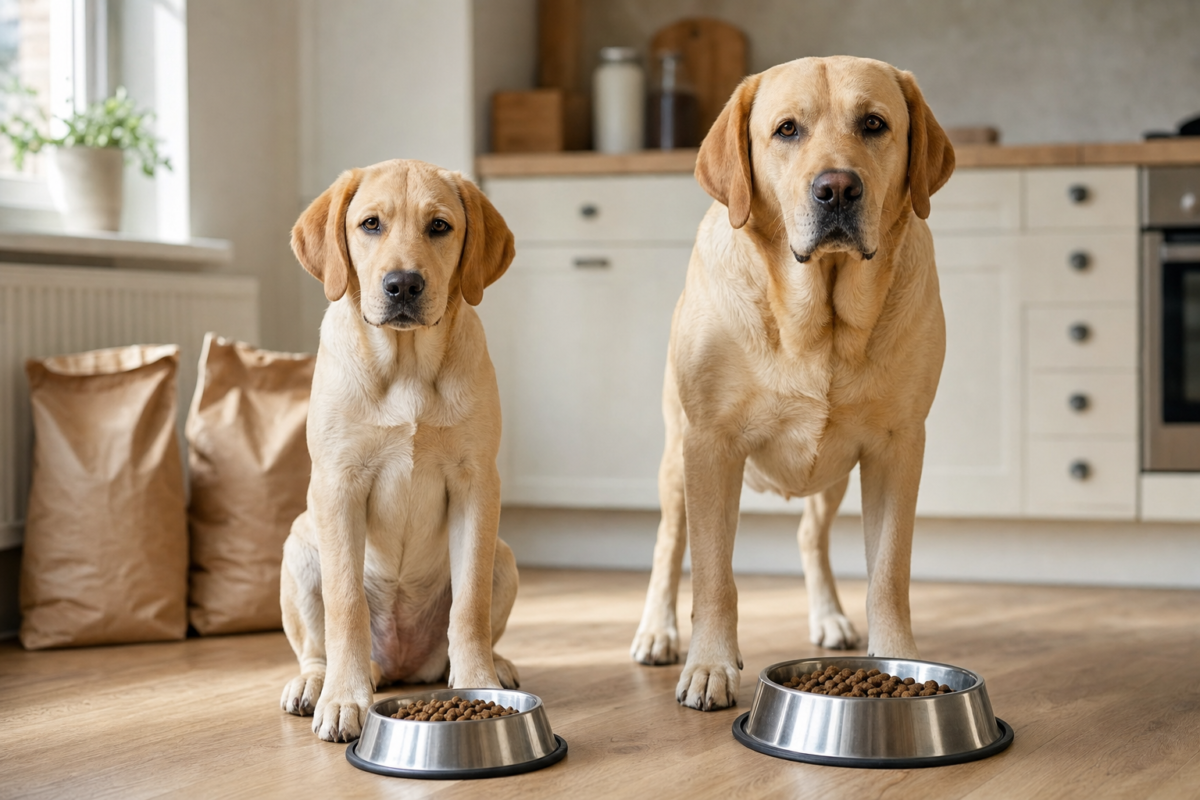
Most large breed dogs move from puppy food to adult food between 12 and 18 months, and most giant breeds wait until 18 to 24 months. The trigger is not a birthday. It is the point where your dog has reached roughly 90 percent of expected adult weight and the fast growth phase has clearly slowed. Large breed puppy food differs from adult food in three ways that matter: controlled calcium, controlled calories and a balanced calcium to phosphorus ratio, all of which support steady rather than rushed growth.
If you are standing in the pet food aisle holding two bags and wondering which your growing dog actually needs, you are asking the right question. For big dogs the difference between puppy food and adult food is not marketing. It is a real difference in minerals and calories that shapes how fast a young frame builds itself. This guide covers what changes between the bags, when to switch, and how to transition without an upset stomach.
When should a large breed dog switch from puppy food to adult food?
A large breed dog should switch from puppy food to adult food once the fastest phase of growth has finished, which for most large breeds falls between 12 and 18 months and for most giant breeds between 18 and 24 months. A practical rule is to switch at about 90 percent of expected adult weight, once monthly weight gain has flattened. Switching earlier leaves a still growing dog short on the balance it needs. Switching much later adds calories a maturing dog no longer burns.
Sex, breed, neutering status and activity level all shift the timing, so treat these ranges as a dependable guide rather than a fixed rule. Your veterinarian sees your individual dog and can confirm the right week to begin.
What actually makes large breed puppy food different
Small breed puppies and big breed puppies grow along completely different curves. A little dog can be near adult size in under a year. A Great Dane can add more than one hundred pounds over that stretch. That sustained build is why large breed growth food exists as its own category rather than as a badge on a familiar bag. Three things set it apart:
- Controlled calcium. A growing big dog absorbs calcium far less selectively than an adult does, so the level in the bowl matters. These formulas cap calcium rather than pushing it high, which supports normal bone and joint development while the skeleton is forming.
- Controlled energy density. Fat and calories are held back so a puppy can eat a satisfying volume without growing faster than the frame can comfortably carry.
- A balanced calcium to phosphorus ratio. The two minerals work together, and the ratio matters as much as the amount.
Adult maintenance food does a different job. It feeds a finished body, not a building one, so it carries no growth specific mineral ceilings and assumes the skeleton is already set. That is what a mature dog needs, and not what a nine month old giant breed puppy needs.
Puppy food versus adult food, side by side
Exact numbers vary by brand, so read the label rather than assuming.
| Feature | Large breed puppy food | Adult maintenance food |
|---|---|---|
| Calcium | Capped, commonly 1.1 to 1.5 percent dry matter | No growth ceiling, often higher or unstated |
| Calcium to phosphorus ratio | Held close to a target near 1.2 to 1 | Wider range accepted |
| Calories | Moderate and deliberately restrained | Varies widely by formula and purpose |
| Protein | Typically 23 to 30 percent | Typically 18 to 26 percent |
| Fat | Moderate, often 12 to 16 percent | Low in weight formulas, high in performance ones |
| DHA for brain and eye development | Usually included | Often absent |
| Label statement to look for | Growth, including growth of large size dogs at 70 pounds or more as an adult | Adult maintenance |
| Meals per day | Three while young, then two | Two |
The World Small Animal Veterinary Association’s Global Nutrition Committee publishes evidence-based guidance for evaluating dog food and feeding practices. Read more from the WSAVA Global Nutrition Guidelines.
That label statement is the most useful thing on the bag. It is the manufacturer stating plainly that the formula was built for a dog finishing at 70 pounds or more. A bag that says only growth was not designed with your dog in mind.
When to switch, by expected adult weight
The heavier your dog will finish, the later the switch. Use this alongside the scale rather than instead of it.
| Expected adult weight | Typical switch window | What is usually happening |
|---|---|---|
| 50 to 65 lb | 12 to 14 months | Height is set, muscle still filling in |
| 65 to 80 lb | 13 to 16 months | Growth clearly slowing month to month |
| 80 to 100 lb | 15 to 18 months | Near adult height, chest still deepening |
| 100 to 130 lb | 18 to 22 months | Frame nearly complete, substance arriving |
| 130 lb and above | 20 to 24 months | Slow final build, appetite steadying |
If you are unsure where your dog will land, the parents are the best predictor, and our expected adult weight tool gets you close enough to plan around.
Why the growth window matters more than the calendar
Underneath all of this sits one idea. A big dog spends its first two years building the bone, cartilage and connective tissue it will stand on for life. That build runs roughly 8 to 30 months, closing near 24 months for large breeds and 30 for giants.
What is still developing during the switch
Even as you change bags, your dog is not finished. Growth plates, the soft areas at the ends of the long bones, often stay open into the second year in the largest breeds, and muscle and chest depth keep developing past the point the scale settles. The switch is a nutrition milestone, not a finish line.
Switching Too Early
Moving a still growing dog onto adult food removes the growth specific mineral balance at the moment it is doing the most work.
Switching Too Late
A maturing dog on rich puppy food gains weight it does not need, and every extra pound rides on the joints.
Adding Calcium On Top
Calcium alongside a complete growth food undoes the balance the formula was built around. Ask your veterinarian first.
Free Feeding The Bowl
Leaving food down all day makes portions invisible. Measure meals so you can adjust when the waistline changes.
How to switch food without upsetting the stomach
Big dogs have famously sensitive digestion, and an abrupt change is the fastest route to a messy week. Take seven to ten days.
- Days one to three. Serve one quarter new food mixed with three quarters current food.
- Days four to six. Move to half and half.
- Days seven to nine. Three quarters new food, one quarter old.
- Day ten. Fully on the new food, assuming stools have stayed firm throughout.
Slow down or pause if you see loose stools, gas or a dip in appetite. Pick a calm week with no travel and no other diet changes, so you know what caused any upset.
Watch the portion as well as the food. The two bags rarely carry the same calories per cup, so scooping from habit can quietly change your dog’s intake overnight. Read the feeding guide on the new bag and adjust from what you see. Our complete food formulated for large breed puppies guide covers portioning in detail.
How to check body condition in ten seconds
The scale tells you weight. Body condition tells you whether that weight is right for your dog, and it is what should drive your portions.
- Ribs. Run your hands along the sides. You should feel the ribs easily under a thin layer. If you have to press, ease back on food.
- Waist. Look down from above. You want a clear waist that tucks in behind the ribs.
- Tuck. From the side, the belly should rise toward the back legs rather than hanging level.
Check every couple of weeks through the growth years, and more often during a transition. Adjust gently and confirm with your veterinarian at each visit.
Movement during and after the switch
Food is only half the picture, and the months around the switch are when many parents start increasing activity. Favour free play and steady walks on soft ground, build distance gradually rather than jumping into long runs once your dog looks adult, and keep repeated jumping moderate while the largest breeds finish closing their growth plates.
Supporting joints through the whole growth window
The switch is a natural moment to look at the bigger picture. Your dog is heavier and more active than ever, and still finishing the frame that carries all of it. Supporting healthy joint development through that stretch is one of the simplest habits a big dog parent can build.
Alongside lean feeding and sensible exercise, many big dog parents add a daily joint support chew made for large and giant breeds. MoveGuard Growth is built for exactly this stage. It combines nine actives, including New Zealand Green Lipped Mussel, glucosamine, chondroitin, MSM and hyaluronic acid, to support the developing joints of young large breed dogs across the roughly 8 to 30 month growth window. You dose by expected adult weight, so dogs finishing at 50 to 80 pounds sit at two chews a day and those at 80 to 100 pounds and above take three. It ships as 90 chews, is made in the USA in an NSF facility, and is backed by a 60 day guarantee.
Support A Growing Frame
Give your growing big dog daily joint support built for large and giant breeds. Explore MoveGuard Growth.
Signs the switch is going well
In the two to three weeks after the transition, look for firm consistent stools, a steady appetite, a glossy coat, energy that holds through the day, and a body condition that stays lean rather than climbing.
If you see persistent loose stools, gas, itching, a dull coat, sudden weight gain or a drop in energy, talk to your veterinarian. Sometimes the answer is a slower transition or a smaller portion, sometimes a different formula.
A simple feeding game plan, stage by stage
You need the right emphasis at the right time.
8 weeks to 4 months. A complete large breed puppy food, three measured meals a day, and portions confirmed at every checkup because the right amount changes fast. Weigh your puppy regularly so you have a curve to look at later.
4 to 8 months. The fastest stretch. Your puppy may look leggy and eat like the food is about to run out. Hold the line on lean feeding, keep exercise moderate, and resist the urge to feed for size.
8 to 18 months. Growth slows while appetite stays high. Drop to two meals a day, watch the waistline, and plan the switch on expected adult weight rather than the calendar. Most large breeds change bags in this window, and this is a natural point to begin a daily joint support routine.
18 months to 3 years. Giant breeds finish here and make their switch. For everyone else the adult routine settles in: measured meals, a lean body condition, and activity built up gradually.
Common feeding mistakes to avoid
Most feeding problems come from a handful of avoidable habits.
- Using a general puppy food. A formula built for all puppies can carry more calcium and calories than a big dog needs. Look for the large size dogs wording.
- Switching on the first birthday out of habit. Twelve months is a milestone for a Labrador and the middle of the build for a Mastiff.
- Adding calcium or a bone supplement. A complete growth food is already balanced, and adding minerals on top works against it. Ask your veterinarian first.
- Feeding for size. A heavy young dog is not a healthier one. Feed lean and let size arrive on its own timeline.
- Changing food overnight. Take seven to ten days every time.
- Waiting for a problem before supporting joints. The growth window is the ideal time to support developing joints, not after signs appear.
What about all life stages formulas?
You will see bags labelled for all life stages, meaning the food meets the requirements for growth as well as adult maintenance. The catch is that an all life stages claim does not automatically include the large size dogs wording, and a food built to satisfy growth in general can carry more calcium than a giant breed puppy needs.
So the rule holds whichever category the bag sits in: read the label statement. Homemade and raw diets deserve more scrutiny still, because balancing calcium and phosphorus for a growing giant breed is genuinely difficult. Work with a veterinary nutritionist rather than a recipe from the internet.
Frequently asked questions
When should a large breed puppy switch to adult food?
Most large breeds switch between 12 and 18 months and most giant breeds between 18 and 24 months. The better trigger is reaching roughly 90 percent of expected adult weight with growth clearly slowing, rather than a specific birthday.
What happens if I feed adult food to a large breed puppy?
Adult maintenance food is not formulated with the calcium ceiling and controlled energy density that support steady growth in big dogs, so a still growing puppy may not get the balance it needs during the months the skeleton is forming. Speak with your veterinarian if your puppy has been eating adult food.
Is large breed puppy food really different from regular puppy food?
Yes. Large breed growth formulas cap calcium, hold the calcium to phosphorus ratio near a target and restrain calories, so a big puppy can build steadily rather than quickly. Look for the label statement naming growth of large size dogs at 70 pounds or more.
How long does it take to switch a dog to a new food?
Plan on seven to ten days, moving from one quarter new food to half, then three quarters, then fully across. Slow down if stools loosen, and avoid transitioning during a week with travel or other changes.
Should I keep giving joint support after switching to adult food?
Many big dog parents do. The frame is still finishing well past the food switch, and daily joint support during and after the growth window is a common habit for large and giant breeds. Ask your veterinarian what suits your individual dog.
The bottom line
Puppy food and adult food are not two versions of the same thing. For a big dog, the puppy bag carries a capped calcium level, a balanced mineral ratio and restrained calories that support steady growth while your dog builds its frame. The adult bag feeds a body that has finished that work. Switch near 90 percent of expected adult weight, which usually means 12 to 18 months for large breeds and 18 to 24 for giants. Take ten days over the change, measure the new portions, keep your dog lean, and support those joints all the way through.
Want the Simple Roadmap in One Place?
Grab our free Big Dog Growth Blueprint for the growth window checklist, feeding framework and joint safe exercise limits, all written for large and giant breeds.
This article is for general educational purposes only and is not veterinary advice. It is not intended to diagnose, treat, cure or prevent any disease. Always consult your veterinarian about your dog’s individual health, nutrition and supplement needs. These statements have not been evaluated by the Food and Drug Administration.
Support Big Breed Joints from Day One
Large and giant breeds carry more load through every growth stage. MoveGuard Growth supports developing joints in young big dogs (8 to 30 months); MoveGuard Adult keeps grown big dogs moving comfortably.
Leave a Reply