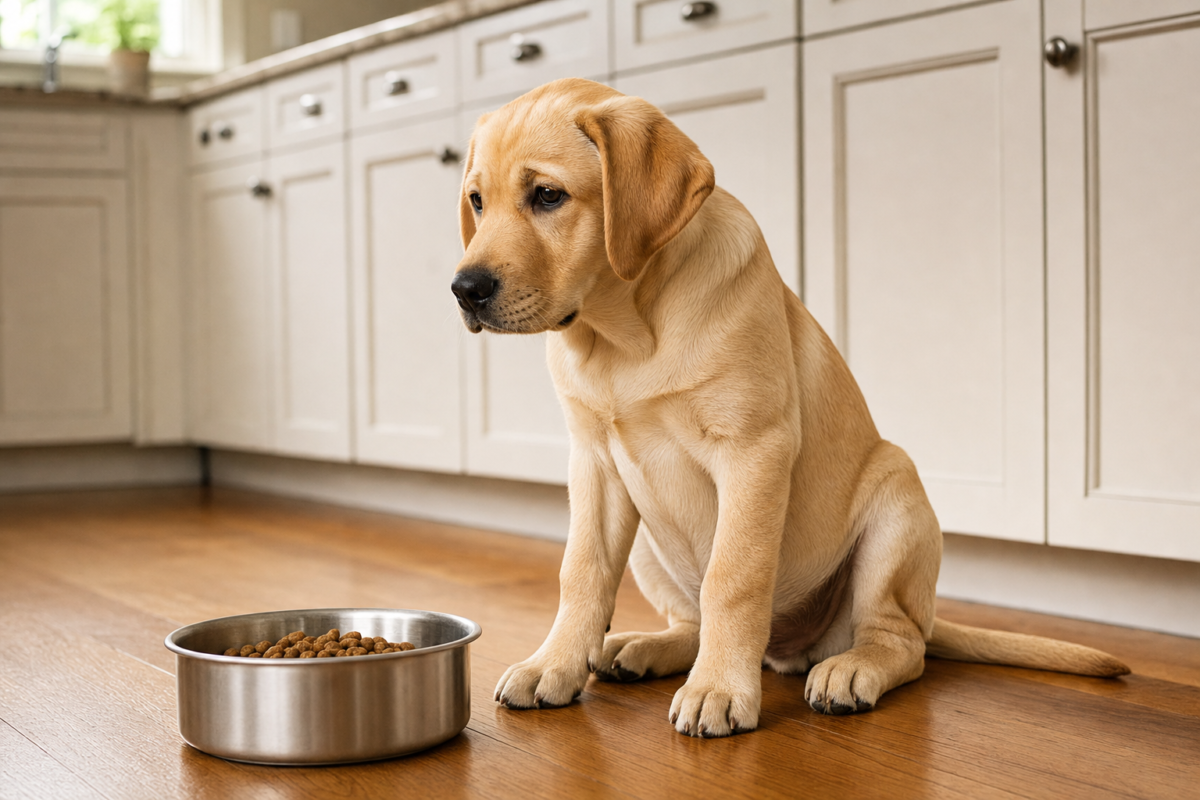
The best nutrition approach for a large breed puppy is a complete food specifically formulated for large breed growth, fed in measured meals to a lean body condition. Look for controlled calcium of roughly 1.0 to 1.5 percent on a dry matter basis, moderate calorie density, and an AAFCO growth statement that includes large size dogs. Feed by expected adult weight rather than current weight, keep treats under about ten percent of daily calories, and let your veterinarian confirm portions at every visit.
Walk down a pet food aisle with a big dog puppy at home and the choice is overwhelming. Every bag promises strength, every label uses the same warm words, and the price range is wide enough to be its own decision. The good news is that large breed puppy nutrition comes down to a short list of things that genuinely matter and a much longer list that does not. This guide walks through the approach itself, so you can pick a food with confidence and then stop thinking about it.
What is the best nutrition approach for a large breed puppy?
The best approach is a complete large breed puppy formula, fed in measured meals, portioned by expected adult weight, and adjusted by body condition rather than by the number on the bag. Everything else is detail. That single combination handles the two things large breed nutrition has to get right at the same time, which are supplying enough of everything a fast growing body needs while keeping the growth curve itself unhurried.
What the approach is not is a search for the richest or most premium food you can find. A large breed puppy fed generously on an excellent adult formula is worse off than one fed carefully on a modest large breed puppy formula, because the problem was never the quality of the ingredients. It was the mineral profile and the calorie load reaching a skeleton that is not ready for them.
What makes big dog puppy nutrition different
Small breed puppies finish growing in under a year and are remarkably good at regulating how much dietary calcium they absorb. Large and giant breed puppies do neither. They grow for eighteen months to three years, they build an enormous amount of bone and cartilage while doing it, and they absorb a higher share of the calcium they are given whether or not the body needs it.
That combination is why a food formulated for large breed growth is the foundation of the whole approach. Those formulas deliberately hold calcium, phosphorus and calorie density in a narrower band than an all purpose puppy food does, so the body gets what it needs to build without being pushed to build faster. Everything else in this guide, from meal structure to treats, exists to protect that same principle of controlled growth.
The second difference is duration. A big dog puppy stays on a growth formula far longer than a small one, often past the first birthday and sometimes to eighteen months or beyond, so the food you choose is a decision you live with for a long stretch rather than a few months.
What to look for on a large breed puppy food label
Most of the useful information sits in two places on the bag, which are the guaranteed analysis and the AAFCO nutritional adequacy statement. Here is what to look for and why it matters.
| What to check | Look for | Why it matters |
|---|---|---|
| AAFCO statement | Growth, including large size dogs 70 lb or more as an adult | The clearest single signal that the food was formulated for big dog growth |
| Calcium | About 1.0 to 1.5 percent dry matter | Keeps mineral intake inside the range a growing large breed handles well |
| Phosphorus | About 0.8 to 1.2 percent dry matter | Works alongside calcium in bone development |
| Calcium to phosphorus ratio | Roughly 1.1 to 1 up to 1.4 to 1 | Balance matters as much as the individual amounts |
| Protein | About 23 to 30 percent dry matter | Supports lean muscle without driving excess calories |
| Fat | About 12 to 18 percent dry matter | Moderate fat keeps calorie density in check |
| DHA | Listed on the label | Supports normal brain and vision development in puppies |
The World Small Animal Veterinary Association’s Global Nutrition Committee publishes evidence-based guidance for evaluating dog food and feeding practices. Read more from the WSAVA Global Nutrition Guidelines.
If a bag does not state the AAFCO growth wording for large size dogs, it was probably not formulated for this job, however good the ingredient list reads.
How much and how often to feed
Portion size is where most of the day to day work happens, and the bag is only a starting point. Feeding guides are generous by design, so treat the printed amount as an opening offer and let body condition make the final call.
- Start from the feeding guide for your puppy’s expected adult weight, not current weight, then adjust from there.
- Measure with a proper cup or a kitchen scale. A scale is more accurate and takes no longer once it is on the counter.
- Feed three meals a day through roughly six months, then move to two meals. Smaller, more frequent meals suit a deep chested puppy better than one large one.
- Never leave the bowl down all day. Free feeding hands the growth curve to your puppy’s appetite.
- Recheck the amount at every veterinary visit, because the right portion changes quickly during the first year.
How to check body condition in ten seconds
Body condition, not the scale, tells you whether the current portion is right.
- Ribs. Run both hands along the sides. You should feel the ribs easily under a thin covering. If you have to press, reduce the portion slightly.
- Waist. From above, look for a clear narrowing behind the ribs.
- Tuck. From the side, the belly should rise toward the back legs rather than run level.
Check every couple of weeks and change portions in small steps rather than large ones.
Adult Food Too Early
Adult formulas are not built for the mineral needs of a growing big dog. Stay on a growth formula.
Added Calcium
Supplements and mineral rich toppers push intake past what a large breed puppy manages comfortably.
Calorie Creep
Chews, training treats and table food add up fast and quietly steepen the growth curve.
Feeding The Bag
Printed guides run generous. Body condition, not the label, decides the final portion.
Treats, toppers and the extras that quietly add up
Food is only part of what a puppy eats. Training treats, dental chews, a spoon of what you are having and the crust nobody wanted all carry calories, and in a household with several people the total is usually far higher than anyone realises.
The working rule is that treats stay under about ten percent of daily calories, and that the food portion comes down slightly on days with heavy training. Use your puppy’s own kibble as training rewards, which costs nothing and keeps the daily total honest. Skip bone meal, calcium powders and mineral rich supplements entirely unless your veterinarian has asked for them, since a complete food is already balanced and additions only unbalance it.
One practical habit helps more than any rule: agree the treat budget out loud with everyone in the house, then keep the day’s allowance in a single labelled jar. When the jar is empty, the day is done.
Mealtime habits worth building early
How a big dog eats matters alongside what it eats, and the habits are far easier to set at twelve weeks than at twelve months.
- Feed in a quiet spot on a surface with grip, so a leggy puppy is not bracing on a slippery floor.
- Keep fresh water available at all times, and refill rather than top up so the bowl stays clean.
- Let meals be calm. A puppy that gulps a meal in fifteen seconds does better with a slow feeder bowl.
- Build in a settled rest period after eating rather than immediate hard play.
- Change foods gradually over seven to ten days, mixing an increasing share of the new food into the old.
Daily habits that support developing joints
Nutrition sets the pace of growth, and the habits around it decide how comfortably a big dog carries the frame that growth builds. Lean feeding, good footing, movement that respects open growth plates and steady joint support all pull in the same direction while the body is still forming.
Alongside a well chosen food, many big dog parents add a daily joint support chew made for large and giant breeds. MoveGuard Growth is built for this stage. It combines nine actives, including New Zealand Green Lipped Mussel, glucosamine, chondroitin, MSM and hyaluronic acid, to support healthy joint development and normal cartilage and connective tissue across the roughly 8 to 30 month growth window. Dosing follows expected adult weight, so a puppy heading for 50 to 80 pounds takes two chews a day and one heading for 80 to 100 pounds or more takes three. It is made in the USA, comes as 90 chews and carries a 60 day guarantee.
Support The Growth Window
Give your growing big dog daily joint support built for large and giant breeds. Explore MoveGuard Growth.
Signs the nutrition plan is working
A well fed large breed puppy is bright and energetic without being frantic, has ribs you can feel under light pressure and a waist you can see from above, produces firm consistent stools, carries a glossy coat, and gains weight in steady increments rather than jumps. Slightly leggy and slightly awkward through the first year is exactly right.
Worth a conversation with your veterinarian are persistent loose stools, a dull coat, low energy, sudden fussiness at meals, limping or stiffness, or weight climbing much faster than expected. Most of these are small adjustments when caught early.
A stage by stage feeding plan
The approach stays the same throughout. What changes is the emphasis.
8 weeks to 4 months. Continue whatever the breeder was feeding for the first week, then transition gradually to your chosen large breed puppy food. Three measured meals a day, no calcium extras, and weekly weigh ins so you learn your puppy’s normal pace.
4 to 8 months. The hungriest stretch, and the one where portions creep up without anyone deciding to increase them. Keep measuring, keep checking ribs, and hold the line on treats. Appetite here is not a reliable guide to need.
8 to 18 months. Growth slows and calorie need often falls before the appetite does. This is the most common point for a big dog puppy to start carrying extra weight, so let body condition drive portions and be ready to trim.
18 months onward. Move to an adult formula on your veterinarian’s timing, transition over seven to ten days, and carry the lean habit into adult life. Many parents keep the daily joint support routine going as well.
Common nutrition mistakes to avoid
- Choosing an all life stage food. These are formulated to suit everyone, which means they are not tuned to the mineral needs of a fast growing large breed puppy.
- Switching to adult food at six months. A big dog is still growing well past that point. Confirm the timing with your veterinarian rather than the calendar.
- Adding calcium. A complete food is already balanced, and extra minerals push intake past what a large breed puppy handles well.
- Feeding to the printed guide forever. The bag cannot see your dog. Ribs and waist can.
- Changing foods often. Frequent switching upsets digestion and makes it impossible to tell what is working.
- Adding a topper to fix fussiness. A big dog puppy that skips a meal is rarely unwell, and a tasty addition usually creates a fussier eater, not a hungrier one.
When to switch to adult food
The honest answer is that it depends on the dog and belongs in a conversation with your veterinarian, but the general pattern is clear. Large breeds heading for 70 to 100 pounds usually move across somewhere between 12 and 18 months, and giant breeds heading past 100 pounds often stay on a growth formula until 18 months or later.
The signal to watch for is not a birthday. It is growth genuinely slowing, with weight settling and portions needing to come down to keep body condition lean. When you notice you are steadily reducing food to stop your dog gaining, the frame has largely finished and the switch is usually close. Make it gradually over seven to ten days, and keep the same measured, body condition led habits you built during growth.
Frequently asked questions
What should I look for in a large breed puppy food?
Look for an AAFCO growth statement that includes large size dogs, calcium around 1.0 to 1.5 percent on a dry matter basis, moderate fat and calorie density, and DHA on the label. Those four things matter far more than marketing terms on the front of the bag.
Can a large breed puppy eat all life stage food?
All life stage foods are formulated to suit dogs of every size, which means the mineral profile is not tuned to a fast growing large breed. A food formulated specifically for large breed growth is the safer choice. Discuss any exception with your veterinarian.
How many times a day should I feed a big dog puppy?
Three measured meals a day through roughly six months of age, then two meals after that. Splitting the daily amount keeps energy even and suits a deep chested puppy better than one large meal.
Should I feed a large breed puppy wet food or dry food?
Either works if it is a complete food formulated for large breed growth. Dry food is easier to measure precisely, which is an advantage during the growth window. If you feed wet or a mix, weigh portions and keep the daily calorie total consistent.
How many treats can a large breed puppy have?
Keep treats under about ten percent of daily calories and reduce the meal portion slightly on heavy training days. Using your puppy’s own kibble as training rewards is the simplest way to stay inside that budget.
The bottom line
Good large breed puppy nutrition is not complicated and it is not expensive. Choose a complete food formulated for large breed growth, measure every meal, portion by expected adult weight, let ribs and waist make the final call, keep treats modest, skip the calcium extras, and change food gradually when the time comes. Do those things consistently and the rest of the aisle stops mattering.
Want the Simple Roadmap in One Place?
Grab our free Big Dog Growth Blueprint for the growth window checklist, feeding framework and joint safe exercise limits, all written for large and giant breeds.
This article is for general educational purposes only and is not veterinary advice. It is not intended to diagnose, treat, cure or prevent any disease. Always consult your veterinarian about your dog’s individual health, nutrition and supplement needs. These statements have not been evaluated by the Food and Drug Administration.
Support Big Breed Joints from Day One
Large and giant breeds carry more load through every growth stage. MoveGuard Growth supports developing joints in young big dogs (8 to 30 months); MoveGuard Adult keeps grown big dogs moving comfortably.
Leave a Reply