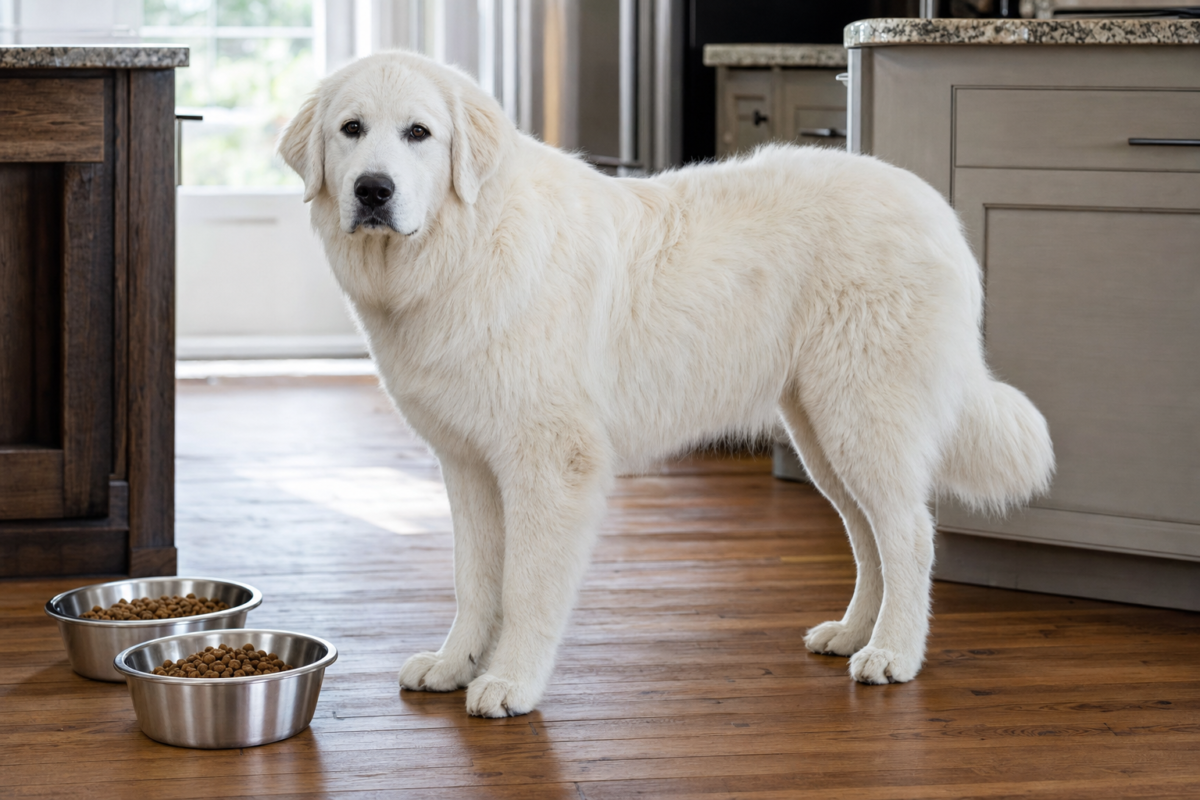
Switch a large breed puppy to adult food once growth in height has essentially finished, which for most large breeds means 12 to 18 months and for giant breeds 18 to 24 months. Go by expected adult weight rather than by the calendar: a 60 pound adult is usually ready near 12 to 14 months, while a 140 pound adult may still need puppy food at 22 months. Make the change gradually across seven to ten days.
The bag of puppy food runs low, your dog suddenly looks enormous, and you find yourself standing in the aisle wondering whether it is time. It is a genuinely important question for a big dog, because large breed puppy food is doing a specific job while the skeleton is still forming, and both leaving it too early and staying too long have real consequences. This guide gives you a clear timing table by expected adult weight, a simple transition plan, and the habits that keep a growing dog lean through the change.
When should I switch a large breed puppy to adult food?
Switch when your puppy has essentially finished growing in height, not when a birthday arrives. For most large breeds that point falls between 12 and 18 months, and for giant breeds it is usually 18 to 24 months. The reliable signal is expected adult weight: the heavier the adult, the later the switch. A dog heading for 60 pounds is generally ready near 12 to 14 months, while a dog heading for 150 pounds may still need puppy food past 22 months.
Two things make this different from feeding a smaller dog. Large breed puppy formulas are built to slow the growth curve deliberately, and they control the calcium and phosphorus that a rapidly growing big skeleton is particularly sensitive to. Pull that support early and you remove it during the exact months it was designed for. Leave it far too long and you are feeding a growth formula to a dog that has stopped growing, which usually shows up as weight gain.
Why large breed puppy food is different in the first place
A complete food formulated for large breed puppies is not simply a bigger kibble. It is a different formulation with three jobs.
First, it moderates calories, so a puppy grows steadily rather than explosively. Fast growth in a big breed is not a sign of thriving. It asks more of joints and bones that are still soft and forming.
Second, it controls calcium and phosphorus and the ratio between them. Small breed puppies handle a surplus of dietary calcium reasonably well. Large and giant breed puppies do not regulate it as effectively during their fastest growth, which is why every reputable large breed puppy formula keeps calcium inside a tighter band rather than simply adding more.
Third, it supports a longer growth period. A big dog spends far more of its early life in the growth stage than a terrier does, so the food has to carry that developing frame for eighteen months or more rather than eight.
Adult food does a different job. It maintains a finished body at a healthy weight. Both foods are correct, just for different dogs, and the switch is simply the handover between them.
Switch timing by expected adult weight
Use expected adult weight, which you can estimate from the parents, the breeder or your veterinarian. Treat this as a guide and confirm the timing at your next checkup.
| Expected adult weight | Typical switch window | Notes |
|---|---|---|
| 50 to 65 lb | 12 to 14 months | Height is usually set near 12 months |
| 65 to 80 lb | 14 to 16 months | Muscle continues to fill in afterwards |
| 80 to 100 lb | 16 to 18 months | Do not switch on the first birthday |
| 100 to 130 lb | 18 to 22 months | Giant territory, stay patient |
| 130 lb and above | 22 to 26 months | Chest and bone finish last |
The World Small Animal Veterinary Association’s Global Nutrition Committee publishes evidence-based guidance for evaluating dog food and feeding practices. Read more from the WSAVA Global Nutrition Guidelines.
If your dog sits on a boundary, favour the later date. There is very little cost to another month of a well formulated large breed puppy food, and rather more cost to removing it a month early.
When do large breed puppies stop growing?
Height comes first and substance comes later, and the switch tracks height. Most large breeds reach close to their adult height between 12 and 18 months, then spend another year adding muscle, chest and bone density. Giant breeds reach adult height closer to 18 to 24 months and keep broadening until two and a half or three years of age.
So a dog can be ready for adult food while still looking adolescent. That is normal and it is not a reason to delay. What you are waiting for is the end of skeletal growth in height, not the arrival of a finished looking adult.
Why the growth window still matters after the switch
The growth window runs roughly 8 to 30 months depending on the size of the dog, which means it usually extends past the food change. Your puppy stops eating puppy food while the body is still laying down cartilage, connective tissue and bone density. Growth plates in the largest breeds close late, so the habits that protected a six month old still matter at eighteen months. Keep the dog lean, keep impact sensible, and keep supporting the joints through the whole window rather than stopping the day the food changes.
Switching Too Early
Moving to adult food at six or eight months removes controlled calcium and calories during the fastest growth months.
Switching Too Late
A finished dog on a growth formula usually gains weight. Extra pounds load the joints you spent a year protecting.
Changing Too Fast
An overnight swap commonly upsets the digestion. Blend across seven to ten days instead.
Keeping The Same Scoop
Adult food has a different calorie density. Recalculate the portion rather than reusing the old measure.
How to make the switch, step by step
The transition itself is simple, and going slowly costs you nothing.
- Days one to three. Serve about a quarter adult food mixed with three quarters puppy food, keeping the total daily amount the same.
- Days four to six. Move to roughly half and half.
- Days seven to nine. Move to about three quarters adult food.
- Day ten. Serve adult food alone, and recheck the portion against the new label rather than assuming it matches.
- Slow down if needed. If the stool softens, hold at the current blend for a few extra days before advancing. A sensitive dog can take two full weeks and that is fine.
- Change one thing at a time. Do not run the food transition in the same week as a house move, boarding, a new puppy or a vaccination if you can avoid it.
- Drop to two meals. Most large breed puppies eat three meals a day. Adults do well on two, which suits deep chested dogs better than one large meal.
How to check body condition in ten seconds
The scale tells you weight, but body condition tells you whether the new portion is right. Check it in the first fortnight after the switch and then monthly.
- Ribs. Run your hands along the sides. You should feel the ribs easily under a thin layer. If you have to press, ease the portion back.
- Waist. Look down from above. You want a clear narrowing behind the ribs.
- Tuck. From the side, the belly should rise toward the back legs rather than hanging level.
Adjust portions gently, in small steps of about ten percent, and confirm with your veterinarian at the next visit. Most dogs need slightly fewer calories after neutering, which often falls near the same age as the food change and quietly catches people out.
Exercise while the switch happens
The months around the food change are also the months when many big dogs start doing more. Build that up gradually rather than all at once.
- Increase walk length in steps rather than jumping to long outings the week the adult food arrives.
- Keep repeated jumping, hard sprints on pavement and stair repetitions moderate until the largest breeds are past two years.
- Favour soft ground, and keep rugs on slippery floors where a big dog turns and scrambles.
- Let the dog rest fully between bursts of activity. Recovery is part of growing well.
Supporting the joints through the whole growth window
The food change is a milestone, but the frame is still finishing. Supporting healthy joint development across the entire growth window, rather than stopping when the puppy bag runs out, is one of the simplest habits a big dog parent can keep alongside lean feeding and sensible movement.
Many parents add a daily joint support chew made for large and giant breeds. MoveGuard Growth is built for exactly this stage. It combines nine actives, including 250mg of New Zealand Green Lipped Mussel, 400mg glucosamine, 300mg chondroitin, 250mg MSM and hyaluronic acid, to support the developing joints of young large breed dogs across the roughly 8 to 30 month growth window. You dose by expected adult weight, so most large breeds sit at two chews a day and the biggest at three. It ships as 90 chicken liver flavour chews, is made in the USA in an NSF registered facility, and is backed by a 60 day guarantee.
Carry The Habit Past The Switch
Support your growing dog through the whole growth window, not just the puppy food months. Explore MoveGuard Growth.
Signs the switch is going well
You are looking for a quiet, uneventful fortnight. Firm and consistent stools, a steady appetite, stable energy, a coat that stays glossy, and a body condition that holds rather than creeping upward. A slightly reduced appetite in the first few days is common as the taste changes and usually settles on its own.
If you see persistent loose stools beyond a few days, repeated vomiting, itching or a noticeable drop in energy, pause at the current blend and speak with your veterinarian. Occasionally a dog simply does better on a different adult formula, and that is worth knowing early rather than after three bags.
A simple feeding game plan, stage by stage
You do not need a complicated programme. You need the right emphasis at the right time.
8 weeks to 4 months. Large breed puppy food, three calm meals a day, and a weekly hands on body condition check. Establish the habit of measuring rather than eyeballing portions now.
4 to 8 months. The fastest growth. Keep the same food, recheck the portion every few weeks because the right amount changes quickly, and resist the urge to feed for size. This is a natural point to begin a daily joint support routine.
8 to 18 months. Height nears its peak. For most large breeds this is when the switch happens. Move to two meals, recalculate the portion on the adult label, and watch the body condition closely for the first month afterwards.
18 months and beyond. Giant breeds make the switch here rather than earlier. For everyone else this is maintenance: feed to a lean condition for life, adjust for neutering and for the seasons, and keep the joint routine going into adulthood.
Common mistakes to avoid
Most of the trouble around this change comes from a handful of avoidable habits.
- Switching on the first birthday by default. Twelve months is right for a 60 pound dog and early for a 120 pound one. Go by expected adult weight.
- Switching because the puppy looks big. Large breed puppies look adult long before the skeleton finishes. Size is not the signal.
- Adding calcium supplements at any stage. A complete formula already balances calcium and phosphorus. Ask your veterinarian before adding anything mineral based.
- Reusing the old scoop. Adult food often has a different calorie density, so the same volume is not the same meal.
- Free feeding after the switch. Leaving a full bowl down makes body condition almost impossible to manage on a big dog.
- Stopping every supportive habit at once. The growth window outlasts the puppy food. Keep the joint routine, the lean feeding and the sensible exercise going.
How to read the label like a big dog parent
Two lines on the bag tell you almost everything you need, and most people never read either.
The first is the nutritional adequacy statement, usually in small print near the feeding chart. For a puppy food you want wording that covers growth including the growth of large size dogs, typically phrased as dogs reaching 70 pounds or more as an adult. A food labelled for growth that does not carry that large size wording has not been formulated with your dog in mind. This one line separates a genuine large breed puppy food from a general one.
The second is the guaranteed analysis, where calcium is worth a glance. Large breed puppy formulas keep it in a controlled band rather than maximising it. You do not need to memorise numbers, but you do want to see the value stated rather than absent.
An all life stages food can be a reasonable choice provided it carries that large size growth wording, since those foods are formulated to the growth standard by definition. Without it, treat an all life stages label as an adult food. Your veterinarian can confirm whether a specific bag suits your individual dog, and that conversation takes two minutes at a checkup you were attending anyway.
Frequently asked questions
Can I switch a large breed puppy to adult food at 12 months?
For a dog whose expected adult weight is around 50 to 65 pounds, 12 months is usually reasonable. For a dog heading past 80 pounds it is early, and for a giant breed it is much too early. Go by expected adult weight rather than by age alone.
How long should the food transition take?
Seven to ten days is the usual plan, moving in roughly quarter steps from puppy food to adult food. A sensitive dog can take two weeks. Hold at the current blend for a few extra days if the stool softens.
What happens if I switch too early?
You remove a formula designed to moderate calories and control calcium during the fastest growth months, which can lead to quicker growth and weight gain at a stage when the skeleton is still forming. If it has already happened, speak with your veterinarian about moving back for the remainder of the growth window.
Does my dog need less food after switching to adult food?
Usually the portion changes rather than simply shrinking, because adult formulas have a different calorie density. Recalculate from the new label, then adjust in small steps based on body condition over the following month.
Should I still give joint support after the switch?
The growth window runs roughly 8 to 30 months depending on the size of the dog, so it typically continues past the food change. Many big dog parents keep a daily joint support routine going through the whole window and into adulthood. Speak with your veterinarian about your individual dog.
The bottom line
Switch your large breed puppy to adult food when growth in height finishes, which means 12 to 18 months for most large breeds and 18 to 24 months for giant ones, and let expected adult weight rather than a birthday make the call. Blend across seven to ten days, drop to two meals, recalculate the portion on the new label, and keep checking body condition with your hands. Everything else that protected your puppy through the growth window still applies afterwards.
Want the Simple Roadmap in One Place?
Grab our free Big Dog Growth Blueprint for the growth window checklist, feeding framework and joint safe exercise limits, all written for large and giant breeds.
This article is for general educational purposes only and is not veterinary advice. It is not intended to diagnose, treat, cure or prevent any disease. Always consult your veterinarian about your dog’s individual health, nutrition and supplement needs. These statements have not been evaluated by the Food and Drug Administration.
Support Big Breed Joints from Day One
Large and giant breeds carry more load through every growth stage. MoveGuard Growth supports developing joints in young big dogs (8 to 30 months); MoveGuard Adult keeps grown big dogs moving comfortably.
Leave a Reply