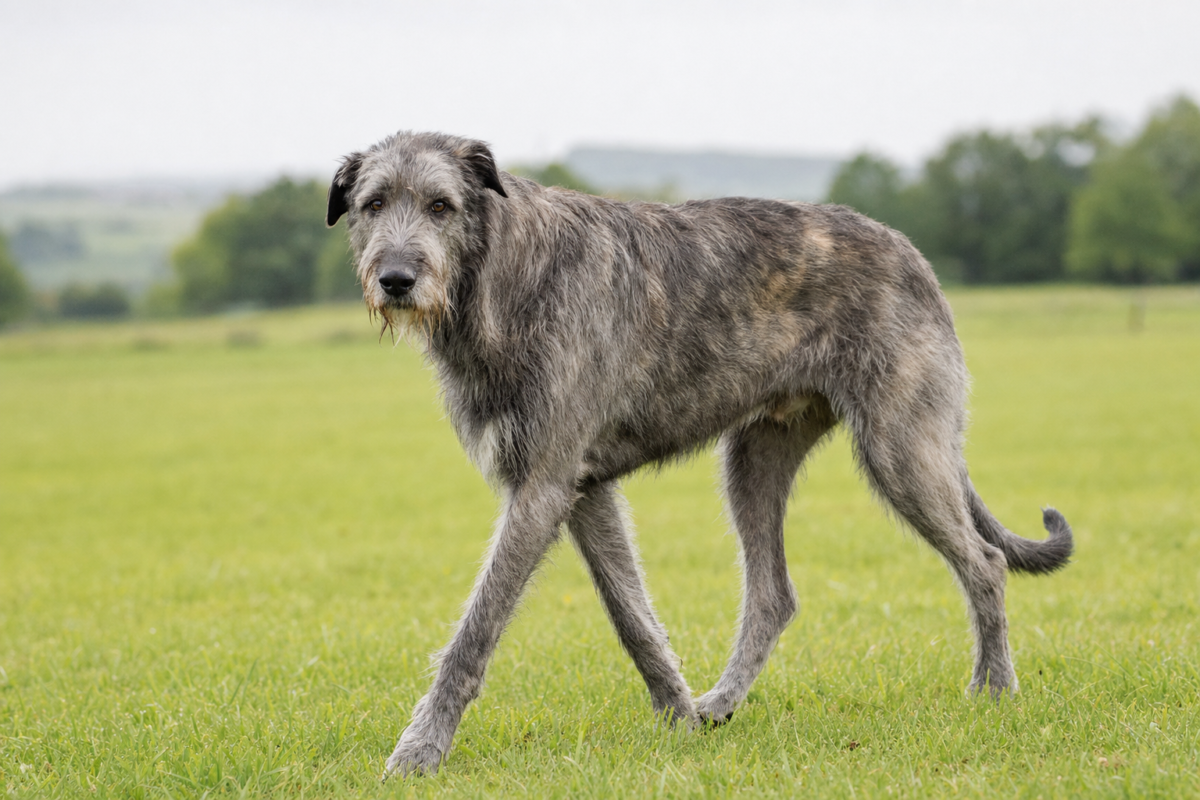
A healthy adult giant breed dog needs roughly 30 to 60 minutes of moderate activity a day, usually split into two outings rather than one long session. Giant breed puppies need far less than most people expect: a common guide is about five minutes of structured walking per month of age, twice a day, so a five month old puppy walks around 25 minutes at a time. Because giant frames finish developing at roughly 24 to 30 months, low impact activity such as steady walking, swimming and sniffing work suits them far better than long runs, repeated jumping or hard sprints.
Giant breed dogs confuse the usual exercise advice. They look like they should need enormous amounts of running, and yet most of them are quite happy to potter, sniff and then sleep for the rest of the afternoon. Give one too little and you get restlessness and stiffness. Give one too much, too young, and you ask a great deal of a frame that is still under construction. This guide sets out how much your giant breed dog actually needs at every age, what kind of movement serves that big body best, and how to read the signals that tell you when you have the balance right.
How much exercise does a giant breed dog need?
A fully grown giant breed dog needs about 30 to 60 minutes of moderate daily exercise, ideally split across two walks with some free movement and sniffing time included. That is less than an equivalent hour for a working line medium breed, because the goal for a heavy dog is regular, steady movement rather than intensity. Puppies need considerably less. The widely used guide is roughly five minutes of structured walking per month of age, given up to twice a day, which means a three month old puppy walks about 15 minutes at a time and a six month old about 30.
Those figures are a floor and a frame, not a target to beat. Free play in a garden, gentle exploring and sniffing all count toward a dog being properly exercised, and for a growing giant they are often the better half of the total. What matters most is that activity is regular, moderate in impact, and matched to the dog in front of you rather than to a number on a chart.
Why giant breeds are different from other large dogs
Every large dog carries weight through its joints, but a giant breed does it on a longer timeline. A giant puppy multiplies its birth weight enormously and keeps growing for two and a half years, which is a full year longer than many large breeds and nearly two years longer than a medium breed. Throughout that period the bone, cartilage and connective tissue that has to carry 120 to 180 pounds for a decade is still forming.
Heavy dogs also generate more force with every stride, turn and landing. A 40 pound dog jumping off a tailgate lands lightly. A 150 pound dog doing the same thing lands hard. That difference is why the exercise conversation for giant breeds is much less about duration and much more about impact, surface and repetition.
The third difference is heat. Big bodies shed heat slowly, and many giant breeds carry heavy double coats on top of that. A warm day that a small dog barely notices can be genuinely demanding for a giant, which changes when and how far you go.
Giant breed exercise by age
Use this table as a starting point and adjust to your own dog. Every figure below is structured walking, meaning lead walking or purposeful activity. Free pottering, sniffing and gentle play in a garden sit on top and do not need to be counted.
| Age | Structured walking | What it should look like |
|---|---|---|
| 8 to 12 weeks | 10 minutes, twice a day | Short exploring, soft ground, plenty of rest |
| 3 to 4 months | 15 to 20 minutes, twice a day | Lead training, new surfaces, sniffing walks |
| 5 to 6 months | 25 to 30 minutes, twice a day | Steady pace, no forced running, frequent breaks |
| 7 to 12 months | 30 to 40 minutes, twice a day | Longer sniffing walks, swimming, calm play |
| 12 to 24 months | 30 to 45 minutes, twice a day | Build gradually, keep impact low |
| Adult, 2 to 6 years | 30 to 60 minutes total | Two walks, hiking on soft ground, swimming |
| Senior, 7 years plus | 20 to 40 minutes total | Shorter and more frequent, gentle and consistent |
The American Kennel Club’s Chief Veterinary Officer, Dr. Jerry Klein, DVM, has written extensively on the slower growth and development timeline of large and giant breeds. Read more from the AKC’s guidance on caring for large-breed dogs.
Notice that the adult figure is not dramatically higher than the adolescent one. Giant breeds are not endurance athletes. Consistency across the week beats a big weekend push every time, and a dog that gets a sensible amount every day stays more comfortable than one that rests for five days and then hikes for four hours.
The growth window and why young joints set the rules
Giant breeds are typically still developing until 24 to 30 months. The growth plates at the ends of the long bones are soft areas where new bone is still being laid down, and they stay open through much of the first year and sometimes beyond in the biggest breeds. While they are open, repeated hard impact asks more of the frame than it is ready to give.
This is the single reason the puppy numbers above look so conservative. It is not that a five month old giant breed puppy cannot physically walk for an hour. It is that doing so every day, on pavement, during the fastest growth of its life, is a demand you never need to make. The same puppy will be a stronger, more comfortable adult if those months are spent on soft ground, in short sessions, with real rest in between.
Repeated Impact
Long runs, ball chasing and jumping in and out of cars concentrate force on joints that are still forming.
Hard Surfaces
Pavement and concrete give nothing back. Grass, woodland trails and sand are far kinder to a heavy frame.
The Weekend Warrior
Five quiet days then a long hike is harder on a big dog than the same total spread evenly across the week.
Heat Build Up
Heavy coats and big bodies shed heat slowly. Warm days need shade, water and shorter outings.
What actually counts as exercise
Many Dog Parents picture exercise as a brisk walk and nothing else. For a giant breed, the useful definition is much wider, and widening it is often what makes a big dog settle properly in the evening.
- Sniffing walks. A slow walk where the dog chooses the route and stops constantly is genuinely tiring. Twenty minutes of sniffing satisfies most giants more than forty minutes of marching.
- Swimming. The best low impact option there is. Water carries the weight while the muscles work, which suits heavy dogs at every age.
- Free movement. Loose pottering in a garden or a safe field, at whatever pace the dog picks, is ideal for growing puppies.
- Training and puzzle work. Ten minutes of thinking tires a dog surprisingly well and costs the joints nothing.
- Gentle hill walking. Steady uphill work on soft ground builds hindquarter muscle without impact, once the dog is mature.
Low impact activity for heavy dogs
Because impact rather than duration is the limiting factor, the best programme for a giant breed leans heavily on activity that keeps four feet moving without hard landings.
- Favour walking on grass, woodland trails, sand or snow over pavement wherever you have the choice.
- Swim where it is safe and supervised, building up gradually since swimming is more tiring than it looks.
- Use ramps rather than jumps for car boots, and keep repeated ball throwing to a minimum because the stop and turn is the hard part, not the running.
- Break a long outing into two shorter ones, which gives the same total movement with far less cumulative load.
- Warm up with five minutes of easy walking before anything more demanding, and cool down the same way.
Signs you have the balance wrong
Your dog will tell you long before a chart will. Watch for these after activity and adjust the next few days accordingly.
Signs of too much: stiffness when getting up after a rest, lagging behind on the second half of a walk, lying down mid outing, reluctance to go out the next day, or soreness that shows up the following morning rather than immediately.
Signs of too little: restlessness in the evening, pacing, destructive chewing, weight creeping up, difficulty settling, or a dog that becomes overexcited by ordinary events at the front door.
Any limping, persistent stiffness, or a sudden change in willingness to move deserves a conversation with your veterinarian rather than an adjustment to the walking schedule.
Keeping a lean body condition
Exercise and weight work together. A lean giant breed moves more comfortably at every age, and no amount of walking compensates for a dog carrying extra pounds on a big frame. Feeding a complete food formulated for large breed puppies during the growth years, and then measuring adult portions rather than eyeballing them, does more for joint comfort than an extra walk ever will.
How to check body condition in ten seconds
- Ribs. Run your hands along the sides. You should feel the ribs easily under a thin layer. If you have to press, ease back on portions.
- Waist. Look down from above. There should be a clear narrowing behind the ribs.
- Tuck. From the side, the belly should rise toward the back legs rather than running level.
Check every couple of weeks and make small adjustments with your veterinarian guiding the changes.
Supporting the joints that do all the work
Every minute of activity travels through the joints, which is why daily habits that support healthy joint development matter so much in the heaviest breeds. Sensible surfaces, a lean body, moderate impact and consistent joint support all work toward the same goal, which is a dog that moves comfortably for as many years as possible.
Alongside those habits, many giant breed parents add a daily joint chew made for large and giant breeds. MoveGuard Growth is built for the growing years. It combines nine actives, including New Zealand Green Lipped Mussel, glucosamine, chondroitin, MSM and hyaluronic acid, to support the developing joints of young large breed dogs across the roughly 8 to 30 month growth window. Dosing follows expected adult weight, so most giant breed puppies sit at three chews a day. It ships as 90 chews in a chicken liver flavour, is made in the USA in an NSF facility, and carries a 60 day guarantee. For dogs already past the growth window, MoveGuard Adult continues the same daily routine into adulthood.
Support Every Stride
Give your giant breed daily joint support built for large and giant breeds. Explore MoveGuard Growth.
A simple exercise plan, stage by stage
8 weeks to 4 months. Little and often. Two short outings a day for lead training and new experiences, plus free pottering at home on surfaces that give grip. Put runners down on slippery floors now, because indoor slipping is a bigger daily load than most walks. Rest is doing real work at this age.
4 to 8 months. The fastest growth of the whole timeline, and the stage where people most often overdo it because the puppy suddenly looks like a dog. Hold the line on short, moderate sessions. Swap distance for sniffing, add gentle swimming if you have it, and skip stairs and car jumps entirely by using a ramp.
8 to 18 months. Adolescence arrives with a lot of energy and not much judgement. Build duration slowly, keep surfaces soft, and start structured training that channels the mind. Avoid organised jumping sports until your veterinarian confirms the growth plates have closed.
18 to 30 months. The frame finishes filling out. Build toward the full adult routine of two moderate outings a day, adding hills and longer hikes on soft ground gradually rather than all at once.
Adult and beyond. Keep it consistent. As your dog ages, shorten each outing and add a third rather than dropping activity altogether, since regular gentle movement is what keeps an older giant comfortable.
Exercising the mind, not just the body
Mental work is the most underused tool available to giant breed parents. A dog that has solved problems, followed a scent trail and worked through a short training session is genuinely tired, and none of it costs the joints anything. That makes it perfect for rainy days, hot afternoons, recovery periods, and the whole growth window.
Scatter feeding in the garden, a snuffle mat, a frozen filled toy, five minutes of nose work with hidden treats, or a short obedience session all count. Many giant breeds are thoughtful, deliberate dogs that enjoy this kind of work more than repetitive fetch, and building it into the daily routine early gives you a reliable way to satisfy a big dog on days when a long walk is not the right choice.
Common exercise mistakes with giant breeds
- Treating a young giant like an adult. The body looks finished long before it is. Adolescence is the highest risk period precisely because the dog looks capable.
- Running with a puppy. Jogging alongside a bicycle or a runner asks for sustained repetitive impact at a fixed pace, which is the opposite of what a growing frame needs.
- Endless ball throwing. The sprint is fine. The hard stop, the twist and the landing are what accumulate.
- Jumping out of car boots. A ramp costs less than one veterinary visit and removes a daily high impact landing.
- Walking only on pavement. Convenient, but the hardest surface available. Vary it whenever you can.
- Exercising in the heat of the day. Big dogs overheat faster than their owners expect. Move walks to early morning and evening in summer.
- Skipping exercise entirely on bad days. Consistency matters. A ten minute sniffing walk beats nothing at all.
Frequently asked questions
How long should I walk a giant breed puppy?
A common guide is about five minutes of structured walking per month of age, up to twice a day. That means roughly 15 minutes at three months, 25 to 30 minutes at five or six months, and building slowly from there. Free pottering and sniffing at home sit on top of that and do not need counting.
Can I run with my giant breed dog?
Not while the dog is growing. Sustained running at a fixed pace concentrates repetitive impact on a frame that is still developing, and giant breeds are not finished until roughly 24 to 30 months. Ask your veterinarian to confirm maturity before starting any running programme, and build up gradually on soft ground.
Is swimming good exercise for a giant breed dog?
Swimming is one of the best options available. The water carries the body weight while the muscles work, which suits heavy dogs at every age. Build up gradually because it is more tiring than it looks, and always supervise closely near open water.
How much exercise does a senior giant breed need?
Most senior giants do well on 20 to 40 minutes total, split into shorter and more frequent outings rather than one long walk. Regular gentle movement helps an older dog stay comfortable, so the goal is consistency at a lower intensity, not stopping.
What are the signs my big dog is getting too much exercise?
Watch for stiffness after rest, lagging on the way home, lying down mid walk, reluctance to head out the next day, or soreness that appears the following morning. Any limping or persistent stiffness is a reason to speak with your veterinarian rather than simply adjusting the schedule.
The bottom line
A giant breed dog needs less exercise than its size suggests and more care in how that exercise is delivered. Aim for 30 to 60 minutes a day for a healthy adult, split into two outings, with soft surfaces, low impact activity and plenty of sniffing built in. For puppies, hold to roughly five minutes per month of age twice a day and let free movement do the rest. Keep the body lean, support the joints through the long growth window, use the mind as well as the legs, and you give that enormous frame the best chance of moving comfortably for years.
Want the Simple Roadmap in One Place?
Grab our free Big Dog Growth Blueprint for the growth window checklist, feeding framework and joint safe exercise limits, all written for large and giant breeds.
This article is for general educational purposes only and is not veterinary advice. It is not intended to diagnose, treat, cure or prevent any disease. Always consult your veterinarian about your dog’s individual health, nutrition and supplement needs. These statements have not been evaluated by the Food and Drug Administration.
Support Big Breed Joints from Day One
Large and giant breeds carry more load through every growth stage. MoveGuard Growth supports developing joints in young big dogs (8 to 30 months); MoveGuard Adult keeps grown big dogs moving comfortably.
Leave a Reply