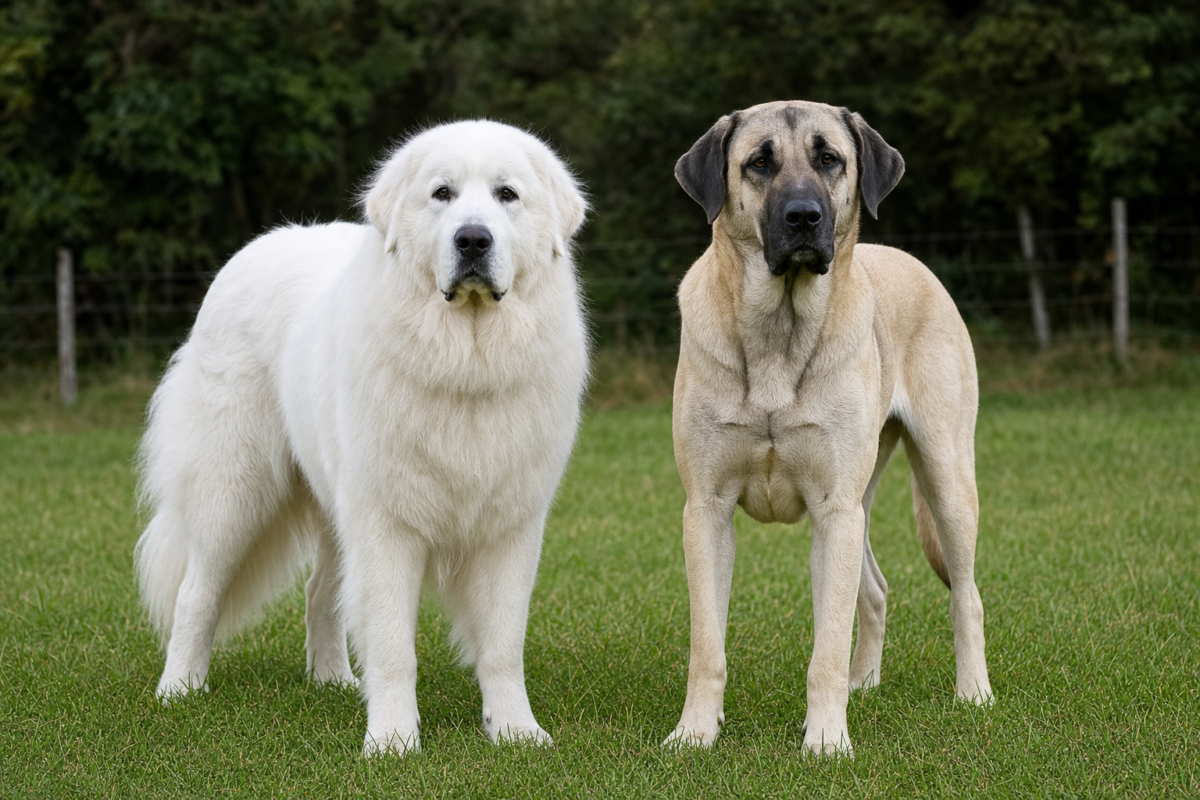
Both are giant livestock guardian breeds, but they are built and wired differently. The Great Pyrenees is heavier and softer, with a long white double coat, a calm indoor manner and a famous habit of barking at night. The Anatolian Shepherd is taller, leaner and far more athletic, with a short coat, more stamina and a more serious, territorial temperament. Males run 100 to 130 pounds for a Pyrenees and 110 to 150 pounds for an Anatolian.
These two breeds get compared constantly, usually by someone with acreage, a livestock problem or simply a love of very large dogs. They look superficially similar in a photograph and they do a similar job, yet living with one is genuinely different from living with the other. This guide lays out the size, growth, temperament and daily care differences in plain terms, so you can choose the dog that fits your home rather than the one that photographs well.
What is the difference between a Great Pyrenees and an Anatolian Shepherd?
The short version is coat, build and intensity. The Great Pyrenees is a heavy, thickly coated mountain guardian, almost always white, with a calm and rather gentle manner around its own family and a strong tendency to guard by barking. The Anatolian Shepherd is a lighter framed, longer legged guardian from the Turkish plateau, short coated and usually fawn with a black mask, bred to cover ground with flocks and to act decisively rather than to announce.
In practice that means the Pyrenees is the easier dog indoors and the harder dog for neighbours, while the Anatolian is quieter but needs more space, more secure fencing and a more experienced handler. Both are independent thinkers that were bred to make their own decisions at a distance from people, so neither is a biddable obedience breed.
Where each breed came from
The Great Pyrenees developed in the mountains between France and Spain, working alongside shepherds to protect flocks from wolves and bears at high altitude. That history explains the dense weatherproof double coat, the heavy bone, the unhurried pace and the nocturnal watchfulness. A Pyrenees was bred to sit on a slope through a cold night and make noise when something moved.
The Anatolian Shepherd comes from the plateau of central Turkey, where flocks travel long distances across hot, open country. That produced a rangier, faster dog with a short coat suited to heat, enormous stamina and a habit of patrolling a wide perimeter. The Anatolian was bred to be out with the flock, not beside a shepherd, and to handle a threat directly.
Those two jobs sound alike and are not. One dog guards a fixed place with its voice and its presence. The other covers territory and closes distance. Almost every difference in daily life traces back to that split.
Great Pyrenees vs Anatolian Shepherd, side by side
Use this as a guide rather than a rule. Individual dogs and individual lines vary, especially in working versus companion bred stock.
| Trait | Great Pyrenees | Anatolian Shepherd |
|---|---|---|
| Male height | 27 to 32 inches | 29 inches and above |
| Male weight | 100 to 130 lb | 110 to 150 lb |
| Female height | 25 to 29 inches | 27 inches and above |
| Female weight | 85 to 110 lb | 80 to 120 lb |
| Build | Heavy, broad, thickly coated | Lean, long legged, athletic |
| Coat | Long white double coat | Short to rough, often fawn with a black mask |
| Grooming | High, with heavy seasonal shedding | Moderate, with heavy seasonal shedding |
| Energy | Low to moderate, patrols slowly | Moderate, high stamina, covers ground |
| Barking | Considerable, especially at night | Moderate, acts more than announces |
| Typical lifespan | 10 to 12 years | 11 to 13 years |
The American Kennel Club’s Chief Veterinary Officer, Dr. Jerry Klein, DVM, has written extensively on the slower growth and development timeline of large and giant breeds. Read more from the AKC’s guidance on caring for large-breed dogs.
Note that the Anatolian is usually the taller and heavier dog while looking lighter, because the weight sits on a longer, leaner frame rather than under a coat. People routinely guess the opposite from photographs.
When do Great Pyrenees and Anatolian Shepherds stop growing?
Both are giant breeds and both take their time. Expect most of the adult height by around 18 to 20 months, then a further year of broadening through the chest, shoulders and head. A Great Pyrenees usually finishes filling out between two and two and a half years. An Anatolian Shepherd often takes slightly longer to look mature, with heavy males still adding substance close to three years of age.
A young dog of either breed can therefore look leggy and unfinished well past the first birthday. That is normal and it is not a reason to feed for size.
Why the growth window matters for both
As a rough guide, dogs with an expected adult weight of 100 to 130 pounds keep developing for roughly 22 to 26 months, and dogs heading past 130 pounds for 24 to 30 months. During that window the body is laying down the cartilage, bone and connective tissue that will carry a very heavy adult. Growth plates stay open through much of the first year and close later in giant breeds than in medium ones, so lean feeding and sensible exercise carry extra weight here.
Growing Too Fast
A rushed growth curve asks a great deal of developing giant joints in either breed. Steady beats impressive.
Excess Weight
The Pyrenees coat hides condition easily, so weight creeps up unnoticed. Judge by hand, not by eye.
Too Much Impact Too Young
An Anatolian will happily cover miles long before the frame is ready. Build distance gradually.
Under Occupation
A guardian with nothing to watch invents a job. Boredom shows up as fence work, roaming and noise.
Feeding a giant guardian puppy
Feeding is broadly the same for both breeds, with one practical difference: the Anatolian is usually the more active dog and may need slightly more food at the same weight, while the Pyrenees is easier to overfeed because the coat conceals the evidence.
- Choose a complete food formulated for large breed puppies, which balances calories, calcium and phosphorus for slower, steadier growth.
- Split the daily amount into three meals while young, then two meals as an adult. Deep chested dogs do better with smaller, calmer meals.
- Do not add calcium supplements. A complete large breed formula already balances the minerals a growing giant needs.
- Feed to a lean body condition rather than to the bag, and recheck the portion every few weeks through the first year.
- Confirm the daily amount with your veterinarian at each checkup, since the right portion for a giant puppy changes quickly.
How to check body condition in ten seconds
The scale tells you weight, but body condition tells you health, and on a coated breed your hands are far more honest than your eyes.
- Ribs. Run your hands along the sides, pressing gently through the coat. You should find the ribs without hunting for them.
- Waist. Look down from above, or feel for the narrowing behind the ribs on a heavily coated Pyrenees.
- Tuck. From the side, the belly should rise toward the back legs rather than hanging level.
Check every couple of weeks through the growth years and adjust portions gently with your veterinarian’s guidance.
Exercise and containment
This is where the two breeds separate most clearly in daily life. Both need secure fencing, and both are capable of deciding that the perimeter is negotiable.
- Great Pyrenees. Moderate needs. Slow patrolling, a daily walk and a place to lie where the dog can see its territory. Content with less distance than you would expect from the size.
- Anatolian Shepherd. More stamina and a real drive to cover ground. Needs space, purposeful activity and a genuinely secure boundary. An underexercised Anatolian in a small yard is an unhappy dog.
- Both, while growing. Keep long walks on pavement, repeated stairs and jumping down from vehicles moderate while the growth plates are open.
- Both, always. Fence height and depth matter. These are climbers and diggers when motivated, and a loose guardian breed is a serious problem for a neighbourhood.
Supporting the joints of a very large guardian
Both breeds spend their lives carrying heavy frames over ground, and both benefit from the same simple habits: lean weight, sensible surfaces and steady daily joint support rather than a reaction after something changes.
Many big dog parents add a daily joint support chew made for large and giant breeds. MoveGuard Growth is built for the growth years. It combines nine actives, including 250mg of New Zealand Green Lipped Mussel, 400mg glucosamine, 300mg chondroitin, 250mg MSM and hyaluronic acid, to support the developing joints of young large breed dogs across the roughly 8 to 30 month growth window. You dose by expected adult weight, so both of these breeds sit at three chews a day. Once your dog is mature, MoveGuard Adult carries the same habit forward. Both ship as 90 chicken liver flavour chews, are made in the USA in an NSF registered facility, and are backed by a 60 day guarantee.
Support A Working Frame
Give your growing guardian daily joint support built for large and giant breeds. Explore MoveGuard Growth.
Temperament and daily life compared
The Great Pyrenees is the gentler of the two with its own household. It tends to be tolerant, patient and rather serene indoors, happy to lie by a door and observe. The guarding instinct expresses itself mostly through the voice, which is why the breed has a genuine reputation for barking through the night. If you have close neighbours, take that seriously rather than assuming training will remove it.
The Anatolian Shepherd is more reserved and more serious. It bonds deeply but undemonstratively, is naturally suspicious of strangers, and is more likely to place itself between a visitor and its family than to sound off from a distance. It can be selective with unfamiliar dogs and generally wants a job, a boundary and room to work.
Both share the independent guardian mindset. Neither will work for praise the way a retriever does, and both will weigh up an instruction before complying. Training should be short, calm, food rewarded and started early, while the dog still weighs less than you do. Socialisation matters enormously for both: a guardian that has met the world before six months grows into measured watchfulness, while a sheltered one grows into suspicion of everything.
Grooming, climate and household fit
The Pyrenees carries a long white double coat that needs regular brushing, sheds heavily twice a year and fills a house with white hair for weeks at a time. It handles cold beautifully and struggles in sustained heat. Never shave that coat, since it insulates against heat as well as cold.
The Anatolian carries a short to rough coat that is far less work day to day but still sheds a surprising amount seasonally. It copes considerably better with heat and dry climates, which is exactly what it was bred for, and it needs shelter rather than pampering in the cold.
On fit, the Pyrenees suits a rural or semi rural home with tolerant neighbours, a securely fenced area and someone who accepts a large white shadow on the furniture. The Anatolian suits acreage, a working role or a genuinely committed owner with experience of independent guardian breeds. Neither is a good match for a small yard, a first time dog parent, or a household that wants an eager, obedient companion.
A simple growth game plan, stage by stage
The plan is the same for both breeds. Only the exercise volume differs.
8 weeks to 4 months. Foundation stage. Large breed puppy food, three calm meals a day, rugs on slippery floors, and heavy investment in socialisation and handling. Start teaching a calm walk immediately.
4 to 8 months. Fast growth and a leggy, unfinished look. Keep feeding lean, keep outings short and soft underfoot, and begin a daily joint support routine that carries through the whole growth window.
8 to 18 months. Height nears its peak and the guarding instinct switches on. Hold the lean body condition, keep impact moderate, and reinforce boundaries and recall now rather than later.
18 months to 3 years. The adolescent becomes a powerful adult. Growth in height slows while chest and bone continue. Build activity up as your veterinarian advises, and many parents move from Growth to Adult joint support at this point.
Common mistakes to avoid
Most trouble with either breed comes from a handful of avoidable habits.
- Choosing on appearance. These dogs look similar and live very differently. Choose on temperament, noise tolerance and the space you actually have.
- Underestimating the fencing. Both breeds expand their territory if allowed. Fence properly before the puppy arrives, not after the first escape.
- Expecting obedience breed responsiveness. Independence is the job, not a flaw. Train with that in mind and keep sessions short.
- Skipping early socialisation. A guardian breed that meets little grows into an adult that trusts little, and it will weigh over a hundred pounds.
- Overfeeding under a coat. Weight hides on a Pyrenees in particular. Use your hands every fortnight.
- Waiting for a problem before supporting joints. The growth window is the time to support developing joints, not after signs appear.
Frequently asked questions
Which is bigger, a Great Pyrenees or an Anatolian Shepherd?
The Anatolian Shepherd is usually the taller and heavier of the two, with males running 110 to 150 pounds against 100 to 130 pounds for a Great Pyrenees. The Pyrenees often looks broader because of its long double coat.
Which breed barks more?
The Great Pyrenees, clearly and by design. It guards largely through its voice and is known for barking at night. The Anatolian Shepherd is quieter but more likely to move toward a perceived threat.
Are Great Pyrenees or Anatolian Shepherds easier for a first time owner?
Neither is an easy first dog, but the Great Pyrenees is generally the softer and more forgiving of the two indoors. Both are independent guardian breeds that need early socialisation, secure fencing and an owner who accepts independent thinking.
At what age are these breeds full grown?
Both reach most of their adult height by around 18 to 20 months, then keep broadening through the chest and shoulders. A Great Pyrenees usually finishes near two to two and a half years and an Anatolian Shepherd closer to three.
Do both breeds need joint support?
Both carry heavy frames and place real demand on their joints, so steady growth, a lean body condition, sensible surfaces and daily joint support through the growth window are all sensible ways to support long term comfort. Speak with your veterinarian about your individual dog.
The bottom line
Choose the Great Pyrenees if you want a calmer, gentler giant for a rural home and you can live with a serious coat and a serious voice. Choose the Anatolian Shepherd if you have land, experience and a genuine job for a fast, independent guardian that acts rather than announces. Raise either one lean and unhurried, socialise early, fence properly, and support the frame through a growth window that runs well past the first birthday.
Want the Simple Roadmap in One Place?
Grab our free Big Dog Growth Blueprint for the growth window checklist, feeding framework and joint safe exercise limits, all written for large and giant breeds.
This article is for general educational purposes only and is not veterinary advice. It is not intended to diagnose, treat, cure or prevent any disease. Always consult your veterinarian about your dog’s individual health, nutrition and supplement needs. These statements have not been evaluated by the Food and Drug Administration.
Support Big Breed Joints from Day One
Large and giant breeds carry more load through every growth stage. MoveGuard Growth supports developing joints in young big dogs (8 to 30 months); MoveGuard Adult keeps grown big dogs moving comfortably.
Leave a Reply