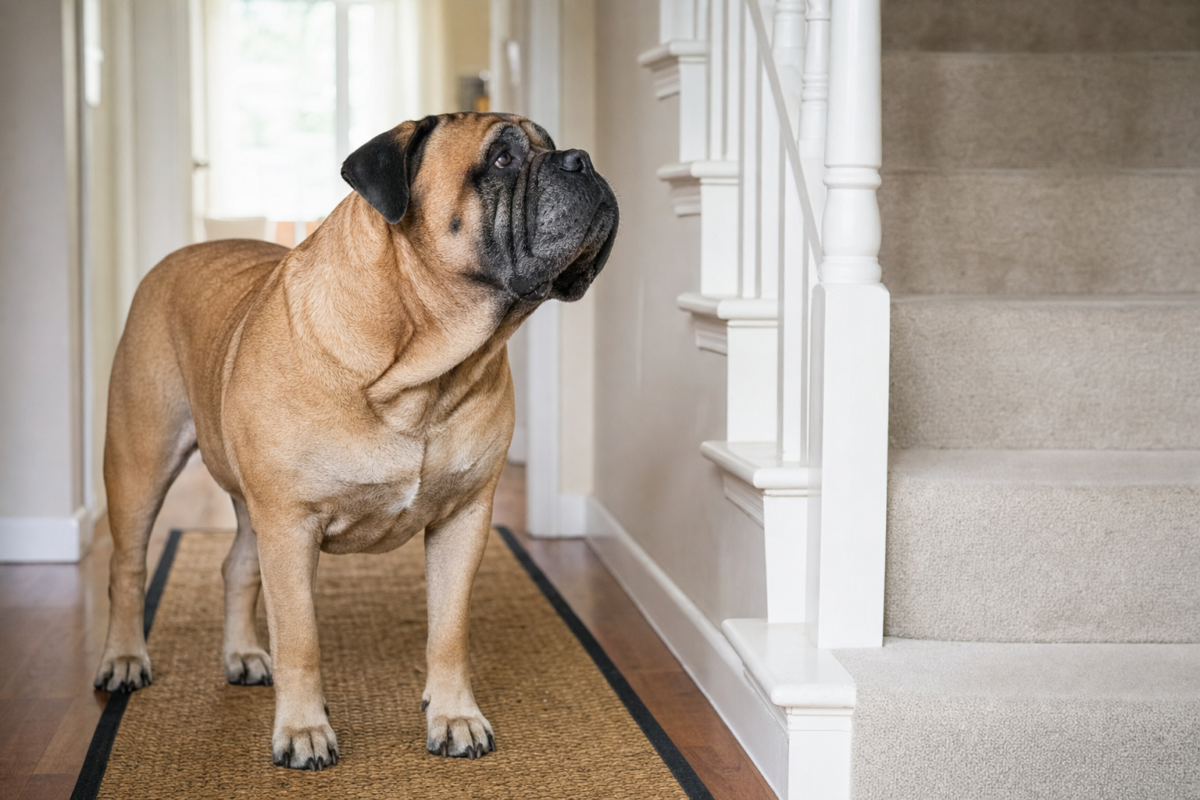
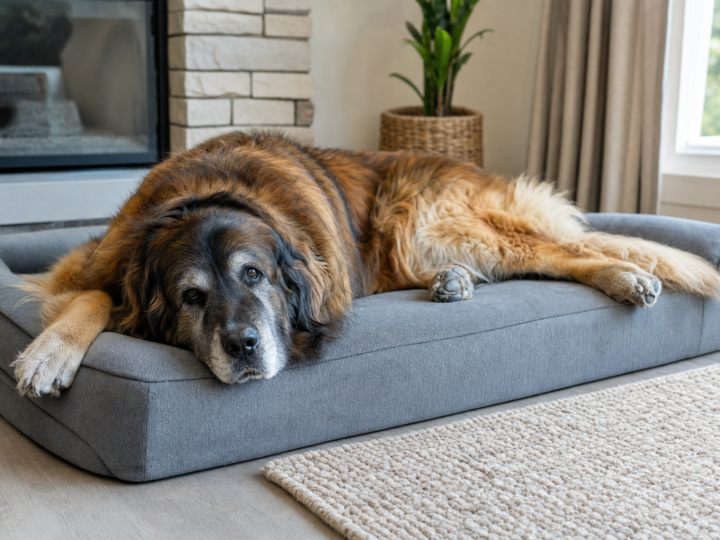
The earliest signs a big dog is slowing down with age are usually about hesitation rather than pain: a pause before the stairs, a slower rise from the floor, shorter interest in walks, more sleep, stiffness in the first few minutes after rest, and a preference for soft ground over hard. Large breeds often show these changes from around 6 or 7 years old, and giant breeds a year or two earlier. Most are normal ageing, but any change that appears suddenly is worth a veterinary conversation.
Nobody wants to be the first to notice. One day your big dog takes the back steps a beat slower, or waits at the bottom of the stairs while you go up, and you tell yourself it was a lazy afternoon. Large breeds age earlier than smaller dogs and they are famously good at hiding discomfort, so the early signals are quiet ones. This guide walks through what those signals actually look like, which ones are ordinary ageing and which deserve a call to your veterinarian, and the daily habits that help a big dog stay comfortable and confident for longer.
What are the signs my big dog is slowing down with age?
The most common signs are a slower or more effortful rise from lying down, hesitation before stairs, jumps or the car, shorter walks or a wish to turn back early, stiffness for the first few minutes after a nap, more sleeping overall, a shift toward carpet and grass and away from tile or wood, and less interest in rough play. Muscle over the hips and back legs often softens, and some dogs become quieter or less patient with handling.
Individually, none of these is alarming. Together, and appearing over weeks rather than overnight, they usually mean your dog has entered the stage where comfort deserves more of your attention than distance or intensity does.
Why large breeds age earlier than smaller dogs
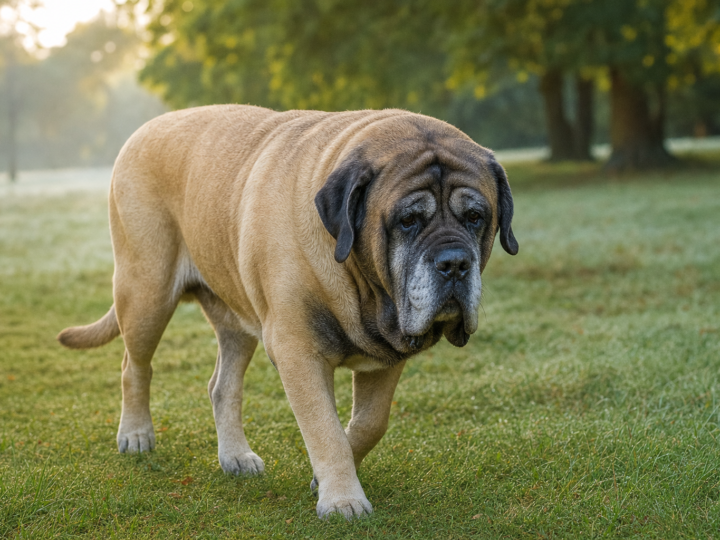
A 20 pound terrier is often still bouncing at 10 years old. A 130 pound mastiff at the same age is deep into a different chapter. Body size and lifespan run in opposite directions in dogs, and the bigger the frame the earlier the calendar turns.
Part of it is simple mechanics. A big dog carries more weight through the same set of joints on every stride, every stair and every turn, which means a lifetime of loading arrives sooner. Part of it is growth: large and giant breeds spend far longer building bone and cartilage, and they finish that job under more load than a small dog ever experiences. And part of it is biology that nobody has fully explained, which is why a Great Dane is often considered senior at five while a spaniel is not until nine.
The practical takeaway is that you should start watching earlier than you might expect, and that noticing early is genuinely useful rather than merely worrying.
When large breeds typically start to slow, by adult weight
Use this as a rough map of when to start paying closer attention, not as a countdown. Individual dogs vary a great deal, and a lean, well conditioned dog often tracks a year or more behind the row it sits in.
| Adult weight | Often considered senior from | Typical life expectancy | What usually changes first |
|---|---|---|---|
| 50 to 70 lb | 7 to 8 years | 10 to 13 years | Shorter walks, slower recovery |
| 70 to 90 lb | 6 to 7 years | 10 to 12 years | Stiffness after rest |
| 90 to 110 lb | 6 years | 9 to 11 years | Hesitation at stairs |
| 110 to 140 lb | 5 to 6 years | 8 to 10 years | Slower rise from the floor |
| 140 lb and above | 5 years | 6 to 10 years | Traction and footing worries |
The American Veterinary Medical Association notes that larger breeds are generally considered senior earlier than small breeds, given their shorter typical lifespans. Read more from the AVMA’s guidance on caring for senior pets.
The signs, one by one
Here is what to actually look for, roughly in the order most Dog Parents notice them.
- A slower rise. Watch how your dog gets up from a lie down. A slight gather of the back legs, a pause halfway, or a push off with the front end doing extra work are all early markers. This is often the very first sign, and it is easy to miss because it takes two seconds.
- Hesitation at thresholds. Stairs, the car boot, the step into the garden, the slippery hallway. A dog that used to move without thinking now pauses, gathers, and commits. The pause is the sign.
- Stiffness that fades. Movement that looks tight for the first minute or two after a nap and then loosens as the dog warms up. Cold mornings and damp weather usually make it more obvious.
- Shorter range. The walk that used to be forty minutes is now thirty, or your dog turns for home at the same corner every time. Enthusiasm at the door with fatigue at the far end is a classic pattern.
- More sleep, deeper sleep. Senior big dogs sleep more and are harder to rouse. Some of that is hearing, some of it is genuine tiredness.
- Surface preference. A dog that starts choosing rugs, grass and carpet over tile, laminate and wood is telling you that footing has become something to think about.
- Muscle change. Run your hands over the hips and thighs. Softening or unevenness there, especially compared with the shoulders, is worth noting and mentioning at the next visit.
- Posture shifts. Sitting slightly to one side, standing with the back legs closer together, or lying down in stages rather than one movement.
- Less rough play. The dog still wants the greeting and the ball, but opts out of the wrestling and the sharp turns.
- Quieter mood or shorter patience. Some big dogs become more withdrawn, some become less tolerant of being nudged, groomed or climbed on by children. Both can be comfort related rather than personality.
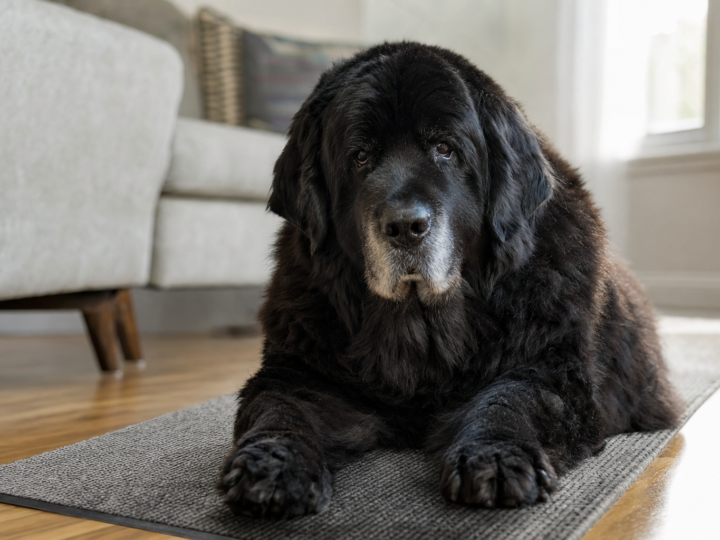
- Grey around the muzzle and eyes. The most visible sign and the least informative one. Greying tells you about age, not about comfort.
Slippery Floors
Hard smooth flooring is the single biggest daily obstacle for an ageing big dog. Runners and rugs change more than most products do.
Extra Weight
Every additional pound travels through joints that have already done years of work. Lean is the kindest thing you can be.
Weekend Warrior Days
Quiet all week then a long hike on Sunday asks more of an older frame than steady daily movement does.
Waiting To Act
Big dogs mask discomfort well. By the time a change is obvious it has usually been building for a while.
Feeding an older big dog
Weight management does more for an ageing large breed than almost anything else you can buy, because it is the one variable that changes load on every single step.
- Recalculate the portion. Older, quieter dogs typically need fewer calories than they did at four, and a portion set years ago is a common reason for slow weight gain. Check the number against how much to feed an adult large dog and confirm with your veterinarian.
- Keep two meals a day rather than one, which suits a deep chested dog and keeps energy even.
- Count the extras. Treats, chews and table food should stay under 10 percent of daily calories.
- Raise the bowl only if your veterinarian recommends it for your individual dog, since raised feeding is not right for every big breed.
- Keep water easy to reach on a surface with grip, because a dog that has to brace on tile to drink will drink less.
How to check body condition in ten seconds
The number on the scale moves slowly. Body condition tells you where you stand today.
- Ribs. Run your hands flat along the sides. You should feel the ribs easily under a thin layer. If you have to press, ease the portion back by about 10 percent.
- Waist. From above, look for a clear waist behind the ribs rather than a straight line from chest to hip.
- Tuck. From the side, the belly should rise toward the back legs instead of hanging level.
Check monthly with an older dog, and adjust in small steps with your veterinarian’s guidance. On a coated breed, use your hands rather than your eyes, because a thick coat hides a great deal.
Exercise that suits a slowing big dog
The instinct when a dog slows is to do less. The better answer is usually to do the same amount, differently. Muscle protects joints, and muscle that goes unused disappears quickly in an older large breed.
- Trade one long outing for two or three shorter ones spread across the day.
- Favour soft, even ground. Grass and forest trails are kinder than pavement, and pavement is kinder than a slippery floor.
- Keep it steady. Consistent daily movement builds condition; sudden bursts after quiet days do not.
- Warm up. Let the first few minutes be a slow amble rather than a fast start, particularly on cold mornings.
- Swap some physical work for mental work. Scent games, food puzzles and gentle training satisfy an older dog without loading the frame. There is more on this in our guide to helping your senior big dog stay active.
- Watch the day after. If your dog is stiffer the following morning, the outing was slightly too much. Adjust down and rebuild slowly.
Daily habits that support comfortable movement
Small environmental changes tend to matter more than dramatic ones for an ageing big dog. Runners across slippery hallways, a ramp instead of a jump into the car, a supportive bed away from draughts, nails kept short so the feet grip properly, and a warm room in winter all add up.
Alongside those habits, many big dog parents add a daily joint support chew built for larger breeds. MoveGuard Adult is made for adult dogs from 25 to 75 pounds and combines clinically studied eggshell membrane and New Zealand Green Lipped Mussel with glucosamine, chondroitin, MSM and hyaluronic acid to support cartilage, connective tissue and comfortable movement as dogs age. The daily amount is printed on the label and tiered by weight, at one chew for dogs from 25 to 50 pounds and two for dogs from 50 to 75 pounds and up, with the label advising senior dogs of seven and older to use the higher amount for their weight and to allow six to eight weeks. It ships as 60 soft chews in chicken liver flavour, is made in the USA in an NSF facility, and is backed by a 60 day guarantee.
Support The Years Ahead
Give your ageing big dog daily joint support built for larger breeds. Explore MoveGuard Adult.
Which signs need a veterinarian rather than a wait and see
Gradual change over months is usually ageing. Sudden change is information, and it deserves a professional look rather than a watchful week at home. Book a visit promptly if you notice any of the following.
- Limping that appears suddenly, or any lameness that lasts more than a day or two.
- Reluctance to put weight on one leg, or a change that affects one side only.
- A yelp, a flinch on touch, or panting at rest.
- Weight loss or gain that you did not intend, or a clear change in appetite or thirst.
- Trouble getting up at all, wobbling, dragging a foot, or scuffed nails on one side.
- Confusion, pacing at night, staring at walls, or getting stuck in corners.
- Any change that arrives over days rather than months.
Twice yearly checkups are the standard advice for senior large breeds, and they are worth keeping even in a year when nothing seems wrong. Ageing and treatable conditions look similar from the outside, and only your veterinarian can tell them apart.
A simple comfort game plan, stage by stage
You do not need to change everything at once. Emphasis shifts as the years pass.
The watching years, roughly 5 to 7. Nothing looks different yet, which makes this the best time to build habits. Keep your dog lean, put runners down before they are needed, start a daily joint support routine, and take a short video of your dog rising and walking so you have a baseline to compare against later.
The first signs, roughly 7 to 9. Stiffness after rest and hesitation at stairs appear. Split walks into shorter outings, add traction and a ramp for the car, move to twice yearly checkups, and recalculate the food portion downward if activity has dropped.
The adjusting years, roughly 9 to 11. Range shortens and sleep increases. Bring the routine to the dog: feeding, water and bed all on grippy surfaces and on one level where possible. Keep gentle daily movement going, because this is the stage where muscle disappears fastest. Mental work carries more of the load.
The comfort years, 11 and beyond. Priorities narrow to warmth, grip, easy access, gentle handling and dignity. Short, frequent, familiar walks. Groom and check feet often. Keep your veterinarian closely involved and revisit the plan every few months rather than every year.
Common mistakes with an ageing big dog
Most of what goes wrong here comes from good intentions rather than neglect.
- Assuming everything is just age. Limping, sudden change and one sided problems are not ageing. They are findings, and they need a veterinarian.
- Stopping exercise entirely. Rest feels kind and costs muscle. Less intensity, same consistency, is the better trade.
- Letting weight creep. A quieter dog on the same portion gains slowly and invisibly, and that gain lands on the joints you are trying to protect.
- Ignoring the floor. Dog Parents will buy a bed and a supplement and leave the slippery hallway that their dog crosses thirty times a day.
- Waiting for a bad day. The habits that support comfortable movement work best when they start before the signs, not after them.
- Changing five things at once. Change one thing at a time and give it a few weeks, or you will never know what helped.
What does not change as your big dog ages
It is easy to read a list like this and feel that something is ending. In practice most big dogs move into their senior years with their character entirely intact. The greeting at the door is the same greeting. The opinion about the postman is unchanged. The lean against your leg, the sigh at your feet, the absolute conviction that a 140 pound dog belongs on the sofa: all still there.
What changes is the pace, not the dog. Older large breeds often become easier company, more settled, more attentive and more content to simply be near you. Many Dog Parents describe these years as their favourite ones, once they have adjusted the routine to fit the dog rather than expecting the dog to fit the routine.
So take the signs seriously without taking them sadly. Noticing early is what buys comfort later, and a big dog whose home has been adjusted around him tends to carry on doing the things he loves for a good deal longer than anyone expected.
Frequently asked questions
At what age is a large breed dog considered senior?
Most large breeds are considered senior between 6 and 8 years old, and giant breeds from around 5. The bigger the adult weight, the earlier the stage begins, which is why a Great Dane may be senior at five while a 60 pound dog is not until seven or eight.
Is it normal for an older big dog to sleep more?
Yes. More sleep and deeper sleep are among the most common and least concerning signs of ageing in large breeds. What is worth raising with your veterinarian is sleep that changes suddenly, restlessness at night, or a dog who becomes hard to wake alongside other new changes.
How do I tell ageing apart from something that needs a vet?
Look at speed and symmetry. Ageing is gradual, affects both sides, and comes and goes with warmth and movement. A problem that needs attention tends to appear over days, affect one side, involve limping or a yelp, or come with changes in appetite, thirst or behaviour.
Should I still walk my dog if he seems stiff?
In most cases yes, but shorter and more often. Muscle supports joints and it fades quickly in an inactive older dog. Favour soft ground, start slowly to let him warm up, and use the following morning as your guide to whether the outing was the right length. Confirm the plan with your veterinarian.
What can I do at home to keep my senior big dog comfortable?
Keep him lean, put runners on slippery floors, use a ramp instead of a jump into the car, provide a supportive bed away from draughts, keep nails short so his feet grip, keep daily movement gentle and consistent, and support the routine with daily joint support made for larger breeds.
The bottom line
Your big dog will tell you he is slowing down long before it becomes obvious, and he will do it quietly: a pause at the stairs, a slower rise, a shorter walk, a preference for the rug. Large breeds reach that stage from around 6 or 7 years old and giant breeds sooner, so watch earlier than feels necessary. Keep him lean, keep him moving gently and consistently, fix the floors, support the joints daily, and get anything sudden looked at properly. Do those things and the slowing becomes what it should be, which is a change of pace rather than a loss.
Want the simple roadmap in one place? Grab our free Big Dog Mobility Guide for the daily comfort checklist, feeding framework and low impact movement limits, all written for large and giant breeds.
This article is for general educational purposes only and is not veterinary advice. It is not intended to diagnose, treat, cure or prevent any disease. Always consult your veterinarian about your dog’s individual health, nutrition and supplement needs. These statements have not been evaluated by the Food and Drug Administration.
Support Big Breed Joints from Day One
Large and giant breeds carry more load through every growth stage. MoveGuard Growth supports developing joints in young big dogs (8 to 30 months); MoveGuard Adult keeps grown big dogs moving comfortably.
Leave a Reply