
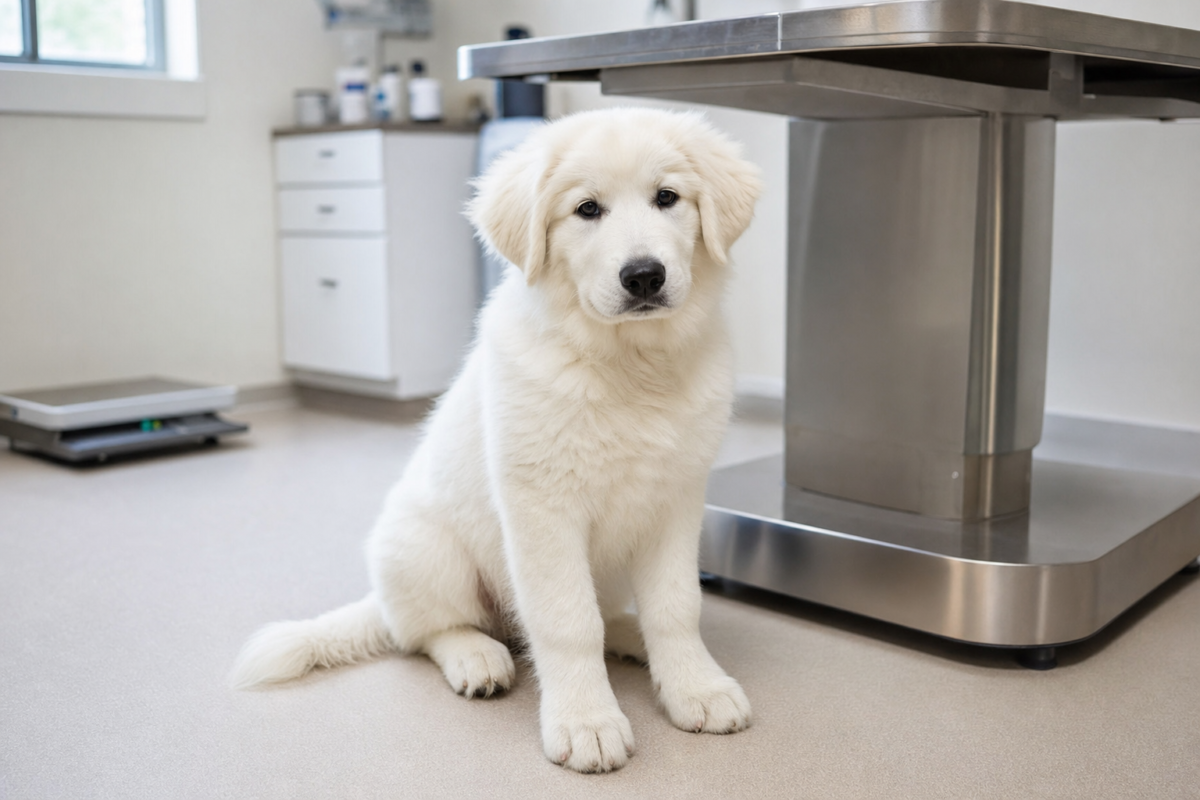
A large breed puppy usually sees the veterinarian at 6 to 8 weeks, then every three to four weeks until about 16 weeks for the core vaccine series, with rabies typically given between 12 and 16 weeks. After that most puppies go back at around 6 months to discuss desexing timing, and at 12 months for the first adult wellness visit. Large and giant breeds often add one or two extra growth checks between 4 and 12 months, because weight, body condition and joint development need watching more closely on a fast growing frame.
Bringing home a big puppy comes with a stack of paperwork and a vague sense that you are supposed to be at the vet a lot in the first year. You are, and it is worth it. The visits in that first twelve months are not just about vaccines. They are the checkpoints where someone with a trained eye watches your puppy grow, tells you whether the growth curve looks sensible, and adjusts food before a small problem becomes a big one. Here is the schedule, what happens at each stop, and the questions that matter most when the puppy in the room is going to weigh a hundred pounds.
What is the vet visit schedule for a large breed puppy?
Most large breed puppies follow this pattern: a first visit at 6 to 8 weeks, boosters roughly every three to four weeks until about 16 weeks of age, rabies between 12 and 16 weeks depending on local law, a growth and desexing conversation around 6 months, and a first adult wellness visit at 12 months. Giant breeds often add checks at 4 and 9 months because they are still growing when smaller dogs have finished.
Your own clinic may space things slightly differently based on where you live, what your puppy has already had from the breeder or rescue, and which diseases are common in your area. Treat the schedule below as the shape of the year, then let your veterinarian set the exact dates.
The first year, visit by visit
Print this, stick it on the fridge, and book the next appointment before you leave the current one.
| Age | Visit | Usually covers |
|---|---|---|
| 6 to 8 weeks | First puppy exam | Full physical, first core vaccine, deworming, faecal test, weight baseline |
| 10 to 12 weeks | Second booster | Core booster, parasite prevention, weight check, first food review |
| 12 to 16 weeks | Rabies and third booster | Rabies as local law requires, core booster, microchip if not done |
| 16 to 20 weeks | Final puppy booster | Last core dose, lifestyle vaccines discussed, growth check |
| 4 to 5 months | Growth check | Weight, body condition, teeth, food amount for the next stage |
| 6 months | Desexing conversation | Timing options, heartworm test if due, growth plate discussion |
| 9 months | Optional giant breed check | Weight curve, joints, exercise plan as activity increases |
| 12 months | First adult wellness visit | Full exam, food transition timing, adult vaccine plan |
What actually happens at each stage
6 to 16 weeks: the vaccine window. This block is about building protection while your puppy is most vulnerable. Expect a physical exam every time, a core vaccine roughly every three to four weeks, deworming, and a faecal sample request. Every visit also produces a weight, and those early weights become the line your veterinarian later compares against.
4 to 6 months: the growth window. The vaccines are largely done and the focus shifts to how your puppy is growing. This is when a good veterinarian starts looking hard at body condition, teeth as the adult set comes in, and whether portion sizes have quietly outpaced need. It is also when the desexing conversation starts, and for a big dog that conversation deserves proper time.
6 to 12 months: the adolescent stretch. Many owners drift here because nothing is due. Large and giant breeds are still building frame through this whole period, so a check at 9 months is genuinely useful even when no needle is involved. Bring your weight log and your questions about exercise.
The desexing timing question
For large and giant breeds, the timing of spaying or neutering is a real discussion rather than a formality. Sex hormones play a part in when growth plates close, so many veterinarians now talk with big dog parents about waiting longer than the traditional six months, often into the 12 to 18 month range for the largest breeds. There are health, behaviour and household factors on both sides. Ask early, ask for the reasoning, and make the decision with your own veterinarian rather than from a forum.
Skipping The Growth Checks
Vaccines end at 16 weeks but growth does not. The visits with no needle are the ones that catch a curve going too fast.
No Weight Log
Without numbers between visits, a veterinarian is judging your puppy on one day. Weigh monthly and bring the list.
Guessing At Portions
Big puppies outgrow their food amount fast. Confirm the daily amount at every single visit.
A Fearful Clinic Dog
An anxious hundred pound adult is hard to examine. Make early visits short, happy and full of treats.
Food questions worth asking at every visit
Feeding is the single biggest lever you control in year one, and it changes faster than anything else on a big puppy. Bring these to each appointment:
- Is this still the right complete food formulated for large breed puppies for us, given the growth so far?
- How many cups a day, split across how many meals, until the next visit?
- Does the body condition look lean enough, or should we ease back?
- When should we move to adult food, and how gradually?
- Are treats and chews pushing us over the daily calorie total?
How to check body condition in ten seconds
The scale tells you weight. Body condition tells you what that weight means. Check it at home every couple of weeks.
- Ribs. Run your hands along the sides. You should feel the ribs easily under a thin layer. If you have to press, ease back on food.
- Waist. Look down from above. You want a clear waist that tucks in behind the ribs.
- Tuck. From the side, the belly should rise toward the back legs rather than hanging level.
Exercise questions for a growing frame
Large breed puppies need activity, and they need it shaped around a skeleton that is still forming. Ask your veterinarian how much is sensible for your puppy at each stage, and use the visit to sanity check what you are already doing.
- How long should walks be at this age, and on what surfaces?
- Are stairs, long runs and repeated jumping reasonable yet?
- When can we start structured activities such as agility or long hikes?
- Is there anything in how my puppy moves that you would want to see again?
Building a joint support routine during growth
The first two years are when your puppy lays down the cartilage, bone and connective tissue that carry a heavy frame for the rest of its life. Alongside lean feeding and sensible activity, many big dog parents start a daily joint support chew during the growth window and mention it at a routine visit.
MoveGuard Growth is built for exactly this stage. It combines nine actives, including New Zealand Green Lipped Mussel, glucosamine, chondroitin, MSM and hyaluronic acid, to support the developing joints of young large breed dogs across the roughly 8 to 30 month growth window. You dose by expected adult weight, so a puppy heading for 50 to 80 pounds takes two chews a day and one heading for 80 to 100 pounds or more takes three. It ships as 90 chews, is made in the USA in an NSF facility, and is backed by a 60 day guarantee.
Support A Growing Frame
Give your growing big puppy daily joint support built for large and giant breeds. Explore MoveGuard Growth.
What to bring to every appointment
A prepared owner gets far more out of fifteen minutes. Keep a folder or a note on your phone with:
- The vaccine record from your breeder or rescue, including dates and product names.
- Your monthly weight log, with the date next to each number.
- The exact food brand, formula and current daily amount.
- A fresh faecal sample when the clinic has asked for one.
- A short list of your questions, written before you walk in.
- Any phone video of something odd you noticed and cannot reproduce on demand.
Take treats too. A big puppy who learns that the clinic means chicken becomes an adult you can actually examine, and that pays back for a decade.
What to track between visits
Most of the useful information about a growing puppy is collected at home, not in the exam room.
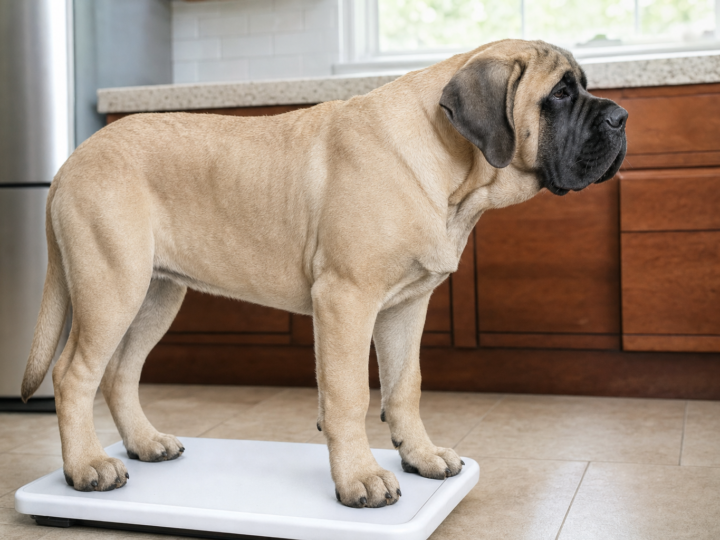
Weigh monthly. Same day each month, same scale. Many clinics let you use the lobby scale for free, which is also a friendly no needle trip.
Photograph from above and from the side. Two pictures a month, same angles, make changes in body condition obvious in a way that living with your dog daily never does.
Note the appetite and the output. A puppy who suddenly goes off food, or whose stools change for more than a day or two, is worth a call.
Watch how your puppy moves. Limping, stiffness after a nap, or a reluctance to use one leg all deserve a call rather than a wait for the next booster.
When to call before the next scheduled visit
The schedule is a plan, not a rule. Call your clinic sooner if you see repeated vomiting or diarrhoea, a puppy who will not eat or drink, lethargy that does not lift, limping that lasts more than a day, laboured breathing, a swollen or painful belly, or any sudden change in behaviour. Young puppies can go downhill quickly, and clinics would far rather hear from you early. Keep the emergency number saved in your phone alongside the clinic number before you need it.
Common mistakes to avoid
- Stopping after the last booster. Sixteen weeks is the end of the vaccine series, not the end of the growth checks.
- Booking on the day. Book the next appointment before you leave. Slots for a Saturday morning fill weeks ahead.
- Guessing the food amount. Portions that were right eight weeks ago rarely still are.
- Socialising nowhere. Ask your veterinarian what is safe before the series finishes rather than keeping your puppy home entirely.
- Only visiting for procedures. A few happy weigh in visits change how your big dog feels about the building.
Making the clinic a place your big dog likes
This matters more for large breeds than almost any other group, for the simple reason that a frightened giant is genuinely difficult to handle. A nervous small dog can be scooped up. A hundred and thirty pound dog who does not want to walk through the door decides the outcome, and the exam that gets skipped is sometimes the one that mattered.
The fix is easy and it starts now. Drop in for thirty seconds, let your puppy stand on the scale, hand over a treat, and leave. Do it every few weeks through the first year. At home, practise the handling a veterinarian actually needs: touching paws and toes, looking in ears, lifting lips to see teeth, running hands down each leg. Keep it short and pair it with something good. By the time your dog is fully grown, an exam is just a normal Tuesday rather than a wrestling match, and that is a gift to your veterinarian as much as to your dog.
Frequently asked questions
How many vet visits does a large breed puppy need in the first year?
Most large breed puppies have around five to eight visits in the first year: three or four for the core vaccine series between 6 and 16 weeks, one or two growth checks between 4 and 9 months, and a first adult wellness visit at 12 months. Giant breeds often add one extra growth check.
When does a large breed puppy finish the core vaccine series?
The core series usually finishes at about 16 weeks of age, with some clinics giving a final dose closer to 18 or 20 weeks. Rabies is typically given between 12 and 16 weeks depending on local law. Your veterinarian sets the exact dates based on what your puppy has already had.
Should I wait longer to spay or neuter a large breed dog?
Many veterinarians now discuss later desexing for large and giant breeds, sometimes into the 12 to 18 month range, because sex hormones influence when growth plates close. There are arguments on both sides and they depend on your dog and your household, so raise it at the 6 month visit and decide together.
How often should I weigh my large breed puppy at home?
Once a month is plenty, on the same scale and around the same date. Bring the log to every appointment. A steady, even curve matters far more than any single number, and a written record makes a fast growth spurt easy to spot.
Do I need extra vet visits just because my puppy is a giant breed?
Not extra vaccines, but often one or two extra growth checks. Giant breeds keep developing well past the age when smaller dogs have finished, so checks at around 9 and 12 months give your veterinarian a chance to review weight, body condition and joints while the frame is still forming.
The bottom line
The first year with a big puppy runs on a simple rhythm: the vaccine series from 6 to 16 weeks, a growth check around 4 to 5 months, the desexing conversation at 6 months, an optional giant breed check at 9 months, and the first adult wellness visit at 12 months. Book the next appointment before you leave the last one, weigh at home every month, bring your questions written down, and keep the visits happy so your fully grown dog still walks through the door willingly. That rhythm is how a big puppy becomes a sound, comfortable adult.
Want the simple roadmap in one place? Grab our free Big Dog Growth Guide for the growth window checklist, feeding framework and joint safe exercise limits, all written for large and giant breeds.
This article is for general educational purposes only and is not veterinary advice. It is not intended to diagnose, treat, cure or prevent any disease. Always consult your veterinarian about your dog’s individual health, nutrition and supplement needs. These statements have not been evaluated by the Food and Drug Administration.
Support Big Breed Joints from Day One
Large and giant breeds carry more load through every growth stage. MoveGuard Growth supports developing joints in young big dogs (8 to 30 months); MoveGuard Adult keeps grown big dogs moving comfortably.
Leave a Reply