
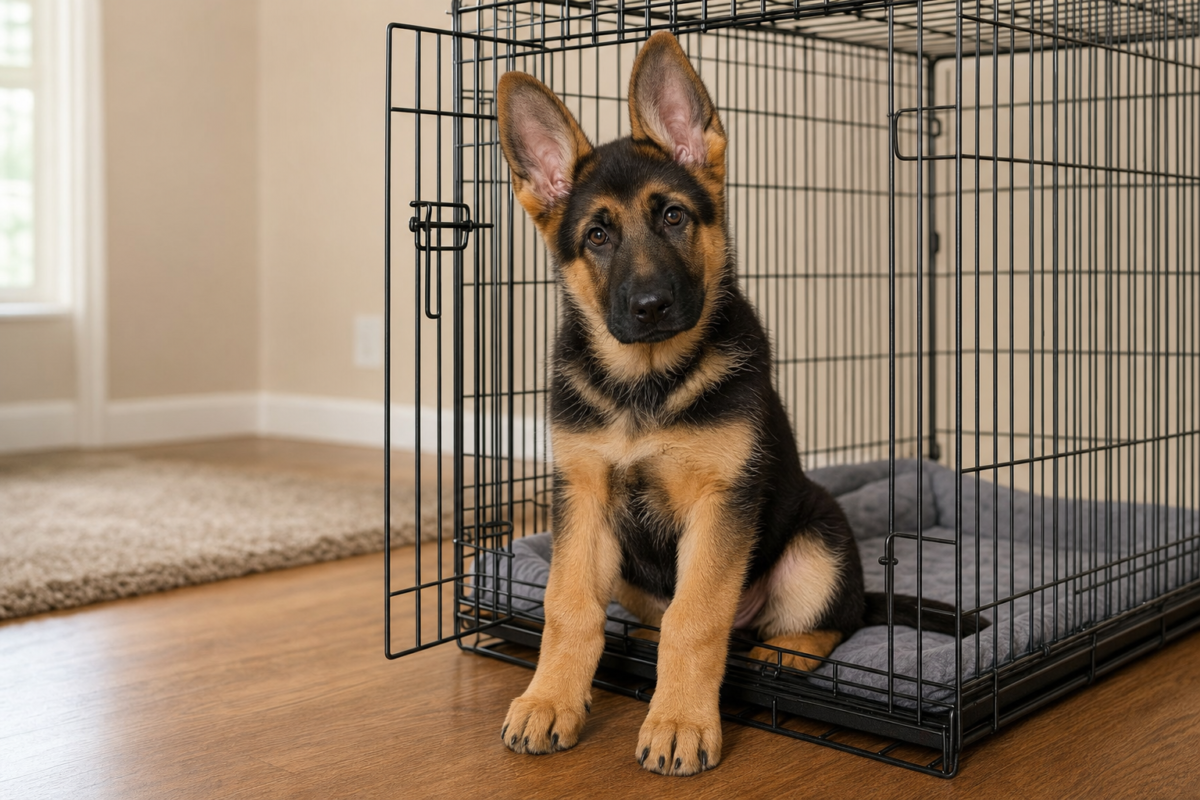
Buy the crate that fits your puppy as a fully grown adult, then use the divider panel to shrink it while they are small. Most large breeds need a 42 inch crate, dogs finishing around 90 to 110 pounds need 48 inches, and giant breeds over 110 pounds need 54 inches. The crate is the right size when your dog can stand without ducking, turn around comfortably and lie down fully stretched out, with roughly two to four inches of clearance above the head.
Buying a crate for a large breed puppy is one of those purchases that feels simple until you are standing in the aisle looking at a box the size of a small car. The puppy in front of you weighs eighteen pounds. The dog they will become might weigh a hundred. Get the sizing right and the crate becomes a calm, safe den your dog uses happily for years. Get it wrong and you either buy twice or end up with a puppy who treats one end as a bedroom and the other as a bathroom. This guide covers how to measure, which size to buy, why the divider panel matters so much, and how to set the whole thing up.
What size crate does a large breed puppy need?
A large breed puppy needs a crate sized for their expected adult body, not their current one, with a divider panel used to reduce the usable space while they are young. As a rule of thumb, a dog finishing at 40 to 70 pounds needs a 36 inch crate, 70 to 90 pounds needs 42 inches, 90 to 110 pounds needs 48 inches, and anything above that needs a 54 inch crate. The test for the finished size is simple: your adult dog should be able to stand up without lowering their head, turn around in one movement, and lie flat on their side with legs extended.
Buying for the adult sounds wasteful when your puppy is small enough to sit in a shoe box, but it is much the cheaper path. A large breed puppy will pass through three crate sizes in under a year if you buy to fit, and the divider panel exists precisely so you do not have to.
How to measure your puppy for a crate
You are really measuring two dogs: the one in front of you, for the divider setting, and the adult they will become, for the crate itself. Both measurements are quick.
- Length. With your dog standing, measure from the tip of the nose to the base of the tail, not the tip. Add two to four inches. That is your minimum crate length.
- Height. Measure from the floor to the top of the head while your dog is sitting, since sitting is usually the tallest position. Add two to four inches for the crate height.
- For the adult figure. Use the breed standard for your dog rather than guessing, or work from their expected adult weight and the chart below.
- Round up, not down. When your dog falls between two sizes, take the larger crate and set the divider tighter. A crate that is slightly too big can be adjusted, and one that is too small cannot.
Crate size chart by expected adult weight
Crate sizes are named after their length in inches, and the common range runs from 36 up to 54. Here is where most large and giant breeds land.
| Crate size | Adult weight | Typical breeds |
|---|---|---|
| 36 inch | 40 to 70 lb | Boxer, Standard Poodle, smaller Labrador |
| 42 inch | 70 to 90 lb | German Shepherd, Golden Retriever, Labrador, Doberman |
| 48 inch | 90 to 110 lb | Rottweiler, Cane Corso, Bernese Mountain Dog |
| 54 inch | 110 lb and above | Great Dane, English Mastiff, Saint Bernard, Newfoundland, Leonberger |
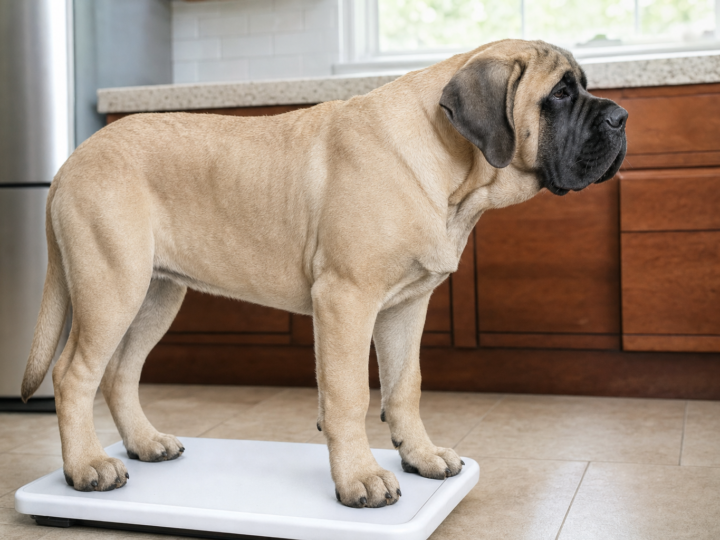
Treat the chart as a starting point rather than a verdict. A tall, leggy dog of 95 pounds may need the 54 inch crate for height even though the weight suggests 48, and a compact, low slung dog of the same weight may be perfectly comfortable in the smaller one. Height and length decide the answer. Weight is only a shortcut.
Why the divider panel matters
The divider is a flat panel that clips inside the crate and blocks off the far section, so a 54 inch crate can present as a 30 inch space for a small puppy. It is the single most useful accessory in the box, and it exists for one reason: house training.
Dogs are naturally reluctant to soil the space where they sleep, which is what makes crate training work. But that instinct only holds when the space is just big enough for sleeping. Give a young puppy the run of a full giant breed crate and they will simply designate a corner as the bathroom and carry on sleeping at the other end, which teaches exactly the habit you were trying to avoid.
Set the divider so your puppy can stand, turn around and lie down flat, and no more. Then move it back every couple of weeks as they grow. Checking it at the same time you check body condition makes it easy to remember.
Too Much Space Too Early
A puppy with a spare corner will use it. Set the divider tight and open it up gradually.
Buying To Fit Today
A crate that fits an eight week old giant breed puppy will be outgrown within weeks. Buy for the adult.
Not Enough Headroom
If your dog ducks to stand, the crate is too short. Allow two to four inches above the head when sitting.
Slippery Flooring
A bare plastic tray offers no grip. Add a mat so a growing dog is not scrabbling every time they stand.
Wire, plastic or furniture style
Once the size is settled, the material decides how the crate lives in your home. All three types work for a large breed. They just suit different households.
- Wire crates. The usual choice for big dogs. They fold flat, ship with a divider, offer excellent airflow and let your puppy see the room, which most young dogs prefer. Look for a heavy gauge model, since a bored adolescent giant is genuinely strong.
- Plastic travel crates. More enclosed and more den like, which suits an anxious dog, and required for most air travel. They are bulkier to store and rarely come with a divider.
- Furniture style crates. Wooden units that double as a side table. Handsome in a living room, but usually built for looks rather than for a determined 120 pound adolescent, so they suit a settled adult far better than a young puppy.
- Soft sided crates. Best avoided for large breed puppies. A teething giant breed will be through the mesh in an afternoon.
Setting the crate up properly
The crate itself is only half the job. How you set it up decides whether your puppy sees it as a den or as a punishment.
- Placement. Put it in a room the family uses, out of direct sun and away from draughts. Puppies settle far better when they can hear the household.
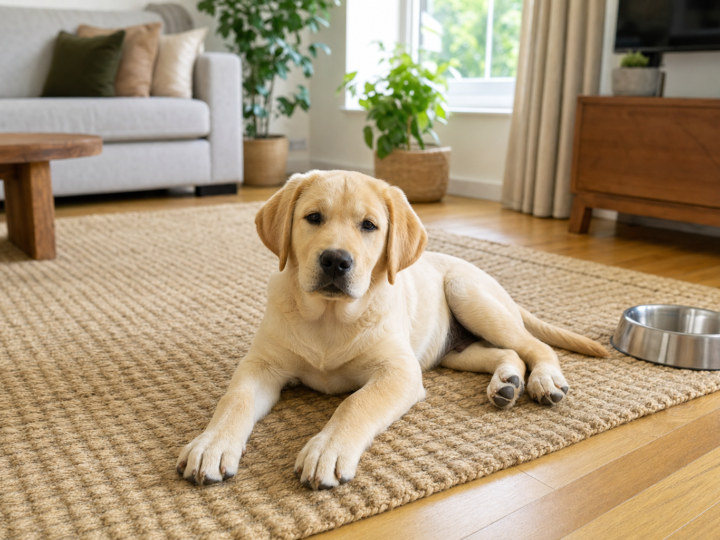
- Bedding. A supportive mat is better than a heap of blankets, especially for a heavy breed. Keep it washable and keep a spare.
- Traction. Make sure the surface under the crate does not slide on a hard floor, and that the base inside is not slippery.
- Water. A clip on bowl for longer stays, though not usually overnight while house training.
- Safety. Remove collars with tags before your dog goes in, since they can catch on wire. Check the surrounding area for cables and anything chewable within reach of the bars.
Supporting a growing frame at rest
The crate is where a large breed puppy spends a surprising share of the day, and rest is genuinely part of how a big dog grows. Puppies of these breeds need far more sleep than people expect, and the hours spent lying down are when the frame does its building. That makes the surface underneath worth thinking about: a supportive mat spreads the load of a heavy puppy far better than a folded towel, and grip on the way out of the crate protects joints that are still under construction. The same applies to the floor around it, since a puppy launching out onto a slick surface is doing the opposite of what those growth plates need.
Alongside lean feeding and sensible exercise, many big dog parents add a daily joint chew during the growth years. MoveGuard Growth is built for that window. It combines nine actives, including New Zealand Green Lipped Mussel, glucosamine, chondroitin, MSM and hyaluronic acid, to support the developing joints of young large breed dogs across the roughly 8 to 30 month growth window. Dosing follows expected adult weight, so most large breeds sit at two chews a day and giant breeds at three. It ships as 90 chews, is made in the USA in an NSF facility, and comes with a 60 day guarantee.
Support A Growing Frame
Give your large breed puppy daily joint support built for the growth window. Explore MoveGuard Growth.
Introducing the crate step by step
A correctly sized crate that your puppy dislikes is not much use, so the introduction is worth doing slowly. Most puppies come round within a week or two if nobody rushes it.
Day one to three. Leave the door open and let the crate simply exist. Feed meals just inside it and scatter a few treats in there through the day. Say nothing and make no fuss.
Day four to seven. Start closing the door for a minute or two while your puppy eats, then opening it before they finish. Build up in small increments and always open the door while your puppy is calm rather than after they have complained.
Week two. Begin short absences. Step out of the room, come back, and gradually stretch the time. A stuffed chew given only in the crate makes this considerably easier.
Overnight. Put the crate in the bedroom at first. A puppy who can hear you settles far faster, and you will also hear the request to go outside, which speeds up house training.
Common crate sizing mistakes
- Buying three crates instead of one. A divider does the same job for a fraction of the cost and takes ten seconds to move.
- Sizing by weight alone. Two dogs of the same weight can need different crates. Measure height and length.
- Leaving the divider wide open from day one. This is the most common cause of a puppy soiling their crate, and it is entirely avoidable.
- Choosing a light frame for a strong breed. Adolescent giants test everything. A heavy gauge wire crate is worth the extra.
- Using the crate as a punishment. The crate has to stay a good place. Send your puppy there for rest, never in anger.
- Forgetting to adjust as they grow. Large breeds change shape monthly. Check the divider setting every couple of weeks.
When to stop using the crate
There is no fixed date. Many large breed dogs are reliably house trained and past the worst of the chewing by around twelve to eighteen months, at which point the door can start being left open overnight. Others carry on using the crate happily for life, simply because it is their spot.
The signals to watch for are straightforward: your dog is clean overnight, no longer destructive when unsupervised, and settles calmly when left. Even then, most parents leave the crate up with the door open for a while. A dog who has learned the crate is a safe place will often keep choosing it, which is useful the next time you travel, move house or have builders in.
Frequently asked questions
Should I buy a crate for my puppy or for the adult dog?
Buy for the adult dog and use the divider panel to reduce the space while your puppy is small. Large breeds would otherwise need two or three crates in the first year, and the divider gives you the same fit for a fraction of the cost.
What size crate does a Great Dane need?
A 54 inch crate is the usual answer for a Great Dane, and the same applies to most giant breeds finishing above 110 pounds, including the English Mastiff, Saint Bernard and Newfoundland. Check that your adult dog can stand without ducking their head.
How much room should a dog have in a crate?
Enough to stand up without lowering the head, turn around in one movement, and lie down fully stretched on one side. Roughly two to four inches of clearance above the head when sitting is the usual guide. More space than that is unnecessary while house training.
Can a crate be too big for a puppy?
Yes. A puppy given more space than they need will often sleep at one end and use the other as a toilet, which undoes the main advantage of crate training. That is exactly the problem the divider panel is designed to solve.
How long can a large breed puppy stay in a crate?
A useful guide is one hour for each month of age, up to a maximum of about four hours during the day for a young puppy, with overnight being longer once they can hold it. Puppies also need frequent breaks for the toilet, food and company.
The bottom line
Crate sizing for a large breed puppy comes down to one decision made once: buy the crate your adult dog will need, then use the divider to make it fit the puppy you have today. Measure length and height rather than trusting weight alone, round up when your dog falls between sizes, choose a frame strong enough for an adolescent giant, and put a supportive, grippy surface inside it. Do that and the crate stops being a piece of equipment you outgrow and becomes the calm corner your big dog chooses for the next decade.
Want the whole first year in one place? Grab our free Big Dog Growth Guide for the growth window checklist, feeding framework and joint safe exercise limits, all written for large and giant breeds.
This article is for general educational purposes only and is not veterinary advice. It is not intended to diagnose, treat, cure or prevent any disease. Always consult your veterinarian about your dog’s individual health, nutrition and supplement needs. These statements have not been evaluated by the Food and Drug Administration.
Support Big Breed Joints from Day One
Large and giant breeds carry more load through every growth stage. MoveGuard Growth supports developing joints in young big dogs (8 to 30 months); MoveGuard Adult keeps grown big dogs moving comfortably.
Leave a Reply