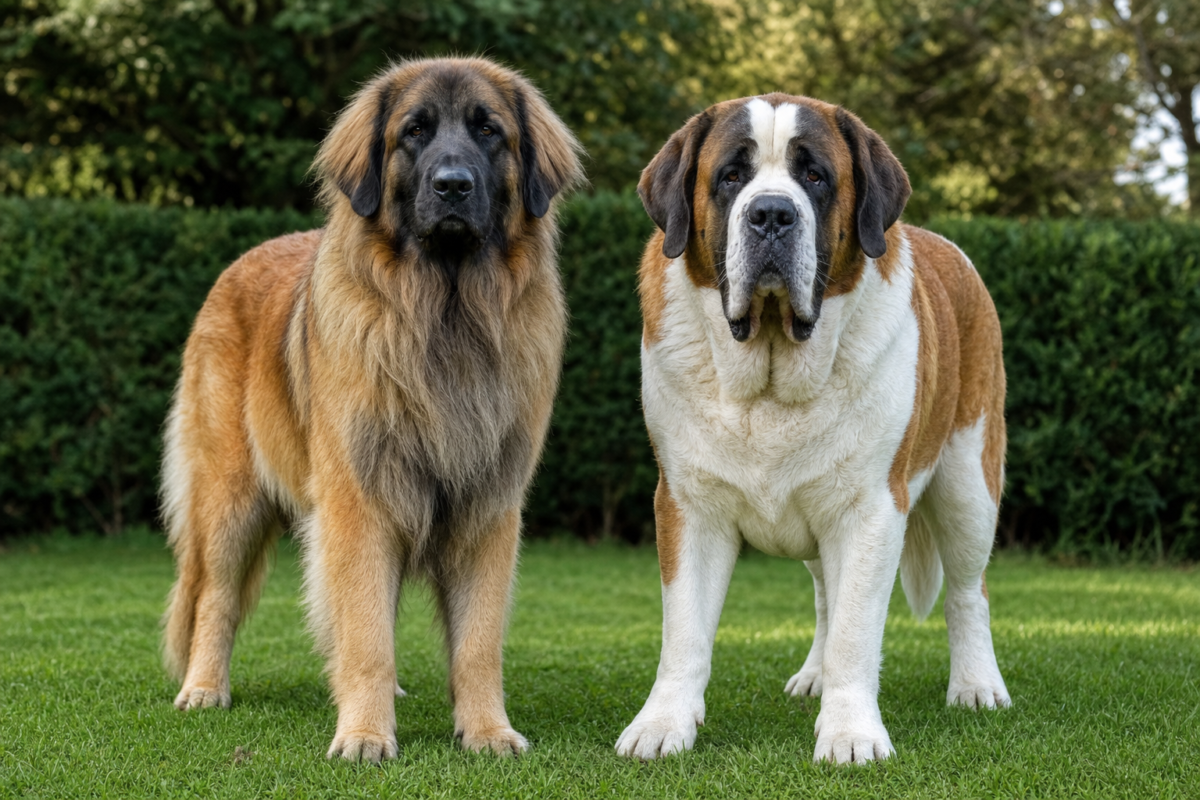
The Saint Bernard is the heavier, stockier breed, with males weighing 140 to 180 pounds and standing 28 to 30 inches at the shoulder. The Leonberger is taller but leaner, with males at 110 to 170 pounds and 28 to 31.5 inches. The Saint Bernard was bred as a mountain rescue dog and carries a broad head, heavy jowls and a real tendency to drool. The Leonberger is an agile water loving working dog with a lion like mane, webbed feet and noticeably more stamina. Both are gentle family giants that take two and a half years to finish growing.
If you are choosing between these two magnificent giants, you are weighing up two dogs that look superficially similar and live rather differently. Both are enormous, both are famously good natured, and both will reshape your sofa, your car and your weekly routine. But one is a stocky mountain rescue breed built for hauling through deep snow, and the other is an athletic water dog that would happily swim all afternoon. This guide compares them on size, coat, temperament, exercise, grooming and the practical realities of the growth years, so you can pick the one that fits the life you actually live.
What is the difference between a Leonberger and a Saint Bernard?
The main difference is build and energy. A Saint Bernard is heavier and more powerfully built, with a broad head, pronounced jowls and a calm, low output daily routine. A Leonberger is taller at the shoulder but lighter through the body, more athletic in outline, and needs substantially more exercise, particularly swimming. The Saint Bernard drools considerably. The Leonberger barely drools at all but carries a thicker mane and sheds heavily twice a year. Temperament is where they are most alike: both are patient, people focused giants that want to be in the room with their family.
In practical terms, a Saint Bernard suits a household that wants a calm, watchful presence and can manage the drool and the mass. A Leonberger suits an active household with space, water nearby and time for daily grooming.
Size and build compared
Both breeds sit firmly in giant territory, and both will pass most large breeds on the way up. The difference is in proportion rather than sheer scale.
| Trait | Leonberger | Saint Bernard |
|---|---|---|
| Male height | 28 to 31.5 inches | 28 to 30 inches |
| Female height | 25.5 to 29.5 inches | 26 to 28 inches |
| Male weight | 110 to 170 lb | 140 to 180 lb |
| Female weight | 90 to 140 lb | 120 to 140 lb |
| Build | Tall, athletic, balanced | Broad, deep, powerfully massive |
| Coat | Long double coat with a mane | Smooth or rough double coat |
| Drool | Minimal | Considerable |
| Typical lifespan | 7 to 9 years | 8 to 10 years |
The American Kennel Club’s Chief Veterinary Officer, Dr. Jerry Klein, DVM, has written extensively on the slower growth and development timeline of large and giant breeds. Read more from the AKC’s guidance on caring for large-breed dogs.
Put a mature male of each side by side and the Leonberger often looks the taller dog while the Saint Bernard clearly looks the heavier one. If you want a fuller picture of either breed on its own, our guides on how big a Leonberger gets and how big a Saint Bernard gets break the numbers down month by month.
How they grow
Growth is one area where the two breeds behave almost identically, and it is the single most important thing for a new giant breed parent to understand. Both reach most of their adult height somewhere between 18 and 24 months, then continue adding chest, muscle and substance until roughly two and a half to three years of age.
That long timeline is a feature, not a delay. Giant breeds carry an enormous adult frame on a skeleton that spends far longer under construction than a medium dog does. The growth plates, the soft areas at the ends of the long bones, stay open through much of the first year and beyond, which is why lean feeding and moderate exercise matter more for these two breeds than for almost any others.
Growing Too Fast
Both breeds do best on steady growth. Pushing size early asks a great deal of a frame that is still forming.
Carrying Extra Weight
On a 150 pound dog, a few surplus pounds add up quickly. Lean is the target at every age.
Too Much Impact Too Young
Long runs, stairs and repeated jumping are a lot to ask of an open giant breed skeleton.
Heat
Both carry heavy double coats. Warm days call for shade, water and early morning activity rather than midday walks.
Temperament and family life
This is where the two breeds are closest, and where both earn their reputations. The Saint Bernard is famously patient, steady and tolerant, a dog that tends to lie down in the middle of the household and quietly supervise. It is watchful without being sharp, and slow to take offence. The breed is often described as a gentle giant, and for once the label fits.
The Leonberger is equally friendly but a touch more engaged. It is self assured, curious and playful well into adulthood, and it likes having something to do. Leonbergers tend to stay closer to their people, follow them from room to room, and enjoy training more actively than a Saint Bernard typically does.
Both breeds are good with respectful children, and both are large enough that supervision is simply common sense rather than a comment on temperament. Early socialisation matters enormously for both, because a confident giant is a pleasure to live with and an unsure one is very hard to manage physically.
Exercise needs
Here the two part company. A Saint Bernard is content with moderate daily activity: a couple of steady walks, some garden time, and a great deal of lying down. Overdo it, especially in warm weather, and you will see the breed simply stop and rest.
A Leonberger needs more. Expect an hour or more of daily activity for an adult, ideally including swimming, which the breed adores and which is famously kind to joints. Leonbergers also enjoy carting, tracking and obedience work, and a bored one will find something less convenient to do with its afternoon.
- Saint Bernard adult. Two moderate walks a day plus free time in a secure space is usually plenty.
- Leonberger adult. Longer walks, swimming where possible, and some form of structured work or training.
- Both as puppies. Short, frequent, low impact sessions on soft ground rather than distance.
- Both in summer. Early and late outings only, with shade and water available at all times.
Coat, grooming and the drool question
Neither breed is low maintenance, but they are demanding in different ways. The Leonberger carries a long, water resistant double coat with a distinct mane on males, plus feathering on the legs and tail. Plan on brushing several times a week, rising to daily during the heavy seasonal sheds, when the undercoat comes out in impressive quantities.
Saint Bernards come in two coat types. The smooth coat is shorter and easier to maintain, while the rough coat is longer and needs more frequent brushing. Both shed steadily. What really separates the breeds day to day is drool: the Saint Bernard has loose jowls and produces a lot of it, particularly after drinking or when anticipating food. Households that keep a Saint Bernard generally keep a towel in every room and learn to accept the occasional decorated wall.
Feeding two very large dogs
Both breeds eat impressively, though rather less than people expect for their size, and the priority in both cases is controlled, steady growth rather than fast growth.
- Choose a complete food formulated for large breed puppies, which balances calories, calcium and phosphorus for slower development.
- Split the daily amount across three meals while young and two as an adult, which also suits deep chested breeds better than one large meal.
- Feed to a lean body condition. You should feel the ribs easily under a light covering at every age.
- Confirm portions with your veterinarian at each checkup, since the right amount changes fast through the first year.
- Avoid hard exercise immediately before or after eating, a sensible habit for any deep chested giant.
Supporting giant breed joints
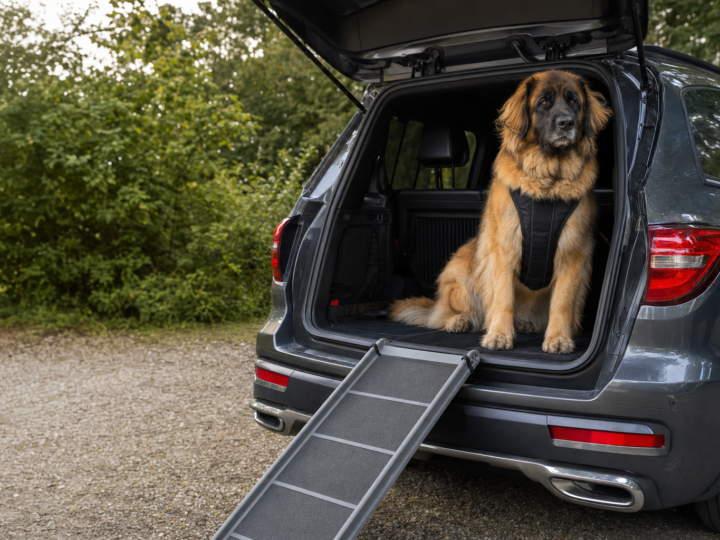
Both breeds carry a great deal of dog on four joints, and both spend an unusually long stretch of life building the frame that has to do it. That makes the daily habits around movement worth getting right early: lean body condition, steady activity on forgiving surfaces, good traction on slippery floors, and a ramp rather than a jump into the car.
Many giant breed parents also add a daily joint chew during the growth years. MoveGuard Growth is made for that stage. It brings together nine actives, including New Zealand Green Lipped Mussel, glucosamine, chondroitin, MSM and hyaluronic acid, to support healthy joint development across the roughly 8 to 30 month growth window that both of these breeds sit inside. Dosing follows expected adult weight, so most Leonbergers and Saint Bernards land at three chews a day. It ships as 90 chews, is made in the USA in an NSF facility, and carries a 60 day guarantee. Once growth finishes, many parents move across to MoveGuard Adult and keep the routine going.
Support A Giant Frame
Give your growing giant daily joint support built for large and giant breeds. Explore MoveGuard Growth.
Signs your giant breed puppy is growing on track
With both breeds, the reassuring signs are the same and none of them require a scale. Look for a puppy that is bright and interested, moves smoothly and evenly on soft ground, has a waist you can see from above, and ribs you can feel with light pressure under the coat. On a heavily coated breed the hands tell you far more than the eyes, so make a habit of running them along the sides once a fortnight.
A leggy, slightly gangly adolescent is normal in both breeds and usually means growth is happening at a sensible pace rather than a rushed one. A puppy that looks heavy and round through the middle is the one worth discussing with your veterinarian, because on a frame this large the surplus goes straight through the joints.
Do speak to your veterinarian if you notice limping, stiffness after rest, a reluctance to get up, or a sudden change in how your puppy moves. Catching a question early is far easier than catching it late, and giant breeds give you a long window in which small adjustments make a real difference.
Which breed suits which household?
Neither breed is the better dog. They simply fit different lives, and being honest about yours is the whole exercise.
Choose a Saint Bernard if you want a calm, watchful, immovably steady presence in the home, your daily activity is moderate, you have space for a very heavy dog to stretch out, and drool genuinely does not bother you. This breed is superb with a settled family routine and does not ask you to entertain it.
Choose a Leonberger if you want an active companion that will train, swim and work with you, you can commit to serious grooming, and you have the time for an hour or more of daily activity. This breed rewards involvement and is happiest when it has a job of some kind.
Think carefully about either if you live somewhere consistently hot, you are away from home for long stretches, or the budget for food, veterinary care and equipment is tight. Giant breeds cost giant amounts to run, and that is true from the first month.
Common mistakes with both breeds
- Feeding for size. A heavier giant puppy is not a healthier one. Extra weight loads a skeleton that is still forming.
- Treating the puppy stage as short. These breeds are adolescents for well over a year, and training has to keep pace with their strength.
- Underestimating the grooming. Both coats need real time, and a neglected Leonberger coat mats quickly.
- Skipping early socialisation. A 150 pound dog that never learned to be relaxed in public is a genuine handful.
- Ignoring heat. Both breeds cope poorly with warm weather, and both need the day planned around it in summer.
Frequently asked questions
Is a Leonberger bigger than a Saint Bernard?
A Leonberger is usually taller at the shoulder, with males reaching 28 to 31.5 inches, while a Saint Bernard is usually heavier, with males at 140 to 180 pounds against 110 to 170 for a Leonberger. So the Leonberger is the taller breed and the Saint Bernard is the more massive one.
Which breed drools more?
The Saint Bernard, by a wide margin. Its loose jowls mean regular drool, especially around food and water. Leonbergers have tighter lips and drool very little, which is one of the most noticeable everyday differences between the two.
Which breed needs more exercise?
The Leonberger. An adult typically wants an hour or more of daily activity, with swimming being an ideal option. A Saint Bernard is generally content with two moderate walks and plenty of rest in between.
Are Leonbergers and Saint Bernards good family dogs?
Both have excellent reputations with families and are known for patience and steadiness. Their size means supervision around small children is simply sensible, and early socialisation and training matter a great deal for any dog that will weigh well over 100 pounds.
How long do these breeds take to stop growing?
Both reach most of their adult height between 18 and 24 months, then continue filling out in muscle and chest until roughly two and a half to three years of age. Steady growth across that long window is the goal for both breeds.
The bottom line
The Saint Bernard and the Leonberger are both wonderful giants, and the choice really comes down to energy and upkeep. Take the Saint Bernard for a calmer, heavier, more sedentary companion and accept the drool as the price of admission. Take the Leonberger for a taller, more athletic dog that wants to swim, train and be involved, and accept the brush as the price instead. Whichever you choose, feed lean, keep exercise sensible through a long growth window, and support those joints early. That is how a giant breed puppy becomes a comfortable, confident adult.
Want the roadmap in one place? Grab our free Big Dog Growth Blueprint for the growth window checklist, feeding framework and joint safe exercise limits, all written for large and giant breeds.
This article is for general educational purposes only and is not veterinary advice. It is not intended to diagnose, treat, cure or prevent any disease. Always consult your veterinarian about your dog’s individual health, nutrition and supplement needs. These statements have not been evaluated by the Food and Drug Administration.
Support Big Breed Joints from Day One
Large and giant breeds carry more load through every growth stage. MoveGuard Growth supports developing joints in young big dogs (8 to 30 months); MoveGuard Adult keeps grown big dogs moving comfortably.
Leave a Reply