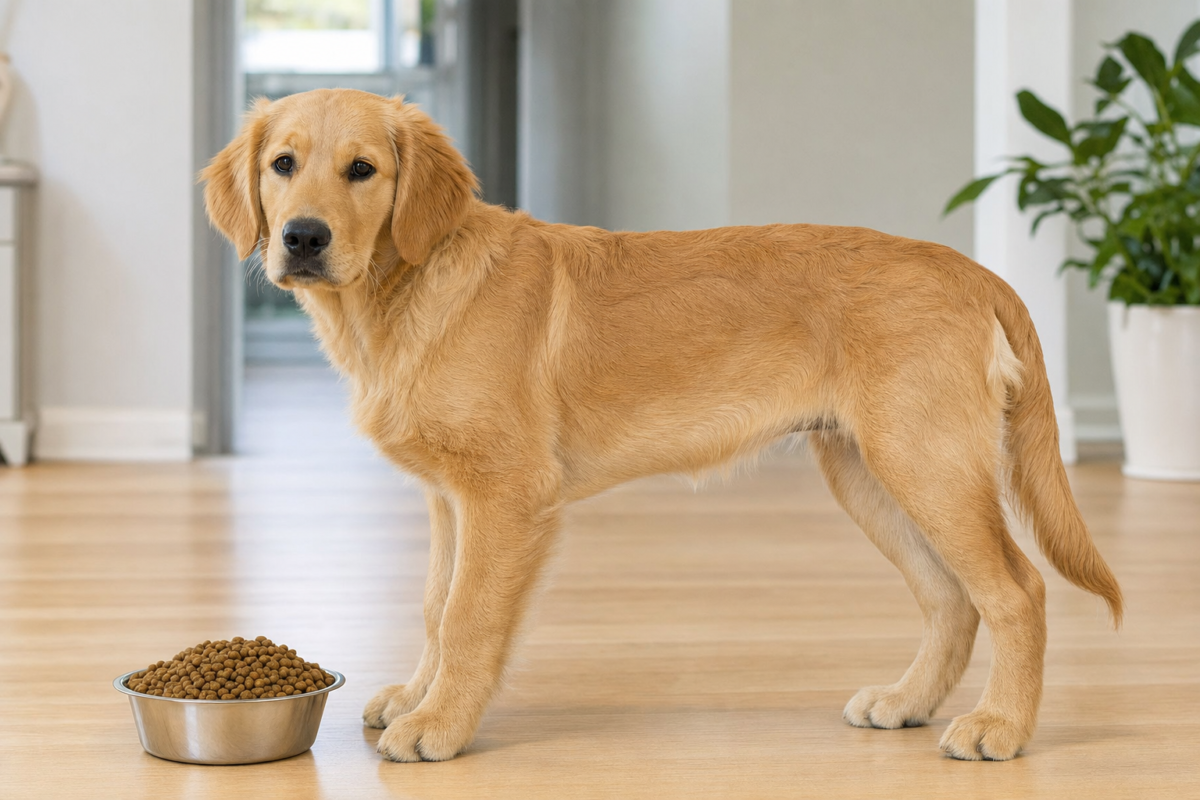
You are probably overfeeding a large breed puppy if you cannot feel the ribs easily under a thin layer, the waist has disappeared when you look down from above, the belly hangs level rather than tucking up, or your puppy is racing ahead of the growth chart month after month. Soft or loose stools, a heavy rolling gait and a puppy that seems constantly sleepy after meals are three more common signals. The fix is almost always a small portion reduction rather than a dramatic diet change.
Nobody sets out to overfeed a puppy. It happens quietly, through a scoop that got a little generous, treats that never got counted, and the very reasonable instinct that a big dog needs big meals. The trouble is that a large breed puppy is carrying a growing frame, and extra weight is felt by joints that are still forming. The good news is that overfeeding leaves obvious clues once you know where to look, and correcting it takes days rather than months.
How can I tell if I am overfeeding my large breed puppy?
The clearest test takes ten seconds and needs no equipment. Run your hands along your puppy sides. If you cannot feel the ribs easily under a thin layer of covering, and you cannot see a waist behind the ribs when you look down from above, your puppy is carrying more weight than a growing frame needs. Rapid weight gain, loose stools and low energy after meals are supporting evidence.
Weight alone is a poor test, because a big puppy is supposed to be getting heavier every week. What matters is the shape underneath the growth. A puppy can gain steadily and stay lean, or gain quickly and turn round, and only your hands can tell the difference.
Why overfeeding matters more in a large breed puppy
A large or giant breed puppy multiplies its birth weight many times over during a first year that runs far longer than it does in a small breed. All of that new bone and cartilage is laid down while the skeleton is still soft, and every extra pound is carried by a frame in the middle of building itself.
Feeding for speed also works against you. Pushing calories does not create a bigger adult dog. Adult size is set by genetics, so extra food simply gets your puppy to that size faster, on joints that would rather take the slow road. Steady, unhurried growth is what supports comfortable movement now and years from now.
The signs of overfeeding, one by one
Most Dog Parents notice one of these before the others. Any single sign is worth a look, and two or more together is a clear prompt to adjust.
| Sign | What you notice | What to do |
|---|---|---|
| Ribs hard to feel | You have to press to find them | Reduce the daily amount by about ten percent |
| No visible waist | Straight sides from above, no tuck behind the ribs | Measure every meal and recheck in two weeks |
| Belly hangs level | No upward tuck toward the back legs from the side | Cut treats first, then trim meal portions |
| Gaining very fast | Well above the expected curve month after month | Discuss the growth rate with your veterinarian |
| Loose stools | Soft, frequent or larger than expected | Check portion size before changing food |
| Low energy after meals | Heavy, sleepy and reluctant to move | Split the same total into more, smaller meals |
| Rolling, heavy gait | Movement looks laboured rather than springy | Book a body condition check with your veterinarian |
The World Small Animal Veterinary Association’s Global Nutrition Committee publishes evidence-based guidance for evaluating dog food and feeding practices. Read more from the WSAVA Global Nutrition Guidelines.
Notice how many of the fixes are small. A ten percent adjustment held for a month usually does more than a dramatic change, and it is far gentler on a growing puppy.
How fast should a big puppy actually gain?
A healthy large breed puppy gains weight quickly through the first six months, then slows steadily. Most of the height arrives in the first year while substance keeps filling in well beyond it. What you want is a curve that climbs smoothly, not one that leaps between checkups.
Compare your puppy to its own trend rather than to the neighbour dog. If you know the expected adult weight, you can sense check the pace, but the honest test is still the one you do with your hands every couple of weeks.
Why the growth window makes this urgent
Large and giant breeds grow across roughly an 8 to 30 month window depending on adult size. Growth plates, the soft zones at the ends of the long bones, stay open through much of that time. While they are open, carrying extra weight asks more of a frame that has not finished forming, which is why lean feeding matters far more in a big puppy than in a small one. The window is also short. Habits set now shape the adult dog that walks out the other side.
Feeding By Eye
A random scoop or mug drifts upward over weeks. Measure every meal with the same cup or a scale.
Uncounted Treats
Training rewards and chews add up fast in a puppy learning quickly. Count them inside the daily total.
Feeding For Size
Extra food does not build a bigger adult. It only gets your puppy there faster, on joints still forming.
Two Sets Of Hands
Two people each giving a meal is the most common overfeeding cause in a busy household.
What to do when you spot the signs
Correcting a slightly heavy puppy is a gentle process, not a diet. The goal is to hold weight steady while the frame keeps growing into it.
- Cut treats and table extras first. They are usually the easiest calories to remove and the least missed.
- Reduce meals by about ten percent, then hold for two to four weeks before judging.
- Feed a complete food formulated for large breed puppies, which balances calories, calcium and phosphorus for slower, steadier growth.
- Measure with a proper cup or a kitchen scale at every meal, not by eye.
- Never crash diet a growing puppy. Rapid restriction is its own problem, and any significant change belongs in a conversation with your veterinarian.
How to check body condition in ten seconds
This is the check that replaces guesswork. Do it every couple of weeks through the growth years.
- Ribs. Run your hands along the sides. You should feel the ribs easily under a thin layer. If you have to press, ease back on food.
- Waist. Look down from above. You want a clear waist that tucks in behind the ribs.
- Tuck. From the side, the belly should rise toward the back legs rather than hanging level.
Adjust portions gently with your veterinarian guidance, and remember that a puppy who feels a touch lean is usually exactly right.
Exercise is a support act, not the solution
It is tempting to answer extra weight with extra exercise, but that logic works better in adults than in growing puppies. Hard impact on open growth plates is a lot to ask, and a heavy puppy is the last one you want doing repeated jumping.
- Favour free play, exploring and short walks on soft ground.
- Keep long runs, hard sprints and repeated jumping moderate while the growth plates are open.
- Use training, puzzle feeders and scent games to burn energy without pounding on joints.
- Let your puppy rest fully between bursts of activity, because sleep is when growth actually happens.
Fix the bowl first and let movement support it. Portions do the heavy lifting at this age.
Supporting the joints carrying the weight
Keeping a puppy lean is really a joint decision dressed up as a feeding one. Every pound travels through the hips, elbows, knees and shoulders thousands of times a day, and that load lands on structures still under construction.
Alongside lean feeding and sensible exercise, many big dog parents add a daily joint support chew made for large and giant breeds. MoveGuard Growth is built for exactly this stage. It combines nine actives, including New Zealand Green Lipped Mussel, glucosamine, chondroitin, MSM and hyaluronic acid, to support the developing joints of young large breed dogs across the roughly 8 to 30 month growth window. You dose by expected adult weight, so a puppy heading for 50 to 80 pounds sits at two chews a day and a bigger dog at three. It ships as 90 chews, is made in the USA in an NSF facility, and is backed by a 60 day guarantee.
Support A Growing Frame
Give your growing puppy daily joint support built for large and giant breeds. Explore MoveGuard Growth.
Signs your puppy is growing on track
The reassuring picture is easy to recognise. A bright, springy puppy with a waist you can see from above, ribs you can feel with light pressure, firm consistent stools, and a healthy appetite that arrives at meals without desperation. Movement looks light and bouncy rather than heavy. Weight climbs steadily week by week without dramatic jumps.
If you notice limping, stiffness after rest, reluctance to move, or growth that suddenly accelerates, a quick chat with your veterinarian brings peace of mind and lets you adjust food or activity early.
A simple game plan, stage by stage
Overfeeding tends to creep in at predictable moments. Knowing them makes it easy to stay ahead.
8 weeks to 4 months. Portions change fast at this age, so recheck the daily amount every two weeks. Split it across three or four meals. This is when generous scooping habits form, so measure from day one.
4 to 8 months. Appetite becomes enormous and it is tempting to answer it. Hold the measured amount, watch body condition instead of the bowl, and count every training treat. This is a natural point to begin a daily joint support routine that carries through the whole growth window.
8 to 18 months. Growth slows while appetite often does not. This is the most common window for quiet weight gain. Recheck portions when meals drop from three a day to two, since many households keep the old portion size and accidentally add calories.
18 months onward. The move to adult food changes calorie density, so recalculate rather than assume. Keep the monthly body condition check going for life.
Common overfeeding mistakes to avoid
These few habits explain most of the heavy puppies we hear about.
- Following the bag without adjusting. Bag guides are generous and assume a very active dog. Many puppies need less than the printed amount.
- Free feeding. A full bowl left down all day makes portion control impossible and hides appetite changes.
- Rewarding with food all day. Training is essential, but the rewards belong inside the daily total.
- Topping up because a big puppy looks hungry. Large breeds are convincing. Trust your hands over the eyes across the kitchen.
- Adding supplements to correct a diet. A complete large breed puppy food is already balanced. Extra calcium in particular should only be given if your veterinarian asks for it.
Where the extra calories actually come from
When a household audits a heavy puppy, the culprit is rarely the meals. It is everything around them. A dental chew can carry as many calories as a small meal. A handful of training treats during a busy afternoon can quietly add a fifth of the daily total. A generous scoop that runs slightly over adds up to a whole extra meal across a week.
The fix is a shared plan rather than more willpower. Write the daily amount, the meal times and the treat allowance on the fridge so everyone is running the same numbers. Set aside a small portion of the day kibble in a jar for training, and when the jar is empty, rewards for the day are done. It costs nothing, keeps the total honest, and your puppy never notices the difference.
If more than one person feeds, agree on who does which meal. Two well meaning dinners is the single most common story behind a puppy who gained faster than expected.
Frequently asked questions
How do I know if my puppy is overweight or just growing?
Use your hands rather than the scale. A growing puppy gains weight every week, which is normal, but you should still feel the ribs easily under a thin layer and see a waist from above. If both are missing, the gain is more than growth.
Should I put my large breed puppy on a diet?
Not a diet in the adult sense. Reduce the daily amount by about ten percent, cut treats, and let your puppy grow into its weight rather than losing weight quickly. Any significant change should be discussed with your veterinarian first.
Can overfeeding make my puppy grow bigger?
No. Adult size is set by genetics. Extra food only moves your puppy toward that size faster, which asks more of joints that are still forming during the growth window.
Are loose stools a sign of overfeeding?
They can be. Portion size is worth checking before you change food, since more food than a young digestive system can comfortably handle often shows up as softer, larger or more frequent stools. Persistent changes deserve a veterinary visit.
How often should I weigh my puppy?
Every two weeks through the fastest growth months, then monthly. Pair each weigh in with a ten second body condition check, because the shape tells you more than the number.
The bottom line
Overfeeding a big puppy shows up in the hands long before it shows up on the scale. If the ribs are hard to feel and the waist has gone, trim treats, reduce meals by about ten percent, measure every portion and recheck in a month. Feed for a lean, steady curve rather than a fast one, support the growth window with sensible habits, and you give your puppy the best chance of moving comfortably for a long time.
Want the Simple Roadmap in One Place?
Grab our free Big Dog Growth Blueprint for the growth window checklist, feeding framework and joint safe exercise limits, all written for large and giant breeds.
This article is for general educational purposes only and is not veterinary advice. It is not intended to diagnose, treat, cure or prevent any disease. Always consult your veterinarian about your dog’s individual health, nutrition and supplement needs. These statements have not been evaluated by the Food and Drug Administration.
Support Big Breed Joints from Day One
Large and giant breeds carry more load through every growth stage. MoveGuard Growth supports developing joints in young big dogs (8 to 30 months); MoveGuard Adult keeps grown big dogs moving comfortably.
Leave a Reply