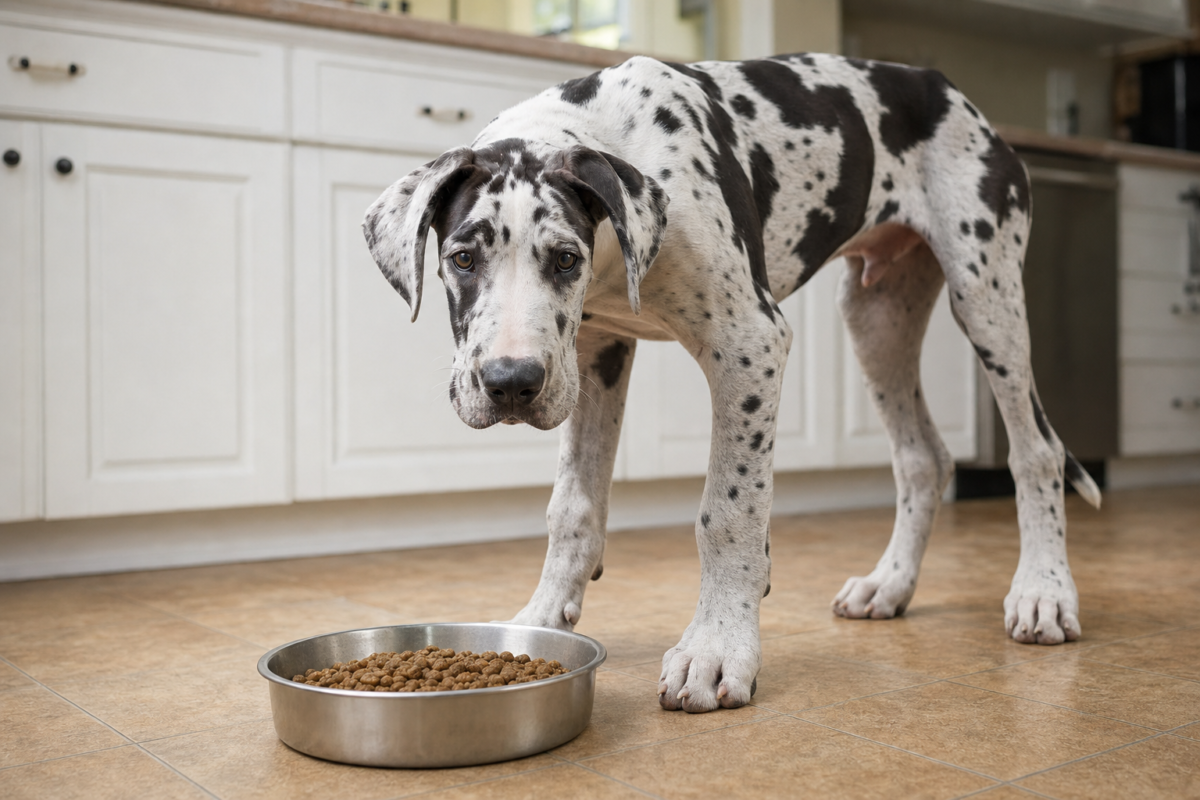
A giant breed puppy such as a Great Dane typically eats 4 to 6 cups of a complete large breed puppy food a day at four months, rising to roughly 7 to 10 cups a day between nine and twelve months, then settling slightly as growth slows. Split that total across three meals until about six months, then two. Portion by expected adult weight rather than current weight, and let body condition rather than the bag make the final call.
Feeding a giant breed puppy is the one part of big dog ownership where the numbers feel genuinely alarming. The bag empties in days, the printed guide runs off the end of its own chart, and your puppy still looks at you as though the meal has not happened. This guide gives you real daily amounts by age, a simple way to calculate your own dog’s number, and the checks that tell you whether the amount in the bowl is actually right.
How much should I feed a giant breed puppy?
Most giant breed puppies eat between 4 and 6 cups of a complete large breed puppy food a day at four months of age, between 6 and 8 cups at six months, and somewhere around 7 to 10 cups a day through the hungriest stretch from nine to twelve months. A dog heading toward 160 pounds sits near the top of every one of those ranges, and one heading toward 110 pounds sits near the bottom.
Those figures assume a food of roughly 350 to 400 calories per cup, which is typical for large breed puppy formulas. Check the calorie figure on your own bag, because a denser food changes the cup count considerably while the calorie total stays the same. Cups are a convenience. Calories and body condition are the actual measures.
Why giant breed portions work differently
A giant breed puppy is not simply a bigger version of a normal puppy. It is a dog that will multiply its birth weight roughly a hundred times, on a frame that takes two to three years to finish, while carrying an appetite that arrives long before the judgement to manage it does.
That creates a tension unique to this size group. Feed too little and you are short changing an enormous construction project. Feed too much and you steepen the growth curve, which is exactly what controlled growth exists to avoid. The target is the narrow middle, and the only reliable way to find it is to feed a measured amount and then read the dog rather than the bowl.
The second quirk is that portion size peaks and then falls. A giant breed puppy usually eats more at ten months than it will as a full grown adult, because growth itself is expensive. Many parents miss the point where the amount should start coming down, which is the single most common cause of a heavy adolescent.
Giant breed puppy feeding chart by age
Use the column that matches your puppy’s expected adult weight, not what your puppy weighs today. Amounts assume a large breed puppy food of about 380 calories per cup.
| Age | Toward 120 lb adult | Toward 160 lb adult | Meals per day |
|---|---|---|---|
| 2 months | 2 to 3 cups | 3 to 4 cups | 3 to 4 |
| 3 months | 3 to 4 cups | 4 to 5 cups | 3 |
| 4 months | 4 to 5 cups | 5 to 6 cups | 3 |
| 6 months | 6 to 7 cups | 7 to 8 cups | 3 |
| 9 months | 7 to 8 cups | 8 to 9 cups | 2 |
| 12 months | 7 to 8 cups | 8 to 10 cups | 2 |
| 18 months | 6 to 8 cups | 8 to 9 cups | 2 |
| Adult | 6 to 8 cups | 8 to 10 cups | 2 |
The World Small Animal Veterinary Association’s Global Nutrition Committee publishes evidence-based guidance for evaluating dog food and feeding practices. Read more from the WSAVA Global Nutrition Guidelines.
Treat these as a starting point rather than a prescription. Two puppies of the same age and breeding can differ by a cup a day and both be exactly right.
How to work out your own puppy’s number
If you would rather calculate than estimate, the arithmetic takes two minutes and gives you a figure tailored to your own dog.
- Step one. Convert current weight to kilograms by dividing pounds by 2.2.
- Step two. Work out resting energy needs: multiply 70 by that weight in kilograms raised to the power of 0.75. Most phone calculators handle this, and plenty of online tools do it for you.
- Step three. Multiply the result by 3 for a puppy under four months, or by 2 for a puppy over four months. That gives daily calories.
- Step four. Divide daily calories by the calories per cup on your bag. That is your cup count.
- Step five. Recheck every two to three weeks, because the number climbs quickly while your puppy is growing fastest.
A worked example helps. A five month old heading for 140 pounds and currently weighing 70 pounds is about 32 kilograms, which gives resting needs near 940 calories, doubled to roughly 1,880 calories a day. On a food of 380 calories per cup that is about 5 cups daily, split across three meals.
How to check body condition in ten seconds
Whatever the chart or the calculator says, body condition settles the argument.
- Ribs. Run both hands along the sides. Ribs should be easy to feel under a thin covering. If you have to press, reduce the portion.
- Waist. From above, look for a clear narrowing behind the ribs.
- Tuck. From the side, the belly should rise toward the back legs rather than run level.
Adjust by half a cup at a time and give each change two weeks before judging it.
Feeding The Bag
Printed guides run generous and cannot see your dog. Ribs and waist decide the final number.
Missing The Peak
Portions should fall after growth slows. Many giant breeds stay on their hungriest amount too long.
One Huge Meal
A deep chested giant does better on smaller, more frequent meals with calm rest afterwards.
Invisible Calories
Chews, training treats and scraps add up quickly and quietly steepen the growth curve.
Splitting the day and keeping meals calm
How the total is delivered matters as much as the total itself for a breed built like a Great Dane. Deep chested dogs do better with smaller portions, unhurried eating and a settled hour afterwards.
- Feed three meals a day until about six months, then two meals for life. Avoid dropping to a single large meal.
- Use a slow feeder bowl if your puppy inhales a meal in seconds.
- Keep the feeding spot quiet and on a surface with grip so a leggy puppy is not bracing on a slippery floor.
- Allow calm rest around meals rather than hard play immediately before or after.
- Keep fresh water available at all times and refill rather than top up.
Growth safe movement while you feed for growth
Portion control and sensible activity are the same project. A giant breed puppy at the right weight can still ask too much of a young joint through the wrong kind of exercise, so keep movement frequent and moderate while growth plates are still open. Free play on soft ground, short exploratory walks and plenty of thinking work suit this stage. Save jogging, long hikes and repeated jumping until your veterinarian confirms the frame has matured, and use a ramp for the car rather than letting a growing giant leap down.
Daily habits that support developing joints
Once the portion is right, the habits stacked around it decide how comfortably your dog carries the frame all that food is building. Lean feeding, good footing, moderate movement and steady joint support all work toward the same outcome during the growth years.
Alongside a measured bowl, many big dog parents add a daily joint support chew made for large and giant breeds. MoveGuard Growth is built for exactly this stage. It combines nine actives, including New Zealand Green Lipped Mussel, glucosamine, chondroitin, MSM and hyaluronic acid, to support healthy joint development and normal cartilage and connective tissue across the roughly 8 to 30 month growth window. Dosing follows expected adult weight, so a puppy heading for 50 to 80 pounds takes two chews a day and one heading for 80 to 100 pounds or more takes three. It is made in the USA, comes as 90 chews and carries a 60 day guarantee.
Support The Growth Window
Give your growing giant daily joint support built for large and giant breeds. Explore MoveGuard Growth.
Signs the portion is right
A correctly fed giant breed puppy is bright and energetic, has ribs you can feel with light pressure and a waist visible from above, produces firm consistent stools, and gains weight in steady increments. Looking lean and a little leggy through the first eighteen months is exactly what you want.
Worth a call to your veterinarian are persistent loose stools, weight climbing far faster than the chart, ribs you cannot find, limping or stiffness, or a puppy who suddenly loses interest in food. Caught early these are almost always small adjustments.
A stage by stage feeding plan
8 weeks to 4 months. Keep the breeder’s food for the first week, then transition gradually to your chosen complete food formulated for large breed puppies. Three to four measured meals a day, weekly weigh ins, and no calcium supplements.
4 to 8 months. The steepest climb in both growth and appetite. Expect to increase the amount every two to three weeks, but increase it because body condition asks you to, not because the bowl empties fast.
8 to 14 months. Peak intake, usually the largest daily amount your dog will ever eat. Watch closely for the turn, which is the first time you notice ribs becoming harder to feel at the same portion.
14 months onward. Growth slows and the amount should start easing down. Move to an adult formula on your veterinarian’s timing, transition across seven to ten days, and settle into the adult figure with the same body condition checks you have used all along.
Common feeding mistakes to avoid
- Free feeding. Leaving food down all day removes the one control that matters most in the growth window.
- Feeding by current weight. Portions should follow expected adult weight, or you will be permanently behind a fast growing dog.
- Ignoring the calorie figure. Cups only mean something once you know how many calories are in one.
- Adding calcium. A complete food is already balanced, and extra minerals push intake past what a giant breed puppy handles well.
- Feeding for size. A heavier puppy is not a bigger adult. Adult size is genetic and extra food simply loads a young frame.
- Holding the peak amount too long. The portion that was right at eleven months is usually too much at sixteen.
Living with a giant appetite
Nobody warns you how much of giant breed ownership is quietly about food logistics. The bag is enormous, the storage bin is furniture, and the shopping rhythm becomes part of the household calendar. Breeds like the Great Dane are famously gentle and famously persuasive at the same time, and a hopeful stare from a dog whose head is already at counter height is a genuinely difficult thing to ignore.
What helps is making the decision once rather than at every meal. Measure the day’s food in the morning, keep the treat allowance in a labelled jar, tell everyone in the house what the numbers are, and let the routine carry the discipline instead of your willpower. Danes and their giant cousins are creatures of habit and settle into a predictable feeding rhythm quickly. Give it a fortnight and the hopeful stare becomes background noise rather than a negotiation.
Frequently asked questions
How many cups a day does a Great Dane puppy eat?
Roughly 4 to 6 cups a day at four months, 7 to 8 cups at six months, and around 8 to 10 cups through the hungriest stretch from nine to twelve months, assuming a large breed puppy food of about 380 calories per cup. Adjust to body condition.
Should I feed a giant breed puppy by current weight or adult weight?
Portion by expected adult weight. Feeding to current weight leaves you permanently behind a fast growing dog, while expected adult weight gives a target that stays stable as your puppy grows into it.
Can I free feed a giant breed puppy?
Free feeding is not recommended during growth. Leaving the bowl down hands the growth curve to your puppy’s appetite, and a giant breed appetite is not a careful planner. Measured meals give you the control the growth window needs.
When does a giant breed puppy eat the most?
Peak intake usually falls somewhere between nine and fourteen months, when growth is still expensive and the body is at its largest daily requirement. After that the amount should gradually ease down as growth slows.
How do I know if I am feeding too much?
Ribs you have to press to find, a waist that has disappeared from above, and weight climbing much faster than expected are the three clearest signals. Reduce by half a cup, give it two weeks, and check again with your veterinarian.
The bottom line
Feeding a giant breed puppy well is a matter of measuring, portioning by expected adult weight, and then trusting your hands over the bag. Expect to climb steadily to somewhere near 8 to 10 cups a day at the peak, split across two or three meals, and expect that number to come back down as growth finishes. Keep the ribs findable, keep the treats modest, and let the routine do the work.
Want the Simple Roadmap in One Place?
Grab our free Big Dog Growth Blueprint for the growth window checklist, feeding framework and joint safe exercise limits, all written for large and giant breeds.
This article is for general educational purposes only and is not veterinary advice. It is not intended to diagnose, treat, cure or prevent any disease. Always consult your veterinarian about your dog’s individual health, nutrition and supplement needs. These statements have not been evaluated by the Food and Drug Administration.
Support Big Breed Joints from Day One
Large and giant breeds carry more load through every growth stage. MoveGuard Growth supports developing joints in young big dogs (8 to 30 months); MoveGuard Adult keeps grown big dogs moving comfortably.
Leave a Reply