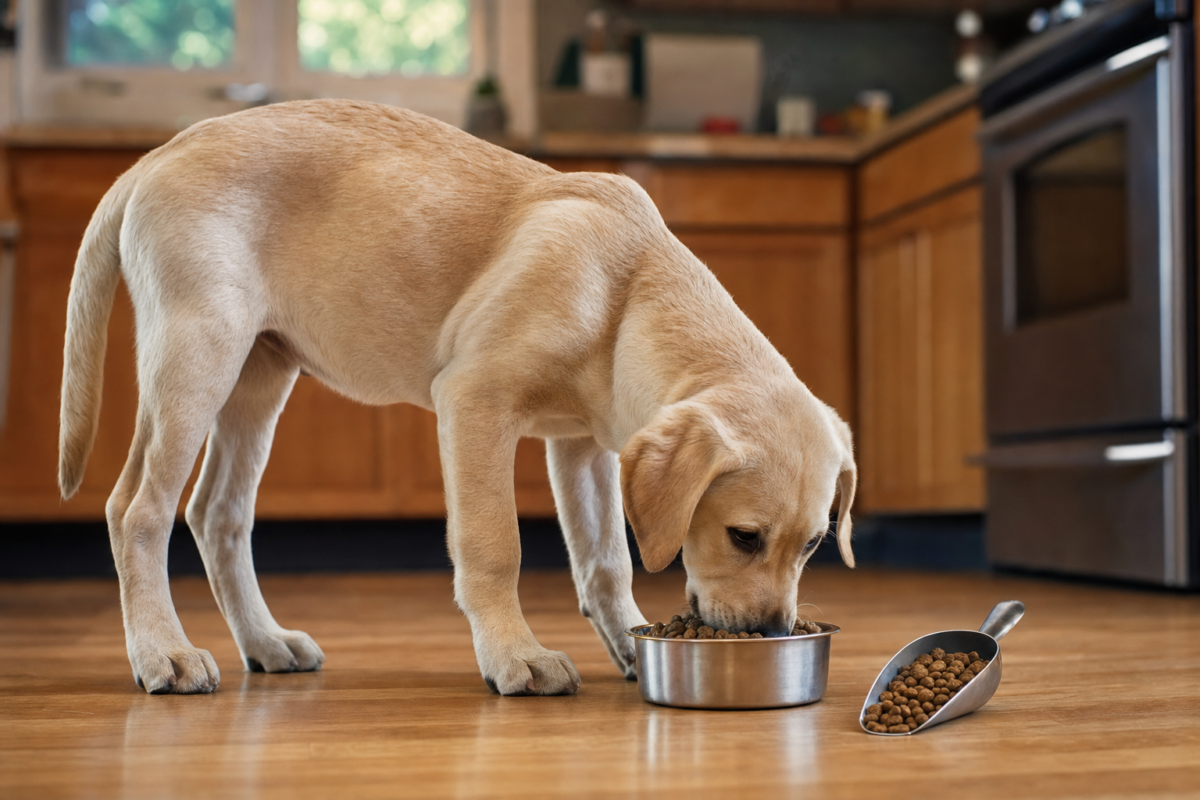
Most large breed puppies need roughly 450 to 750 calories a day at 10 to 20 pounds, 1,000 to 1,250 calories at 30 to 45 pounds, 1,500 to 1,750 calories at 60 to 80 pounds, and 2,000 to 2,400 calories once they pass 100 pounds. On a typical large breed puppy food of about 380 calories per cup, that works out to roughly 1.25 cups a day for the smallest puppies and 6 cups a day for the biggest. Always confirm the amount against your food label and your veterinarian.
Feeding a big puppy is the one daily decision that shapes almost everything else about how that dog grows. Portion size drives the growth curve, the growth curve loads the joints, and the joints carry a heavy adult body for a decade. The good news is that getting it right is not complicated. You need a sensible starting amount for your puppy’s current weight, a way to check whether it is working, and the confidence to adjust. This guide gives you all three, in a chart you can actually use.
How much food does a large breed puppy need by weight?
A large breed puppy needs about 2 times its resting energy requirement while under four months, then closer to 1.6 times as growth slows. In practice that means roughly 450 to 750 calories a day for a puppy weighing 10 to 20 pounds, 750 to 1,000 calories at 20 to 30 pounds, 1,250 to 1,500 calories at 45 to 60 pounds, and 2,000 to 2,400 calories once your puppy passes 100 pounds. Divide the daily calories by the calories per cup printed on your food bag to get the daily cups, then split that across the day’s meals.
Two things move these numbers. Activity level shifts the requirement up or down by a surprising margin, and food density varies a great deal between brands, so two cups of one food is not two cups of another. Treat the chart below as a starting point, then let your puppy’s body condition tell you whether to adjust.
What makes large breed puppy feeding different
A large breed puppy is not simply a bigger version of a small one. It is laying down a great deal of bone across a much longer window, and the balance of the diet matters as much as the volume. Large breed puppy formulas are built with controlled calcium and phosphorus levels and a moderate calorie density, precisely so that a big puppy grows steadily rather than explosively. Adult food and standard puppy food are not designed for that job.
The second difference is timing. A small dog is essentially finished within a year. A large breed keeps growing for 18 to 30 months depending on expected adult weight, and stays on a puppy formula far longer as a result. The third difference is consequence. Extra weight on a 90 pound frame is simply more load than extra weight on a 20 pound frame, and it arrives while the skeleton is still under construction.
All of which is why the guiding principle for a big puppy is steady growth rather than fast growth. You are not trying to grow the biggest dog. You are trying to grow the soundest one.
Large breed puppy feeding chart by weight
Amounts below assume a complete food formulated for large breed puppies at about 380 calories per cup. Check your own bag, because a denser food means fewer cups for the same calories.
| Current weight | Daily calories | Approximate cups per day | Meals per day |
|---|---|---|---|
| 10 to 20 lb | 450 to 750 | 1.25 to 2 | 3 |
| 20 to 30 lb | 750 to 1,000 | 2 to 2.5 | 3 |
| 30 to 45 lb | 1,000 to 1,250 | 2.5 to 3.25 | 3 |
| 45 to 60 lb | 1,250 to 1,500 | 3.25 to 4 | 2 or 3 |
| 60 to 80 lb | 1,500 to 1,750 | 4 to 4.5 | 2 |
| 80 to 100 lb | 1,750 to 2,000 | 4.5 to 5.25 | 2 |
| 100 lb and above | 2,000 to 2,400 | 5.25 to 6.25 | 2 |
The World Small Animal Veterinary Association’s Global Nutrition Committee publishes evidence-based guidance for evaluating dog food and feeding practices. Read more from the WSAVA Global Nutrition Guidelines.
Weigh your puppy every couple of weeks and move down the chart as the number climbs. A big puppy can outgrow a portion in a fortnight, which is why a chart by weight is more useful than a chart by age.
When to change the amount and when to switch to adult food
Change the portion whenever your puppy’s weight moves into a new band, and whenever body condition tells you to. Those two triggers cover almost every adjustment you will ever need to make. Beyond that, the big transition is the move from puppy food to adult food, and it comes later in big dogs than most people expect.
As a working guide, dogs expected to finish at 50 to 65 pounds grow for roughly 16 to 18 months. At 65 to 80 pounds it is about 18 to 22 months. At 80 to 100 pounds, 20 to 24 months. At 100 to 130 pounds, 22 to 26 months. Above 130 pounds, growth can run 24 to 30 months or longer. Most veterinarians move a large breed to adult food near the end of that window, once the growth curve has clearly flattened.
Why the growth window matters for feeding
Through this whole window your puppy is building the cartilage, bone and connective tissue that will carry an adult body. Growth plates, the soft areas at the ends of long bones, stay open through much of the first year and close later in bigger breeds. Feeding for even growth while that construction is under way is one of the simplest ways to support comfortable movement later, alongside sensible exercise and daily joint support.
Free Feeding
A bowl left down all day makes portion control impossible and lets a big puppy grow too fast.
Uncounted Treats
Training rewards add up quickly. Take them out of the daily total rather than adding them on top.
Added Calcium
A complete large breed puppy food is already balanced. Never add mineral supplements without veterinary direction.
Feeding For Size
Pushing food to grow a bigger dog loads a frame with open growth plates. Lean is kind at this age.
How to feed for steady growth
Once you have a starting amount from the chart, a few habits keep it accurate as your puppy grows.
- Measure with a proper measuring cup or, better, a kitchen scale. Scooping with a mug is how portions quietly drift upward.
- Split the daily amount across set meals rather than leaving food down. Three meals while young, two once adolescence arrives.
- Count every treat, chew and training reward inside the daily total, and keep them under about a tenth of the calories.
- Weigh your puppy every two weeks and compare against the chart bands rather than against another puppy.
- Bring the food bag or a photo of the label to each veterinary visit so the amount can be checked against the actual calorie density.
- Change foods gradually across a week, mixing increasing proportions of the new food into the old.
How to check body condition in ten seconds
The chart gives you a starting point. Body condition tells you whether it is right for your individual dog.
- Ribs. Run your hands along the sides. You should feel the ribs easily under a thin layer. If you have to press through padding, ease back on food.
- Waist. Look down from above. You want a clear waist that tucks in behind the ribs.
- Tuck. From the side, the belly should rise toward the back legs rather than hanging level.
Check every couple of weeks through the growth years and adjust portions by about ten percent at a time, with your veterinarian’s guidance.
Exercise and appetite go together
How much your puppy moves changes how much your puppy needs, and during the fast growth months the goal is regular, moderate activity rather than repeated hard impact.
- Favour free play, exploring and short walks on soft ground while young.
- Keep long runs, hard sprints and repeated jumping moderate while growth plates are open.
- Add scent games and training, which tire a big puppy without loading young joints.
- If activity rises for a stretch, expect appetite to rise with it, and adjust portions rather than adding extra treats.
Supporting joints through the growth years
Feeding steadily is one half of protecting a big dog’s frame. Supporting the joints that frame rests on is the other. A large breed carries real weight through every stride, and the growth window is when the supporting structures are actually being built.
Alongside lean feeding and sensible exercise, many big dog parents add a daily joint support chew made for large and giant breeds. MoveGuard Growth is built for exactly this stage. It combines nine actives, including New Zealand Green Lipped Mussel, glucosamine, chondroitin, MSM and hyaluronic acid, to support the developing joints of young large breed dogs across the roughly 8 to 30 month growth window. You dose by expected adult weight, so a dog expected to finish at 50 to 80 pounds takes two chews a day and one heading past 80 pounds takes three. It is made in the USA and is backed by a 60 day guarantee.
Support A Growing Frame
Give your growing big dog daily joint support built for large and giant breeds. Explore MoveGuard Growth.
Signs you are feeding the right amount
You do not need a spreadsheet to know feeding is going well. Look for a puppy with a waist you can see from above, ribs you can feel with light pressure, plenty of energy, a glossy coat and firm, consistent stools. Growth should look like a steady climb rather than a series of jumps.
If your puppy seems constantly ravenous yet stays thin, or gains quickly and starts to look round through the middle, or has loose stools that persist for more than a day or two, those are all good reasons to talk with your veterinarian rather than guess.
A simple feeding game plan, stage by stage
You do not need a complicated program. You need the right emphasis at the right time.
8 weeks to 4 months. Three measured meals a day of a complete large breed puppy food. This is the fastest growth of the whole timeline, so weigh often and move up the chart bands as needed.
4 to 8 months. Appetite peaks and so does the temptation to overfeed. Keep measuring, keep treats counted, and start checking body condition on a schedule rather than when you happen to think of it. A natural point to begin a daily joint support routine.
8 to 18 months. Growth slows and the calorie requirement flattens even as your dog gets taller. Many puppies need a modest reduction here. Drop to two meals a day if you have not already.
18 months onward. Discuss the switch to adult food with your veterinarian, timed to your dog’s expected adult weight. Recalculate portions on the new food rather than keeping the same number of cups.
Common feeding mistakes to avoid
Most feeding problems in big puppies come from a few avoidable habits.
- Keeping the same portion for months. A big puppy outgrows its amount fast, then outgrows it in the other direction as growth slows.
- Switching cups without switching maths. A new food with a different calorie density needs a new portion, not the same scoop.
- Adding toppers and table food. Extras unbalance a carefully formulated puppy diet and quietly add calories.
- Rushing to adult food. Large breeds need puppy formulas longer than small dogs. Let your veterinarian set the date.
- Judging by the scale alone. Weight without body condition tells you only half the story.
Mealtime habits worth building
How you feed matters alongside how much. Big dogs eat fast, and a puppy that inhales a bowl is worth slowing down early with a slow feeder bowl or by scattering kibble across a snuffle mat. It turns a ten second meal into a satisfying few minutes and gives a busy mind something to do.
Feed in the same quiet place each time, and let your puppy eat undisturbed. Wandering hands around a food bowl teach a dog to worry about people approaching a meal, which is the opposite of what you want in a dog that will one day weigh as much as a person. Instead, occasionally walk past and drop something better into the bowl, so an approaching person becomes good news.
Finally, keep the routine steady. Predictable meals at predictable times settle a growing dog, make it far easier to notice a change in appetite, and turn feeding into one of the calmest parts of your day rather than one of the loudest.
Frequently asked questions
How many cups should I feed a large breed puppy?
It depends on your puppy’s current weight and the calorie density of your food. On a typical large breed puppy food of about 380 calories per cup, a 30 pound puppy needs roughly 2.5 cups a day and an 80 pound puppy roughly 4.5 cups. Always check your bag and confirm with your veterinarian.
How many times a day should a large breed puppy eat?
Three measured meals a day while young, moving to two meals as your puppy reaches adolescence. Split meals keep energy even and make portion control far easier than free feeding.
When should I switch my large breed puppy to adult food?
Later than most people expect. Large breeds usually move to adult food between 18 and 24 months, and giant breeds later still, once the growth curve has flattened. Let your veterinarian set the timing.
Should I add calcium to a large breed puppy diet?
No, not unless your veterinarian specifically directs it. A complete large breed puppy food already balances calcium and phosphorus for steady growth, and extra minerals unbalance a carefully built formula.
Is my large breed puppy too thin or too heavy?
Use body condition rather than the scale. You should feel the ribs easily under a thin layer, see a waist from above, and see the belly rise toward the back legs from the side. Adjust portions gently and ask your veterinarian if you are unsure.
The bottom line
Feed your large breed puppy by current weight rather than by age, using the chart above as a starting point and your food label to convert calories into cups. Measure every meal, count the treats, weigh your puppy every couple of weeks, and let body condition make the final call. Steady, unhurried growth is the goal, and it is the single kindest thing you can do for a frame that has to carry a big body for a long time.
Want the Simple Roadmap in One Place?
Grab our free Big Dog Growth Blueprint for the growth window checklist, feeding framework and joint safe exercise limits, all written for large and giant breeds.
This article is for general educational purposes only and is not veterinary advice. It is not intended to diagnose, treat, cure or prevent any disease. Always consult your veterinarian about your dog’s individual health, nutrition and supplement needs. These statements have not been evaluated by the Food and Drug Administration.
Support Big Breed Joints from Day One
Large and giant breeds carry more load through every growth stage. MoveGuard Growth supports developing joints in young big dogs (8 to 30 months); MoveGuard Adult keeps grown big dogs moving comfortably.

Leave a Reply