
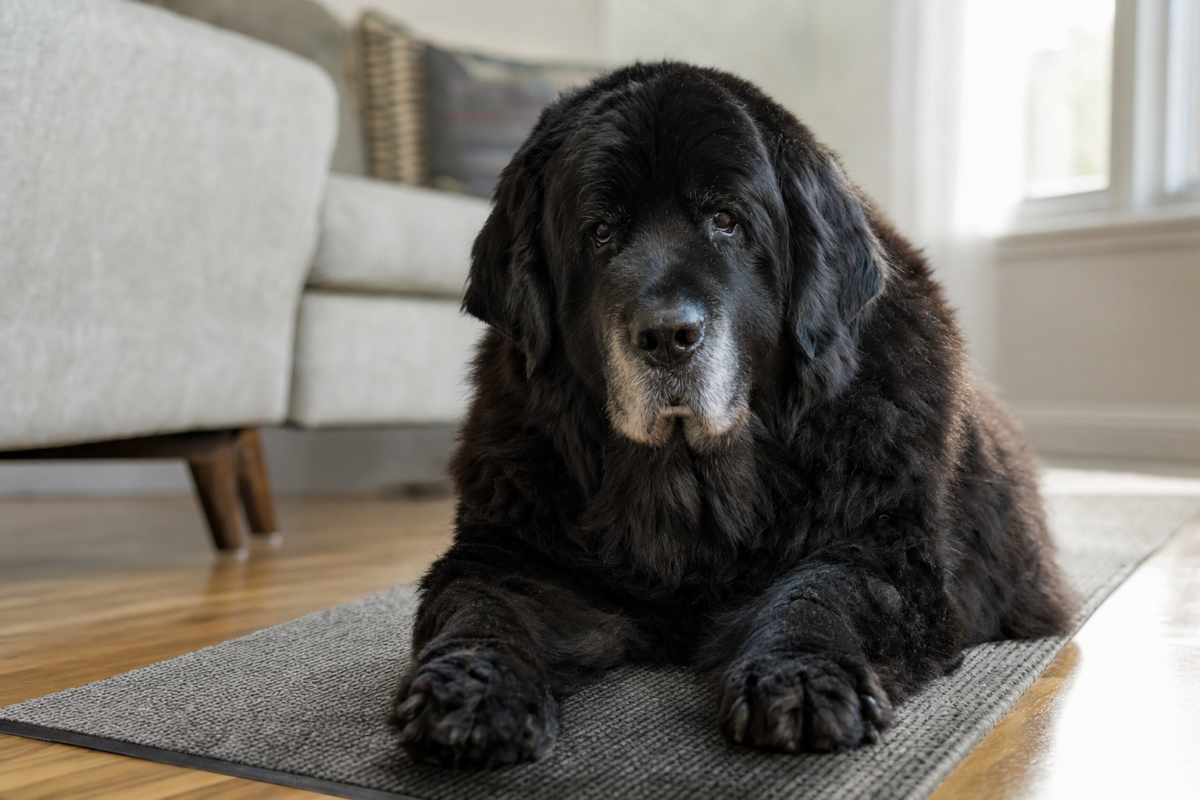
Setting up a home for an ageing big dog comes down to traction, height and distance. Cover slippery floors with rugs or runners along every route your dog uses daily, raise the bed and the food and water bowls so your dog is not folding down to floor level, shorten the trip to the garden with a ramp or a gentler door, and give your dog one warm, padded, draught free resting spot on the ground floor. Most homes need three or four changes, not a renovation, and the difference in how confidently a big old dog moves is usually visible within a week.
There is a moment most big dog parents recognise. Your dog pauses at the top of the hardwood hallway, plants both front feet, and thinks about it. That hesitation is almost never stubbornness. It is a large body telling you that the surfaces and distances in your house now ask more than they used to. A home is far easier to change than a dog, and a handful of cheap adjustments give an older big dog back a great deal of independence.
How should I set up my home for an ageing big dog?
Set up your home around four things: grip underfoot, height at the bed and the bowls, short and simple routes to the door, and a warm padded place to rest on the level where your family actually spends time. Lay rugs or rubber backed runners along every daily route, raise food and water so your dog eats standing tall rather than folded over, add a ramp or a single wide step wherever your dog has to change level, and move the main bed to the ground floor near the people. Then remove the small obstacles that have always been there and nobody notices: the sliding mat at the back door, the coffee table in the turning circle, the dim hallway at night.
Everything else is refinement. Work through the house once with the routes in mind, fix the worst surface first, and you will have solved most of it in an afternoon.
What changes for a big dog as the years add up
Large and giant breeds age on their own schedule. A Great Dane or a Mastiff may be considered senior around six or seven, while a Labrador or a Shepherd is often eight or nine before the label fits. The changes themselves are predictable. Muscle over the hips and shoulders thins, so pushing up from the floor takes more effort. Reaction time slows, so a foot that starts to slide is not caught as quickly. Low light vision dims and hearing softens, so a dog that once crossed a dark house on autopilot now travels carefully.
What makes this harder for big dogs is leverage. A heavy dog that loses grip has a long way to fall and a lot of weight behind it, so one bad slide on a polished floor can turn into weeks of caution. Because big dogs are stoic, the first signal is rarely a limp. It is a changed choice: taking the long way round the rug, sleeping downstairs, waiting at the door instead of trotting out. The signs your big dog is slowing down tell you which room to fix first.
Room by room home setup checklist
Use this as a walkthrough. Follow your dog through a normal day and change what your dog meets most often: the hallway crossed twenty times a day matters more than the spare room.
| Area | What to change | Why it helps |
|---|---|---|
| Hallways and landings | Rubber backed runners along the full route, corner to corner | Gives a continuous grip surface so no stride lands on bare board |
| Living room | Large low pile rug in the turning and settling area, coffee table pushed back | Creates a safe place to lie down and stand up, and widens the turning circle |
| Kitchen | Non slip mat under the bowls, second mat where your dog waits and turns | Tile and vinyl are the slipperiest surfaces in most homes |
| Feeding station | Raised food and water at roughly elbow height, or check the height with your veterinarian | Lets your dog eat and drink without folding neck, elbows and hips down to the floor |
| Sleeping spot | Thick supportive bed on the ground floor, near the family, away from draughts | Warm, even support makes lying down and getting up easier and less stiff |
| Stairs | Carpet treads, a gate at the top, or a routine that avoids them entirely | Stairs are where most household slips happen for heavy dogs |
| Back door and threshold | Ramp or one broad shallow step, plus a fixed mat on both sides | Removes the jump down and the slide on landing |
| Car and garden gate | Wide sturdy ramp with side rails and a grippy surface | Keeps your dog moving on four legs instead of being lifted or leaping |
| Night routes | Plug in night lights along the path from bed to door and to water | Supports failing low light vision and prevents collisions with furniture |
Traction comes first, before anything else
If you only do one thing this month, make it the floors. Hardwood, laminate, polished concrete and tile were designed for human shoes and give a dog claw almost nothing to hold. A younger dog compensates with speed and strength; an older big dog cannot, and every slide teaches a caution that is hard to unteach. This is why floor traction does more for confidence than any other change in the house.
Build a continuous path rather than islands. A rug here and a mat there leaves gaps, and the gap is where a dog lengthens stride and loses grip. Cover the route from bed to water bowl to back door end to end, using rubber backed runners or a proper grip underlay so nothing shifts, keep the pile low so paws do not catch, and check the edges every few weeks because a curled corner is its own hazard.
The paw check nobody thinks to do
Traction is half floor and half foot. Long nails tip the toes upward and shrink the contact patch, so keep them short enough that they do not tap on a hard floor. Trim the tufts of hair between the pads, because a long tuft acts like a sock on a wooden floor. Both jobs are free and together they often recover more grip than an expensive rug.
Slippery Routes
Bare hard floors on a daily route are the single most common cause of household slips for heavy dogs.
Floor Level Bowls
Eating from the ground asks an old frame to fold and hold a position for several minutes at a time.
Unavoidable Stairs
A flight taken many times a day is heavy work, and a descent on a slick tread is riskier than any climb.
Cold And Draughts
A bed near a door or an uninsulated wall lets an old body stiffen overnight, and stiffness shows up as reluctance.
Stairs, thresholds and getting outside
Changing level is the hardest thing a big old dog does in a normal day, and it happens more often than most of us count. If your dog climbs a full flight six times a day because the sofa is upstairs, the cheapest fix is not a ramp, it is moving the destination downstairs.
- Make stairs optional first. Move the bed, the water and the favourite resting spot downstairs so the climb becomes a choice rather than the price of joining the family.
- Add grip to any flight that stays in use. Carpet treads or stick on rubber strips on every step, not every other step, and a light at the top and bottom.
- Gate the top if your dog rushes. Enthusiasm at the top of a flight is the risky moment, especially first thing in the morning.
- Ramp the back door. A single ramp with a grippy surface and low side rails beats a jump down onto a wet patio.
- Retire the leap into the car. A wide ramp or solid steps protect both your dog and your own back.
Set up ramps before you need them. A dog that learns a ramp while still steady will use it happily for years; one asked to learn on a bad day will refuse, and you will end up lifting.
The bed, the resting spots and the night routine
An ageing big dog spends most of the day lying down, so the bed is not furniture, it is equipment. Big dogs need thickness more than softness: a deep supportive foam base spreads weight evenly, keeps elbows and hips off the hard floor underneath, and gives something to push against when standing up. A thin pad on tile is close to no bed at all, which is why the practical details of the best bed for a senior large breed dog matter more at this age than any other.
- Size it generously. Your dog should be able to stretch out fully on their side without a limb hanging off the edge.
- Keep sides low on at least one edge. A high bolster all the way round is something to climb over at three in the morning.
- Put it on a rug, not bare floor. The bed will slide when your dog pushes up, and a sliding bed undoes everything the bed was for.
- Place it out of the draught. Away from the back door, off the coldest wall, and warm enough that your dog wakes loose rather than stiff.
- Offer two spots, not one. A main bed near the family plus a second padded spot where your dog likes to keep watch means resting never costs a long walk.
Night deserves its own plan. Older dogs often need a garden trip at an unsociable hour, so make that route the safest in the house: lit, carpeted, short and clear of furniture. Keep fresh water within a few steps of the bed too, because a thirsty dog facing a dark kitchen will sometimes just stay put.
Food, water and the mealtime setup
Raising the bowls is the second change most parents see a response to. A big dog eating from the floor holds neck, shoulders and elbows folded for several minutes at a time, and an older frame protests. Heights vary with build, so start at roughly your dog elbow height and ask your veterinarian to confirm what suits your individual dog.
- Set both bowls on a wide non slip mat so nothing slides while your dog eats.
- Keep a second water station near the main resting spot so drinking never requires a journey.
- Use wide shallow bowls, which are easier on a dog that no longer wants to dip deep.
- Feed two measured meals a day at predictable times.
- Watch weight closely. A few extra pounds load every joint on every step, and weight is the lever with the most immediate effect on comfort.
How to check body condition in ten seconds
The scale tells you weight, but body condition tells you what that weight means. You can check it at home in seconds.
- Ribs. Run your hands along the sides. You should feel the ribs easily under a thin layer. If you have to press, ease back on portions.
- Waist. Look down from above. You want a clear waist that tucks in behind the ribs.
- Tuck. From the side, the belly should rise toward the back legs rather than hanging level.
Check every couple of weeks and adjust portions with your veterinarian guidance. Muscle loss hides behind a steady number on the scale, so use your hands as well as the numbers.
Gentle daily movement inside the house
A well set up home is not a padded box. Movement is what keeps the muscle that supports the joints. What changes is the shape of it: little and often beats one long outing, and soft ground beats pavement.
- Several short walks a day rather than one long one, on grass or soft trail where you can.
- A few minutes of pottering in the garden after meals, which keeps things loose.
- Slow, deliberate movement on grippy surfaces inside, so your dog keeps practising balance.
- Warm up gently after a long sleep, because the first few minutes after standing are the stiffest.
- Scent games and slow food puzzles on the rug, which tire a big dog without loading the joints.
Daily habits that support comfortable movement
A home that grips underfoot, a bed that supports, a sensible weight and steady gentle movement do most of the work of keeping an older big dog comfortable. Many big dog parents add one more daily habit alongside those, a joint support chew built for larger frames. The broader picture of joint support is worth reading if this is new to you.
MoveGuard Adult is a daily soft chew made for medium and large breed adult dogs. It combines New Zealand Green Lipped Mussel, glucosamine, chondroitin, MSM, eggshell membrane collagen, hyaluronic acid and vitamins C and E to support cartilage, connective tissue and comfortable everyday movement. It ships as 60 soft chews in a chicken liver flavour, is made in the USA in an NSF registered facility, and is backed by a 60 day guarantee. Confirm the right daily serving for your dog with your veterinarian, particularly if your dog already takes other supplements.
Support Comfortable Movement
Give your older big dog daily joint support built for large and giant breeds. Explore MoveGuard Adult.
Signs your setup is working
Watch how your dog chooses to move over the following week or two. Progress looks like crossing the hallway at a normal walk instead of picking along the edge, settling in the middle of the room, standing up in one motion, and following you between rooms without weighing it up first. A dog that wakes loose rather than stiff usually had a warm, supportive night.
If instead you see new limping, sudden reluctance to stand, a change in appetite, or stiffness that lasts well into the day, that is a conversation with your veterinarian rather than another rug.
A simple setup plan you can finish in one weekend
You do not have to do everything at once, and you should not. Work in the order your dog feels it.
Hour one: walk the routes. Follow your dog through a normal day and write down every surface change and every level change, plus any point where your dog pauses before committing. That list is your whole project.
Saturday: fix the floors. Lay runners and rugs along the routes you listed, with grip underlay, edge to edge, no gaps. Trim nails and pad hair the same day. This is the change with the biggest return and the lowest cost.
Sunday morning: raise and reposition. Put the bowls up on a mat, move the main bed to the ground floor near the family and out of the draught, add the second resting spot, and put a water bowl beside it.
Sunday afternoon: solve the level changes. Add the back door ramp, carpet the stairs that remain in use or gate them, fit the car ramp, and plug in the night lights along the route from bed to door.
The following week: watch and adjust. Notice which spots your dog now chooses and which they still avoid, then fix the avoided one. Book the routine veterinary check too, because a mobility conversation is more useful with two weeks of observation behind it.
Common mistakes when adapting a home
Most of these are well meant, which is exactly why they are easy to miss.
- Islands instead of paths. Scattered mats leave bare gaps, and the gap is where the slide happens.
- Waiting for a limp. Big dogs hide discomfort for a long time. Set the house up while your dog is still steady, not after a fall.
- Banishing the dog to a quiet room. Comfort that costs company is not comfort, and isolation shows up as anxiety and pacing.
- Lifting instead of ramping. Carrying a heavy dog is unpleasant for both of you and teaches your dog that the journey is not theirs.
- Buying a thin bed for a heavy dog. If your hand presses through to the floor, so do the elbows and hips.
- Letting weight creep. As activity drops the portions usually should too. It is the quietest change with the loudest effect on joints.
- Rearranging everything at once. A dog with dimming sight navigates by memory. Change things in stages and keep the furniture map broadly familiar.
Keeping an older big dog part of the household
The point of all this is not to wrap a dog in cotton wool. It is to keep an old dog in the room. Large breeds are intensely social, and the best home setup is the one that lets your dog stay exactly where they always were, just with better grip and a softer landing.
Keep their place in the routine. Let them come to the door when someone arrives, take the short version of the family walk rather than none of it, lie beside the sofa in the evening. Add mental work as the physical work shrinks, because a scent game on the rug satisfies a big dog enormously and costs the joints nothing. Predictability helps too: the same bed, the same feeding times, the same route to the garden. Confidence is half of mobility at this age, and a familiar day builds it.
Frequently asked questions
At what age should I start adapting my home for a big dog?
Earlier than most parents expect. Giant breeds are often considered senior around six or seven and large breeds around eight or nine, and traction, bed support and raised bowls all help before any visible change. Setting things up while your dog is still steady also means ramps and new resting spots get learned easily rather than under pressure.
Do raised bowls really help an older large breed dog?
Many big dog parents find their dog eats more comfortably at a raised height, because it removes the folded neck and elbow position that floor level bowls require. Height should suit your individual dog, so start around elbow height and confirm the setup with your veterinarian, especially for deep chested breeds.
What is the best flooring for a senior big dog?
Anything with grip. Low pile carpet and rubber backed runners give the most reliable footing, while hardwood, laminate, tile and polished concrete give the least. If replacing floors is not realistic, covering the daily routes end to end with runners achieves almost the same result for a fraction of the cost.
Should I stop my ageing big dog using the stairs?
Reduce the trips rather than banning them outright where you can, by moving the bed, water and favourite resting spot to the ground floor. Any flight still in use should have carpet or rubber treads on every step and light at both ends. Ask your veterinarian for guidance specific to your dog.
How do I know whether my home changes are helping?
Watch the choices your dog makes over the next week or two. Crossing the middle of a room instead of hugging the wall, standing up in one motion, settling in new places and following you between rooms all suggest the setup is working. New limping or lasting stiffness is a reason to call your veterinarian.
The bottom line
An ageing big dog does not need a different house, just a slightly kinder one. Cover the daily routes so every step has grip, raise the bowls, put a thick supportive bed on the ground floor near the family, take the jump out of every level change, and light the night route. Keep your dog lean and keep the movement gentle and frequent. You will see the proof in how your dog walks across the room.
Want the simple roadmap in one place? Grab our free Big Dog Mobility Guide for the home setup checklist, mobility watchpoints and daily habits, all written for large and giant breeds.
This article is for general educational purposes only and is not veterinary advice. It is not intended to diagnose, treat, cure or prevent any disease. Always consult your veterinarian about your dog’s individual health, nutrition and supplement needs. These statements have not been evaluated by the Food and Drug Administration.
Support Big Breed Joints from Day One
Large and giant breeds carry more load through every growth stage. MoveGuard Growth supports developing joints in young big dogs (8 to 30 months); MoveGuard Adult keeps grown big dogs moving comfortably.
Leave a Reply