Giant dog breeds exist because people deliberately bred for size to do jobs that needed it. Mastiff types were built to guard property and to face large animals, livestock guardians were bred big enough to stand between a flock and a wolf, draught breeds were built to pull carts and haul nets, and sighthounds were bred tall and fast to course deer and wolves. Every giant breed alive today is the descendant of a working brief, and the size was the tool.
Stand next to a Great Dane and the obvious question arrives on its own. Why does a dog need to be this big? Dogs are the most physically varied species on earth, spanning from two pound companions to two hundred pound guardians, and that range is not an accident of nature. It is the record of thousands of years of people choosing which puppies to keep. This guide walks through the jobs that produced the giants, the biology that made such a spread possible, and what that inheritance means for the dog asleep across your feet right now.
Why do giant dog breeds exist?
Giant breeds exist because size solved specific problems for the people who created them. A dog guarding a flock in the mountains had to be physically capable of deterring a wolf or a bear, which meant matching the predator for presence. A dog guarding a property or a caravan had to look formidable enough that trouble went elsewhere. A dog pulling a cart or hauling a fishing net needed mass and power. A dog coursing deer over open ground needed length of leg and reach of stride.
In each case a bigger dog performed the task better, so bigger dogs were bred from. Repeat that decision across hundreds of generations in a particular valley, region or estate, and you end up with a population that reliably produces enormous animals. That is the whole mechanism, and it is why the giant breeds cluster so neatly into a handful of job families rather than appearing at random.
The four jobs that produced the giants
Almost every giant breed traces back to one of four working briefs, and knowing which one your dog descends from explains a great deal about how they behave in your living room.
| Working brief | What size was for | Breeds that came from it |
|---|---|---|
| Property and personal guarding | Presence and deterrence | Mastiff, Bullmastiff, Cane Corso, Boerboel, Dogue de Bordeaux |
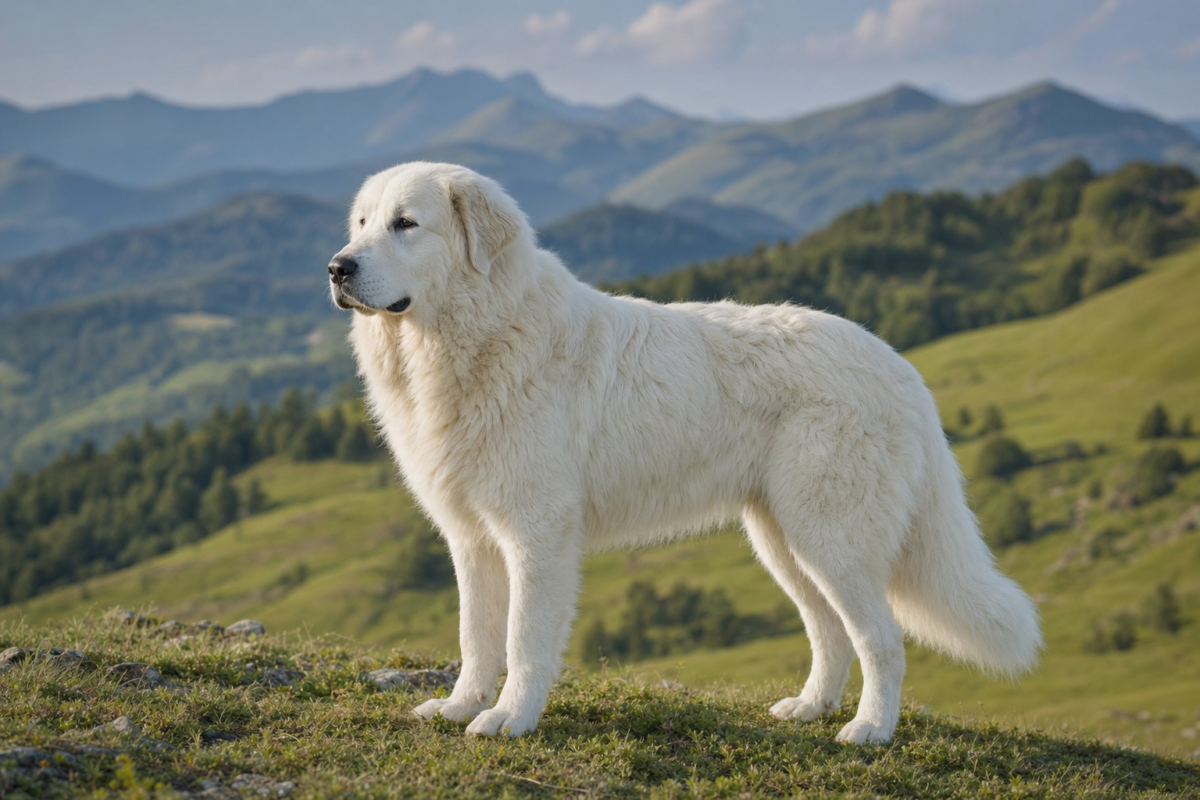
| Livestock guarding | Matching a predator on open ground | Great Pyrenees, Anatolian Shepherd, Kuvasz, Maremma, Kangal |
| Draught and water work | Pulling, hauling and swimming power | Newfoundland, Bernese Mountain Dog, Greater Swiss Mountain Dog, Leonberger |
| Coursing large game | Reach, speed and stride length | Irish Wolfhound, Scottish Deerhound, Borzoi, Great Dane |
The American Kennel Club’s Chief Veterinary Officer, Dr. Jerry Klein, DVM, has written extensively on the slower growth and development timeline of large and giant breeds. Read more from the AKC’s guidance on caring for large-breed dogs.
Notice that only one of those four briefs is about confrontation, and even that one is mostly about deterrence rather than conflict. Three of the four are jobs of patience: standing between something and a threat, pulling a load, or waiting for the moment to run.
A short history of the giants
Large guarding and hunting dogs appear in the written and carved record of the ancient world long before anything resembling a modern breed existed. Heavy molosser types are depicted across the Mediterranean and the Near East, kept for guarding, for war and for hunting big game, and Roman expansion carried those dogs across Europe where they mixed with local stock and settled into regional types.
Those regional types are the ancestors of most of today’s giants. In the Alps, monks at the hospice on the Great Saint Bernard Pass kept powerful mountain dogs that became the Saint Bernard. In the Swiss valleys, farm dogs pulled milk carts and became the Bernese and the Greater Swiss. On the Newfoundland coast, heavy water dogs hauled nets and lines for fishermen and became the Newfoundland. Across the mountains of Anatolia, the Caucasus and the Pyrenees, shepherds kept enormous pale dogs that lived permanently with the flock.
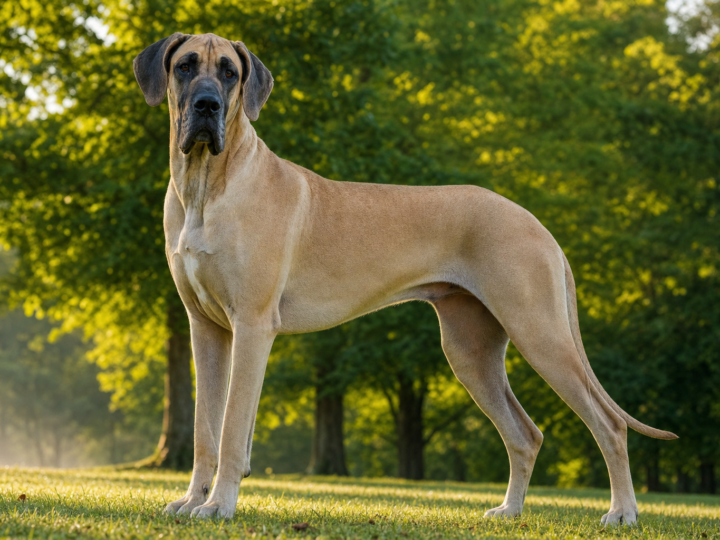
The Great Dane is a useful illustration of how much the picture has changed. Despite the name it is a German breed, developed to hunt wild boar, which required a dog with the height and courage to hold an animal that could kill it. The boar hunting ended, the dog stayed, and the breed was gradually refined into the sociable house companion people know now. Most giant breeds have a version of that story, where the job disappeared and the animal was kept for what it had become.
How dogs became so variable in the first place
The spread between the smallest and largest dogs is greater than in any other land mammal species, and that is a genuinely unusual thing. A large part of the explanation sits in a small number of genes with outsized effects on body size, one of which appears in an ancient form far older than modern breeds. Domestic dogs, in other words, carried the raw material for dramatic size variation long before anyone set out to make a Mastiff.
What people added was direction and speed. Once you select consistently for one trait within a closed population, change accumulates fast. Most of the breeds we recognise today were formalised only in the last two centuries, when breed registries fixed appearance and pedigree, but the working types behind them are far older. The registries did not create the giants. They standardised populations that had been drifting toward size for a very long time.
Bred For A Job
The brief explains the behaviour. A guardian watches, a draught breed leans, a sighthound sprints then sleeps.
Size Has A Cost
Large bodies mature slowly and live shorter lives. That trade is written into the inheritance.
Jobs Have Faded
Almost no giant now does the work it was built for, so the outlet has to be supplied deliberately.
Type Beats Label
What the ancestors did tells you more about your dog than which registry group they sit in.
Why so many giants come from cold, high places
Look at where the largest breeds originate and a pattern appears. The Pyrenees, the Alps, the Caucasus, Anatolia, Tibet, Newfoundland and the Russian steppe are all cold, often mountainous, and all produced very large dogs. Two forces pushed in the same direction.
The first is physics. A big body loses heat more slowly than a small one because volume grows faster than surface area, so large size is genuinely advantageous in a cold climate. Pair that with the thick double coats these regions produced and you get a dog built to sleep outdoors through a mountain winter.
The second is the work available. Cold, high country is where livestock met large predators, and where loads had to be moved without roads. Both jobs rewarded mass. Warmer regions with different threats and different transport tended to produce different dogs, which is why the hot climate breeds skew smaller, leaner and shorter coated.
What size cost the giants
Bigger was better for the job, but biology charged for it, and the bill still arrives in every giant breed home today. Large dogs mature far more slowly than small ones, taking two to three years to finish building a frame a terrier completes inside a year. The expected adult weight a puppy is heading toward is the single best predictor of how long that process runs.
Lifespan runs the other way to the pattern seen between species. Across the animal kingdom larger species usually live longer, yet within dogs the relationship inverts sharply: small breeds routinely reach fifteen or sixteen years while many giants are considered senior at six or seven. The leading explanation is that fast early growth and large body size carry a metabolic cost that accumulates over a lifetime.
Structure pays too. Every pound travels through the joints with each stride, which is why joint support, lean body condition and sensible surfaces matter more for a hundred pound dog than for a twenty pound one. The size that made these dogs useful is the same size that asks something of their frame every day.
What the old jobs mean for your dog today
Almost no giant breed still does the work it was designed for. The flocks are fenced, the carts have engines, and nobody is coursing wolves. What has not gone anywhere is the temperament that came with the job, and that mismatch explains most of the friction people experience with giant breeds.
A livestock guardian bred to make independent decisions at three in the morning will not deliver crisp obedience, because independence was the point. A draught breed bred to work alongside people is biddable and leans on you constantly. A sighthound explodes into motion, then sleeps for eighteen hours, and finds repetitive training tedious. A property guardian is watchful with strangers and needs early, generous exposure so that watchfulness stays proportionate. None of that is a behaviour problem. It is a job description with nowhere to go.
The practical answer is to supply a version of the original outlet. Scent games and puzzle work suit the thinkers. A weight pulling harness or a long structured walk suits the haulers. A safe space to sprint suits the coursers. Give the inheritance somewhere to go and the giant in your house settles into the calm companion the breed is famous for.
Choosing a giant breed by its original job
If you are weighing up which giant might suit your household, the working brief is a far better guide than the breed description on a kennel club page. Ask what these dogs were bred to do all day, then ask honestly whether your life offers anything like it.
- Livestock guardian lines suit space, a secure boundary and a person who values independence over obedience. They think for themselves, they bark with purpose, and they are not trying to be a companion dog.
- Draught and water lines suit families. They were bred to work close to people, which makes them biddable, tolerant and inclined to lean on everyone in the room.
- Property guarding lines suit confident, consistent households willing to invest heavily in early exposure so that natural watchfulness stays proportionate.
- Coursing lines suit people who can offer a safe place to sprint and who do not mind a dog that sleeps most of the day and finds drills boring.
Match the brief to your life and the breed will feel easy. Mismatch it and you will spend years managing an instinct that has nowhere to go, which is the single most common reason a giant ends up needing rehoming.
Are giant breeds getting bigger?
Not really, and in several breeds the opposite is happening. Breed standards set height and weight expectations, and most giant standards have been stable for decades. Where change is visible it tends to come from show ring fashion favouring heavier bone and broader heads in some lines, while working lines stay lighter and more athletic.
There is also growing attention among breeders to the health cost of extreme size, with more emphasis on soundness, longevity and hip and elbow screening than on producing the largest possible dog. That is a welcome shift. The record holders for height and weight tend to be individual outliers rather than evidence of a breed trending upward.
Common misconceptions about giant breeds
- They need enormous amounts of exercise. Most giants need less than a working spaniel. Moderate, regular movement suits them better than long hard sessions, especially while young.
- They are all descended from wolves crossed with dogs. They are not. Giant size came from selective breeding within domestic dogs, not from recent wolf ancestry.
- Bigger dogs eat proportionally more. Large dogs eat more in total but fewer calories per pound of body weight than small dogs, because metabolic rate does not scale in a straight line.
- They cannot live in smaller homes. Many giants are famously inactive indoors. Floor space for a dog to lie flat and daily safe exercise matter more than square footage.
- Giant means unhealthy. Size brings real considerations, but a well bred giant from health tested parents, kept lean, is a robust dog.
Frequently asked questions
Why do giant dog breeds exist?
Because people bred deliberately for size to do jobs that required it: guarding property, protecting livestock from large predators, pulling carts and hauling nets, and coursing large game. In each case a bigger dog did the job better, so bigger dogs were bred from across many generations.
What is the largest dog breed?
By height the Irish Wolfhound and the Great Dane are the tallest, standing around 30 to 32 inches at the shoulder. By weight the English Mastiff is the heaviest, with males commonly reaching 160 to 230 pounds and record individuals exceeding that considerably.
Why do giant breeds have shorter lives?
Within dogs the usual pattern reverses, and larger breeds age faster than small ones. The leading explanation is that rapid early growth and large body size carry a metabolic cost that accumulates, so many giants are considered senior around six or seven years.
Were giant dog breeds bred from wolves?
No. All domestic dogs share ancient wolf ancestry, but giant size came from selective breeding within domestic dog populations rather than from any recent crossing. A small number of genes with large effects on body size made that rapid change possible.
Do giant breeds need more exercise than other dogs?
Usually less than people expect. Most giants are moderate energy and many are notably inactive indoors. Regular gentle movement suits them better than long, hard sessions, and that is especially true through the slow growth years.
The bottom line
Giant breeds exist because size was once the answer to a practical problem, and every one of them carries the fingerprints of the job that made them. Understanding which brief your dog descends from tells you more about their behaviour than any label, and understanding what size costs them tells you where to put your care: slow growth respected, lean condition kept, joints looked after, and the old instinct given somewhere sensible to go.
Want the simple roadmap in one place? Grab our free Big Dog Mobility Guide for the body condition check, home setup and movement framework, all written for large and giant breeds.
This article is for general educational purposes only and is not veterinary advice. It is not intended to diagnose, treat, cure or prevent any disease. Always consult your veterinarian about your dog’s individual health, nutrition and supplement needs. These statements have not been evaluated by the Food and Drug Administration.
Support Big Breed Joints from Day One
Large and giant breeds carry more load through every growth stage. MoveGuard Growth supports developing joints in young big dogs (8 to 30 months); MoveGuard Adult keeps grown big dogs moving comfortably.
Leave a Reply