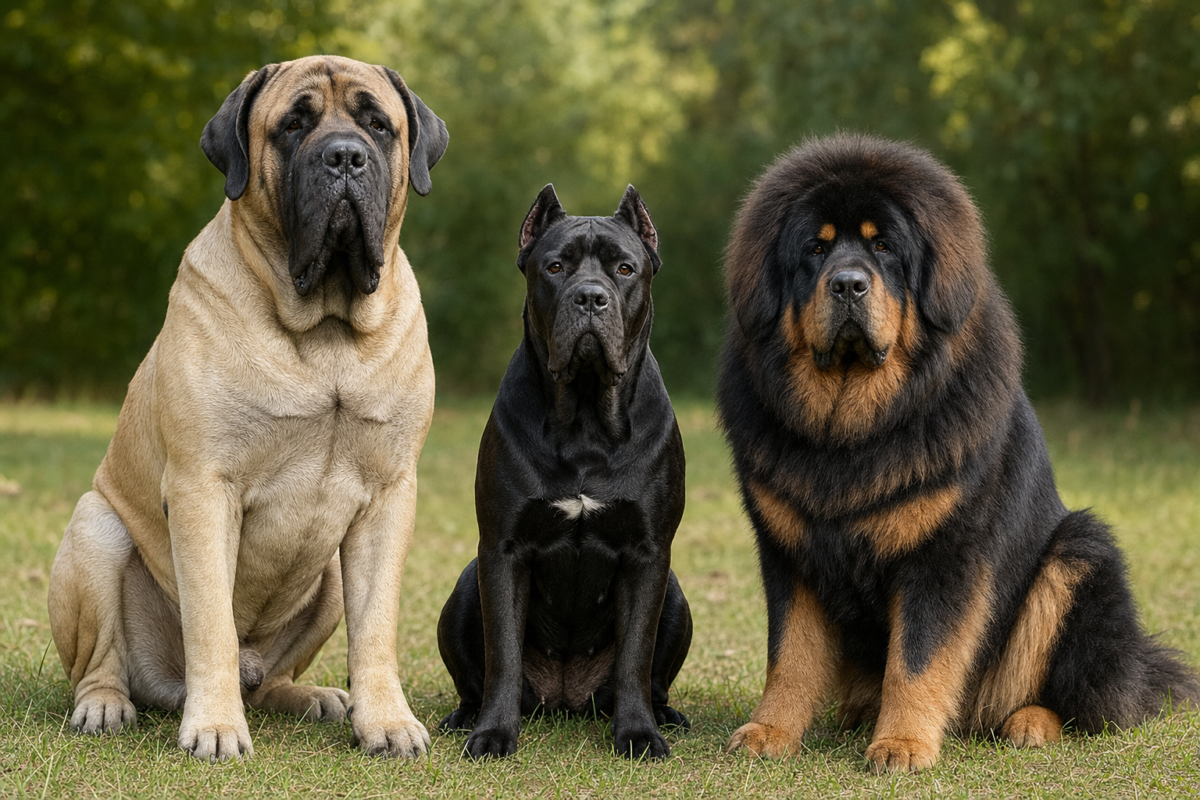
The mastiff family is a group of heavy, broad headed guardian breeds descended from the ancient molossers of the old world. The most widely recognised members are the English Mastiff, Bullmastiff, Cane Corso, Neapolitan Mastiff, Dogue de Bordeaux, Tibetan Mastiff, Boerboel and Spanish Mastiff. Several other giants sit on the wider branches of the same tree, including the Saint Bernard, the Great Dane and the Rottweiler. What unites them is not one country or one look. It is a shared build, a shared guarding history and a long, slow road to adulthood.
If someone has told you your big, square headed dog is a mastiff type, you may have wondered exactly where that label starts and stops. The mastiff family is one of the oldest and most tangled groups in the dog world, and its branches reach into breeds that look nothing alike at first glance. This guide walks the family tree from its ancient roots to the modern breeds you meet at the park, and shows what those shared traits mean for the Dog Parents raising them.
Which breeds are in the mastiff family
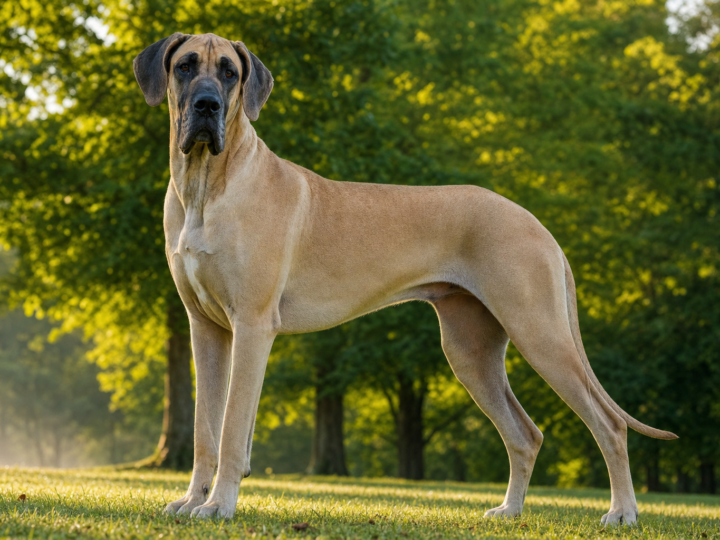
The mastiff family includes the English Mastiff, Bullmastiff, Cane Corso, Neapolitan Mastiff, Dogue de Bordeaux, Tibetan Mastiff, Boerboel, Spanish Mastiff, Pyrenean Mastiff, Fila Brasileiro, Presa Canario, Tosa and Broholmer. The wider family, often called the molossers, also takes in the Saint Bernard, the Newfoundland, the Great Pyrenees, the Great Dane, the Rottweiler and the Bernese Mountain Dog, all of which carry ancient guardian blood in their background.
No single registry defines the family the same way. Kennel clubs sort breeds by the job they do today, while the mastiff family is defined by shared ancestry and shared physical type. That is why close cousins turn up scattered across the working group, the guardian group and even the hound group depending on which country is doing the sorting.
Where the mastiff family came from
The story starts thousands of years ago with the large flock and property guardians of Central Asia and the Middle East. These were working animals kept for their size, their steadiness and their willingness to stand between a threat and the things their people valued. Traders and armies carried them west, and every region they reached adapted them to local work.
The Greeks knew a heavy guardian dog associated with the region of Molossis, and it is from that name that the modern term molosser comes. Rome spread the type further still. When the Roman network faded, those dogs stayed behind in the places they had reached, and centuries of isolated local breeding turned one broad ancient type into the distinct breeds we know now.
That is the key to reading the family tree. The English Mastiff of a British estate, the Cane Corso of an Italian farm and the Tibetan Mastiff of a Himalayan village are not copies of one another. They are what happened when a similar ancient dog met three very different jobs and climates.
The mastiff family at a glance
Use this table as an orientation map rather than a strict rulebook. Weights are typical adult ranges, with males toward the upper end.
| Breed | Home country | Typical adult weight | Original job |
|---|---|---|---|
| English Mastiff | England | 120 to 230 lb | Estate and property guardian |
| Bullmastiff | England | 100 to 130 lb | Gamekeeper companion |
| Cane Corso | Italy | 88 to 110 lb | Farm guardian and drover |
| Neapolitan Mastiff | Italy | 110 to 150 lb | Close property guardian |
| Dogue de Bordeaux | France | 99 to 120 lb | Estate guarding and haulage |
| Tibetan Mastiff | Himalayan region | 70 to 150 lb | Village and flock guardian |
| Boerboel | South Africa | 110 to 200 lb | Farm guardian |
| Spanish Mastiff | Spain | 130 to 200 lb | Livestock guardian |
| Saint Bernard | Switzerland | 120 to 180 lb | Alpine rescue and haulage |
| Great Dane | Germany | 110 to 175 lb | Boar hunting and estate guarding |
The American Kennel Club’s Chief Veterinary Officer, Dr. Jerry Klein, DVM, has written extensively on the slower growth and development timeline of large and giant breeds. Read more from the AKC’s guidance on caring for large-breed dogs.
The main branches of the mastiff family
Rather than memorising a list, it helps to think in branches. Each one solved a different problem, and that is why the dogs on it look and behave the way they do.
The classic guardian mastiffs
This is the branch most people picture: enormous, broad headed, deliberate dogs whose job was to be present and immovable. The English Mastiff sits at the centre of it, and our guide on how big an English Mastiff gets lays out the numbers year by year. The Neapolitan Mastiff and the Spanish Mastiff belong here too. These were not dogs bred for speed. They were bred for mass, calm and presence, and they still carry all three.
The working and droving branch
Lighter, faster and more athletic, these breeds kept the guardian instinct but had to move stock and cover ground as well. The Cane Corso is the clearest example, along with the Rottweiler, whose ancestors drove cattle along Roman routes through what is now southern Germany. Dogs on this branch are tighter in build, quicker on their feet and far more energetic than their heavier cousins, which surprises a lot of first time Dog Parents.
The mountain and livestock branch
Where the work was weather and wolves rather than gates and courtyards, the family grew a coat and a very independent mind. The Tibetan Mastiff, the Pyrenean Mastiff, the Great Pyrenees and the Saint Bernard all sit here. These dogs made their own decisions on a hillside at night with no one to ask, and that self direction is still part of the package in a modern living room.
The bull and mastiff crosses
The youngest branch on the tree, and the most deliberately engineered. The Bullmastiff was created in nineteenth century England by crossing mastiff mass with bulldog drive, producing a dog fast enough to catch a poacher and steady enough to hold rather than harm. The Boerboel, the Presa Canario and the Fila Brasileiro all emerged from similar thinking in their own regions, blending guardian bulk with a sharper working edge.
Very Slow Maturity
Mastiff family breeds keep developing for 24 to 30 months or longer. A two year old is often still a teenager in a very large body.
Serious Adult Weight
Every branch carries real mass. Even a few extra pounds ask a lot of joints built to carry a lot already.
Guardian Instinct
These breeds were shaped to assess and respond. Early, generous socialisation matters more here than in almost any other group.
Heat And Effort
Broad heads and heavy coats mean many of these dogs work harder in warm weather. Plan activity for the cool parts of the day.
Feeding a mastiff family puppy
Because the whole family finishes growing so late, the feeding job is a long one. The goal is never to make a big puppy bigger faster. It is to let a very large frame arrive slowly and evenly, so the skeleton and the soft tissue that supports it develop together.
- Choose a complete food formulated for large breed puppies, which controls calories and the calcium to phosphorus balance for steadier growth.
- Split the daily ration into three meals while young, then two as an adult, and keep meals calm rather than rushed.
- Feed to a lean body condition every single week of the growth years, not to a number on a bag.
- Confirm portions with your veterinarian at every visit, because the correct amount changes quickly in the first eighteen months.
- Resist free feeding. A puppy left with a full bowl often grows faster than its frame appreciates.
How to check body condition in ten seconds
Weight alone tells you very little on a dog this size, because the healthy range is enormous. Body condition tells you far more, and you can read it in seconds with your hands.
- Ribs. Run flat palms along the ribcage. You should feel the ribs easily through a thin covering. If you have to press, ease the portions back.
- Waist. Look down from above. There should be a visible narrowing behind the ribs rather than a straight line from shoulder to hip.
- Tuck. From the side, the belly should lift toward the back legs instead of running level with the chest.
Check every couple of weeks and adjust gently with veterinary guidance. Small early corrections beat large late ones.
Growth safe exercise for a mastiff family puppy
Every branch of this family shares one thing: a huge adult frame assembled slowly. The growth plates at the ends of the long bones stay open well past the first birthday in most of these breeds, and while they are open, repeated hard impact asks a great deal of a structure that is still forming.
- Favour free play, sniffing walks and exploring on soft, forgiving ground.
- Keep long runs, forced jogging and repeated jumping moderate until your veterinarian confirms maturity.
- Manage stairs, slick floors and car entry deliberately. A ramp is a genuinely useful purchase for this family.
- Use training, scent games and puzzle work to tire the mind. Guardian breeds settle far better when they have had something to think about.
- Let a growing giant rest properly between bursts. Sleep is when the building happens.
The same logic applies to joint support habits generally. What you do across those first two years shapes the comfort of the decade that follows.
Which mastiff family breed suits which home
The branches differ enough that choosing between them is a real decision, not a matter of taste in coat colour. Think in terms of energy, independence and space.
If you want a calm household presence. The heavier guardian breeds, such as the English Mastiff and the Neapolitan Mastiff, are famously low energy indoors once mature. They want proximity far more than activity.
If you want a working partner. The Cane Corso and the Rottweiler bring drive, athleticism and a real need for structure. They are happiest with a job, consistent training and a person who enjoys the work.
If you want an independent thinker. The Tibetan Mastiff and the livestock guardians will love you deeply and still make their own decisions. Recall is a lifelong project and secure fencing is not optional.
If you want size with a softer edge. The Saint Bernard, the Newfoundland and the Bernese Mountain Dog carry ancient guardian ancestry with far gentler modern temperaments, which is why they turn up so often in family homes. Our piece on why giant dog breeds exist covers how that softening happened.
Common misconceptions about the mastiff family
A group this old collects a lot of folklore. A few points worth clearing up.
- They are not all descended from one dog. The family shares a type and a broad ancestry, not a single founder. Modern genetic work shows the group is far messier and more regional than the tidy old charts suggested.
- Bigger does not mean lazier. The droving branch is genuinely athletic. A Cane Corso that is under exercised is a difficult dog to live with.
- They are not automatically aggressive. Guardian instinct is discernment, not hostility, and early exposure to the ordinary world is what calibrates it.
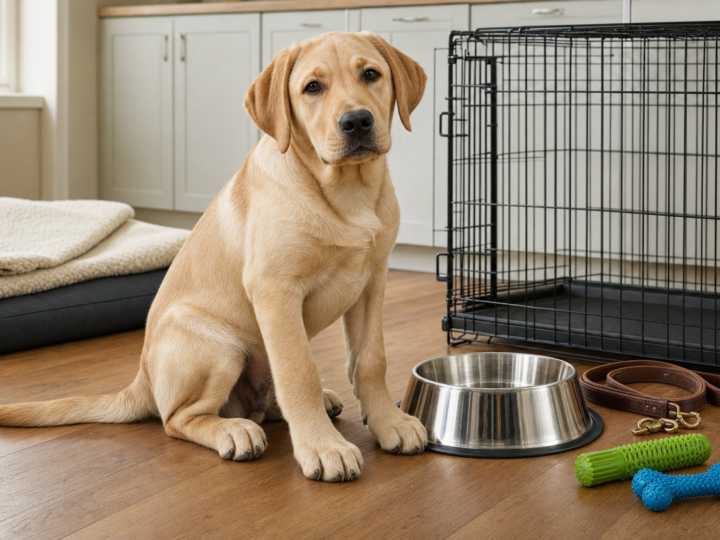
- A mastiff puppy is not a small dog for long. Buy the crate, the bed and the fencing for the adult, not the puppy.
- Growth does not stop at one year. Height may slow, but chest, head and muscle keep arriving deep into the second and third year.
The mastiff family temperament
For all the variation in size and job, there is a recognisable family character. These are watchful dogs. They notice arrivals, they assess, and then, in a well raised dog, they settle. That assessment is the whole point of the type and it cannot be trained out, only shaped.
They also tend to be strikingly sensitive for their size. Harsh handling lands badly on a mastiff family dog and often produces exactly the wariness a Dog Parent was hoping to avoid. Calm, consistent, generously rewarded training works far better, and it works best when it starts on day one rather than at the point the puppy outweighs the person holding the lead.
Bonding is the other constant. These breeds were developed to live alongside their people, not in a kennel at the edge of the field. They want to be in the room, and a mastiff family dog left alone in a yard all day is a dog whose instincts have nothing useful to attach to.
Finally, plan for the timeline honestly. The giants on this tree live shorter lives than smaller dogs, often six to ten years depending on breed, while taking two of those years to finish growing up. That arithmetic is the hardest part of loving them, and it is why so many Dog Parents in this family are deliberate about daily habits from the very beginning.
Frequently asked questions
What is the difference between a mastiff and a molosser?
Molosser is the broader term. It covers all the heavy guardian breeds descended from the ancient dogs of the old world, including mountain breeds and drovers. Mastiff usually refers to the heaviest, broadest headed branch of that group, and it is also the common name of one specific breed, the English Mastiff.
Is a Cane Corso a mastiff?
Yes. The Cane Corso is an Italian mastiff type, sitting on the lighter working and droving branch of the family. It shares the guardian ancestry and the broad head, but it is considerably more athletic and more energetic than the heaviest members of the group.
Which mastiff breed is the largest?
By sheer mass the English Mastiff is generally the heaviest breed in the world, with large males reaching well past 200 pounds. The Great Dane and the Irish Wolfhound stand taller, but they carry that height on a far lighter frame.
Are mastiff family breeds good family dogs?
Many are, provided they are well bred, socialised early and supervised sensibly around small children given their size. The gentler members such as the Saint Bernard and the Newfoundland are popular family dogs, while the sharper guardian breeds suit experienced homes that enjoy structure and training.
How long do mastiff breeds take to stop growing?
Most of the family keeps developing for 24 to 30 months, and the very largest members can take longer still. Height tends to arrive first, followed by a long stretch of chest, head and muscle development through the second and third year.
The bottom line
The mastiff family is less a neat lineage than a very old idea that travelled well: a big, steady dog that watches over what matters. Follow that idea from Central Asia through Greece and Rome and out into England, Italy, France, Spain, Tibet and South Africa, and you get every branch on the tree, from the immovable English Mastiff to the athletic Cane Corso to the snow bound livestock guardians. Knowing which branch you are living with is the single most useful thing you can learn about your own dog. What they all share is mass, a late finish line and a temperament that rewards patience.
Want the practical side in one place? Grab our free Big Dog Mobility Guide for the daily habits, weight targets and movement checks that keep large and giant breeds comfortable through every stage of life.
This article is for general educational purposes only and is not veterinary advice. It is not intended to diagnose, treat, cure or prevent any disease. Always consult your veterinarian about your dog’s individual health, nutrition and supplement needs. These statements have not been evaluated by the Food and Drug Administration.
Support Big Breed Joints from Day One
Large and giant breeds carry more load through every growth stage. MoveGuard Growth supports developing joints in young big dogs (8 to 30 months); MoveGuard Adult keeps grown big dogs moving comfortably.
Leave a Reply