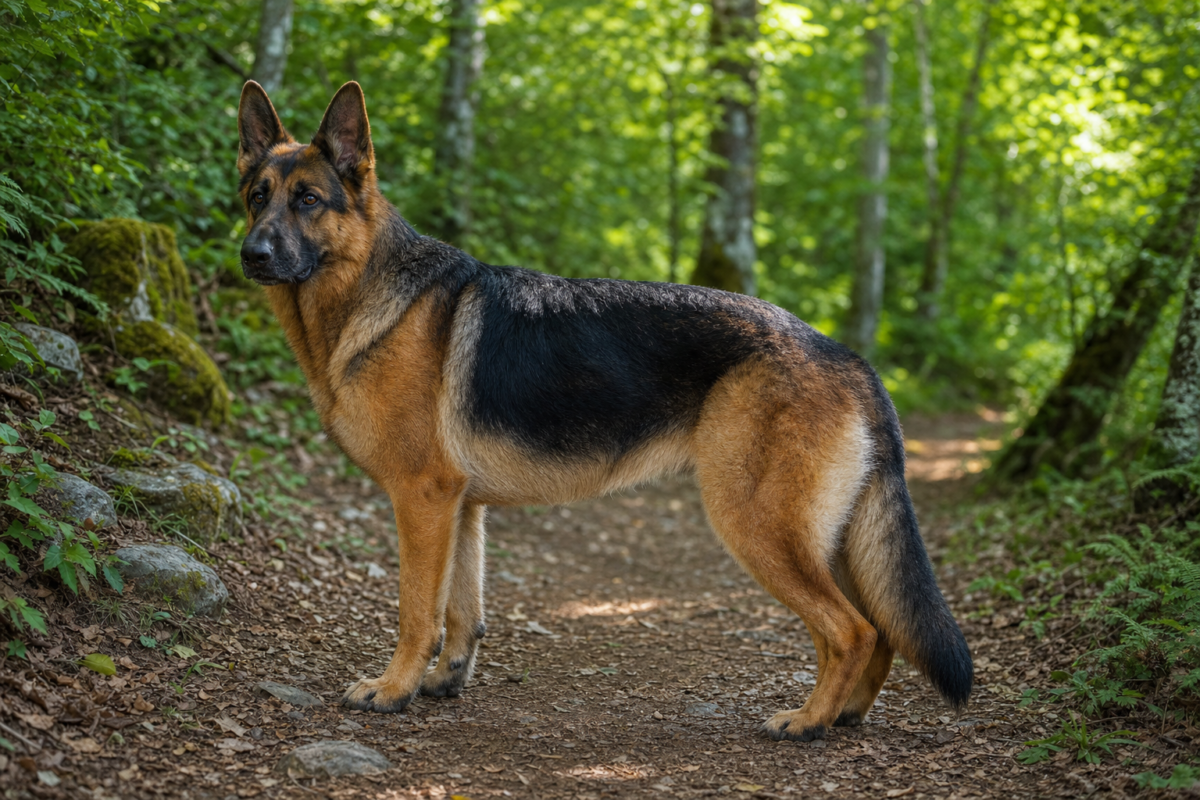
To hike safely with a large breed dog, build distance slowly over several weeks, wait until the growth window closes before attempting long or steep trails, and carry at least one litre of water for every hour on the trail. Choose soft ground over rock where you can, keep the pace to your dog rather than your own, stop for a rest and a water break every 30 to 45 minutes, and check the paws, gait and breathing at every stop. Big dogs carry more weight over the same joints and shed heat far more slowly than small dogs, so cool weather, shorter days and honest turnaround times matter more than mileage.
There is very little in life better than a quiet trail and a big dog walking beside you. Large and giant breeds were built for exactly this kind of steady, purposeful work, and a well planned hike gives them the physical outlet and the mental stimulation that a lap around the block never will. The catch is that everything about hiking scales differently for a hundred pound dog than it does for a twenty pound one. This guide walks you through how far is reasonable, when your dog is ready, what to carry, and how to read the signals that tell you it is time to turn back.
How do I hike safely with a large breed dog?
Hike safely with a large breed dog by matching the trail to your dog rather than your dog to the trail. Start with short, flat routes of 20 to 30 minutes and add roughly ten percent more distance a week, keep hikes to cool parts of the day, carry a litre of water for every hour you plan to be out, and stop every 30 to 45 minutes to offer water and check paws and breathing. Save long, steep or rocky routes until your dog is physically mature, which for most large and giant breeds falls somewhere between 18 and 30 months.
The core difference is load. A big dog carries far more body weight through every step, every descent and every jump down off a rock, and that load travels through joints and pads that have to do the same work your own boots and knees do. The good news is that big dogs are often naturally suited to hiking pace, which is slow, steady and continuous. It is the extremes at either end, the sprint and the marathon, that ask the most of a heavy frame.
What makes hiking different for a big dog
Three things set large and giant breeds apart on the trail, and each one changes how you plan the day.
Heat. A dog cools itself mostly by panting, and the amount of heat a body makes rises with its mass while the surface available to shed that heat does not keep pace. A large, dark coated dog working uphill in still air heats up quickly and cools down slowly. This is the single most common reason a hike goes wrong, and it has nothing to do with fitness.
Load through the joints. Descents are harder on a big dog than climbs. Going down, each front leg absorbs braking force from a heavy body, which is why many large breeds look fine at the summit and stiff at the car park. Building the habit of a controlled, unhurried descent does more for long term comfort than any amount of uphill conditioning.
Recovery time. A giant breed often needs a full day of easy movement after a hard hike, not a quick nap. Planning the rest day is part of planning the hike.
Trail readiness by age and stage
Use this as a starting frame and adjust to the individual dog in front of you. Every figure below assumes cool weather, soft ground and a willing dog.
| Age | Reasonable outing | What to focus on |
|---|---|---|
| 8 weeks to 4 months | 10 to 20 minutes on flat, soft ground | Confidence, surfaces, recall. No real trail yet. |
| 4 to 8 months | 20 to 40 minutes, gentle gradient | Short loops, frequent rests, no jumping down. |
| 8 to 12 months | 45 to 60 minutes, easy trail | Steady pace, soft footing, water discipline. |
| 12 to 18 months | 1 to 2 hours, moderate trail | Build distance slowly. Avoid long descents. |
| 18 months to 3 years | 2 to 4 hours once conditioned | Full days become reasonable for most breeds. |
| Adult, 3 to 7 years | Half day to full day | Conditioning, paw care, honest turnaround points. |
| Senior, 7 years plus | 30 to 90 minutes, flat and familiar | Shorter and more often beats long and rare. |
The American Kennel Club’s Chief Veterinary Officer, Dr. Jerry Klein, DVM, has written extensively on the slower growth and development timeline of large and giant breeds. Read more from the AKC’s guidance on caring for large-breed dogs.
When is a large breed dog old enough for real trails?
A large breed dog is ready for genuine hiking when the skeleton has finished growing, and that takes longer than most new Dog Parents expect. The soft areas at the ends of the long bones, known as growth plates, stay open through much of the first year and beyond. While they are open, repeated impact and long distance ask a great deal of a frame that is still forming.
Why the growth window sets the ceiling
As a rough guide, dogs with an expected adult weight of 50 to 65 pounds finish structural growth around 16 to 18 months, 65 to 80 pounds around 18 to 22 months, 80 to 100 pounds around 20 to 24 months, 100 to 130 pounds around 22 to 26 months, and the true giants at 130 pounds and up can keep developing to 30 months or beyond. A puppy can absolutely come along on a gentle walk in the woods during that window. What waits is the eight mile day, the scramble, the sustained descent and the repeated jumping down off boulders. If you want a detailed picture of the ramp, our guide to long walks for large breed puppies maps distance to age in more detail.
Overheating
The most common trail emergency for big dogs and the fastest to arrive. Hike early, hike in shade, and turn back on heat rather than on distance.
Paw Damage
Hot rock, sharp scree and wet grit wear pads raw. Check all four paws at every stop, not just at the end.
Too Much, Too Soon
A big dog will happily follow you well past its own limit. Distance has to be built over weeks, not decided on the morning.
Hard Descents
Downhill braking loads the front end heavily. Keep descents slow, take the gentler line, and lift rather than let your dog jump down.
Water, food and fuel on the trail
A big dog needs roughly a litre of water for every hour of moderate hiking in mild conditions, and more in heat. Assume your dog will not find clean water on the way, because puddles, still ponds and farm runoff are not a plan.
- Carry your own supply and a collapsible bowl. Offer small amounts often rather than a large volume at once.
- Avoid a big meal in the two hours before setting off and the hour after finishing, when a hard working dog is least ready to digest one.
- Bring a small amount of your dog’s normal food for a long day, rather than novel treats that can unsettle a stomach far from home.
- Feed to a lean body condition all year round. Every extra pound is a pound your dog carries up every hill.
How to run a trail check in ten seconds
Every rest stop is a chance to catch a small problem before it becomes the reason you carry a hundred pound dog back to the car. Four quick checks cover almost everything.
- Paws. Lift each one and look at the pads and between the toes. You are looking for redness, grit, cracks or a torn edge.
- Breathing. Panting should slow within a minute or two of stopping in shade. Fast, frantic panting that does not settle means the hike is over for today.
- Gait. Walk your dog a few steps on the flat. Any head bob, short stride or reluctance to load a leg is your turnaround signal.
- Gums and interest. Bright gums and a dog still curious about the smells around it are a dog who is enjoying the day.
Building trail fitness the safe way
Conditioning a big dog is genuinely simple, and the pattern is the same one runners use on themselves. Add a little, hold it, then add a little more.
- Establish a base of daily walks on varied ground before adding any real elevation.
- Increase either distance or climb in a given week, never both.
- Add roughly ten percent more distance a week and hold the new figure for two outings before going further.
- Keep one easy day between any two demanding days, and use low impact exercise such as swimming or level walking on those days.
- Practise the descent deliberately. Most dogs are fitter climbing than they are coming down.
Gear that actually matters for a big dog
You do not need much, and most of what you need is for you rather than your dog.
- A well fitted harness rather than a collar for anything with gradient. It spreads load across the chest and gives you a safe handle on rough steps.
- A fixed length lead of one to two metres. Retractable leads and rocky ground are a poor combination with a strong dog.
- Water, bowl and a spare litre in the boot of the car for the drive home.
- A basic first aid kit with vet wrap, gauze and tweezers, plus a paw balm for pads.
- Something to lift with. Know before you set off how you would move your dog 200 metres if you had to. For most giant breeds the honest answer is a shorter route.
Daily habits that support comfortable movement
Hiking well with a big dog is mostly about what happens on the other six days of the week. Steady daily movement, a lean body condition and sensible surfaces at home all add up to a dog who arrives at the trailhead ready to enjoy it. Many big dog parents also keep a daily joint support routine going year round as part of that picture.
For a young dog still inside the growth window, MoveGuard Growth is built for that stage. It brings together nine actives, including New Zealand Green Lipped Mussel, glucosamine, chondroitin, MSM and hyaluronic acid, to support healthy joint development across the roughly 8 to 30 month growth window. You dose by expected adult weight, so most large breeds sit at two chews a day and the biggest at three. For a dog who has finished growing and is doing real mileage, MoveGuard Adult covers the same ground for a mature frame. Both ship as 90 chews, are made in the USA in an NSF registered facility, and carry a 60 day guarantee.
Support Every Mile
Give your trail companion daily joint support built for large and giant breeds. Explore MoveGuard Growth.
Signs your dog is enjoying the hike
A dog having a good day on the trail moves with a loose, even stride, keeps its head up and its nose busy, checks in with you without being asked, and settles quickly at each stop before getting up willingly. That last one is the most useful signal you have. A dog who rises eagerly after two minutes of rest has more in the tank. A dog who has to be encouraged up is telling you something.
Lagging behind, seeking shade at every opportunity, lying down unprompted, a dropped tail, wide frantic panting or a shortened stride are all reasons to stop, water up and head back the way you came. None of them mean you did something wrong. They mean today was the day you found the ceiling, which is exactly what these checks are for.
A simple hiking game plan, stage by stage
The week before. Walk the route yourself or read it properly. Note the water, the shade and the two points where you could cut the day short. Check the forecast for temperature rather than rain.
The morning of. Set off early. Skip the large breakfast. Load twice the water you think you need and leave a spare litre in the car. Check your dog over on the flat before you start climbing.
On the trail. Set the pace off your dog, not your watch. Stop every 30 to 45 minutes for water and the ten second check. Take the soft line where one exists, and lift rather than let your dog jump down anything above knee height.
The descent. Slow down deliberately and shorten the lead. This is where a tired big dog picks up the strains that show at home, so treat the way down as the serious half of the day.
That evening and the next day. Offer water in small amounts, check the paws properly in good light, and give a gentle walk the next morning rather than complete rest. Easy movement helps a big frame loosen off. Any stiffness that has not cleared within a day or two is worth a call to your veterinarian.
Common hiking mistakes to avoid
Almost every difficult day on the trail traces back to one of these.
- Planning around your own fitness. You are wearing boots, carrying one body and sweating to cool down. Your dog is doing none of those things.
- Judging heat by how you feel. A cool morning for you at the trailhead can be a hard afternoon for a black coated giant breed on an exposed ridge.
- Jumping from nothing to a full day. The one big hike a season pattern is where most soft tissue strains come from.
- Letting a young dog set the pace. Puppies have no brakes and no sense of their own limits. Yours is the only judgement in play.
- Ignoring the paws until the end. Pad damage builds gradually and is entirely preventable with a look every half hour.
- Skipping the recovery day. A big dog needs time to come back from a hard day, and a second hard day on top is how a good week goes wrong.
Trail manners and the big dog temperament
A large dog on a narrow path is a social event whether you intended one or not. Other walkers, cyclists and dogs will all read your dog by its size before they read anything else, and a calm, predictable big dog does a great deal of quiet ambassadorial work for every breed on this site.
Practise stepping off the path and sitting while others pass. Teach a reliable recall long before you need it, and be honest about whether your dog has one. Keep the lead on around livestock, nesting ground and cliff edges without exception, because a big dog committed to a chase is not a dog you can physically stop. Most of all, remember that the mental side of a hike, the new smells, the changing ground and the long shared task of walking somewhere together, is a large part of why your dog comes home satisfied. That satisfaction is available on a gentle two mile loop just as much as on a summit.
Frequently asked questions
How far can a large breed dog hike in a day?
A fit, mature large breed dog in cool weather can comfortably manage two to four hours of moderate trail, and a well conditioned adult can handle a full day. That figure only applies once distance has been built gradually over weeks. Young dogs inside the growth window and seniors should stay well below it.
At what age can a puppy start hiking?
Puppies can enjoy short, flat walks in the woods from the moment they are fully vaccinated, but genuine hiking with distance and gradient should wait until structural growth finishes. That is roughly 16 to 18 months for a 50 to 65 pound breed and up to 30 months for a true giant breed.
How much water should I carry for a big dog?
Plan on about one litre per hour of moderate hiking in mild weather, and more in heat or on sustained climbs. Offer small amounts at every stop rather than a large volume at once, and keep a spare litre in the car for the drive home.
Do large dogs need boots for hiking?
Most large dogs hike well on natural ground without boots, and pads toughen with regular use. Boots are worth considering for hot rock, sharp scree, ice or road salt. Fit them at home first, because a dog learning to walk in boots on a trail is a new problem rather than a solution.
What temperature is too hot to hike a big dog?
There is no single number, because humidity, shade, coat and fitness all matter, but caution rises sharply once the air is warm enough that you would want to stop in the shade yourself. Big dogs shed heat slowly, so hike at dawn in summer, judge by your dog rather than the thermometer, and turn back on the first sign of panting that will not settle.
The bottom line
Hiking with a large breed dog is one of the great pleasures of big dog life, and it asks for planning rather than restraint. Wait out the growth window before real distance, build mileage ten percent at a time, carry more water than feels necessary, treat the descent as the serious half of the day, and run a ten second check on paws, breathing and gait at every stop. Do those five things and your dog gets years of trails rather than one memorable season of them.
Want the Simple Roadmap in One Place?
Grab our free Big Dog Growth Blueprint for the growth window checklist, feeding framework and joint safe exercise limits, all written for large and giant breeds.
This article is for general educational purposes only and is not veterinary advice. It is not intended to diagnose, treat, cure or prevent any disease. Always consult your veterinarian about your dog’s individual health, nutrition and supplement needs. These statements have not been evaluated by the Food and Drug Administration.
Support Big Breed Joints from Day One
Large and giant breeds carry more load through every growth stage. MoveGuard Growth supports developing joints in young big dogs (8 to 30 months); MoveGuard Adult keeps grown big dogs moving comfortably.
Leave a Reply