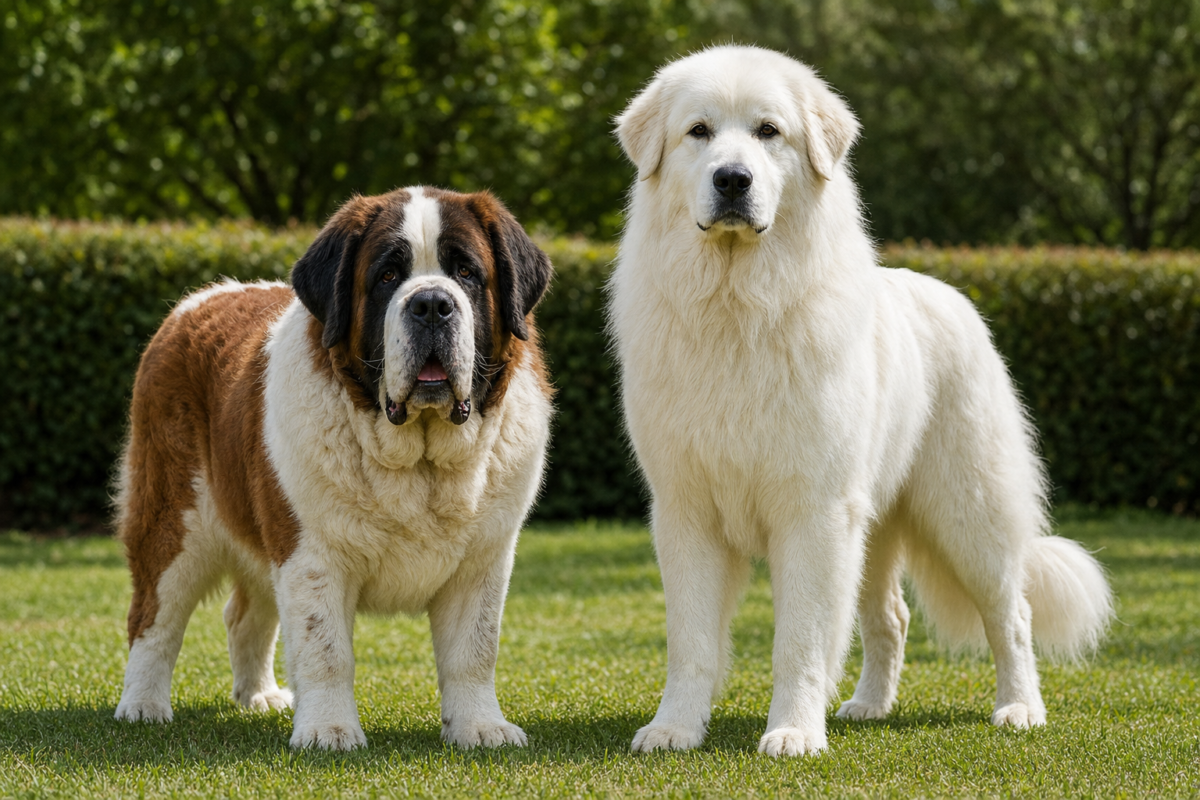
The Saint Bernard is heavier and shorter lived, typically 120 to 180 pounds, bred as a calm mountain rescue dog who wants to be with people. The Great Pyrenees is taller but lighter, typically 85 to 160 pounds, bred as an independent livestock guardian who patrols, barks at night and thinks for itself. Both are giant, both shed heavily and both need slow, careful growth. Choose the Saint Bernard for a softer, more biddable house companion, and the Great Pyrenees for a self reliant guardian who is content outdoors.
Put a Saint Bernard and a Great Pyrenees side by side and the differences are easy to miss. Two enormous, gentle, heavily coated dogs, both with a long history in the mountains. Live with them and the differences are impossible to miss, because these two breeds were built for opposite jobs. This guide compares size, growth, coat, temperament, exercise and the daily realities of each, so you can work out which giant genuinely suits your home.
What is the difference between a Saint Bernard and a Great Pyrenees?
The main difference is job and temperament. Saint Bernards were bred at a hospice in the Swiss Alps to work closely alongside people on rescue and haulage, which produced a heavy, powerful, deeply people focused dog. Great Pyrenees were bred to live out with flocks in the Pyrenees mountains, guarding livestock without a handler present, which produced a lighter, taller, weather proof dog who makes its own decisions and barks to warn intruders away.
In practice that means a Saint Bernard usually wants to be in the room with you and takes direction more readily, while a Great Pyrenees is affectionate but independent, patrols boundaries, is often vocal at night, and treats recall as a suggestion. Both are calm and famously good natured with family. They simply arrive at that calmness from different directions.
Where each breed came from
The Saint Bernard takes its name from the Great Saint Bernard Hospice, a refuge on the pass between Switzerland and Italy where monks kept large dogs from around the seventeenth century. Those dogs worked with people, hauling, warming and locating travellers lost in snow, and the breed that came out of it is heavy, powerful and profoundly oriented toward humans.
The Great Pyrenees, known in Europe as the Pyrenean Mountain Dog, came from the other side of the working relationship. For centuries it lived out with flocks in the mountains between France and Spain, deterring wolves and bears without a shepherd standing over it. A guardian who needs instructions is no use at three in the morning on a hillside, so the breed was selected for independent judgement, a weather proof white coat that blends with sheep, and a voice that carries.
Those two histories explain almost everything you will notice day to day, from how each breed greets a stranger to how each responds to a recall.
Saint Bernard and Great Pyrenees, side by side
Use these figures as a dependable guide rather than a fixed rule. Individual dogs vary with genetics, sex and line.
| Trait | Saint Bernard | Great Pyrenees |
|---|---|---|
| Male weight | 140 to 180 lb | 100 to 160 lb |
| Female weight | 120 to 140 lb | 85 to 115 lb |
| Male height | 28 to 30 in | 27 to 32 in |
| Build | Broad, heavy, deep chested | Tall, lighter framed, athletic |
| Coat | Smooth or rough, red and white | Thick white double coat |
| Original job | Alpine rescue and haulage | Livestock guardian |
| Typical temperament | Gentle, biddable, people focused | Gentle, independent, watchful |
| Exercise need | Moderate, low endurance | Moderate, likes to patrol |
| Drool | Considerable | Minimal |
| Typical lifespan | 8 to 10 years | 10 to 12 years |
The American Kennel Club’s Chief Veterinary Officer, Dr. Jerry Klein, DVM, has written extensively on the slower growth and development timeline of large and giant breeds. Read more from the AKC’s guidance on caring for large-breed dogs.
How each breed grows
Both are giant breeds, so both grow for a long time and both need that growth kept steady rather than fast. A Saint Bernard puts on weight quickly and can pass 100 pounds before its first birthday, reaching most of its height by around 18 to 24 months and continuing to fill out through the chest and shoulders until roughly three years of age.
A Great Pyrenees follows a slightly lighter curve. Height arrives early and the frame stays leggy through adolescence, with muscle and coat filling in through the second year and a mature outline appearing at around two to three years. Because the Pyrenees carries less bulk, its growth is a little more forgiving, but the window is just as long.
Why the growth window matters for both
In giant breeds the growth plates stay open through much of the first year and beyond, and dogs with an expected adult weight above 130 pounds keep developing for roughly 24 to 30 months. Through that stretch the bone, cartilage and connective tissue that carry an enormous adult are still forming. Lean feeding, moderate exercise and daily joint support matter more here than in almost any other kind of dog.
Growing Too Fast
Both breeds gain weight rapidly in the first year. A steady curve asks less of joints that are still forming.
Heat
A Saint Bernard in a hot climate struggles, and a Pyrenees coat holds warmth. Walk early and late in summer.
Too Much Impact
Repeated jumping and long runs are a lot for a giant adolescent. Keep young exercise moderate and on soft ground.
Underestimating The Coat
Both shed heavily and both need regular brushing. A neglected coat mats, which is uncomfortable and hard to undo.
Coat and grooming compared
The Saint Bernard comes in two coat types. The smooth coat is dense and short and sheds steadily. The rough coat is longer, feathered at the legs and tail, and picks up more mud and debris. Either way the colouring is red and white, and either way the shedding is substantial twice a year.
The Great Pyrenees wears a thick white double coat built for mountain weather, with a coarse outer layer that sheds dirt surprisingly well and a soft undercoat that blows out heavily in spring. It is not a coat that needs clipping, and clipping it removes the insulation that keeps a Pyrenees comfortable in both heat and cold. Weekly brushing suits both breeds, moving to several times a week during a shed.
Feeding a giant breed puppy of either breed
Both breeds do best on steady, moderate growth. Feeding for size is one of the most common mistakes made with giant puppies, and it asks the most of the joints.
- Choose a complete food formulated for large breed puppies, which controls calories, calcium and phosphorus for a slower growth curve.
- Split the daily amount into three meals while young, then two as an adult.
- Keep meals calm and avoid hard activity for about an hour either side of eating.
- Confirm portions with your veterinarian at every checkup, since the right amount changes quickly in the first year.
How to check body condition in ten seconds
Under all that coat, weight can be hard to judge by eye, which makes the hands on check especially useful for these two breeds.
- Ribs. Flat hands along both sides. You should feel the ribs easily under a thin covering.
- Waist. From above, a clear waist should tuck in behind the ribs.
- Tuck. From the side, the belly should rise toward the back legs rather than running level.
Check every couple of weeks through the growing years and adjust portions gently with your veterinarian guiding the changes.
Exercise needs compared
Neither breed is an endurance athlete, and neither wants a running partner. What they want is different in character though.
A Saint Bernard is happy with a steady daily walk and then a long nap somewhere in the middle of the household. Heat tires it quickly and it has little interest in distance. A Great Pyrenees enjoys the same moderate walking but also wants a territory to patrol, which is why secure fencing matters so much. A Pyrenees who finds an open gate will go and check the wider neighbourhood, calmly and at length.
- Keep exercise moderate and on soft ground while either breed is growing.
- Walk in the cool parts of the day through summer for both, and especially for a Saint Bernard.
- Give a Pyrenees a securely fenced space rather than relying on recall.
- Use scent games and training to tire the mind without loading young joints.
Supporting the joints of a giant breed
Both of these dogs will spend two to three years building a frame that carries well over a hundred pounds, and then a decade using it. Supporting healthy joint development early, and comfortable movement later, is one of the most useful daily habits a Dog Parent of a giant breed can keep.
Many big dog parents pair lean feeding and sensible exercise with a daily joint support chew. MoveGuard Growth is made for the puppy and adolescent stage, combining nine actives including New Zealand Green Lipped Mussel, glucosamine, chondroitin, MSM and hyaluronic acid to support developing joints across the roughly 8 to 30 month growth window, dosed by expected adult weight. For a grown dog, MoveGuard Adult carries a six ingredient joint formula for adult medium and large breeds. Both are made in the USA in an NSF facility and are backed by a 60 day guarantee.
Built For Giant Frames
Support your giant breed through the growth years and beyond. Explore MoveGuard Growth.
Temperament and family life
A Saint Bernard is a house dog in the truest sense. It wants to be near its people, it takes training willingly if a little slowly, and it is famously tolerant with children. The trade offs are drool, shedding, sensitivity to heat and a shorter average lifespan than most large breeds.
A Great Pyrenees is affectionate but self contained. It was bred to make decisions alone in the mountains at night, and that is exactly what it does in a garden at two in the morning, which is why the barking deserves honest consideration before you commit. Training a Pyrenees is a conversation rather than an instruction, and most stay best on a lead or behind a fence for life. In return you get a calm, dignified, quietly watchful dog who is gentle with the family it guards.
Both breeds are patient and good natured, and both are enormous, so early socialisation and calm manners are not optional. Loose lead walking, a settled greeting and a reliable stay are worth more in a giant breed than any trick, because they are what make an enormous dog easy to live with in ordinary situations. A well handled giant is a joy in a household. An unmanaged one is simply too big to be easy.
Which one suits your home?
Choose a Saint Bernard if you want a devoted indoor companion who follows you room to room, you can cope with drool and shedding, you live somewhere with cool seasons, and you are comfortable with a shorter lifespan in exchange for that softness.
Choose a Great Pyrenees if you have secure fencing and space, you appreciate an independent dog who thinks for itself, you can live with night barking, and you want a longer lived giant with a lower drool factor.
Think again about both if you need a dog with reliable off lead recall, you want a jogging partner, or a heavy shedding coat would be a daily source of stress. Neither breed changes on those points.
Common mistakes with either breed
- Feeding for size. A heavier giant puppy is not a healthier one, and the extra weight loads joints that are still forming.
- Skipping large breed puppy food. Standard puppy formulas can push growth faster than a giant frame wants.
- Too much hard exercise too young. Long walks and repeated jumping are a lot to ask before two years of age.
- Leaving socialisation late. Manners are far easier to teach at 40 pounds than at 140.
- Underestimating the coat and the drool. Both are permanent features rather than phases.
Frequently asked questions
Which is bigger, a Saint Bernard or a Great Pyrenees?
The Saint Bernard is heavier, usually 140 to 180 pounds for a male against 100 to 160 pounds for a male Great Pyrenees. The Pyrenees is often the taller of the two, standing 27 to 32 inches, because it carries a lighter, leggier frame.
Which breed is easier to train?
The Saint Bernard, generally. It was bred to work alongside people and takes direction more readily. The Great Pyrenees was bred to guard flocks alone and makes its own decisions, so training works best as patient cooperation rather than repetition drills.
Do Great Pyrenees bark a lot at night?
Many do. Night barking is part of the livestock guardian role the breed was developed for, and it is one of the most common surprises for new Pyrenees parents. Management helps, but it is fairest to expect a vocal dog rather than hope for a quiet one.
Which breed lives longer?
The Great Pyrenees, typically 10 to 12 years against 8 to 10 for a Saint Bernard. Lean body condition, steady growth and sensible daily exercise support comfortable movement across those years in both breeds.
Are both breeds good with children?
Both have a reputation for patience and gentleness with family children. Their size means supervision and early manners training still matter a great deal, because an unbalanced giant can knock a small child over without any intent at all.
The bottom line
The Saint Bernard and the Great Pyrenees are both magnificent, gentle giants, and the right choice comes down to how you want to live. One is a heavy, affectionate house companion who wants to be at your feet. The other is a taller, lighter, watchful guardian who wants a boundary to patrol and a family to keep an eye on. Feed either for slow steady growth, keep exercise moderate through those long growing years, support the joints daily, and start the manners early. Do that and you get the best of a giant breed: enormous presence, enormous calm and an enormous heart.
Want the Simple Roadmap in One Place?
Grab our free Big Dog Growth Blueprint for the growth window checklist, feeding framework and joint safe exercise limits, all written for large and giant breeds.
This article is for general educational purposes only and is not veterinary advice. It is not intended to diagnose, treat, cure or prevent any disease. Always consult your veterinarian about your dog’s individual health, nutrition and supplement needs. These statements have not been evaluated by the Food and Drug Administration.
Support Big Breed Joints from Day One
Large and giant breeds carry more load through every growth stage. MoveGuard Growth supports developing joints in young big dogs (8 to 30 months); MoveGuard Adult keeps grown big dogs moving comfortably.
Leave a Reply